If 13.1 g of O2 is required to inflate a balloon to a certain size at...
If 13.1 g of O2 is required to inflate a balloon to a certain size at 40. °C, what mass of O2 is required to inflate it to the same size (and pressure) at 8.0 °C?
Homework Answers

Add Answer to:
If 13.1 g of O2 is required to inflate a balloon to a certain
size at...
You inflate a balloon to 1L at sea level where the atmospheric pressure is 760 mmHg....
You inflate a balloon to 1L at sea level where the atmospheric pressure is 760 mmHg. You then take this balloon with you as you pilot a spaceship to Mars, where the atmospheric pressure is 6 mmHg. When you step out of your spaceship on Mars, the balloon's size will ____________ because the transmural pressure ____________. stay the same; stayed the same decrease; increased decrease; decreased increase; decreased increase; increased
Suppose we inflate a balloon to a volume of 11 at 27 °C and then place...
 Suppose we inflate a balloon to a volume of 11 at 27 °C and then place it in a refrigerator kept at 7°C. What is the volume of the balloon when the gas in it cools in the refrigerator?
Divers often inflate heavy duty balloons attached to salvage items on the sea floor. If a balloon is filled to a volume...
Divers often inflate heavy duty balloons attached to salvage items on the sea floor. If a balloon is filled to a volume of 3.00 L at a pressure of 2.50 atm, what is the volume of the balloon when it reaches the surface?
1. If I double the temperature (in K) of a balloon, the volume of the balloon a) doubles b) halves c) stays the sam...
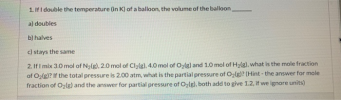 1. If I double the temperature (in K) of a balloon, the volume of the balloon a) doubles b) halves c) stays the same 2. If I mix 3.0 mol of N2(g), 2.0 mol of Cl2(g), 4.0 mol of O2lg) and 1.0 mol of H2(g), what is the mole fraction of O2(g)? If the total pressure is 2.00 atm, what is the partial pressure of O2(g)? (Hint-the answer for mole fraction of O2(g) and the answer for partial pressure of...
6. (25 pts) There's a giant 188 L balloon filled with 0.3333 atm of O2(g) and...
 6. (25 pts) There's a giant 188 L balloon filled with 0.3333 atm of O2(g) and 0.6667 atm Fr() at room temperature (298 K). The balloon can not burst but it's volume can fluctuate. a. How many mols of each, O2 and F3, are present in the balloon? (Use R=0.08206) b. The F, reacts with the O, to produce OF2(g). Assuming the reaction happens so fast the balloon's volume remains constant, initially, what is the new total pressure inside the...
Given: 2H2 (g) + O2 (g) --> 2H2O (l) Calculate the mass of water produced if...
Given: 2H2 (g) + O2 (g) --> 2H2O (l) Calculate the mass of water produced if 3.50 L O2 is at 1.25 ATM at 22.0oC reacting with excess H2. 4.55 L sample of CO2 has a pressure of 1.12 ATM. If the pressure is increased to 2.50 ATM what would be the resulting volume? Assume constant temp and no change in moles of gas. B) 4.55 L of He is at 25.0oC in a balloon. If the temp is increased...
Item 13 Hide Times 01:58:40 13 of 22 Part A If you take the balloon with...
 Item 13 Hide Times 01:58:40 13 of 22 Part A If you take the balloon with you as you dive to a depth of 40 m, what if anything, will happen to the size of the balloonsume temperature stays the same)? The balloon would decrease in size as the pressure increased. The balloon would increase in size as the pressure decreased The balloon would increase in size as the pressure increased. The balloon would decrease in size as the pressure...
A helium party balloon assumed to be a perfect sphere, has a radius of 18 cm....
A helium party balloon assumed to be a perfect sphere, has a radius of 18 cm. At room temperature (20°C), it’s internal pressure is 1.05 ATM. Find the number of moles of helium in the balloons and the mass of helium needed to inflate the balloon to these values.
Consider that you have a balloon containing 2.00 moles of CO and 1.00 mole of O2...
Consider that you have a balloon containing 2.00 moles of CO and 1.00 mole of O2 which is in a room that has a temperature of 28oC and a pressure of 1.00 atm. Then, the following reaction occurs inside the balloon to completion: 2 CO(g) + O2(g) -> 2 CO2(g). Calculate the change in work due to the reaction occurring inside the balloon. Enter your answer to three significant figures and in units of kJ.
The reaction 2H2O2(aq)→2H2O(l)+O2(g) is first order in H2O2 and under certain conditions has a rate constant...
The reaction 2H2O2(aq)→2H2O(l)+O2(g) is first order in H2O2 and under certain conditions has a rate constant of 0.00752 s−1 at 20.0 ∘C. A reaction vessel initially contains 150.0 mL of 30.0% H2O2 by mass solution (the density of the solution is 1.11 g/mL). The gaseous oxygen is collected over water at 20.0 ∘C as it forms. What volume of O2 will form in 73.9 seconds at a barometric pressure of 719.5 mmHg . (The vapor pressure of water at this...
 Suppose we inflate a balloon to a volume of 11 at 27 °C and then place it in a refrigerator kept at 7°C. What is the volume of the balloon when the gas in it cools in the refrigerator?
 1. If I double the temperature (in K) of a balloon, the volume of the balloon a) doubles b) halves c) stays the same 2. If I mix 3.0 mol of N2(g), 2.0 mol of Cl2(g), 4.0 mol of O2lg) and 1.0 mol of H2(g), what is the mole fraction of O2(g)? If the total pressure is 2.00 atm, what is the partial pressure of O2(g)? (Hint-the answer for mole fraction of O2(g) and the answer for partial pressure of...
 6. (25 pts) There's a giant 188 L balloon filled with 0.3333 atm of O2(g) and 0.6667 atm Fr() at room temperature (298 K). The balloon can not burst but it's volume can fluctuate. a. How many mols of each, O2 and F3, are present in the balloon? (Use R=0.08206) b. The F, reacts with the O, to produce OF2(g). Assuming the reaction happens so fast the balloon's volume remains constant, initially, what is the new total pressure inside the...
 Item 13 Hide Times 01:58:40 13 of 22 Part A If you take the balloon with you as you dive to a depth of 40 m, what if anything, will happen to the size of the balloonsume temperature stays the same)? The balloon would decrease in size as the pressure increased. The balloon would increase in size as the pressure decreased The balloon would increase in size as the pressure increased. The balloon would decrease in size as the pressure...
Most questions answered within 3 hours.
-
Where is the error in this code sequence?
String s1 = "Hello";
String s2 = "ello";...
asked 11 months ago -
Financial data for Joel de Paris, Inc., for last year
follow:
Joel de Paris, Inc.
Balance...
asked 11 months ago -
Consider this reaction:
Al2(SO4)3 (aq)+ BaCl3
(aq) Al2Cl6 (aq)- +
3BaSO4(s) . What is the...
asked 11 months ago -
Suppose that Savneet is considering increasing her
recent random sample from 20 car rentals to 40...
asked 11 months ago -
Trucks arrive at an unloading terminal at an average rate of 120
per hour.
Trucks arrive...
asked 11 months ago -
Why are methanol and ethanol completely soluble in water while
octanol is not very little soluble....
asked 11 months ago -
A facilities manager at a university reads in a research report
that the mean amount of...
asked 11 months ago -
When the CuSO4 is rehydrated by adding water to the anhydrous
compound, is this an endothermic...
asked 11 months ago -
A ray of sunlight is passing from diamond into crown glass; the
angle of incidence is...
asked 11 months ago -
A block of mass 0.249 kg is placed on top of a light, vertical
spring of...
asked 11 months ago -
how do the kidneys compensate in the presences of acidosis
a) trigger hyperventilate
b) reserve acid...
asked 11 months ago -
Question 501 pts
The rental rate of capital to the firm increases. Which of the
following...
asked 11 months ago