


Homework Answers

Add Answer to:
Assume that, without taxes, the consumption schedule of an economy is as follows GDP, Billions Consumption,...
Assume that, without taxes, the consumption schedule of an economy is as follows: a. What is...
 Assume that, without taxes, the consumption schedule of an
economy is as follows:
a. What is the value of the MPC?
_______
.Graph the resulting consumption
schedule.
Instructions: Use the tool provided 'CE' to draw
the consumption schedule. Plot 8 points total.
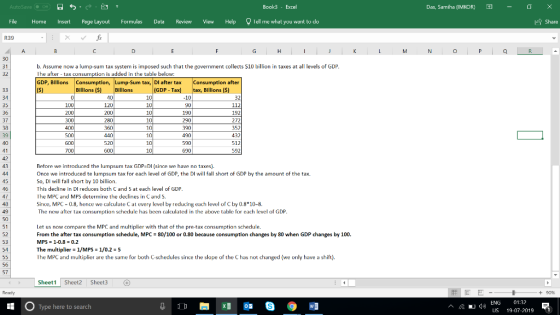
b. Assume now that a lump-sum tax is imposed such that the
government collects $10 billion in taxes at all levels of GDP. Add
the after-tax consumption to the table below.
Compare the MPC and the
multiplier with...
Assume that, without taxes, the consumption schedule of an
economy is as follows:
a. What is the value of the MPC?
_______
.Graph the resulting consumption
schedule.
Instructions: Use the tool provided 'CE' to draw
the consumption schedule. Plot 8 points total.
b. Assume now that a lump-sum tax is imposed such that the
government collects $10 billion in taxes at all levels of GDP. Add
the after-tax consumption to the table below.
Compare the MPC and the
multiplier with...
Hi, I need some help with these. Thanks! C S $ AD $100 $ 160 GDP...
 Hi, I need some help with
these. Thanks!
C S $ AD $100 $ 160 GDP $100 200 300 400 500 600 700 I $80 80 80 80 220 280 340 80 400 80 460 80 Complete the columns on S, and AD. (7 marks) The MPC is and the MPS is (4 marks) At $600 billion level of GDP, the APC is and APS is (4 marks) 4. If both government spending and taxes are zero, the equilibrium level...
Hi, I need some help with
these. Thanks!
C S $ AD $100 $ 160 GDP $100 200 300 400 500 600 700 I $80 80 80 80 220 280 340 80 400 80 460 80 Complete the columns on S, and AD. (7 marks) The MPC is and the MPS is (4 marks) At $600 billion level of GDP, the APC is and APS is (4 marks) 4. If both government spending and taxes are zero, the equilibrium level...
sing and government purchases are leakages. 8. In a mixed closed economy: A taxes and government...
 sing and government purchases are leakages. 8. In a mixed closed economy: A taxes and government purchases are leakages, while investment and saving are injections. • taxes and investment are injections, while saving and government purchases are leakages. taxes and savings are leakages, while investment and government purchases are injections. 1. government purchases and saving are injections, while investment and taxes are leakages. 9. In a mixed open economy, the equilibrium GDP is determined at that point where: A.S. +M+...
Keynesian Consumption Function (billions of dollars per year) Real disposable income Consumption Saving MPC MPS $100...
 Keynesian Consumption Function (billions of dollars per year) Real disposable income Consumption Saving MPC MPS $100 200 300 400 500 $150 200 250 300 350 a.) Calculate the saving schedule. b. Determine the marginal propensities to consume (MPC) and save (MPS). c. Determine the break-even income. d.) What is the relationship between the MPC and the MPS? 3. Explain why the MPC and the MPS must always add up to one. 4. How do households "dissave" 5. Explain how each...
The table below depicts the consumption schedule for an economy. Assume there are no taxes in...
 The table below depicts the consumption schedule for an economy. Assume there are no taxes in this economy Disposable Income and Consumption Disposable Inc Consumption (dollars) (dollars) $0 $25,000 10,000 20,000 30,000 40.000 40,000 45,000 50,000 60.000 References Instructions: Use the tool provided 'C' to plot the consumption line point by point points total). Use the tool Equilibrium' to graph where consumption equals disposable income, plot the equilibrium line point by point use each disposable income entry in the table...
5. Graphing the consumption function from the MPC Consider a hypothetical economy in which the marginal...
 5. Graphing the consumption function from the MPC Consider a hypothetical economy in which the marginal propensity to consume (MPC) is 0.50. That is, if disposable income increases by $1, consumption increases by 50¢. Suppose further that last year disposable income in the economy was $400 billion and consumption was $350 billion. On the following graph, use the blue line (circle symbol) to plot this economy's consumption function based on these data. Consumption Function CONSUMPTION (Billions of dollars) 0 800...
1. Aggregate expenditure and income The following table shows consumption (C), investment (I), government purchases (G),...
1. Aggregate expenditure and income The following table shows consumption (C), investment (I), government purchases (G), and net exports (X−IM) in a hypothetical economy for various levels of real GDP (Y). Assume that the price level remains unchanged at all levels of income. All figures are in billions of dollars. Compute total expenditure for each income level, and fill in the last column in the following table. Y C I G X−IM Total Expenditure 500 300 150 200 -100 600...
2. Consider the following data table for a hypothetical economy. Aggregate Consumption Personal &n
2. Consider the following data table for a hypothetical economy. Aggregate Consumption Personal Planned Aggregate Aggregate Income Expenditure Saving Investment Expenditure Equilibrium 0 100 20 100 180 200 260 300 340 400 420 500 500 600 580 700 660 Complete the table Calculate and interpret MPC and MPS Write the equation of Consumption Function Determine the equilibrium level of Aggregate Income, Consumption Expenditure, and Personal Saving Calculate the Multiplier Calculate the change...
ASSIGNMENT # 3 Actual aggregate expenditure or output (Y) (billions of $) Consumption (C) (billions of...
ASSIGNMENT # 3 Actual aggregate expenditure or output (Y) (billions of $) Consumption (C) (billions of $) Planned investment (billions of $) Government spending (G) (billions of $) Net exports (NX) (billions of $) Unplanned investment (inventory change) (billions of $) 500 300 150 100 50 600 350 700 400 800 450 900 500 For the table shown, answer the following questions: For each level of actual aggregate expenditure, calculate unplanned inventory investment. What is the equilibrium level of aggregate...
Assume that the consumption schedule for a private open economy is such that consumption is
 ADVANCED ANALYSIS Assume that the consumption schedule for a private open economy is such that consumption is:$$ C=80+0.8 Y $$Assume further that planned investment \(I_{g}\) and net exports \(X_{n}\) are independent of the level of real GDP and constant at \(I_{g}=50\) and \(X_{n}\) \(=10 .\) Recall also that, in equilibrium, the real output produced \((Y)\) is equal to aggregate expenditures:$$ Y=C+I_{g}+X_{n} $$Instructions: Round your answers to the nearest whole number.a. What is the equilibrium level of income or real GDP...
 Assume that, without taxes, the consumption schedule of an
economy is as follows:
a. What is the value of the MPC?
_______
.Graph the resulting consumption
schedule.
Instructions: Use the tool provided 'CE' to draw
the consumption schedule. Plot 8 points total.
b. Assume now that a lump-sum tax is imposed such that the
government collects $10 billion in taxes at all levels of GDP. Add
the after-tax consumption to the table below.
Compare the MPC and the
multiplier with...
Assume that, without taxes, the consumption schedule of an
economy is as follows:
a. What is the value of the MPC?
_______
.Graph the resulting consumption
schedule.
Instructions: Use the tool provided 'CE' to draw
the consumption schedule. Plot 8 points total.
b. Assume now that a lump-sum tax is imposed such that the
government collects $10 billion in taxes at all levels of GDP. Add
the after-tax consumption to the table below.
Compare the MPC and the
multiplier with...
 Hi, I need some help with
these. Thanks!
C S $ AD $100 $ 160 GDP $100 200 300 400 500 600 700 I $80 80 80 80 220 280 340 80 400 80 460 80 Complete the columns on S, and AD. (7 marks) The MPC is and the MPS is (4 marks) At $600 billion level of GDP, the APC is and APS is (4 marks) 4. If both government spending and taxes are zero, the equilibrium level...
Hi, I need some help with
these. Thanks!
C S $ AD $100 $ 160 GDP $100 200 300 400 500 600 700 I $80 80 80 80 220 280 340 80 400 80 460 80 Complete the columns on S, and AD. (7 marks) The MPC is and the MPS is (4 marks) At $600 billion level of GDP, the APC is and APS is (4 marks) 4. If both government spending and taxes are zero, the equilibrium level...
 sing and government purchases are leakages. 8. In a mixed closed economy: A taxes and government purchases are leakages, while investment and saving are injections. • taxes and investment are injections, while saving and government purchases are leakages. taxes and savings are leakages, while investment and government purchases are injections. 1. government purchases and saving are injections, while investment and taxes are leakages. 9. In a mixed open economy, the equilibrium GDP is determined at that point where: A.S. +M+...
 Keynesian Consumption Function (billions of dollars per year) Real disposable income Consumption Saving MPC MPS $100 200 300 400 500 $150 200 250 300 350 a.) Calculate the saving schedule. b. Determine the marginal propensities to consume (MPC) and save (MPS). c. Determine the break-even income. d.) What is the relationship between the MPC and the MPS? 3. Explain why the MPC and the MPS must always add up to one. 4. How do households "dissave" 5. Explain how each...
 The table below depicts the consumption schedule for an economy. Assume there are no taxes in this economy Disposable Income and Consumption Disposable Inc Consumption (dollars) (dollars) $0 $25,000 10,000 20,000 30,000 40.000 40,000 45,000 50,000 60.000 References Instructions: Use the tool provided 'C' to plot the consumption line point by point points total). Use the tool Equilibrium' to graph where consumption equals disposable income, plot the equilibrium line point by point use each disposable income entry in the table...
 5. Graphing the consumption function from the MPC Consider a hypothetical economy in which the marginal propensity to consume (MPC) is 0.50. That is, if disposable income increases by $1, consumption increases by 50¢. Suppose further that last year disposable income in the economy was $400 billion and consumption was $350 billion. On the following graph, use the blue line (circle symbol) to plot this economy's consumption function based on these data. Consumption Function CONSUMPTION (Billions of dollars) 0 800...
 ADVANCED ANALYSIS Assume that the consumption schedule for a private open economy is such that consumption is:$$ C=80+0.8 Y $$Assume further that planned investment \(I_{g}\) and net exports \(X_{n}\) are independent of the level of real GDP and constant at \(I_{g}=50\) and \(X_{n}\) \(=10 .\) Recall also that, in equilibrium, the real output produced \((Y)\) is equal to aggregate expenditures:$$ Y=C+I_{g}+X_{n} $$Instructions: Round your answers to the nearest whole number.a. What is the equilibrium level of income or real GDP...
Most questions answered within 3 hours.
-
Where is the error in this code sequence?
String s1 = "Hello";
String s2 = "ello";...
asked 10 months ago -
Financial data for Joel de Paris, Inc., for last year
follow:
Joel de Paris, Inc.
Balance...
asked 10 months ago -
Consider this reaction:
Al2(SO4)3 (aq)+ BaCl3
(aq) Al2Cl6 (aq)- +
3BaSO4(s) . What is the...
asked 10 months ago -
Suppose that Savneet is considering increasing her
recent random sample from 20 car rentals to 40...
asked 10 months ago -
Trucks arrive at an unloading terminal at an average rate of 120
per hour.
Trucks arrive...
asked 10 months ago -
Why are methanol and ethanol completely soluble in water while
octanol is not very little soluble....
asked 10 months ago -
A facilities manager at a university reads in a research report
that the mean amount of...
asked 10 months ago -
When the CuSO4 is rehydrated by adding water to the anhydrous
compound, is this an endothermic...
asked 10 months ago -
A ray of sunlight is passing from diamond into crown glass; the
angle of incidence is...
asked 10 months ago -
A block of mass 0.249 kg is placed on top of a light, vertical
spring of...
asked 10 months ago -
how do the kidneys compensate in the presences of acidosis
a) trigger hyperventilate
b) reserve acid...
asked 10 months ago -
Question 501 pts
The rental rate of capital to the firm increases. Which of the
following...
asked 10 months ago