 j
jHomework Answers


Temperature is defined as the average molecular kinetic energy of a substance. When a substance is heated, the kinetic energy of its molecules increases. Thus, the molecules begin moving more and usually maintain a greater average separation. Materials which contract with increasing temperature are unusual; this effect is limited in size, and only occurs within limited temperature ranges (see examples below). The degree of expansion divided by the change in temperature is called the material's coefficient of thermal expansion and generally varies with temperature.
For solid materials with a significant length, like rods or
cables, an estimate of the amount of thermal expansion can be
described by the material strain, given by  and defined as:
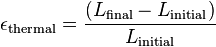
where  is the length before the change of temperature and
  is the length after the change of temperature.
For most solids, thermal expansion is proportional to the change in temperature:

Thus, the change in either the strain or temperature can be estimated by:

where

For isotropic materials the volumetric thermal expansion coefficient is three times the linear coefficient:

This ratio arises because volume is composed of three mutually
orthogonal directions. Thus, in an isotropic material, for small
differential changes, one-third of the volumetric expansion is in a
single axis. As an example, take a cube of steel that has sides of
length L. The original volume will be  and the new volume, after a temperature increase, will be

We can make the substitutions  and, for isotropic materials,
  . We now have:

Since the volumetric and linear coefficients are defined only
for extremely small temperature and dimensional changes (that is,
when  and
and  are small), the last two terms can be ignored and we get the above
relationship between the two coefficients. If we are trying to go
back and forth between volumetric and linear coefficients using
larger values of
then we will need to take into account the third term, and
sometimes even the fourth term.
are small), the last two terms can be ignored and we get the above
relationship between the two coefficients. If we are trying to go
back and forth between volumetric and linear coefficients using
larger values of
then we will need to take into account the third term, and
sometimes even the fourth term.
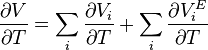
The thermal expansivity of a mixture from the expansivities of the pure components and their excess expansivities follow from:


Add Answer to:
j
1) The volume thermal expansion coefficient is defined as the fractional change in volume of...
Write the equation: Change of thermal energy during a constant volume process: Thermal energy of a...
 Write the equation: Change of thermal energy during a constant volume process: Thermal energy of a monatomic gas: Thermal energy of a diatomic gas: Thermal energy of a solid: Check for Understanding The thermal energy of 1.0 mol of a substance is increased by 1.0 J. What is the temperature change if the system is (A) monatomic, (B) diatomic, and (C) a solid?
Prove that the volume thermal expansion coefficient of a solid is equal to the sum of...
Prove that the volume thermal expansion coefficient of a solid is equal to the sum of its linear expansion coefficients in the three dimensions
Two metal bars experience an equal change in volume due to an equal change in temperature....
 Two metal bars experience an equal change in volume due to an equal change in temperature. The first bar has a coefficient of expansion twice as large as the second bar. How does the original volume of the first bar compare to the original volume of the second bar? Enter your response Why? Comes from 13.2 Thermal Expansion of Solids and Liquids
The adiabatic thermal expansion coefficient is defined by the relation αs=Cv/T(dV/dT)s. (a) Evaluate αs in terms...
The adiabatic thermal expansion coefficient is defined by the relation αs=Cv/T(dV/dT)s. (a) Evaluate αs in terms of α(expansivity), β(compressibility), Cv, T, and V. (b) Show that αs=-Cv/nRT for an ideal gas.
HW PROBLEM 5. Consider the isentropic compression/expansion of an ideal gas in a closed system defined...
 HW PROBLEM 5. Consider the isentropic compression/expansion of an ideal gas in a closed system defined by the inside volume of a frictionless piston. Let and denoted the molar specific heats of the ideal gas at constant volume and pressure, respectively and let the adiabatic coefficient by defined as Derive the following relationships, and in each case give a formula for the variable indicated as "constant" a) T VG = constant b) 0,* P1 = constant c) P(V") = constant
Adiabatic Process An adiabatic process is defined to be one in which there is no heat...
 Adiabatic Process An adiabatic process is defined to be one in which there is no heat transfer-that is, Q-0. Processes that are nearly adiabatic can be achieved by using very effective insulation. Don't use scientific notations in your answers. Case 1. A 0.4-mol monatomic ideal gas system undergoes an adiabatic expansion, which results in a temperature decrease of 30K (a) What is the change in internal energy? Include a proper sign. Keep 2 decimal places. (5 attempts remaining) (b) What...
3. The linear expansion coefficient is defined by AL/L = a AT. Consider a material for...
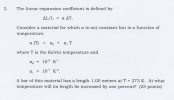 3. The linear expansion coefficient is defined by AL/L = a AT. Consider a material for which a is not constant but is a function of temperature: a (T) = 2o + QT where T is the Kelvin temperature and do = 10-5 K-1 Q = 10-7 K2 A bar of this material has a length 1.00 meters at T = 273 K. At what temperature will its length be increased by one percent? (25 points)
4. The isothermal compressibility B is defined as 1 jav This quantity measures the fractional change...
 4. The isothermal compressibility B is defined as 1 jav This quantity measures the fractional change in volume when the pressure is increased slightly, while the temperature is held constant. Derive an expression for the isothermal compressibility for the van der Waals gas. You may make use of the reciprocity relation ag ах y.2 ag у,2 Caution: Be mindful of which variables must be held constant on both sides.
1. Acetone has a heat capacity at constant volume of 61.50 J/mol K at 310 K...
 1. Acetone has a heat capacity at constant volume of 61.50 J/mol K at 310 K when it is in the gas phase. Consider the system where 1.500 moles of acetone is placed in an adiabatic chamber at 330.04 K. It is allowed to expand such that during the expansion the temperature drops to 288.05 K. Calculate the work done and the change in internal energy for the system. Assume the heat capacity is constant over this temperature range. (ANS:...
1. Name three characteristics of the atoms in a gas that are essential for the gas...
1. Name three characteristics of the atoms in a gas that are essential for the gas to be ideal. Explain why these three qualities of the atoms or molecules make the gas ideal. 2. Considering the Boltzmann distribution of atomic/molecular speeds for an ideal gas at temperature T (in K) , order the following speeds from smallest to largest: average speed, most probable speed, and root mean squared speed. Why are they different speeds? 3. What is the most important...
 Write the equation: Change of thermal energy during a constant volume process: Thermal energy of a monatomic gas: Thermal energy of a diatomic gas: Thermal energy of a solid: Check for Understanding The thermal energy of 1.0 mol of a substance is increased by 1.0 J. What is the temperature change if the system is (A) monatomic, (B) diatomic, and (C) a solid?
 Two metal bars experience an equal change in volume due to an equal change in temperature. The first bar has a coefficient of expansion twice as large as the second bar. How does the original volume of the first bar compare to the original volume of the second bar? Enter your response Why? Comes from 13.2 Thermal Expansion of Solids and Liquids
 HW PROBLEM 5. Consider the isentropic compression/expansion of an ideal gas in a closed system defined by the inside volume of a frictionless piston. Let and denoted the molar specific heats of the ideal gas at constant volume and pressure, respectively and let the adiabatic coefficient by defined as Derive the following relationships, and in each case give a formula for the variable indicated as "constant" a) T VG = constant b) 0,* P1 = constant c) P(V") = constant
 Adiabatic Process An adiabatic process is defined to be one in which there is no heat transfer-that is, Q-0. Processes that are nearly adiabatic can be achieved by using very effective insulation. Don't use scientific notations in your answers. Case 1. A 0.4-mol monatomic ideal gas system undergoes an adiabatic expansion, which results in a temperature decrease of 30K (a) What is the change in internal energy? Include a proper sign. Keep 2 decimal places. (5 attempts remaining) (b) What...
 3. The linear expansion coefficient is defined by AL/L = a AT. Consider a material for which a is not constant but is a function of temperature: a (T) = 2o + QT where T is the Kelvin temperature and do = 10-5 K-1 Q = 10-7 K2 A bar of this material has a length 1.00 meters at T = 273 K. At what temperature will its length be increased by one percent? (25 points)
 4. The isothermal compressibility B is defined as 1 jav This quantity measures the fractional change in volume when the pressure is increased slightly, while the temperature is held constant. Derive an expression for the isothermal compressibility for the van der Waals gas. You may make use of the reciprocity relation ag ах y.2 ag у,2 Caution: Be mindful of which variables must be held constant on both sides.
 1. Acetone has a heat capacity at constant volume of 61.50 J/mol K at 310 K when it is in the gas phase. Consider the system where 1.500 moles of acetone is placed in an adiabatic chamber at 330.04 K. It is allowed to expand such that during the expansion the temperature drops to 288.05 K. Calculate the work done and the change in internal energy for the system. Assume the heat capacity is constant over this temperature range. (ANS:...
Most questions answered within 3 hours.
-
Where is the error in this code sequence?
String s1 = "Hello";
String s2 = "ello";...
asked 11 months ago -
Financial data for Joel de Paris, Inc., for last year
follow:
Joel de Paris, Inc.
Balance...
asked 11 months ago -
Consider this reaction:
Al2(SO4)3 (aq)+ BaCl3
(aq) Al2Cl6 (aq)- +
3BaSO4(s) . What is the...
asked 11 months ago -
Suppose that Savneet is considering increasing her
recent random sample from 20 car rentals to 40...
asked 11 months ago -
Trucks arrive at an unloading terminal at an average rate of 120
per hour.
Trucks arrive...
asked 11 months ago -
Why are methanol and ethanol completely soluble in water while
octanol is not very little soluble....
asked 11 months ago -
A facilities manager at a university reads in a research report
that the mean amount of...
asked 11 months ago -
When the CuSO4 is rehydrated by adding water to the anhydrous
compound, is this an endothermic...
asked 11 months ago -
A ray of sunlight is passing from diamond into crown glass; the
angle of incidence is...
asked 11 months ago -
A block of mass 0.249 kg is placed on top of a light, vertical
spring of...
asked 11 months ago -
how do the kidneys compensate in the presences of acidosis
a) trigger hyperventilate
b) reserve acid...
asked 11 months ago -
Question 501 pts
The rental rate of capital to the firm increases. Which of the
following...
asked 11 months ago