
Homework Answers
`Hey,
Note: If you have any queries related the answer please do comment. I would be very happy to resolve all your queries.
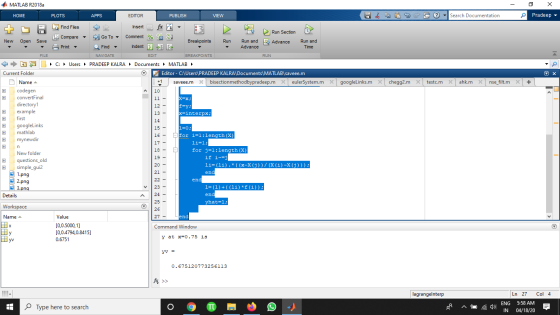
clc
clear all
close all
format long
x=[0,0.5,1];
y=sin(x);
disp('y at x=0.75 is')
[yv]=lagrangeInterp(x,y,0.75)
function [yhat]=lagrangeInterp(x,y,interpx)
X=x;
f=y;
x=interpx;
l=0;
for i=1:length(X)
li=1;
for j=1:length(X)
if i~=j
li=(li).*((x-X(j))/(X(i)-X(j)));
end
end
l=(l)+((li)*f(i));
end
yhat=l;
end
Kindly revert for any queries
Thanks.
Add Answer to:
Problem 2. (Do not solve part b) (20 points) a. Interpolate at x = 0.75 using...
Problem 2. Given the data points (xi. yi), with xi 2 02 4 yil 5 1 1.25 find the following interpo...
 Problem 2. Given the data points (xi. yi), with xi 2 02 4 yil 5 1 1.25 find the following interpolating polynomials, and use MATLAB to graph both the interpolating polynomials and the data points: a) The piecewise linear Lagrange interpolating polynomialx) b) The piecewise quadratic Lagrange interpolating polynomial q(x) c) Newton's divided difference interpolation pa(x) of degree s 4
Problem 2. Given the data points (xi. yi), with xi 2 02 4 yil 5 1 1.25 find the following...
Problem 2. Given the data points (xi. yi), with xi 2 02 4 yil 5 1 1.25 find the following interpolating polynomials, and use MATLAB to graph both the interpolating polynomials and the data points: a) The piecewise linear Lagrange interpolating polynomialx) b) The piecewise quadratic Lagrange interpolating polynomial q(x) c) Newton's divided difference interpolation pa(x) of degree s 4
Problem 2. Given the data points (xi. yi), with xi 2 02 4 yil 5 1 1.25 find the following...
Matlab Matlab Matlab Matlab, Please solve this problem Problem 4 : Runge's phenomenon For this proble,...
 Matlab Matlab Matlab Matlab, Please solve this problem
Problem 4 : Runge's phenomenon For this proble, you wil interpolate the function h(x) = tanh(10x) in I [a, b, through n datapoints (xi, hx with equidistant nodes for several values of n, and observe the behavior of the interpolating polynomial as n increases. You should use the pair of functions polyfit and polyval In your prob40: (a) Interpolate the function tanh(10x) in [-1,1] using a uniform grid of n nodes, where...
Matlab Matlab Matlab Matlab, Please solve this problem
Problem 4 : Runge's phenomenon For this proble, you wil interpolate the function h(x) = tanh(10x) in I [a, b, through n datapoints (xi, hx with equidistant nodes for several values of n, and observe the behavior of the interpolating polynomial as n increases. You should use the pair of functions polyfit and polyval In your prob40: (a) Interpolate the function tanh(10x) in [-1,1] using a uniform grid of n nodes, where...
Please answer every part and show formulas you have used. Will give upvote for good answer Lagrange Polynomial Study Qu...
 Please answer every part and show formulas you have used. Will
give upvote for good answer
Lagrange Polynomial Study Questions Example: For given f(x) - sin3x function input-output table is given as below. Find second order Lagrange interpolating polynomial for f(x) using input-output table a. b. Find the f(1,5) value using second order Lagrange interpolating polynomial (Find Lo(x), Lix), and L2(x)) calculate f(x)-sin3x for x:1,5 using your calculator and compare case b result using c. absolute error calculation. (Hint: Use...
Please answer every part and show formulas you have used. Will
give upvote for good answer
Lagrange Polynomial Study Questions Example: For given f(x) - sin3x function input-output table is given as below. Find second order Lagrange interpolating polynomial for f(x) using input-output table a. b. Find the f(1,5) value using second order Lagrange interpolating polynomial (Find Lo(x), Lix), and L2(x)) calculate f(x)-sin3x for x:1,5 using your calculator and compare case b result using c. absolute error calculation. (Hint: Use...
(a) Find the degree 1 interpolating P(x) through the points (a, f(a)) and (b, f(b)) (b) Develop the following formula b...
 (a) Find the degree 1 interpolating P(x) through the points (a, f(a)) and (b, f(b)) (b) Develop the following formula by using the interpolating polynomial P1 (x), (c) Find the degree of precision of the approximation, T1 (f) = f(1) + f(-1), for f(r)dr.
(a) Find the degree 1 interpolating P(x) through the points (a, f(a)) and (b, f(b)) (b) Develop the following formula by using the interpolating polynomial P1 (x), (c) Find the degree of precision of the approximation,...
(a) Find the degree 1 interpolating P(x) through the points (a, f(a)) and (b, f(b)) (b) Develop the following formula by using the interpolating polynomial P1 (x), (c) Find the degree of precision of the approximation, T1 (f) = f(1) + f(-1), for f(r)dr.
(a) Find the degree 1 interpolating P(x) through the points (a, f(a)) and (b, f(b)) (b) Develop the following formula by using the interpolating polynomial P1 (x), (c) Find the degree of precision of the approximation,...
please answer with good handwriting Q1 (a) Given the function f(x)= x - 5x² - 2x...
 please answer with good handwriting
Q1 (a) Given the function f(x)= x - 5x² - 2x +10. (1) Prove that there at least a root in the interval [1,3] by using Intermediate Value Theorem. (2 marks) (b) (i) Find the root of f(x) by using Bisection method. Iterate until i = 5. (8 marks) Prove the Lagrange interpolating polynomial of second degree for data of (0,1), (1,2) and (4,2) is P2(x) = -* x2 + x + 1. (5 marks)...
please answer with good handwriting
Q1 (a) Given the function f(x)= x - 5x² - 2x +10. (1) Prove that there at least a root in the interval [1,3] by using Intermediate Value Theorem. (2 marks) (b) (i) Find the root of f(x) by using Bisection method. Iterate until i = 5. (8 marks) Prove the Lagrange interpolating polynomial of second degree for data of (0,1), (1,2) and (4,2) is P2(x) = -* x2 + x + 1. (5 marks)...
er Lagrange ,Divided difference and Hermitewatnejed, Jnp 1.5, and x2-2, andf (x)ssin(x) * Given the point sx.-1, a) Find its Lagrange interpolation P on these points b) Write its newton's divi...
 er Lagrange ,Divided difference and Hermitewatnejed, Jnp 1.5, and x2-2, andf (x)ssin(x) * Given the point sx.-1, a) Find its Lagrange interpolation P on these points b) Write its newton's divided difference P, polynomial c)Write Hermite Hs by Using part a outcomes d) Write Hermite Hi by Using part b outcomes Rules: Lagrange form of Hermite polynomial of degre at most 2n-+1 Here, L., (r) denotes the Lagrange coefficient polynomial of degree n. If ec la.bl, then the error formula...
I only need (c) The Force, in Newtons, acting on a system was measured at several...
 I only need (c)
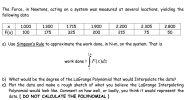
The Force, in Newtons, acting on a system was measured at several locations, yielding the following data 1.000 1.300 1.715 1.900 2.200 2.305 2.800 X F(x) 100 175 325 200 215 75 50 a) Use Simpson's Rule to approximate the work done, in N-m, on the system. That is 2.8 work done 1 b) What would be the degree of the LaGrange Polynomial that would Interpolate the data? c) Plot the data and make a Polynomial...
I only need (c)
The Force, in Newtons, acting on a system was measured at several locations, yielding the following data 1.000 1.300 1.715 1.900 2.200 2.305 2.800 X F(x) 100 175 325 200 215 75 50 a) Use Simpson's Rule to approximate the work done, in N-m, on the system. That is 2.8 work done 1 b) What would be the degree of the LaGrange Polynomial that would Interpolate the data? c) Plot the data and make a Polynomial...
12. Given the data set: We want to find the interpolating polynomial of degree 2 through...
 12. Given the data set: We want to find the interpolating polynomial of degree 2 through these points. a) Write the interpolating polynomial in Lagrange form b) Write the interpolating polynomial in Newton form.
Using Lagrange interpolation, find degree two interpolating polynomial if following points are known (0, 1, 5),...
Using Lagrange interpolation, find degree two interpolating polynomial if following points are known (0, 1, 5), (2, 0, −3), (1, 2, 8), (−2, −1, 10), (−1, 0, 5
Using Lagrange interpolation, find degree two interpolating polynomial if following points are known (0, 1, 5),...
Using Lagrange interpolation, find degree two interpolating polynomial if following points are known (0, 1, 5), (2, 0, −3), (1, 2, 8), (−2, −1, 10), (−1, 0, 5) (2,3,1)
 Problem 2. Given the data points (xi. yi), with xi 2 02 4 yil 5 1 1.25 find the following interpolating polynomials, and use MATLAB to graph both the interpolating polynomials and the data points: a) The piecewise linear Lagrange interpolating polynomialx) b) The piecewise quadratic Lagrange interpolating polynomial q(x) c) Newton's divided difference interpolation pa(x) of degree s 4
Problem 2. Given the data points (xi. yi), with xi 2 02 4 yil 5 1 1.25 find the following...
Problem 2. Given the data points (xi. yi), with xi 2 02 4 yil 5 1 1.25 find the following interpolating polynomials, and use MATLAB to graph both the interpolating polynomials and the data points: a) The piecewise linear Lagrange interpolating polynomialx) b) The piecewise quadratic Lagrange interpolating polynomial q(x) c) Newton's divided difference interpolation pa(x) of degree s 4
Problem 2. Given the data points (xi. yi), with xi 2 02 4 yil 5 1 1.25 find the following...
 Matlab Matlab Matlab Matlab, Please solve this problem
Problem 4 : Runge's phenomenon For this proble, you wil interpolate the function h(x) = tanh(10x) in I [a, b, through n datapoints (xi, hx with equidistant nodes for several values of n, and observe the behavior of the interpolating polynomial as n increases. You should use the pair of functions polyfit and polyval In your prob40: (a) Interpolate the function tanh(10x) in [-1,1] using a uniform grid of n nodes, where...
Matlab Matlab Matlab Matlab, Please solve this problem
Problem 4 : Runge's phenomenon For this proble, you wil interpolate the function h(x) = tanh(10x) in I [a, b, through n datapoints (xi, hx with equidistant nodes for several values of n, and observe the behavior of the interpolating polynomial as n increases. You should use the pair of functions polyfit and polyval In your prob40: (a) Interpolate the function tanh(10x) in [-1,1] using a uniform grid of n nodes, where...
 Please answer every part and show formulas you have used. Will
give upvote for good answer
Lagrange Polynomial Study Questions Example: For given f(x) - sin3x function input-output table is given as below. Find second order Lagrange interpolating polynomial for f(x) using input-output table a. b. Find the f(1,5) value using second order Lagrange interpolating polynomial (Find Lo(x), Lix), and L2(x)) calculate f(x)-sin3x for x:1,5 using your calculator and compare case b result using c. absolute error calculation. (Hint: Use...
Please answer every part and show formulas you have used. Will
give upvote for good answer
Lagrange Polynomial Study Questions Example: For given f(x) - sin3x function input-output table is given as below. Find second order Lagrange interpolating polynomial for f(x) using input-output table a. b. Find the f(1,5) value using second order Lagrange interpolating polynomial (Find Lo(x), Lix), and L2(x)) calculate f(x)-sin3x for x:1,5 using your calculator and compare case b result using c. absolute error calculation. (Hint: Use...
 (a) Find the degree 1 interpolating P(x) through the points (a, f(a)) and (b, f(b)) (b) Develop the following formula by using the interpolating polynomial P1 (x), (c) Find the degree of precision of the approximation, T1 (f) = f(1) + f(-1), for f(r)dr.
(a) Find the degree 1 interpolating P(x) through the points (a, f(a)) and (b, f(b)) (b) Develop the following formula by using the interpolating polynomial P1 (x), (c) Find the degree of precision of the approximation,...
(a) Find the degree 1 interpolating P(x) through the points (a, f(a)) and (b, f(b)) (b) Develop the following formula by using the interpolating polynomial P1 (x), (c) Find the degree of precision of the approximation, T1 (f) = f(1) + f(-1), for f(r)dr.
(a) Find the degree 1 interpolating P(x) through the points (a, f(a)) and (b, f(b)) (b) Develop the following formula by using the interpolating polynomial P1 (x), (c) Find the degree of precision of the approximation,...
 please answer with good handwriting
Q1 (a) Given the function f(x)= x - 5x² - 2x +10. (1) Prove that there at least a root in the interval [1,3] by using Intermediate Value Theorem. (2 marks) (b) (i) Find the root of f(x) by using Bisection method. Iterate until i = 5. (8 marks) Prove the Lagrange interpolating polynomial of second degree for data of (0,1), (1,2) and (4,2) is P2(x) = -* x2 + x + 1. (5 marks)...
please answer with good handwriting
Q1 (a) Given the function f(x)= x - 5x² - 2x +10. (1) Prove that there at least a root in the interval [1,3] by using Intermediate Value Theorem. (2 marks) (b) (i) Find the root of f(x) by using Bisection method. Iterate until i = 5. (8 marks) Prove the Lagrange interpolating polynomial of second degree for data of (0,1), (1,2) and (4,2) is P2(x) = -* x2 + x + 1. (5 marks)...
 er Lagrange ,Divided difference and Hermitewatnejed, Jnp 1.5, and x2-2, andf (x)ssin(x) * Given the point sx.-1, a) Find its Lagrange interpolation P on these points b) Write its newton's divided difference P, polynomial c)Write Hermite Hs by Using part a outcomes d) Write Hermite Hi by Using part b outcomes Rules: Lagrange form of Hermite polynomial of degre at most 2n-+1 Here, L., (r) denotes the Lagrange coefficient polynomial of degree n. If ec la.bl, then the error formula...
 I only need (c)
The Force, in Newtons, acting on a system was measured at several locations, yielding the following data 1.000 1.300 1.715 1.900 2.200 2.305 2.800 X F(x) 100 175 325 200 215 75 50 a) Use Simpson's Rule to approximate the work done, in N-m, on the system. That is 2.8 work done 1 b) What would be the degree of the LaGrange Polynomial that would Interpolate the data? c) Plot the data and make a Polynomial...
I only need (c)
The Force, in Newtons, acting on a system was measured at several locations, yielding the following data 1.000 1.300 1.715 1.900 2.200 2.305 2.800 X F(x) 100 175 325 200 215 75 50 a) Use Simpson's Rule to approximate the work done, in N-m, on the system. That is 2.8 work done 1 b) What would be the degree of the LaGrange Polynomial that would Interpolate the data? c) Plot the data and make a Polynomial...
 12. Given the data set: We want to find the interpolating polynomial of degree 2 through these points. a) Write the interpolating polynomial in Lagrange form b) Write the interpolating polynomial in Newton form.
Most questions answered within 3 hours.
-
Where is the error in this code sequence?
String s1 = "Hello";
String s2 = "ello";...
asked 10 months ago -
Financial data for Joel de Paris, Inc., for last year
follow:
Joel de Paris, Inc.
Balance...
asked 10 months ago -
Consider this reaction:
Al2(SO4)3 (aq)+ BaCl3
(aq) Al2Cl6 (aq)- +
3BaSO4(s) . What is the...
asked 10 months ago -
Suppose that Savneet is considering increasing her
recent random sample from 20 car rentals to 40...
asked 10 months ago -
Trucks arrive at an unloading terminal at an average rate of 120
per hour.
Trucks arrive...
asked 10 months ago -
Why are methanol and ethanol completely soluble in water while
octanol is not very little soluble....
asked 10 months ago -
A facilities manager at a university reads in a research report
that the mean amount of...
asked 10 months ago -
When the CuSO4 is rehydrated by adding water to the anhydrous
compound, is this an endothermic...
asked 10 months ago -
A ray of sunlight is passing from diamond into crown glass; the
angle of incidence is...
asked 10 months ago -
A block of mass 0.249 kg is placed on top of a light, vertical
spring of...
asked 10 months ago -
how do the kidneys compensate in the presences of acidosis
a) trigger hyperventilate
b) reserve acid...
asked 10 months ago -
Question 501 pts
The rental rate of capital to the firm increases. Which of the
following...
asked 10 months ago