
Homework Answers
Add Answer to:
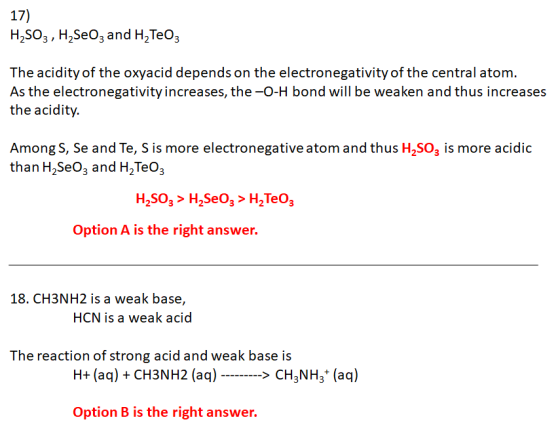
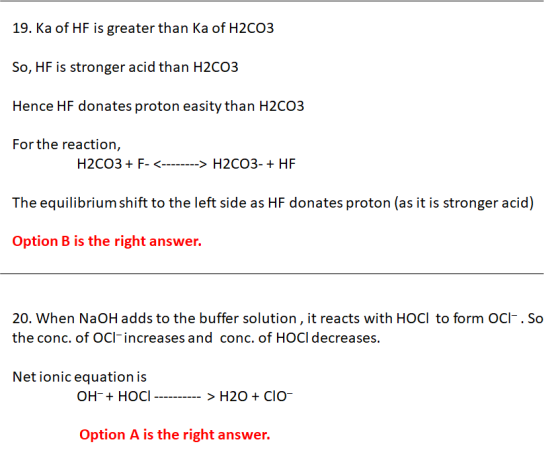
17. Which of these acids is the strongest? A) H2SO3 B) H2SO3 C) H2TeO3 18. Which...
Consider the following reaction: HNO2 (aq) + HPO42-(aq) ⇌ NO2-(aq) + H2PO4-(aq) a.)Identify the Brønsted-Lowry acids...
Consider the following reaction: HNO2 (aq) + HPO42-(aq) ⇌ NO2-(aq) + H2PO4-(aq) a.)Identify the Brønsted-Lowry acids and bases in the forward reaction b.)State the conjugate pairs for the above reaction. Be specific. Identify the acids and bases in the following reactions and identify the conjugate pairs. HF(aq) + H2O(l) ⇌ H3O+(aq) + F-(aq) CH3NH2(aq) + H2O(l) ⇌ OH-(aq) + CH3NH3+(aq) HCO3-(aq) + HSO4-(aq) ⇌ H2CO3(aq) + SO42-(aq) Complete the following reactions: ____________(aq) + Br-(aq) ⇌ NH3(aq) + HBr(aq) CH3COOH(aq) +...
1. Which of the following make a buffer solution? (circle all the correct answers) a. 0.1...
 1. Which of the following make a buffer solution? (circle all the correct answers) a. 0.1 M HCl and 0.1 M NaCl b. 0.1 M HF and 0.075 M KF C. 0.15 M Pentanoic acid and 0.15 M sodium pentanoate d. 0.1 M NaOH and 0.1 M HCI e. 0.1 M acetic acid and 0.00001 sodium acetate 2. Which of the following could make buffer systems when mixed together? (circle the correct answers) a. 0.10 M acetic acid and 0.05...
5. A 3.5 L sample of a 5.8 M NaCl solution is diluted to 55L. What...
 5. A 3.5 L sample of a 5.8 M NaCl solution is diluted to 55L. What is the molarity of the diluted solution? 6. Consider the reaction: K Slaq) + Co(NO3)2 (aq) → 2KNO3(aq) + Cos) What volume of 0.225 M K S solution is required to completely react with 175 mL of 0.115 M CO(NO3)2? 7. For each reaction, identify the Bronsted-Lowry acid, the Bronsted-Lowry base, the conjugate acid and the conjugate base a. Hl(aq) + H2O → H30*...
1. Which of the followi ch of the following reactions is not readily explained by the Arrhenius concept of acids a...
 1. Which of the followi ch of the following reactions is not readily explained by the Arrhenius concept of acids and bases? a. A. HCl(aq) + NaOH(aq) - NaCl(aq) + H20() b. H30(aq) + OH-(aq) + 2H20(1) c. HCI(g) + NH3(g) - NH4Cl(s) d. HC2H302(aq) + H2O(l) H30*(aq) + C2H302-(ag) e. H30 (aq) + OH-(aq) + 2H2O(aq) 2. Classify each of the following species as Brønsted acid or base or both: a) H20, b) OH", c) H30, d) NH3, e)...
4. Equal moles of the indicated acids are dissolved in the ammon of he acid be...
 4. Equal moles of the indicated acids are dissolved in the ammon of he acid be beakers below. In which solution will the percent ionization of water shown in the of the acid be the lowest? Op -HC a. All have equal percent ionization of acid. c.Ⅳ e. 5. For a 0.05 M H2SOs solution, which of the following relationships is true? b. [SO327 키HS037 C [HSOs 1> [H2SO3] dHSH) 6. Which of the following reactions is associated with the...
1) Which one of the following is a Bronsted-Lowry acid? A) (CH3)3NH+ B) CH3COOH C) HNO2...
1) Which one of the following is a Bronsted-Lowry acid? A) (CH3)3NH+ B) CH3COOH C) HNO2 D) all of the above 2) Which one of the following statements regarding Kw is false? A) pKw is 14.00 at 25 °C. B) The value of Kw is always 1.0 × 10⁻¹⁴. C) Kw changes with temperature. D) The value of Kw shows that water is a weak acid. 3) The Ka of benzoic acid is 6.30 × 10⁻⁵. The pH of a...
5. Which of the following species is amphiprotic in aqueous solution? (a) CH3NH2 c) NH4 (e)...
 5. Which of the following species is amphiprotic in aqueous solution? (a) CH3NH2 c) NH4 (e) HSO (d) F (b) Н:0" 6, Use Table 15.2 (page 529) to decide whether the species on the left or those on the right are favored by the reaction. a. NH4 (aq) + H2PO4" (aq) # NH3(aq) + HsPO b. HCN (aq) + HS(aq) CN" (aq) +H2S c. HCO +OH CO2 H2S d. Al(H20)6 3+ +OH = Al(H20) s2+ OH 7. The equilibrium constant...
16. Each of three beakers contains 25.0 mL of 0.100 M solution at 25°C. Beaker 1...
 16. Each of three beakers contains 25.0 mL of 0.100 M solution at 25°C. Beaker 1 Beaker 2 Beaker 3 0.10 M NaOH 0.10 M NaHCO3 0.10 M H2CO3 a. Determine the pH of the solution in beaker 1. Justify your answer. b. In beaker 2, the reaction HCO, (aq) + H2O(1) = H,CO, (aq) + OH(aq) occurs. The value of K, for HCO, (aq) is 2.3x10⁸ at 25°C. i. Write the K, expression for the reaction of HCO, (aq)...
Which of the following acids does not have the ±ic ending? A) HCN B) H2SO3 C)...
Which of the following acids does not have the ±ic ending? A) HCN B) H2SO3 C) H2SO4 D) HF
estion 10 of 65 > Consider the reaction. HF(aq) + KOH(aq) — KF(aq) + H20(1) What...
 estion 10 of 65 > Consider the reaction. HF(aq) + KOH(aq) — KF(aq) + H20(1) What is the net ionic equation for the chemical reaction? HF(aq) + K+(aq) + OH(aq) — K+(aq) + F (aq) + H2O(1) O HF(aq) + K+(aq) + OH-(aq) — K+(aq) + F (aq) + H+(1) + OH-(1) O HF(aq) + OH-(aq) —> F-(aq) + H2O(1) HF(aq) + K+(aq) F (aq) + H+(1) HF(aq) + K+(aq) K+(aq) + H2O(1) - 11 of 65 > Calculate either...
 1. Which of the following make a buffer solution? (circle all the correct answers) a. 0.1 M HCl and 0.1 M NaCl b. 0.1 M HF and 0.075 M KF C. 0.15 M Pentanoic acid and 0.15 M sodium pentanoate d. 0.1 M NaOH and 0.1 M HCI e. 0.1 M acetic acid and 0.00001 sodium acetate 2. Which of the following could make buffer systems when mixed together? (circle the correct answers) a. 0.10 M acetic acid and 0.05...
 5. A 3.5 L sample of a 5.8 M NaCl solution is diluted to 55L. What is the molarity of the diluted solution? 6. Consider the reaction: K Slaq) + Co(NO3)2 (aq) → 2KNO3(aq) + Cos) What volume of 0.225 M K S solution is required to completely react with 175 mL of 0.115 M CO(NO3)2? 7. For each reaction, identify the Bronsted-Lowry acid, the Bronsted-Lowry base, the conjugate acid and the conjugate base a. Hl(aq) + H2O → H30*...
 1. Which of the followi ch of the following reactions is not readily explained by the Arrhenius concept of acids and bases? a. A. HCl(aq) + NaOH(aq) - NaCl(aq) + H20() b. H30(aq) + OH-(aq) + 2H20(1) c. HCI(g) + NH3(g) - NH4Cl(s) d. HC2H302(aq) + H2O(l) H30*(aq) + C2H302-(ag) e. H30 (aq) + OH-(aq) + 2H2O(aq) 2. Classify each of the following species as Brønsted acid or base or both: a) H20, b) OH", c) H30, d) NH3, e)...
 4. Equal moles of the indicated acids are dissolved in the ammon of he acid be beakers below. In which solution will the percent ionization of water shown in the of the acid be the lowest? Op -HC a. All have equal percent ionization of acid. c.Ⅳ e. 5. For a 0.05 M H2SOs solution, which of the following relationships is true? b. [SO327 키HS037 C [HSOs 1> [H2SO3] dHSH) 6. Which of the following reactions is associated with the...
 5. Which of the following species is amphiprotic in aqueous solution? (a) CH3NH2 c) NH4 (e) HSO (d) F (b) Н:0" 6, Use Table 15.2 (page 529) to decide whether the species on the left or those on the right are favored by the reaction. a. NH4 (aq) + H2PO4" (aq) # NH3(aq) + HsPO b. HCN (aq) + HS(aq) CN" (aq) +H2S c. HCO +OH CO2 H2S d. Al(H20)6 3+ +OH = Al(H20) s2+ OH 7. The equilibrium constant...
 16. Each of three beakers contains 25.0 mL of 0.100 M solution at 25°C. Beaker 1 Beaker 2 Beaker 3 0.10 M NaOH 0.10 M NaHCO3 0.10 M H2CO3 a. Determine the pH of the solution in beaker 1. Justify your answer. b. In beaker 2, the reaction HCO, (aq) + H2O(1) = H,CO, (aq) + OH(aq) occurs. The value of K, for HCO, (aq) is 2.3x10⁸ at 25°C. i. Write the K, expression for the reaction of HCO, (aq)...
 estion 10 of 65 > Consider the reaction. HF(aq) + KOH(aq) — KF(aq) + H20(1) What is the net ionic equation for the chemical reaction? HF(aq) + K+(aq) + OH(aq) — K+(aq) + F (aq) + H2O(1) O HF(aq) + K+(aq) + OH-(aq) — K+(aq) + F (aq) + H+(1) + OH-(1) O HF(aq) + OH-(aq) —> F-(aq) + H2O(1) HF(aq) + K+(aq) F (aq) + H+(1) HF(aq) + K+(aq) K+(aq) + H2O(1) - 11 of 65 > Calculate either...
Most questions answered within 3 hours.
-
Where is the error in this code sequence?
String s1 = "Hello";
String s2 = "ello";...
asked 11 months ago -
Financial data for Joel de Paris, Inc., for last year
follow:
Joel de Paris, Inc.
Balance...
asked 11 months ago -
Consider this reaction:
Al2(SO4)3 (aq)+ BaCl3
(aq) Al2Cl6 (aq)- +
3BaSO4(s) . What is the...
asked 11 months ago -
Suppose that Savneet is considering increasing her
recent random sample from 20 car rentals to 40...
asked 11 months ago -
Trucks arrive at an unloading terminal at an average rate of 120
per hour.
Trucks arrive...
asked 11 months ago -
Why are methanol and ethanol completely soluble in water while
octanol is not very little soluble....
asked 11 months ago -
A facilities manager at a university reads in a research report
that the mean amount of...
asked 11 months ago -
When the CuSO4 is rehydrated by adding water to the anhydrous
compound, is this an endothermic...
asked 11 months ago -
A ray of sunlight is passing from diamond into crown glass; the
angle of incidence is...
asked 11 months ago -
A block of mass 0.249 kg is placed on top of a light, vertical
spring of...
asked 11 months ago -
how do the kidneys compensate in the presences of acidosis
a) trigger hyperventilate
b) reserve acid...
asked 11 months ago -
Question 501 pts
The rental rate of capital to the firm increases. Which of the
following...
asked 11 months ago