
Homework Answers
Add Answer to:
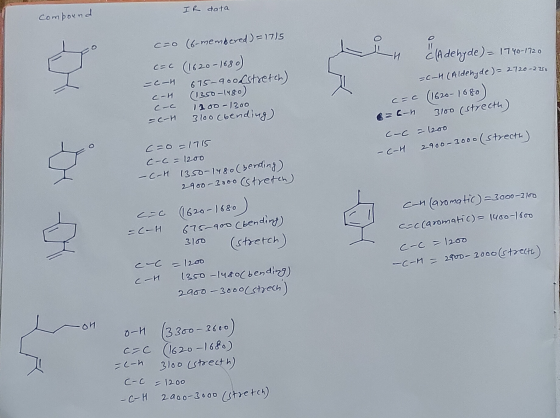
Record the IR spectra of the following: carvone, menthone, limonene, cintronellol,citral, and p-cymene. Share data with...
Compound A displays the following MS, 'HNMR, and IR spectra. Compound A decolorizes a solution of...
 q
is for quadruplet and t is for triplet
Compound A displays the following MS, 'HNMR, and IR spectra. Compound A decolorizes a solution of bromine in dichloromethane. Suggest a structure for Compound A consistent with all of the data given. Account for all of the numbered peaks in the MS, interpret each NMR signal, and identify each peak in the functional group region of the IR spectrum. 4. 100 80 20 10 30 50 60 70 100 A !...
q
is for quadruplet and t is for triplet
Compound A displays the following MS, 'HNMR, and IR spectra. Compound A decolorizes a solution of bromine in dichloromethane. Suggest a structure for Compound A consistent with all of the data given. Account for all of the numbered peaks in the MS, interpret each NMR signal, and identify each peak in the functional group region of the IR spectrum. 4. 100 80 20 10 30 50 60 70 100 A !...
Deduce the following structure of the compound given their IR, H1 NMR, 13C NMR spectra, and...
 Deduce the following structure of the compound given their IR, H1
NMR, 13C NMR spectra, and assign IR functional group absorptions
and assign the structure's protons and carbons to their respective
spectral resonances.
Compound 4 Da- U6)+20 IR Spectrum Oquid fim) 1760 800 1200 2000 1600 3000 4000 v (cm) Mass Spectrum 100 43 No significant UV absorption above 220 nm M146 (1% ) 87 20 CH1004 280 40 80 120 m/e 160 200 240 13C NMR Spectrum (1000 MHz,...
Deduce the following structure of the compound given their IR, H1
NMR, 13C NMR spectra, and assign IR functional group absorptions
and assign the structure's protons and carbons to their respective
spectral resonances.
Compound 4 Da- U6)+20 IR Spectrum Oquid fim) 1760 800 1200 2000 1600 3000 4000 v (cm) Mass Spectrum 100 43 No significant UV absorption above 220 nm M146 (1% ) 87 20 CH1004 280 40 80 120 m/e 160 200 240 13C NMR Spectrum (1000 MHz,...
Deduce the following structure of the compound given their IR, H1 NMR, 13C NMR spectra, and...
 Deduce the following structure of the compound given their IR, H1
NMR, 13C NMR spectra, and assign IR functional group absorptions
and assign the structure's protons and carbons to their respective
spectral resonances.
Compound 6 1756 IR Spectrum uid Sm) 15820 4000 3000 2000 1600 1200 800 V (cm) 100 55 Mass Spectrum 71 80 70 60 No significant UV M158 (1%) absorption above 220 nm C&H140s 40 80 120 160 200 240 280 m/e 13C NMR Spectrum (50.0 MHz,...
Deduce the following structure of the compound given their IR, H1
NMR, 13C NMR spectra, and assign IR functional group absorptions
and assign the structure's protons and carbons to their respective
spectral resonances.
Compound 6 1756 IR Spectrum uid Sm) 15820 4000 3000 2000 1600 1200 800 V (cm) 100 55 Mass Spectrum 71 80 70 60 No significant UV M158 (1%) absorption above 220 nm C&H140s 40 80 120 160 200 240 280 m/e 13C NMR Spectrum (50.0 MHz,...
3. the followong compound has a molecular formula of C6H10O2 and has two stronf syretching bibration peaks in its FTIR spectrum at 1725 and 1200cm-1 giving rise to a specific functional group. what i...
 3. the followong compound has a molecular formula of C6H10O2
and has two stronf syretching bibration peaks in its FTIR spectrum
at 1725 and 1200cm-1 giving rise to a specific functional group.
what is this molecule.
4. based on the mass spectrum below-which heteratom (S, Br,
Cl) is present in the molecule that produces this spectrum?
5. which functional group is present in the molecule that
produces the followong IR spectra?
please answer questions 3-5
Verizon 7:24 PM 3 of...
3. the followong compound has a molecular formula of C6H10O2
and has two stronf syretching bibration peaks in its FTIR spectrum
at 1725 and 1200cm-1 giving rise to a specific functional group.
what is this molecule.
4. based on the mass spectrum below-which heteratom (S, Br,
Cl) is present in the molecule that produces this spectrum?
5. which functional group is present in the molecule that
produces the followong IR spectra?
please answer questions 3-5
Verizon 7:24 PM 3 of...
Please intereperet all spectra fully. Solid U IR Mass Spec. Mt 100- 80 60- 40 0...
 Please intereperet all spectra fully.
Solid U IR Mass Spec. Mt 100- 80 60- 40 0 50 75 100 150 175 m/z Solid U H-NMR doublet, 2H doublet, 2H broad singlet, 1H PPM "C-NMR PPM Solid Unknown Information: Unknown #: Melting Point Infrared Analysis: Explain below how the infrared spectrum led you to select the functional group present in your unknown. Remember, your unknown must belong to one of the following functional groups: alcohol, aldehyde, amine, carboxylic acid, ketone, or...
Please intereperet all spectra fully.
Solid U IR Mass Spec. Mt 100- 80 60- 40 0 50 75 100 150 175 m/z Solid U H-NMR doublet, 2H doublet, 2H broad singlet, 1H PPM "C-NMR PPM Solid Unknown Information: Unknown #: Melting Point Infrared Analysis: Explain below how the infrared spectrum led you to select the functional group present in your unknown. Remember, your unknown must belong to one of the following functional groups: alcohol, aldehyde, amine, carboxylic acid, ketone, or...
A compound of unknown structure gave the following spectroscopic data: Mass spectrum: M+ = 88.1 IR:...
 A compound of unknown structure gave the following
spectroscopic data:
Mass spectrum: M+ = 88.1
IR: 3600cm-1
1H NMR: 1.4 (2H, quartet, J=7Hz); 1.2 (6H, singlet); 1.0 (1H,
singlet); 0.9 (3H, triplet, J=7Hz)
13C NMR: 74, 35, 27, 25
a. assuming that the compound contains C and H but may or may not
contain O, give three possible molecular formulas.
b. how many protons (H) does the compound contain?
c. what functional group(s) does the compound contain?
d. how many...
A compound of unknown structure gave the following
spectroscopic data:
Mass spectrum: M+ = 88.1
IR: 3600cm-1
1H NMR: 1.4 (2H, quartet, J=7Hz); 1.2 (6H, singlet); 1.0 (1H,
singlet); 0.9 (3H, triplet, J=7Hz)
13C NMR: 74, 35, 27, 25
a. assuming that the compound contains C and H but may or may not
contain O, give three possible molecular formulas.
b. how many protons (H) does the compound contain?
c. what functional group(s) does the compound contain?
d. how many...
I need these questions answered for the compound : Styrene, or ethenlybeneze What is the name...
I need these questions answered for the compound : Styrene, or ethenlybeneze What is the name and structure of your compound? Please be sure to include the structure of your compound and not just the molecular formula. What is the major function group in your compound (Hint: Look at the ending of the name of your compound for a hint). List all of the other functional groups present in your compound. What is the HDI (Hydrogen Deficiency Index) for your...
Using the data provided below. Fill out the tables regarding the FTIR and NMR Spectra for...
 Using the data provided below. Fill out the tables regarding the
FTIR and NMR Spectra for 2-methyl-2-ethoxypropane.
FTIR and NMR Spectra After completing a reaction and working up the products, it is still necessary to confirm that the correct product was formed. The most common tools used for this analysis are Fourier Transform Infrared (FTIR) and Nuclear Magnetic Resonance (NMR) spectroscopy. In the virtual laboratory, 'H and ''C NMR spectra are available. Details on interpreting FTIR and NMR spectra are...
Using the data provided below. Fill out the tables regarding the
FTIR and NMR Spectra for 2-methyl-2-ethoxypropane.
FTIR and NMR Spectra After completing a reaction and working up the products, it is still necessary to confirm that the correct product was formed. The most common tools used for this analysis are Fourier Transform Infrared (FTIR) and Nuclear Magnetic Resonance (NMR) spectroscopy. In the virtual laboratory, 'H and ''C NMR spectra are available. Details on interpreting FTIR and NMR spectra are...
Assignment For this discussion, you are asked once again to select organic compound from your text...
Assignment For this discussion, you are asked once again to select organic compound from your text book or one that you found on the list of ingredients from a product in your home or select your favorite organic compound. No ionic compounds! The compound of your choice must be an organic compound. Please make sure you are able to answer the following questions regarding the compound of your choice. You may have difficulty answering the questions below if your compound...
For this discussion, you are asked once again to select organic compound from your text book or one that you found on the list of ingredients from a product in your home or select your favorite organi...
For this discussion, you are asked once again to select organic compound from your text book or one that you found on the list of ingredients from a product in your home or select your favorite organic compound. No ionic compounds! The compound of your choice must be an organic compound. Please make sure you are able to answer the following questions regarding the compound of your choice. You may have difficulty answering the questions below if your compound of...
 q
is for quadruplet and t is for triplet
Compound A displays the following MS, 'HNMR, and IR spectra. Compound A decolorizes a solution of bromine in dichloromethane. Suggest a structure for Compound A consistent with all of the data given. Account for all of the numbered peaks in the MS, interpret each NMR signal, and identify each peak in the functional group region of the IR spectrum. 4. 100 80 20 10 30 50 60 70 100 A !...
q
is for quadruplet and t is for triplet
Compound A displays the following MS, 'HNMR, and IR spectra. Compound A decolorizes a solution of bromine in dichloromethane. Suggest a structure for Compound A consistent with all of the data given. Account for all of the numbered peaks in the MS, interpret each NMR signal, and identify each peak in the functional group region of the IR spectrum. 4. 100 80 20 10 30 50 60 70 100 A !...
 Deduce the following structure of the compound given their IR, H1
NMR, 13C NMR spectra, and assign IR functional group absorptions
and assign the structure's protons and carbons to their respective
spectral resonances.
Compound 4 Da- U6)+20 IR Spectrum Oquid fim) 1760 800 1200 2000 1600 3000 4000 v (cm) Mass Spectrum 100 43 No significant UV absorption above 220 nm M146 (1% ) 87 20 CH1004 280 40 80 120 m/e 160 200 240 13C NMR Spectrum (1000 MHz,...
Deduce the following structure of the compound given their IR, H1
NMR, 13C NMR spectra, and assign IR functional group absorptions
and assign the structure's protons and carbons to their respective
spectral resonances.
Compound 4 Da- U6)+20 IR Spectrum Oquid fim) 1760 800 1200 2000 1600 3000 4000 v (cm) Mass Spectrum 100 43 No significant UV absorption above 220 nm M146 (1% ) 87 20 CH1004 280 40 80 120 m/e 160 200 240 13C NMR Spectrum (1000 MHz,...
 Deduce the following structure of the compound given their IR, H1
NMR, 13C NMR spectra, and assign IR functional group absorptions
and assign the structure's protons and carbons to their respective
spectral resonances.
Compound 6 1756 IR Spectrum uid Sm) 15820 4000 3000 2000 1600 1200 800 V (cm) 100 55 Mass Spectrum 71 80 70 60 No significant UV M158 (1%) absorption above 220 nm C&H140s 40 80 120 160 200 240 280 m/e 13C NMR Spectrum (50.0 MHz,...
Deduce the following structure of the compound given their IR, H1
NMR, 13C NMR spectra, and assign IR functional group absorptions
and assign the structure's protons and carbons to their respective
spectral resonances.
Compound 6 1756 IR Spectrum uid Sm) 15820 4000 3000 2000 1600 1200 800 V (cm) 100 55 Mass Spectrum 71 80 70 60 No significant UV M158 (1%) absorption above 220 nm C&H140s 40 80 120 160 200 240 280 m/e 13C NMR Spectrum (50.0 MHz,...
 3. the followong compound has a molecular formula of C6H10O2
and has two stronf syretching bibration peaks in its FTIR spectrum
at 1725 and 1200cm-1 giving rise to a specific functional group.
what is this molecule.
4. based on the mass spectrum below-which heteratom (S, Br,
Cl) is present in the molecule that produces this spectrum?
5. which functional group is present in the molecule that
produces the followong IR spectra?
please answer questions 3-5
Verizon 7:24 PM 3 of...
3. the followong compound has a molecular formula of C6H10O2
and has two stronf syretching bibration peaks in its FTIR spectrum
at 1725 and 1200cm-1 giving rise to a specific functional group.
what is this molecule.
4. based on the mass spectrum below-which heteratom (S, Br,
Cl) is present in the molecule that produces this spectrum?
5. which functional group is present in the molecule that
produces the followong IR spectra?
please answer questions 3-5
Verizon 7:24 PM 3 of...
 Please intereperet all spectra fully.
Solid U IR Mass Spec. Mt 100- 80 60- 40 0 50 75 100 150 175 m/z Solid U H-NMR doublet, 2H doublet, 2H broad singlet, 1H PPM "C-NMR PPM Solid Unknown Information: Unknown #: Melting Point Infrared Analysis: Explain below how the infrared spectrum led you to select the functional group present in your unknown. Remember, your unknown must belong to one of the following functional groups: alcohol, aldehyde, amine, carboxylic acid, ketone, or...
Please intereperet all spectra fully.
Solid U IR Mass Spec. Mt 100- 80 60- 40 0 50 75 100 150 175 m/z Solid U H-NMR doublet, 2H doublet, 2H broad singlet, 1H PPM "C-NMR PPM Solid Unknown Information: Unknown #: Melting Point Infrared Analysis: Explain below how the infrared spectrum led you to select the functional group present in your unknown. Remember, your unknown must belong to one of the following functional groups: alcohol, aldehyde, amine, carboxylic acid, ketone, or...
 A compound of unknown structure gave the following
spectroscopic data:
Mass spectrum: M+ = 88.1
IR: 3600cm-1
1H NMR: 1.4 (2H, quartet, J=7Hz); 1.2 (6H, singlet); 1.0 (1H,
singlet); 0.9 (3H, triplet, J=7Hz)
13C NMR: 74, 35, 27, 25
a. assuming that the compound contains C and H but may or may not
contain O, give three possible molecular formulas.
b. how many protons (H) does the compound contain?
c. what functional group(s) does the compound contain?
d. how many...
A compound of unknown structure gave the following
spectroscopic data:
Mass spectrum: M+ = 88.1
IR: 3600cm-1
1H NMR: 1.4 (2H, quartet, J=7Hz); 1.2 (6H, singlet); 1.0 (1H,
singlet); 0.9 (3H, triplet, J=7Hz)
13C NMR: 74, 35, 27, 25
a. assuming that the compound contains C and H but may or may not
contain O, give three possible molecular formulas.
b. how many protons (H) does the compound contain?
c. what functional group(s) does the compound contain?
d. how many...
 Using the data provided below. Fill out the tables regarding the
FTIR and NMR Spectra for 2-methyl-2-ethoxypropane.
FTIR and NMR Spectra After completing a reaction and working up the products, it is still necessary to confirm that the correct product was formed. The most common tools used for this analysis are Fourier Transform Infrared (FTIR) and Nuclear Magnetic Resonance (NMR) spectroscopy. In the virtual laboratory, 'H and ''C NMR spectra are available. Details on interpreting FTIR and NMR spectra are...
Using the data provided below. Fill out the tables regarding the
FTIR and NMR Spectra for 2-methyl-2-ethoxypropane.
FTIR and NMR Spectra After completing a reaction and working up the products, it is still necessary to confirm that the correct product was formed. The most common tools used for this analysis are Fourier Transform Infrared (FTIR) and Nuclear Magnetic Resonance (NMR) spectroscopy. In the virtual laboratory, 'H and ''C NMR spectra are available. Details on interpreting FTIR and NMR spectra are...
Most questions answered within 3 hours.
-
Where is the error in this code sequence?
String s1 = "Hello";
String s2 = "ello";...
asked 11 months ago -
Financial data for Joel de Paris, Inc., for last year
follow:
Joel de Paris, Inc.
Balance...
asked 11 months ago -
Consider this reaction:
Al2(SO4)3 (aq)+ BaCl3
(aq) Al2Cl6 (aq)- +
3BaSO4(s) . What is the...
asked 11 months ago -
Suppose that Savneet is considering increasing her
recent random sample from 20 car rentals to 40...
asked 11 months ago -
Trucks arrive at an unloading terminal at an average rate of 120
per hour.
Trucks arrive...
asked 11 months ago -
Why are methanol and ethanol completely soluble in water while
octanol is not very little soluble....
asked 11 months ago -
A facilities manager at a university reads in a research report
that the mean amount of...
asked 11 months ago -
When the CuSO4 is rehydrated by adding water to the anhydrous
compound, is this an endothermic...
asked 11 months ago -
A ray of sunlight is passing from diamond into crown glass; the
angle of incidence is...
asked 11 months ago -
A block of mass 0.249 kg is placed on top of a light, vertical
spring of...
asked 11 months ago -
how do the kidneys compensate in the presences of acidosis
a) trigger hyperventilate
b) reserve acid...
asked 11 months ago -
Question 501 pts
The rental rate of capital to the firm increases. Which of the
following...
asked 11 months ago