
Homework Answers
The last option " A non- protein group required in order for a protein to function" is the correct answer.
Prosthetic group is a non-protein component of a conjugated protein or the co-factor of an enzyme. So all options can be eliminated except first and last one.
They are specific non-polypeptide required for the biological function of some protein. So first option is also eliminated.
The prosthetic group may be organic, inorganic but not composed of amino acids.
Heme is an example which is a prosthetic group present in cytochrome oxidase.
Add Answer to:
What is a prosthetic group? Select the single best answer. a nonprotein group attached to a...
Question 40 (1 point) Saved A prosthetic group: Is the polypeptide chains that make up a multisubunit protein O Is...
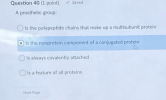 Question 40 (1 point) Saved A prosthetic group: Is the polypeptide chains that make up a multisubunit protein O Is the nonprotein component of a conjugated protein O is always covalently attached Is a feature of all proteins Next Page
What is the activation energy of a reaction? Select the single best answer. the energy...
What is the activation energy of a reaction? Select the single best answer. the energy required for an enzyme to overcome competitive inhibition the energy used up by an enzyme in a reaction the energy required for a reaction to take place the energy required in order for an enzyme to catalyze a reaction What is the relationship between pepsin and pepsinogen? Select all that apply. pepsin is the inactive form of the enzyme; pepsinogen...
Aspartate is the next-most common amine donor (after glutamate) in transamination reactions. What prosthetic group is...
 Aspartate is the next-most common amine donor (after glutamate) in transamination reactions. What prosthetic group is involved in these reactions what is the a-keto acid product of one of these reactions when the a-amino acid substrate is aspartate?
What is a lysosome? Select the single best answer. a. the cleft or groove in the...
What is a lysosome? Select the single best answer. a. the cleft or groove in the surface of an enzyme that is the site of substrate binding b. a hydrolytic enzyme c. an enzyme that has an effector binding site as well as an active site d. a membrane-bound vesicle in the cytoplasm of cells that contains approximately fifty hydrolases
Which of the following best describes a ligand? -a cell membrane protein that allows ions to...
Which of the following best describes a ligand? -a cell membrane protein that allows ions to cross the membrane -a transmembrane protein that binds to extracellular signaling molecules -a molecule that is covalently attached to an amino acid by an enzyme -a small molecule that binds to a protein and affects the protein\'s function
1 attempt left Check my work Select the single best answer. Biological reduction of pyruvic acid,...
 1 attempt left Check my work Select the single best answer. Biological reduction of pyruvic acid, catalyzed by the enzyme lactate dehydrogenase, gives (+)-lactic acid, represented by the Fischer projection shown. What is the configuration of (t)-lactic acid according to the Cahn-Ingold-Prelog R-S notational system? HO biological reduction E 4- HO- 7 CHE Pyruvic acid (Lactic acid References eBook & Resources Multiple Choice Type here to search
of alanine has a pk of 9.87. What is the 153, The amino group charge on...
 of alanine has a pk of 9.87. What is the 153, The amino group charge on that amino group at pH 7.0 145. Which amino acid serves as the first amino acid at the hN terminus of a newly synthesized protein? (B) methionine (A) alanine 9.80. The side chain of that amino acid includes (A) an amine group (C) a carboxylic acid group. (D) an alcohol 154. A certain amino acid has a pl (or pH, isoelectric point) (D) threonine...
2 attempts left Check my work Report Select the single best answer. A portion of the...
 2 attempts left Check my work Report Select the single best answer. A portion of the 'H NMR spectrum of the amino acid phenylalanine is shown below. Why are eight lines observed for H, and H.? H السر Mr 383 3.00 3.55 13 5.70 Chemical shift (oppm) OH, and H) split each other into two quartets. OH, and H, are split by the five hydrogens of the aromatic ring. H, and H, split each other into doublets, and these are...
THIS IS BIOCHEMISTRY A peptide has a low pI value. Which of the following amino acids...
THIS IS BIOCHEMISTRY A peptide has a low pI value. Which of the following amino acids are likely to be present? Glycine Serine Valine Aspartic aci Arginine The R-groups of which of the following pairs of amino acids could participate in the formation of salt bridge electrostatic interaction? Alanine and valine Valine and lysine Lysine and glutamate Serine and isoleucine Asparagine and glutamine Which of the following interactions does NOT contribute to stabilizing tertiary structure? Hydrophobic interactions Electrostatic interations...
xProteins Quiz x ipids Quiz x Lipids Quiz t/view do?attempt- 1&context 0a4ce60a0a0001dc4786cd79dbacf795 Question1 Select one answer...
 xProteins Quiz x ipids Quiz x Lipids Quiz t/view do?attempt- 1&context 0a4ce60a0a0001dc4786cd79dbacf795 Question1 Select one answer Where do peptide bonds form? A. Between adjacent carboxyl groups on amino acids. B. Between amino acids of two different protein chains. C. Between the carboxyl group of one amino acid and the amino group of another amino o points acid. D. Between adjacent amino groups on amino acids. Question2 Select one answer The following structure is the amino acid glutamic acid. Four atoms...
 Question 40 (1 point) Saved A prosthetic group: Is the polypeptide chains that make up a multisubunit protein O Is the nonprotein component of a conjugated protein O is always covalently attached Is a feature of all proteins Next Page
 Aspartate is the next-most common amine donor (after glutamate) in transamination reactions. What prosthetic group is involved in these reactions what is the a-keto acid product of one of these reactions when the a-amino acid substrate is aspartate?
 1 attempt left Check my work Select the single best answer. Biological reduction of pyruvic acid, catalyzed by the enzyme lactate dehydrogenase, gives (+)-lactic acid, represented by the Fischer projection shown. What is the configuration of (t)-lactic acid according to the Cahn-Ingold-Prelog R-S notational system? HO biological reduction E 4- HO- 7 CHE Pyruvic acid (Lactic acid References eBook & Resources Multiple Choice Type here to search
 of alanine has a pk of 9.87. What is the 153, The amino group charge on that amino group at pH 7.0 145. Which amino acid serves as the first amino acid at the hN terminus of a newly synthesized protein? (B) methionine (A) alanine 9.80. The side chain of that amino acid includes (A) an amine group (C) a carboxylic acid group. (D) an alcohol 154. A certain amino acid has a pl (or pH, isoelectric point) (D) threonine...
 2 attempts left Check my work Report Select the single best answer. A portion of the 'H NMR spectrum of the amino acid phenylalanine is shown below. Why are eight lines observed for H, and H.? H السر Mr 383 3.00 3.55 13 5.70 Chemical shift (oppm) OH, and H) split each other into two quartets. OH, and H, are split by the five hydrogens of the aromatic ring. H, and H, split each other into doublets, and these are...
 xProteins Quiz x ipids Quiz x Lipids Quiz t/view do?attempt- 1&context 0a4ce60a0a0001dc4786cd79dbacf795 Question1 Select one answer Where do peptide bonds form? A. Between adjacent carboxyl groups on amino acids. B. Between amino acids of two different protein chains. C. Between the carboxyl group of one amino acid and the amino group of another amino o points acid. D. Between adjacent amino groups on amino acids. Question2 Select one answer The following structure is the amino acid glutamic acid. Four atoms...
Most questions answered within 3 hours.
-
Where is the error in this code sequence?
String s1 = "Hello";
String s2 = "ello";...
asked 10 months ago -
Financial data for Joel de Paris, Inc., for last year
follow:
Joel de Paris, Inc.
Balance...
asked 10 months ago -
Consider this reaction:
Al2(SO4)3 (aq)+ BaCl3
(aq) Al2Cl6 (aq)- +
3BaSO4(s) . What is the...
asked 10 months ago -
Suppose that Savneet is considering increasing her
recent random sample from 20 car rentals to 40...
asked 10 months ago -
Trucks arrive at an unloading terminal at an average rate of 120
per hour.
Trucks arrive...
asked 10 months ago -
Why are methanol and ethanol completely soluble in water while
octanol is not very little soluble....
asked 10 months ago -
A facilities manager at a university reads in a research report
that the mean amount of...
asked 10 months ago -
When the CuSO4 is rehydrated by adding water to the anhydrous
compound, is this an endothermic...
asked 10 months ago -
A ray of sunlight is passing from diamond into crown glass; the
angle of incidence is...
asked 10 months ago -
A block of mass 0.249 kg is placed on top of a light, vertical
spring of...
asked 10 months ago -
how do the kidneys compensate in the presences of acidosis
a) trigger hyperventilate
b) reserve acid...
asked 10 months ago -
Question 501 pts
The rental rate of capital to the firm increases. Which of the
following...
asked 10 months ago