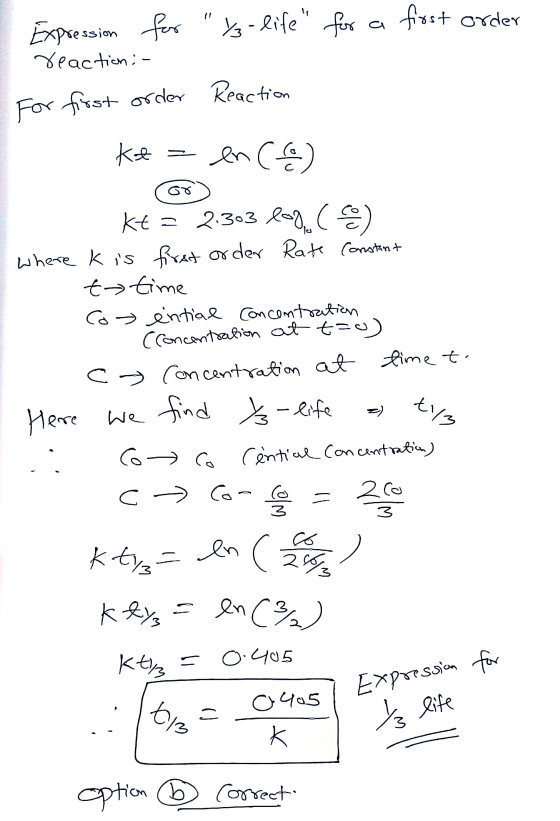
What is the expression for a "1/3-life" for a first-order reaction? A. ??([?]?/[?]0)/−? B. 0.463/? C....
What is the expression for a "1/3-life" for a first-order reaction?
A. ??([?]?/[?]0)/−?
B. 0.463/?
C. ??([?]?/[?]0)/(−3?)
D. 1.099/?
E. 3/k
I need a explanation.
Thanks.
Homework Answers
Add Answer to:
What is the expression for a "1/3-life" for a first-order
reaction?
A. ??([?]?/[?]0)/−?
B. 0.463/?
C....
For a first-order reaction, the half-life is constant. It depends only on the rate constant k...
For a first-order reaction, the half-life is constant. It depends only on the rate constant k k and not on the reactant concentration. It is expressed as t1/2=0.693k t 1 / 2 = 0.693 k For a second-order reaction, the half-life depends on the rate constant and the concentration of the reactant and so is expressed as t1/2=1k[A]0. A certain first-order reaction (A→products A → p r o d u c t s ) has a rate constant of 9.30×10⁻³...
The decomposition of A to B is a first-order reaction with a half-life of 29.9 min:...
The decomposition of A to B is a first-order reaction with a half-life of 29.9 min: A → 2B If the initial concentration of A is 0.463 M, how long will it take for the concentration of A to decrease by 21.3 %? 10.3 min 11.4 min 9.58 min 66.7 min 8.84 min
18. In a first-order reaction, the half-life is 3 minutes. What is the rate constant? A)...
 18. In a first-order reaction, the half-life is 3 minutes. What is the rate constant? A) 5490 s B) 8.75 x 10⁵ s D) 1.26 x 10⁴s E) 0.315 s C) 5.25 x 10³s
The reaction A(aq) ---> B(aq) + C(aq) is a first order reaction. The half-life of A(aq)...
The reaction A(aq) ---> B(aq) + C(aq) is a first order reaction. The half-life of A(aq) is 89.9 s at 25.0oC and its half-life is 70.8 s at 45.0oC. What is its half-life (in s) at 65.0oC? Please help, I have no idea how to do it :(
For a first-order reaction, the half-life is constant. It depends only on the rate constant k...
For a first-order reaction, the half-life is constant. It depends only on the rate constant k and not on the reactant concentration. It is expressed as t 1/2 = 0.693 k For a second-order reaction, the half-life depends on the rate constant and the concentration of the reactant and so is expressed as t 1/2 = 1 k[A ] 0 Part A A certain first-order reaction ( A→products ) has a rate constant of 9.90×10⁻³ s −1 at 45 ∘...
A first order reaction has 2.81 s half-life at 298 K and 0.313 s half-life at...
 A first order reaction has 2.81 s half-life at 298 K and 0.313 s half-life at 318 K. Using the Arrhenius expression, identify the correct activation energy for this reaction? (R = 0.00832 kJ/mol-K) O 1. 10.5 kJ/mol 2.86.3 kJ/mol 3. 105 kJ/mol 4.501 kJ/mol
For a first-order reaction, the half-life is constant. It depends only on the rate constant k...
For a first-order reaction, the half-life is constant. It depends only on the rate constant k and not on the reactant concentration. It is expressed as t1/2=0.693kt1/2=0.693k For a second-order reaction, the half-life depends on the rate constant and the concentration of the reactant and so is expressed as t1/2=1k[A]0 Part A. A certain first-order reaction (A→products) has a rate constant of 3.00×10⁻³ s−1 at 45 ∘C∘C. How many minutes does it take for the concentration of the reactant, [A],...
55) The rate constant for a first-order reaction is 0.54 s-1. What is the half-life of...
 55) The rate constant for a first-order reaction is 0.54 s-1. What is the half-life of this reaction if the initial concentration is 0.33 M? 56) The rate constant for a zero-order reaction is 0.54 s-1. What is the half-life of this reaction if the initial concentration is 0.33 M? 57) The reaction that occurs in a Breathalyzer, a device used to determine the alcohol level in a person's bloodstream, is given below. If the rate of appearance of Cr2(SO4)3...
1. For the expression below, x is 2, y is 1, and z is 0. What...
 1. For the expression below, x is 2, y is 1, and z is 0. What is
the overall reaction order?
A. 0
B. 1
C. 2
D. 3
2. For the expression below, what is true about k.
A. It is the ratio of products to reactants.
B. Its units are s^1.
C. It is a rate constant.
D. It is the ratio or reactants to products.
Product Formation Rate = k[A]*[B]”[C]” Product Formation Rate = k[A]*[B]”[C]”
1. For the expression below, x is 2, y is 1, and z is 0. What is
the overall reaction order?
A. 0
B. 1
C. 2
D. 3
2. For the expression below, what is true about k.
A. It is the ratio of products to reactants.
B. Its units are s^1.
C. It is a rate constant.
D. It is the ratio or reactants to products.
Product Formation Rate = k[A]*[B]”[C]” Product Formation Rate = k[A]*[B]”[C]”
For the following first order reaction, the half-life is 28.3 and the [A]0 = 1.36. Calculate the rate constant.
A.For the following first order reaction, the half-life is 28.3 and the [A]0 = 1.36. Calculate the rate constant.2A -> 3BB.Consider the following reaction. aA + bB -> cCwhose first and second half-lives are 38.2 and 19.1 minutes respectively. If the rate constant is equal to 0.2148 and [A]0 = 16.41, calculate the [A] at t 5.87 minutes.C.A researcher raises the temperature from 46.4 to 66 °C and finds that the rate of the reaction doubles. What was the activation energy (in...
 18. In a first-order reaction, the half-life is 3 minutes. What is the rate constant? A) 5490 s B) 8.75 x 10⁵ s D) 1.26 x 10⁴s E) 0.315 s C) 5.25 x 10³s
 A first order reaction has 2.81 s half-life at 298 K and 0.313 s half-life at 318 K. Using the Arrhenius expression, identify the correct activation energy for this reaction? (R = 0.00832 kJ/mol-K) O 1. 10.5 kJ/mol 2.86.3 kJ/mol 3. 105 kJ/mol 4.501 kJ/mol
 55) The rate constant for a first-order reaction is 0.54 s-1. What is the half-life of this reaction if the initial concentration is 0.33 M? 56) The rate constant for a zero-order reaction is 0.54 s-1. What is the half-life of this reaction if the initial concentration is 0.33 M? 57) The reaction that occurs in a Breathalyzer, a device used to determine the alcohol level in a person's bloodstream, is given below. If the rate of appearance of Cr2(SO4)3...
 1. For the expression below, x is 2, y is 1, and z is 0. What is
the overall reaction order?
A. 0
B. 1
C. 2
D. 3
2. For the expression below, what is true about k.
A. It is the ratio of products to reactants.
B. Its units are s^1.
C. It is a rate constant.
D. It is the ratio or reactants to products.
Product Formation Rate = k[A]*[B]”[C]” Product Formation Rate = k[A]*[B]”[C]”
1. For the expression below, x is 2, y is 1, and z is 0. What is
the overall reaction order?
A. 0
B. 1
C. 2
D. 3
2. For the expression below, what is true about k.
A. It is the ratio of products to reactants.
B. Its units are s^1.
C. It is a rate constant.
D. It is the ratio or reactants to products.
Product Formation Rate = k[A]*[B]”[C]” Product Formation Rate = k[A]*[B]”[C]”
Most questions answered within 3 hours.
-
Where is the error in this code sequence?
String s1 = "Hello";
String s2 = "ello";...
asked 10 months ago -
Financial data for Joel de Paris, Inc., for last year
follow:
Joel de Paris, Inc.
Balance...
asked 10 months ago -
Consider this reaction:
Al2(SO4)3 (aq)+ BaCl3
(aq) Al2Cl6 (aq)- +
3BaSO4(s) . What is the...
asked 10 months ago -
Suppose that Savneet is considering increasing her
recent random sample from 20 car rentals to 40...
asked 10 months ago -
Trucks arrive at an unloading terminal at an average rate of 120
per hour.
Trucks arrive...
asked 10 months ago -
Why are methanol and ethanol completely soluble in water while
octanol is not very little soluble....
asked 10 months ago -
A facilities manager at a university reads in a research report
that the mean amount of...
asked 10 months ago -
When the CuSO4 is rehydrated by adding water to the anhydrous
compound, is this an endothermic...
asked 10 months ago -
A ray of sunlight is passing from diamond into crown glass; the
angle of incidence is...
asked 10 months ago -
A block of mass 0.249 kg is placed on top of a light, vertical
spring of...
asked 10 months ago -
how do the kidneys compensate in the presences of acidosis
a) trigger hyperventilate
b) reserve acid...
asked 10 months ago -
Question 501 pts
The rental rate of capital to the firm increases. Which of the
following...
asked 10 months ago