
Homework Answers
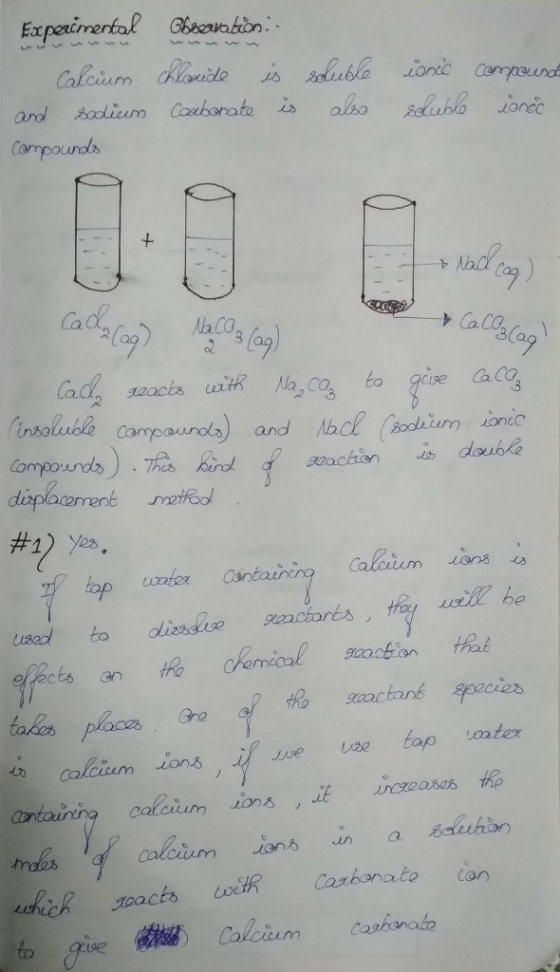
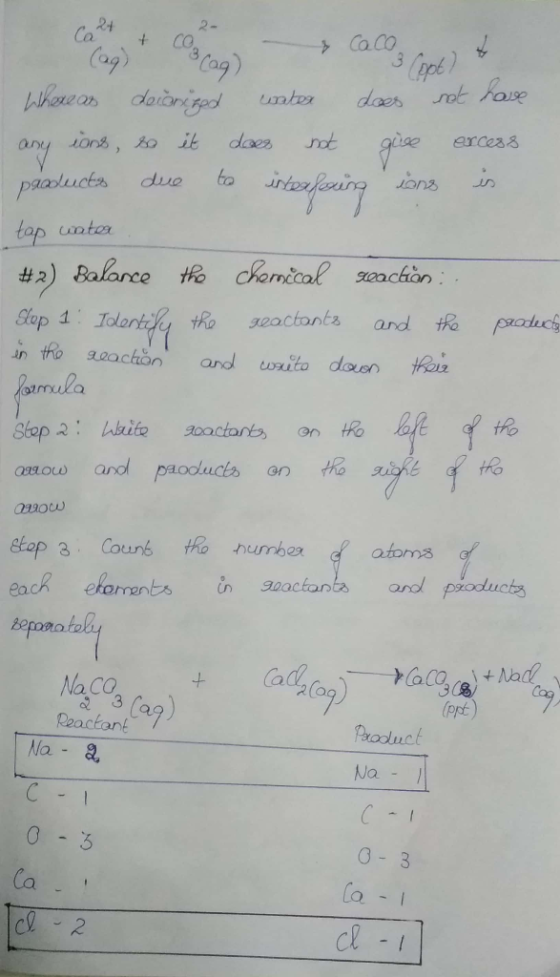
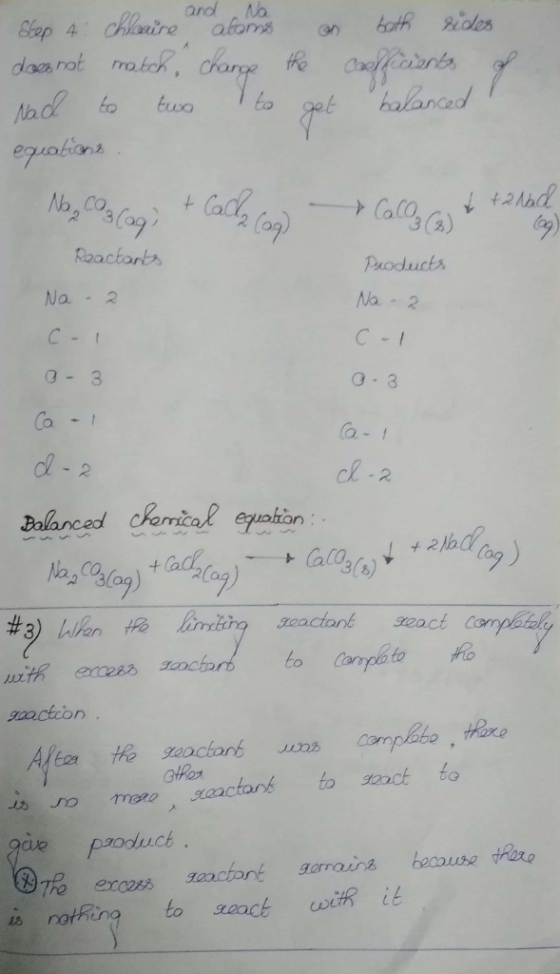

#1) yes, tap water containing calcium ions interfere with the chemical reaction
#2) Na2CO3(aq) +
CaCl2(aq) 
CaCO3(s) + 2NaCl(aq)
CaCO3(s) + 2NaCl(aq)
#3) the excess reactant remains because there is nothing to react with it.
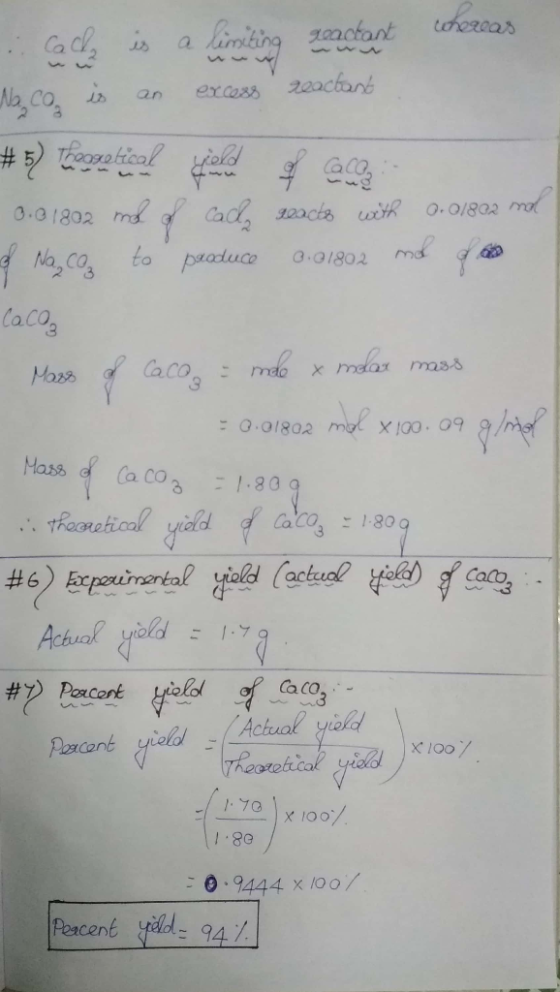
#4) CaCl2 is limiting reagents.
#5) Theoretical yield of CaCO3 is 1.8g
#6) Actual yield of CaCO3 is 1.7g
#7) Percent yield of CaCO3 is 94%
Add Answer to:
Table 9: Mass Data Item Calcium Chloride (CaCl2) Sodium Carbonate (Na,CO3) Filter Paper Caco,(Experimental Yield) Weight...
EXPERIMENT 1: CALCULATING THE YIELD OF CALCIUM CARBONATE Data Sheet Table 5. Mass Data Item Mass...
 EXPERIMENT 1: CALCULATING THE YIELD OF CALCIUM CARBONATE Data Sheet Table 5. Mass Data Item Mass (g) Calcium Chloride (CaCl2) 2.09 Sodium Carbonate (Na2CO3) 2.5 g Filter Paper 4.29 CaCO. (Experimental Yield) Experimental Observations: Insert a photo of your dried filter paper here: Calculations Show your work! Focus Experimental Observations: Insert a photo of your dried filter paper here: Calculations Show your work! 1. Using the mass and molar mass of CaCl2 determine the number of moles of CaCl2. 2....
Table 9: Mass Data Item Mass (g) Calcium Chloride (CaCl2) 59 Sodium Carbonate (Na2CO3) 2,5 2.2....
 Table 9: Mass Data Item Mass (g) Calcium Chloride (CaCl2) 59 Sodium Carbonate (Na2CO3) 2,5 2.2. Filter Paper 15.4-2.7= CaCO3 (Experimental Yield) Experimental Observations: THE REACTION CREATED Buloles AND FORCED AIR INTO THE CYLINDER Post-Lab Questions Na2CO3 + CaCl2 CaCO3 Z g g g/mol g/mol mol mol Ratio (coeff) Ratio (coeff) 4. Identify the limiting reactant and find the calculated (theoretical) yield of CaCO3? What is the actual (experimental) yield of CaCO3? 3.2g 5. Find the percent yield of CaCO3:...
the reaction is: CaCl2(aq) + Na2CO3(aq) ? CaCO3(s) + 2NaCl(aq) Mass Grams Mass of CaCl Mass...
 the reaction is: CaCl2(aq) +
Na2CO3(aq) ? CaCO3(s) +
2NaCl(aq)
Mass Grams Mass of CaCl Mass of Na2CO Mass of Filter Paper Mass of Product, CaCO3 (Experimental Yield) Experimental Observations 2 gm 2.5 gm 2.3 gm 2.4 gm 1. What is the proper name of CaCO? When is it used in real life? 2. What happened to the excess reactant after the reaction was complete? 3. What was the limiting reagent in your experiment? Show your calculations that prove this....
the reaction is: CaCl2(aq) +
Na2CO3(aq) ? CaCO3(s) +
2NaCl(aq)
Mass Grams Mass of CaCl Mass of Na2CO Mass of Filter Paper Mass of Product, CaCO3 (Experimental Yield) Experimental Observations 2 gm 2.5 gm 2.3 gm 2.4 gm 1. What is the proper name of CaCO? When is it used in real life? 2. What happened to the excess reactant after the reaction was complete? 3. What was the limiting reagent in your experiment? Show your calculations that prove this....
please help fill in this chart using this reaction Na2CO3(aq) + CaCl2*2H2O(aq) -> CaCO3(s)+2NaCl(aq)+2H2O (aq) Given...
please help fill in this chart using this reaction Na2CO3(aq) + CaCl2*2H2O(aq) -> CaCO3(s)+2NaCl(aq)+2H2O (aq) Given information 1 - CaCl2•2H2O Calcium chloride, dihydrate - 2.5 g 1 - Filter paper, 12.5 cm 1 - Na2CO3 - Sodium carbonate - 2 g 1 - Weighing boat, plastic Initial: CaCl2•2H2O (g) (1 gram) Initial: CaCl2•2H2O (moles) Initial: CaCl2 (moles) Initial: Na2CO3 (moles) Initial: Na2CO3 (g) Theoretical: CaCO3 (g) Mass of Filter paper (g) Mass of Filter Paper + CaCO3 (g) Actual: CaCO3...
Paragraph Styles CARBONATE Data Sheet Table 5. Mass Data Item Mass (g) Calcium Chloride (CaCl)
 1. Using the mass and molar mass of \(\mathrm{CaCl}_{2}\) determine the number of moles of \(\mathrm{CaCl}_{2}\).2. Convert the moles of \(\mathrm{CaCl}_{2}\) to moles of \(\mathrm{CaCO}_{3}\) using a mole ratio.3. Convert the moles of \(\mathrm{CaCO}_{3}\) to grams of \(\mathrm{CaCO}_{3}\) using the molar mass.4. Using the mass of \(\mathrm{Na}_{2} \mathrm{CO}_{3}\) determine the number of moles of \(\mathrm{Na}_{2} \mathrm{CO}_{3}\).5. Convert the moles of \(\mathrm{Na}_{2} \mathrm{CO}_{3}\) to moles of \(\mathrm{CaCO}_{3}\) using a mole ratio.6. Convert the moles of \(\mathrm{CaCO}_{3}\) to grams of \(\mathrm{CaCO}_{3}\) using...
DATA ANALYSIS Part 1 - Precipitation, Filtration, and Drying of Calcium Carbonate 1. Write a balanced chemical equ...
 DATA ANALYSIS Part 1 - Precipitation, Filtration, and Drying of Calcium Carbonate 1. Write a balanced chemical equation for the reaction between calcium chloride and potassium carbonate. K2CO3 (aq) + CaCl2 (aq) > CaCO3 (s) + 2 KCl (aq). 2. Using stoichiometry, calculate the limiting reactant and the theoretical yield (the mass of Caco, product) for the reaction. 3. What is the actual yield of Cacox(s) formed from your experiment? Show your work. 4. Determine the percent yield of the...
Calculate the theoretical yield of the aspirin. Show all work: 2.50x 180 aSpirin DATA TABLE for A...
 Please use picture #1 to answer the chemistry questions in picture
#2. Thank you
Calculate the theoretical yield of the aspirin. Show all work: 2.50x 180 aSpirin DATA TABLE for ASPIRIN: Mass of salicylic acid (g): Mass of filter paper (g): Calculated theoretical yield of &.So aspirin product: 3.26 Salycylic acid color with Fer FeCl, color tests Your aspirin color with FeCl: Dark pure - Part 2: Mass of acetylsalicylic acid (aspirin) after drying and filter paper Mass aspirin) Calculate...
Please use picture #1 to answer the chemistry questions in picture
#2. Thank you
Calculate the theoretical yield of the aspirin. Show all work: 2.50x 180 aSpirin DATA TABLE for ASPIRIN: Mass of salicylic acid (g): Mass of filter paper (g): Calculated theoretical yield of &.So aspirin product: 3.26 Salycylic acid color with Fer FeCl, color tests Your aspirin color with FeCl: Dark pure - Part 2: Mass of acetylsalicylic acid (aspirin) after drying and filter paper Mass aspirin) Calculate...
help with # 7 Data Table: Reactant 1 Identity_NaCO,H,O 124.00 g/mol Mass 1.02 g Reactant 2...
 help with # 7
Data Table: Reactant 1 Identity_NaCO,H,O 124.00 g/mol Mass 1.02 g Reactant 2 Identity_MnS0, H,0 169.02 g/mol Mass_1.04 g Observation of chemical reaction. Include observations about color of precipitate! Immediately after adding the two aqueous solutions together a pale pink precipitate formed. 1.49 g Mass of filter paper + precipitate Mass of filter paper Mass of precipitate (actual yield) 0.83 g 0.66 g Analysis: 1. Write the balanced chemical equation for this reaction. 2. Use a solubility...
help with # 7
Data Table: Reactant 1 Identity_NaCO,H,O 124.00 g/mol Mass 1.02 g Reactant 2 Identity_MnS0, H,0 169.02 g/mol Mass_1.04 g Observation of chemical reaction. Include observations about color of precipitate! Immediately after adding the two aqueous solutions together a pale pink precipitate formed. 1.49 g Mass of filter paper + precipitate Mass of filter paper Mass of precipitate (actual yield) 0.83 g 0.66 g Analysis: 1. Write the balanced chemical equation for this reaction. 2. Use a solubility...
Please answer the following questions/fill in the data tables based on the following experiment. EXPERIMENTAL PROCEDURE:...
Please answer the following questions/fill in the data tables based on the following experiment. EXPERIMENTAL PROCEDURE: Place sodium hydroxide (2.500 g) in a 100 mL Erlenmeyer flask and add water (25.0 mL) and ethanol (20.0 mL). Add a magnetic stirrer bar and stir until all the NaOH has dissolved. To a second reaction vessel, add benzaldehyde (2.650 g, 0.025 mol) and acetone (0.725 g, 0.0125 mol). Add approximately half of the aldehyde-ketone solution to the sodium hydroxide solution, and stir...
Can someone help answer these? 9. Percent yield a. In an experiment to prepare sodium acetate, the theoretical yie...
 Can
someone help answer these?
9. Percent yield a. In an experiment to prepare sodium acetate, the theoretical yield is 105,0 g. If the actual yield is 99.8 g, what is the percent yield? b. You have calculated that you should obtain 567.3 g of Al from Al2O3. You only obtained 492.2 g. What was your percent yield? c. If you should have gotten 98.5 g of CaCO3 from an experiment and this represented a 75.0% yield, what was the...
Can
someone help answer these?
9. Percent yield a. In an experiment to prepare sodium acetate, the theoretical yield is 105,0 g. If the actual yield is 99.8 g, what is the percent yield? b. You have calculated that you should obtain 567.3 g of Al from Al2O3. You only obtained 492.2 g. What was your percent yield? c. If you should have gotten 98.5 g of CaCO3 from an experiment and this represented a 75.0% yield, what was the...
 EXPERIMENT 1: CALCULATING THE YIELD OF CALCIUM CARBONATE Data Sheet Table 5. Mass Data Item Mass (g) Calcium Chloride (CaCl2) 2.09 Sodium Carbonate (Na2CO3) 2.5 g Filter Paper 4.29 CaCO. (Experimental Yield) Experimental Observations: Insert a photo of your dried filter paper here: Calculations Show your work! Focus Experimental Observations: Insert a photo of your dried filter paper here: Calculations Show your work! 1. Using the mass and molar mass of CaCl2 determine the number of moles of CaCl2. 2....
 Table 9: Mass Data Item Mass (g) Calcium Chloride (CaCl2) 59 Sodium Carbonate (Na2CO3) 2,5 2.2. Filter Paper 15.4-2.7= CaCO3 (Experimental Yield) Experimental Observations: THE REACTION CREATED Buloles AND FORCED AIR INTO THE CYLINDER Post-Lab Questions Na2CO3 + CaCl2 CaCO3 Z g g g/mol g/mol mol mol Ratio (coeff) Ratio (coeff) 4. Identify the limiting reactant and find the calculated (theoretical) yield of CaCO3? What is the actual (experimental) yield of CaCO3? 3.2g 5. Find the percent yield of CaCO3:...
 the reaction is: CaCl2(aq) +
Na2CO3(aq) ? CaCO3(s) +
2NaCl(aq)
Mass Grams Mass of CaCl Mass of Na2CO Mass of Filter Paper Mass of Product, CaCO3 (Experimental Yield) Experimental Observations 2 gm 2.5 gm 2.3 gm 2.4 gm 1. What is the proper name of CaCO? When is it used in real life? 2. What happened to the excess reactant after the reaction was complete? 3. What was the limiting reagent in your experiment? Show your calculations that prove this....
the reaction is: CaCl2(aq) +
Na2CO3(aq) ? CaCO3(s) +
2NaCl(aq)
Mass Grams Mass of CaCl Mass of Na2CO Mass of Filter Paper Mass of Product, CaCO3 (Experimental Yield) Experimental Observations 2 gm 2.5 gm 2.3 gm 2.4 gm 1. What is the proper name of CaCO? When is it used in real life? 2. What happened to the excess reactant after the reaction was complete? 3. What was the limiting reagent in your experiment? Show your calculations that prove this....
 1. Using the mass and molar mass of \(\mathrm{CaCl}_{2}\) determine the number of moles of \(\mathrm{CaCl}_{2}\).2. Convert the moles of \(\mathrm{CaCl}_{2}\) to moles of \(\mathrm{CaCO}_{3}\) using a mole ratio.3. Convert the moles of \(\mathrm{CaCO}_{3}\) to grams of \(\mathrm{CaCO}_{3}\) using the molar mass.4. Using the mass of \(\mathrm{Na}_{2} \mathrm{CO}_{3}\) determine the number of moles of \(\mathrm{Na}_{2} \mathrm{CO}_{3}\).5. Convert the moles of \(\mathrm{Na}_{2} \mathrm{CO}_{3}\) to moles of \(\mathrm{CaCO}_{3}\) using a mole ratio.6. Convert the moles of \(\mathrm{CaCO}_{3}\) to grams of \(\mathrm{CaCO}_{3}\) using...
 DATA ANALYSIS Part 1 - Precipitation, Filtration, and Drying of Calcium Carbonate 1. Write a balanced chemical equation for the reaction between calcium chloride and potassium carbonate. K2CO3 (aq) + CaCl2 (aq) > CaCO3 (s) + 2 KCl (aq). 2. Using stoichiometry, calculate the limiting reactant and the theoretical yield (the mass of Caco, product) for the reaction. 3. What is the actual yield of Cacox(s) formed from your experiment? Show your work. 4. Determine the percent yield of the...
 Please use picture #1 to answer the chemistry questions in picture
#2. Thank you
Calculate the theoretical yield of the aspirin. Show all work: 2.50x 180 aSpirin DATA TABLE for ASPIRIN: Mass of salicylic acid (g): Mass of filter paper (g): Calculated theoretical yield of &.So aspirin product: 3.26 Salycylic acid color with Fer FeCl, color tests Your aspirin color with FeCl: Dark pure - Part 2: Mass of acetylsalicylic acid (aspirin) after drying and filter paper Mass aspirin) Calculate...
Please use picture #1 to answer the chemistry questions in picture
#2. Thank you
Calculate the theoretical yield of the aspirin. Show all work: 2.50x 180 aSpirin DATA TABLE for ASPIRIN: Mass of salicylic acid (g): Mass of filter paper (g): Calculated theoretical yield of &.So aspirin product: 3.26 Salycylic acid color with Fer FeCl, color tests Your aspirin color with FeCl: Dark pure - Part 2: Mass of acetylsalicylic acid (aspirin) after drying and filter paper Mass aspirin) Calculate...
 help with # 7
Data Table: Reactant 1 Identity_NaCO,H,O 124.00 g/mol Mass 1.02 g Reactant 2 Identity_MnS0, H,0 169.02 g/mol Mass_1.04 g Observation of chemical reaction. Include observations about color of precipitate! Immediately after adding the two aqueous solutions together a pale pink precipitate formed. 1.49 g Mass of filter paper + precipitate Mass of filter paper Mass of precipitate (actual yield) 0.83 g 0.66 g Analysis: 1. Write the balanced chemical equation for this reaction. 2. Use a solubility...
help with # 7
Data Table: Reactant 1 Identity_NaCO,H,O 124.00 g/mol Mass 1.02 g Reactant 2 Identity_MnS0, H,0 169.02 g/mol Mass_1.04 g Observation of chemical reaction. Include observations about color of precipitate! Immediately after adding the two aqueous solutions together a pale pink precipitate formed. 1.49 g Mass of filter paper + precipitate Mass of filter paper Mass of precipitate (actual yield) 0.83 g 0.66 g Analysis: 1. Write the balanced chemical equation for this reaction. 2. Use a solubility...
 Can
someone help answer these?
9. Percent yield a. In an experiment to prepare sodium acetate, the theoretical yield is 105,0 g. If the actual yield is 99.8 g, what is the percent yield? b. You have calculated that you should obtain 567.3 g of Al from Al2O3. You only obtained 492.2 g. What was your percent yield? c. If you should have gotten 98.5 g of CaCO3 from an experiment and this represented a 75.0% yield, what was the...
Can
someone help answer these?
9. Percent yield a. In an experiment to prepare sodium acetate, the theoretical yield is 105,0 g. If the actual yield is 99.8 g, what is the percent yield? b. You have calculated that you should obtain 567.3 g of Al from Al2O3. You only obtained 492.2 g. What was your percent yield? c. If you should have gotten 98.5 g of CaCO3 from an experiment and this represented a 75.0% yield, what was the...
Most questions answered within 3 hours.
-
Where is the error in this code sequence?
String s1 = "Hello";
String s2 = "ello";...
asked 10 months ago -
Financial data for Joel de Paris, Inc., for last year
follow:
Joel de Paris, Inc.
Balance...
asked 10 months ago -
Consider this reaction:
Al2(SO4)3 (aq)+ BaCl3
(aq) Al2Cl6 (aq)- +
3BaSO4(s) . What is the...
asked 10 months ago -
Suppose that Savneet is considering increasing her
recent random sample from 20 car rentals to 40...
asked 10 months ago -
Trucks arrive at an unloading terminal at an average rate of 120
per hour.
Trucks arrive...
asked 10 months ago -
Why are methanol and ethanol completely soluble in water while
octanol is not very little soluble....
asked 10 months ago -
A facilities manager at a university reads in a research report
that the mean amount of...
asked 10 months ago -
When the CuSO4 is rehydrated by adding water to the anhydrous
compound, is this an endothermic...
asked 10 months ago -
A ray of sunlight is passing from diamond into crown glass; the
angle of incidence is...
asked 10 months ago -
A block of mass 0.249 kg is placed on top of a light, vertical
spring of...
asked 10 months ago -
how do the kidneys compensate in the presences of acidosis
a) trigger hyperventilate
b) reserve acid...
asked 10 months ago -
Question 501 pts
The rental rate of capital to the firm increases. Which of the
following...
asked 10 months ago