
Homework Answers
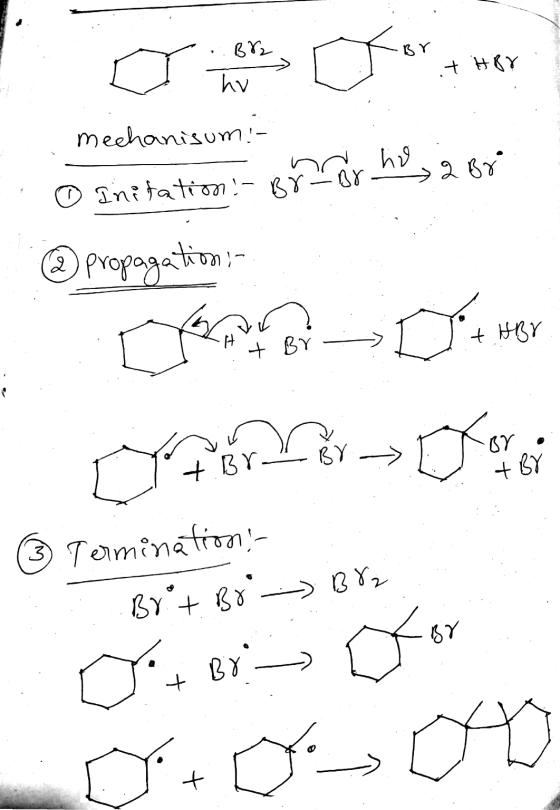
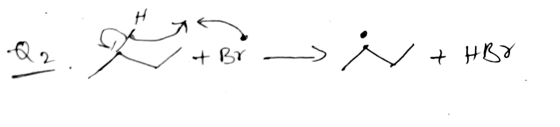
Thank you ?
All the best.
Add Answer to:
Based on the information gathered in (1a), predict the product for the halogenation reaction given below...
Question 1a. (0.5 point) Consider the bond dissociation energies listed below in kcal/mol CH3 – Br...
Question 1a. (0.5 point) Consider the bond dissociation energies listed below in kcal/mol CH3 – Br 70 CH3CH2 – Br 68 (CH3)2CH – Br 68 (CH3)3C – Br 65 These data show that the carbon–bromine bond is weakest when bromine is bound to a ____. a) methyl carbon b) primary carbon c) secondary carbon d) tertiary carbon e) quaternary carbon 1b. Predict the product for the halogenation reaction given below when methyl cyclohexane is subjected to free radical bromination Br2...
What is Wrong? Select the keyword or phrase that will best complete each sentence. Key terms: A radical...
 What is Wrong?
Select the keyword or phrase that will best complete each sentence. Key terms: A radical is a reactive intermediate with a single unpaired electron, formed by homoloysis of a covalent bond. paired unpaired Allylic radicals are stabilized by resonance, making them more stable than tertiary radicals increases inductive effects A compound that contains an especially weak bond that serves as a source of radicals is called a radical initiator ess homoloysis decreases more J Treatment of cyclohexene...
What is Wrong?
Select the keyword or phrase that will best complete each sentence. Key terms: A radical is a reactive intermediate with a single unpaired electron, formed by homoloysis of a covalent bond. paired unpaired Allylic radicals are stabilized by resonance, making them more stable than tertiary radicals increases inductive effects A compound that contains an especially weak bond that serves as a source of radicals is called a radical initiator ess homoloysis decreases more J Treatment of cyclohexene...
can you plz explain how to solve question 1&2? N-bomo soccinamide NBS)-usel speifilly for ally lic...
 can you plz explain how to solve question 1&2?
N-bomo soccinamide NBS)-usel speifilly for ally lic bonnction 1. (16 points) The molecule shown below, 3-ethyl-4-methylenehexane, is subjected to free-radical mono-bromination. a) How many products could be obtained? b) Draw the bond-line structure for the major product c) In the space below, provide the complete mechanism using the arrow notation, for th formation of the major product shown is part b above. HINT A steady and low concentration of bromine is...
can you plz explain how to solve question 1&2?
N-bomo soccinamide NBS)-usel speifilly for ally lic bonnction 1. (16 points) The molecule shown below, 3-ethyl-4-methylenehexane, is subjected to free-radical mono-bromination. a) How many products could be obtained? b) Draw the bond-line structure for the major product c) In the space below, provide the complete mechanism using the arrow notation, for th formation of the major product shown is part b above. HINT A steady and low concentration of bromine is...
please help 13. The reaction of 3-methyl-1-phenylbutane with chlorine yields four different monochlorination products via a...
 please help
13. The reaction of 3-methyl-1-phenylbutane with chlorine yields four different monochlorination products via a free radical mechanism. The experimental distribution of these products is given below. Use this information to determine the relative reactivity of the primary, secondary, tertiary and secondary benzylic hydrogens under these reaction conditions. SHOW ALL WORK!!! on a ou on oso ona 66.27% 12.54% 11.01% 10.18% 14. The free radical reaction of chlorine with 1,3-dimethyl cyclohexane yields five different monochlorination products. Draw the structure...
please help
13. The reaction of 3-methyl-1-phenylbutane with chlorine yields four different monochlorination products via a free radical mechanism. The experimental distribution of these products is given below. Use this information to determine the relative reactivity of the primary, secondary, tertiary and secondary benzylic hydrogens under these reaction conditions. SHOW ALL WORK!!! on a ou on oso ona 66.27% 12.54% 11.01% 10.18% 14. The free radical reaction of chlorine with 1,3-dimethyl cyclohexane yields five different monochlorination products. Draw the structure...
I need the mechanism please. IV. Provide a complete stepwise mechanism for the following reaction sequence,...
 I need the mechanism please.
IV. Provide a complete stepwise mechanism for the following reaction sequence, including initiation and termination steps for any radical reactions (i.e. write a continuous reaction mechanism with the product of step 1 being used in step 2.... Draw the product of each step in the indicated boxes. 1) Br2, hv 2) KO Bu/BuOH 3) HBr, ROOR Br step 1 product step 2 product
I need the mechanism please.
IV. Provide a complete stepwise mechanism for the following reaction sequence, including initiation and termination steps for any radical reactions (i.e. write a continuous reaction mechanism with the product of step 1 being used in step 2.... Draw the product of each step in the indicated boxes. 1) Br2, hv 2) KO Bu/BuOH 3) HBr, ROOR Br step 1 product step 2 product
Predict the major product of the following reaction, and draw complete mechanisms for the initiation and propagation steps. Propose 2 termination steps. Label each elementary step. Br2 hv Initiation:...
 Predict the major product of the following reaction, and draw complete mechanisms for the initiation and propagation steps. Propose 2 termination steps. Label each elementary step. Br2 hv Initiation: Propagation:
Predict the major product of the following reaction, and draw complete mechanisms for the initiation and propagation steps. Propose 2 termination steps. Label each elementary step. Br2 hv Initiation: Propagation:
Predict the major product of the following reaction, and draw complete mechanisms for the initiation and propagation steps. Propose 2 termination steps. Label each elementary step. Br2 hv Initiation: Propagation:
Need Help with the first one specifically, but all would be wonderful. Predict the MAJOR product...
 Need Help with the first one specifically, but all would be
wonderful.
Predict the MAJOR product for the following reactions. (3 pts each) Brą, hv Br2, hv Brą, hv Bry, hy Provide the missing reagents for the following reactions. (Hint:There may be more than 1 step) (4pts each) OH НО. Continued on next page. Draw a plausible stepwise mechanism for the following transformation. Include all steps of the reaction. (5pts) Br2, hv Br
Need Help with the first one specifically, but all would be
wonderful.
Predict the MAJOR product for the following reactions. (3 pts each) Brą, hv Br2, hv Brą, hv Bry, hy Provide the missing reagents for the following reactions. (Hint:There may be more than 1 step) (4pts each) OH НО. Continued on next page. Draw a plausible stepwise mechanism for the following transformation. Include all steps of the reaction. (5pts) Br2, hv Br
How do I answer questions in number 6 please, Thanks 6) (12 points) Draw mechanisms for...
 How do I answer questions in number 6 please, Thanks
6) (12 points) Draw mechanisms for the following transformations +HC HO Br2 + HBr H3C H3 hv H3C rパ HO Br H2O + HBr c) (Hint for Se: Doubling the concentration of water has no effect on the rate.) 7.) (4 points) For the reaction in question 6b,t below is seen product, and what product ratio of question 6b is in fact the major prod stabilities of intermediates involved in...
How do I answer questions in number 6 please, Thanks
6) (12 points) Draw mechanisms for the following transformations +HC HO Br2 + HBr H3C H3 hv H3C rパ HO Br H2O + HBr c) (Hint for Se: Doubling the concentration of water has no effect on the rate.) 7.) (4 points) For the reaction in question 6b,t below is seen product, and what product ratio of question 6b is in fact the major prod stabilities of intermediates involved in...
EXPERIMENT 9: SYNTHESIS OF DIPHENYLACETYLENE Objective: Complete the two-step halogenation/elimination reaction seq...
 EXPERIMENT 9: SYNTHESIS OF DIPHENYLACETYLENE Objective: Complete the two-step halogenation/elimination reaction sequence that converts an alkene (trans- stilbene) to an alkyne (diphenylacetylene) PRELAB NOTEBOOK: In the laboratory notebook, write the overall experimental objective, chemical equation(s), reaction mechanism. draw a diagram or outline of the procedural steps, and complete the chemical safety table for all chemicals. 1. Does this elimination process occur via an E1 or E2 mechanism? Justify your answer by explaining the specific factors that differentiate when E1 versus...
EXPERIMENT 9: SYNTHESIS OF DIPHENYLACETYLENE Objective: Complete the two-step halogenation/elimination reaction sequence that converts an alkene...
 EXPERIMENT 9: SYNTHESIS OF DIPHENYLACETYLENE Objective: Complete the two-step halogenation/elimination reaction sequence that converts an alkene (trans- stilbene) to an alkyne (diphenylacetylene) PRELAB NOTEBOOK: In the laboratory notebook, write the overall experimental objective, chemical equation(s), reaction mechanism. draw a diagram or outline of the procedural steps, and complete the chemical safety table for all chemicals. 1. Does this elimination process occur via an E1 or E2 mechanism? Justify your answer by explaining the specific factors that differentiate when E1 versus...
 What is Wrong?
Select the keyword or phrase that will best complete each sentence. Key terms: A radical is a reactive intermediate with a single unpaired electron, formed by homoloysis of a covalent bond. paired unpaired Allylic radicals are stabilized by resonance, making them more stable than tertiary radicals increases inductive effects A compound that contains an especially weak bond that serves as a source of radicals is called a radical initiator ess homoloysis decreases more J Treatment of cyclohexene...
What is Wrong?
Select the keyword or phrase that will best complete each sentence. Key terms: A radical is a reactive intermediate with a single unpaired electron, formed by homoloysis of a covalent bond. paired unpaired Allylic radicals are stabilized by resonance, making them more stable than tertiary radicals increases inductive effects A compound that contains an especially weak bond that serves as a source of radicals is called a radical initiator ess homoloysis decreases more J Treatment of cyclohexene...
 can you plz explain how to solve question 1&2?
N-bomo soccinamide NBS)-usel speifilly for ally lic bonnction 1. (16 points) The molecule shown below, 3-ethyl-4-methylenehexane, is subjected to free-radical mono-bromination. a) How many products could be obtained? b) Draw the bond-line structure for the major product c) In the space below, provide the complete mechanism using the arrow notation, for th formation of the major product shown is part b above. HINT A steady and low concentration of bromine is...
can you plz explain how to solve question 1&2?
N-bomo soccinamide NBS)-usel speifilly for ally lic bonnction 1. (16 points) The molecule shown below, 3-ethyl-4-methylenehexane, is subjected to free-radical mono-bromination. a) How many products could be obtained? b) Draw the bond-line structure for the major product c) In the space below, provide the complete mechanism using the arrow notation, for th formation of the major product shown is part b above. HINT A steady and low concentration of bromine is...
 please help
13. The reaction of 3-methyl-1-phenylbutane with chlorine yields four different monochlorination products via a free radical mechanism. The experimental distribution of these products is given below. Use this information to determine the relative reactivity of the primary, secondary, tertiary and secondary benzylic hydrogens under these reaction conditions. SHOW ALL WORK!!! on a ou on oso ona 66.27% 12.54% 11.01% 10.18% 14. The free radical reaction of chlorine with 1,3-dimethyl cyclohexane yields five different monochlorination products. Draw the structure...
please help
13. The reaction of 3-methyl-1-phenylbutane with chlorine yields four different monochlorination products via a free radical mechanism. The experimental distribution of these products is given below. Use this information to determine the relative reactivity of the primary, secondary, tertiary and secondary benzylic hydrogens under these reaction conditions. SHOW ALL WORK!!! on a ou on oso ona 66.27% 12.54% 11.01% 10.18% 14. The free radical reaction of chlorine with 1,3-dimethyl cyclohexane yields five different monochlorination products. Draw the structure...
 I need the mechanism please.
IV. Provide a complete stepwise mechanism for the following reaction sequence, including initiation and termination steps for any radical reactions (i.e. write a continuous reaction mechanism with the product of step 1 being used in step 2.... Draw the product of each step in the indicated boxes. 1) Br2, hv 2) KO Bu/BuOH 3) HBr, ROOR Br step 1 product step 2 product
I need the mechanism please.
IV. Provide a complete stepwise mechanism for the following reaction sequence, including initiation and termination steps for any radical reactions (i.e. write a continuous reaction mechanism with the product of step 1 being used in step 2.... Draw the product of each step in the indicated boxes. 1) Br2, hv 2) KO Bu/BuOH 3) HBr, ROOR Br step 1 product step 2 product
 Predict the major product of the following reaction, and draw complete mechanisms for the initiation and propagation steps. Propose 2 termination steps. Label each elementary step. Br2 hv Initiation: Propagation:
Predict the major product of the following reaction, and draw complete mechanisms for the initiation and propagation steps. Propose 2 termination steps. Label each elementary step. Br2 hv Initiation: Propagation:
Predict the major product of the following reaction, and draw complete mechanisms for the initiation and propagation steps. Propose 2 termination steps. Label each elementary step. Br2 hv Initiation: Propagation:
 Need Help with the first one specifically, but all would be
wonderful.
Predict the MAJOR product for the following reactions. (3 pts each) Brą, hv Br2, hv Brą, hv Bry, hy Provide the missing reagents for the following reactions. (Hint:There may be more than 1 step) (4pts each) OH НО. Continued on next page. Draw a plausible stepwise mechanism for the following transformation. Include all steps of the reaction. (5pts) Br2, hv Br
Need Help with the first one specifically, but all would be
wonderful.
Predict the MAJOR product for the following reactions. (3 pts each) Brą, hv Br2, hv Brą, hv Bry, hy Provide the missing reagents for the following reactions. (Hint:There may be more than 1 step) (4pts each) OH НО. Continued on next page. Draw a plausible stepwise mechanism for the following transformation. Include all steps of the reaction. (5pts) Br2, hv Br
 How do I answer questions in number 6 please, Thanks
6) (12 points) Draw mechanisms for the following transformations +HC HO Br2 + HBr H3C H3 hv H3C rパ HO Br H2O + HBr c) (Hint for Se: Doubling the concentration of water has no effect on the rate.) 7.) (4 points) For the reaction in question 6b,t below is seen product, and what product ratio of question 6b is in fact the major prod stabilities of intermediates involved in...
How do I answer questions in number 6 please, Thanks
6) (12 points) Draw mechanisms for the following transformations +HC HO Br2 + HBr H3C H3 hv H3C rパ HO Br H2O + HBr c) (Hint for Se: Doubling the concentration of water has no effect on the rate.) 7.) (4 points) For the reaction in question 6b,t below is seen product, and what product ratio of question 6b is in fact the major prod stabilities of intermediates involved in...
 EXPERIMENT 9: SYNTHESIS OF DIPHENYLACETYLENE Objective: Complete the two-step halogenation/elimination reaction sequence that converts an alkene (trans- stilbene) to an alkyne (diphenylacetylene) PRELAB NOTEBOOK: In the laboratory notebook, write the overall experimental objective, chemical equation(s), reaction mechanism. draw a diagram or outline of the procedural steps, and complete the chemical safety table for all chemicals. 1. Does this elimination process occur via an E1 or E2 mechanism? Justify your answer by explaining the specific factors that differentiate when E1 versus...
 EXPERIMENT 9: SYNTHESIS OF DIPHENYLACETYLENE Objective: Complete the two-step halogenation/elimination reaction sequence that converts an alkene (trans- stilbene) to an alkyne (diphenylacetylene) PRELAB NOTEBOOK: In the laboratory notebook, write the overall experimental objective, chemical equation(s), reaction mechanism. draw a diagram or outline of the procedural steps, and complete the chemical safety table for all chemicals. 1. Does this elimination process occur via an E1 or E2 mechanism? Justify your answer by explaining the specific factors that differentiate when E1 versus...
Most questions answered within 3 hours.
-
Where is the error in this code sequence?
String s1 = "Hello";
String s2 = "ello";...
asked 10 months ago -
Financial data for Joel de Paris, Inc., for last year
follow:
Joel de Paris, Inc.
Balance...
asked 10 months ago -
Consider this reaction:
Al2(SO4)3 (aq)+ BaCl3
(aq) Al2Cl6 (aq)- +
3BaSO4(s) . What is the...
asked 10 months ago -
Suppose that Savneet is considering increasing her
recent random sample from 20 car rentals to 40...
asked 10 months ago -
Trucks arrive at an unloading terminal at an average rate of 120
per hour.
Trucks arrive...
asked 10 months ago -
Why are methanol and ethanol completely soluble in water while
octanol is not very little soluble....
asked 10 months ago -
A facilities manager at a university reads in a research report
that the mean amount of...
asked 10 months ago -
When the CuSO4 is rehydrated by adding water to the anhydrous
compound, is this an endothermic...
asked 10 months ago -
A ray of sunlight is passing from diamond into crown glass; the
angle of incidence is...
asked 10 months ago -
A block of mass 0.249 kg is placed on top of a light, vertical
spring of...
asked 10 months ago -
how do the kidneys compensate in the presences of acidosis
a) trigger hyperventilate
b) reserve acid...
asked 10 months ago -
Question 501 pts
The rental rate of capital to the firm increases. Which of the
following...
asked 10 months ago