
Homework Answers
Add Answer to:
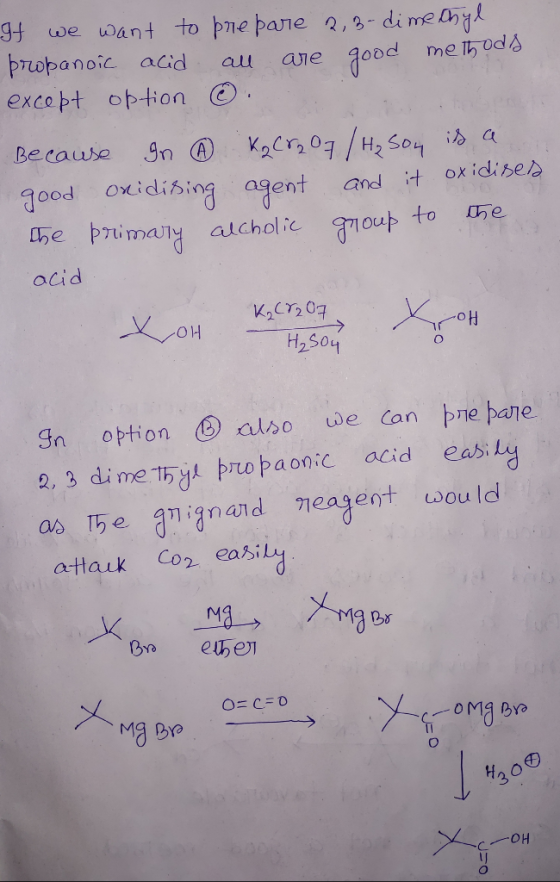
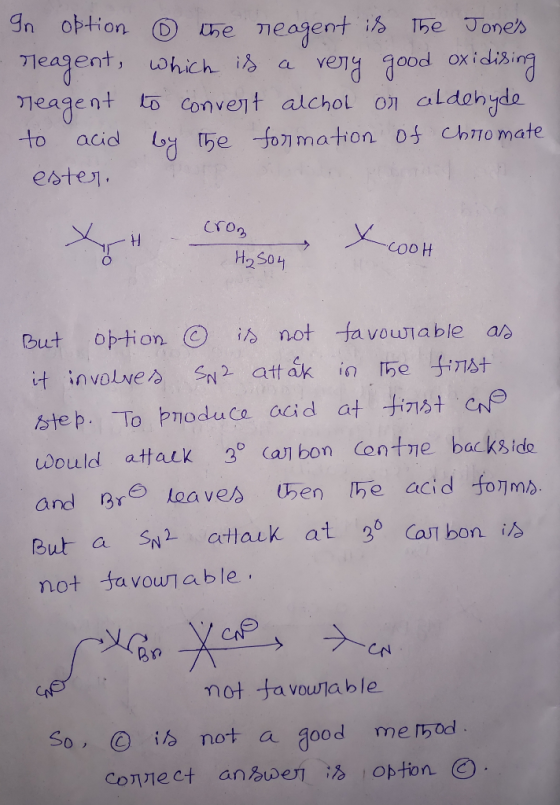
What of the following is not a good method to prepare 2,2-dimethylpropanoic acid? K2Cr2O7, H2SO (A)...
8. Provide the products for each of the following reaction sequences P010 ЛОН Na Cro H2SO,...
 8. Provide the products for each of the following reaction sequences P010 ЛОН Na Cro H2SO, heat 1.) SOCI 2) NHA PBrg NaCN H2SO4(aq) heat H.CMgB H SO daq) imine not isolated NaCN H2SO4(aq) PCC CH2Cl2 (solvent) heat NBS, hv 1.) Mg 2.) CO2 3.) H3O+ Na Cro H2SO, heat CH,OH H2O (CR) Hac-P(PM) 1.) LAH PDC Eto CH.CH 2.) H.O Page 6 of 6
which will produce a carboxylic acid(3rd pic) Question 10 (1 point) Which is not a suitable...
 which
will produce a carboxylic acid(3rd pic)
Question 10 (1 point) Which is not a suitable method to prepare the following carboxylic acid? 1. Mg 2. CO2 3. H2O* 1. NaCN 2. H30*Heat 1.2L 2.CO2 Br 3. H,09 0 1 and 3 only O 1, 2, and 3 O2 only O1 only How many equivalents of the amine below are required for this reaction to go to completion: MeCOCl + EtNH – MeCONHE 01/2 Ol 00 COH 1. Mg 2....
which
will produce a carboxylic acid(3rd pic)
Question 10 (1 point) Which is not a suitable method to prepare the following carboxylic acid? 1. Mg 2. CO2 3. H2O* 1. NaCN 2. H30*Heat 1.2L 2.CO2 Br 3. H,09 0 1 and 3 only O 1, 2, and 3 O2 only O1 only How many equivalents of the amine below are required for this reaction to go to completion: MeCOCl + EtNH – MeCONHE 01/2 Ol 00 COH 1. Mg 2....
4 Rank the following three carboxylic acids in order of increasing acidity l. 4 chlorobutanolc acid...
 4 Rank the following three carboxylic acids in order of increasing acidity l. 4 chlorobutanolc acid 3-chlorobutancic acid 2- S. Which of the following is not a good method to make 2.2-dimethylpropanosik A) (CH,CCH OH H:0, heat Mg () CO diethyl ether(2) NaCN HO, H heut 6. Which of the following is the product of the reaction sequence below? CH Hor- NBS. CCL heal benzoyl peroxide (1)Mpether 2) CO сснь Hi CH (CHjh CH CO H IV
5. Identify the major product expected to form at the completion of the following synthetic sequence....
 5. Identify the major product expected to form at the completion of the following synthetic sequence. O OH SO3, H2SO4 Br2 H2O H3O*-H2O но ОН Br ОН Он Он Br о Он Br но но Но НО но Br SO3H Br Br (A) (B) (C) (D) (E) 6.Which of the following synthetic sequences is expected to yield 2-chloro-4-nitrobenzoic acid in highest yleld? 1. KMnO OH Cla- FeCl HNO3- H2SO heat (A) 2. H30 1. KMnO4 , OH HNO- H2SO Clo-...
OH 1. NaOCHZ 2. H20 CO2H acid catalyst hint: - BuOH 1 2 NaOH, H2O heat...
 OH 1. NaOCHZ 2. H20 CO2H acid catalyst hint: - BuOH 1 2 NaOH, H2O heat 1. (CH3)2CuLi, ether 2. H30* H 3 1. NaOCH3 u 1. H307 2. heat 2. Br Br 5 6
Can you please provide a reaction mechanism for the following reaction and explain what is happening...
 Can you please provide a reaction mechanism for the following
reaction and explain what is happening at each step
A multistep synthesis demonstrating Grignard and Friedel Crafts reactions Part I and II Br MgBr Mg l21 diethyl ether bromobenzene MgBr 1, mix and heat OH 2, H30 benzophenone triphenylmethanol Part IV OCH3 H2so4 OCH3 anisole methoxytetraphenylmethane triphenylmethanol hane from a multistep reaction
Can you please provide a reaction mechanism for the following
reaction and explain what is happening at each step
A multistep synthesis demonstrating Grignard and Friedel Crafts reactions Part I and II Br MgBr Mg l21 diethyl ether bromobenzene MgBr 1, mix and heat OH 2, H30 benzophenone triphenylmethanol Part IV OCH3 H2so4 OCH3 anisole methoxytetraphenylmethane triphenylmethanol hane from a multistep reaction
16. Which of the following is not a method for preparing butanoic acid? A. CH3CH2CH2Br NaCN;...
 16. Which of the following is not a method for preparing butanoic acid? A. CH3CH2CH2Br NaCN; then H3O*, reflux B. CH3CH2CH2MgBr +CO2; then H30 C. CH3CH2CH2OH CO D. CH3CH2CH2CO2Et OH-/H2O; then H0* E. CH3CH2CH2CH2OH KMnO4/OH-/H2O/heat; then H3O 17. Which of these combinations will not produce benzoic acid? A. CeH5CH2OH + KMnO4/OH-/H2O, heat; then H3O* В. СоН:СH, C. CH6+CO2, high pressure D. CHsCOCH3 +Cl2/OH-/H2O; then H3O* E. CHSCOCI+OH-/H2O ; then H3O* KMnO4/OH-/H2O, heat; then H30* 18. What would be the best...
what are the hest methods to produce the desired compounds? 86. Which of the following is...
 what are the hest methods to produce the desired
compounds?
86. Which of the following is the best method for preparing lactic acid from acetaldehyde? OH CH3CHCOOH CH3CH lactic acid acetaldehyde A) C12: -OH; CH3OH B) CH3MgBr; -OH D) HC "N; H30+/heat E) C12, Mg/ether; -OH 87. Which of the sequences works best to accomplish the following conversion? C) KMnO4:-OH Section: 16-4 CHO A) 1. NaCN, HCI 2. H2, Pt D) 1. H2NNH2, H+2. H3O+ B) 1. H2NCH2MgBr 2. H30+...
what are the hest methods to produce the desired
compounds?
86. Which of the following is the best method for preparing lactic acid from acetaldehyde? OH CH3CHCOOH CH3CH lactic acid acetaldehyde A) C12: -OH; CH3OH B) CH3MgBr; -OH D) HC "N; H30+/heat E) C12, Mg/ether; -OH 87. Which of the sequences works best to accomplish the following conversion? C) KMnO4:-OH Section: 16-4 CHO A) 1. NaCN, HCI 2. H2, Pt D) 1. H2NNH2, H+2. H3O+ B) 1. H2NCH2MgBr 2. H30+...
Devise the most efficient synthesis for the carboxylic acid below using a starting material and reagents...
 Devise the most efficient synthesis for the carboxylic acid
below using a starting material and reagents from the tables. Give
your route by specifying the number of the starting material
followed by the letters of the reagents you would use beginning
with the first step.
The answer 4fh means treat t-butanol(4)
with conc. HCl(f) then treat the product with KOH in
alcohol(h).
OH OH Starting materials Br Br OH OH Reagents Aqueous H,SO, at rofu f Conc. HCI or HCI...
Devise the most efficient synthesis for the carboxylic acid
below using a starting material and reagents from the tables. Give
your route by specifying the number of the starting material
followed by the letters of the reagents you would use beginning
with the first step.
The answer 4fh means treat t-butanol(4)
with conc. HCl(f) then treat the product with KOH in
alcohol(h).
OH OH Starting materials Br Br OH OH Reagents Aqueous H,SO, at rofu f Conc. HCI or HCI...
1) What are the products of the following sequence of reactions? Write the structure of the...
 1) What are the products of the following sequence of reactions? Write the structure of the intermediates (reaction with Mg), and the structure of the final product. 1) Mg, Diethyl ether Н,о A Br A) 2-butanol and MgHBr C) butane and Mg(OH)Br B) butane and MgHBr D) 2-butanol and Mg(OH)Br 2) What is the major product of the following reaction? Write the structures of intermediates and the products. 2) Mg, Diethyl ether 1. Н.С-о 2. H20* Br B) 2-ethyl-1-pentanol D)...
 8. Provide the products for each of the following reaction sequences P010 ЛОН Na Cro H2SO, heat 1.) SOCI 2) NHA PBrg NaCN H2SO4(aq) heat H.CMgB H SO daq) imine not isolated NaCN H2SO4(aq) PCC CH2Cl2 (solvent) heat NBS, hv 1.) Mg 2.) CO2 3.) H3O+ Na Cro H2SO, heat CH,OH H2O (CR) Hac-P(PM) 1.) LAH PDC Eto CH.CH 2.) H.O Page 6 of 6
 which
will produce a carboxylic acid(3rd pic)
Question 10 (1 point) Which is not a suitable method to prepare the following carboxylic acid? 1. Mg 2. CO2 3. H2O* 1. NaCN 2. H30*Heat 1.2L 2.CO2 Br 3. H,09 0 1 and 3 only O 1, 2, and 3 O2 only O1 only How many equivalents of the amine below are required for this reaction to go to completion: MeCOCl + EtNH – MeCONHE 01/2 Ol 00 COH 1. Mg 2....
which
will produce a carboxylic acid(3rd pic)
Question 10 (1 point) Which is not a suitable method to prepare the following carboxylic acid? 1. Mg 2. CO2 3. H2O* 1. NaCN 2. H30*Heat 1.2L 2.CO2 Br 3. H,09 0 1 and 3 only O 1, 2, and 3 O2 only O1 only How many equivalents of the amine below are required for this reaction to go to completion: MeCOCl + EtNH – MeCONHE 01/2 Ol 00 COH 1. Mg 2....
 4 Rank the following three carboxylic acids in order of increasing acidity l. 4 chlorobutanolc acid 3-chlorobutancic acid 2- S. Which of the following is not a good method to make 2.2-dimethylpropanosik A) (CH,CCH OH H:0, heat Mg () CO diethyl ether(2) NaCN HO, H heut 6. Which of the following is the product of the reaction sequence below? CH Hor- NBS. CCL heal benzoyl peroxide (1)Mpether 2) CO сснь Hi CH (CHjh CH CO H IV
 5. Identify the major product expected to form at the completion of the following synthetic sequence. O OH SO3, H2SO4 Br2 H2O H3O*-H2O но ОН Br ОН Он Он Br о Он Br но но Но НО но Br SO3H Br Br (A) (B) (C) (D) (E) 6.Which of the following synthetic sequences is expected to yield 2-chloro-4-nitrobenzoic acid in highest yleld? 1. KMnO OH Cla- FeCl HNO3- H2SO heat (A) 2. H30 1. KMnO4 , OH HNO- H2SO Clo-...
 OH 1. NaOCHZ 2. H20 CO2H acid catalyst hint: - BuOH 1 2 NaOH, H2O heat 1. (CH3)2CuLi, ether 2. H30* H 3 1. NaOCH3 u 1. H307 2. heat 2. Br Br 5 6
 Can you please provide a reaction mechanism for the following
reaction and explain what is happening at each step
A multistep synthesis demonstrating Grignard and Friedel Crafts reactions Part I and II Br MgBr Mg l21 diethyl ether bromobenzene MgBr 1, mix and heat OH 2, H30 benzophenone triphenylmethanol Part IV OCH3 H2so4 OCH3 anisole methoxytetraphenylmethane triphenylmethanol hane from a multistep reaction
Can you please provide a reaction mechanism for the following
reaction and explain what is happening at each step
A multistep synthesis demonstrating Grignard and Friedel Crafts reactions Part I and II Br MgBr Mg l21 diethyl ether bromobenzene MgBr 1, mix and heat OH 2, H30 benzophenone triphenylmethanol Part IV OCH3 H2so4 OCH3 anisole methoxytetraphenylmethane triphenylmethanol hane from a multistep reaction
 16. Which of the following is not a method for preparing butanoic acid? A. CH3CH2CH2Br NaCN; then H3O*, reflux B. CH3CH2CH2MgBr +CO2; then H30 C. CH3CH2CH2OH CO D. CH3CH2CH2CO2Et OH-/H2O; then H0* E. CH3CH2CH2CH2OH KMnO4/OH-/H2O/heat; then H3O 17. Which of these combinations will not produce benzoic acid? A. CeH5CH2OH + KMnO4/OH-/H2O, heat; then H3O* В. СоН:СH, C. CH6+CO2, high pressure D. CHsCOCH3 +Cl2/OH-/H2O; then H3O* E. CHSCOCI+OH-/H2O ; then H3O* KMnO4/OH-/H2O, heat; then H30* 18. What would be the best...
 what are the hest methods to produce the desired
compounds?
86. Which of the following is the best method for preparing lactic acid from acetaldehyde? OH CH3CHCOOH CH3CH lactic acid acetaldehyde A) C12: -OH; CH3OH B) CH3MgBr; -OH D) HC "N; H30+/heat E) C12, Mg/ether; -OH 87. Which of the sequences works best to accomplish the following conversion? C) KMnO4:-OH Section: 16-4 CHO A) 1. NaCN, HCI 2. H2, Pt D) 1. H2NNH2, H+2. H3O+ B) 1. H2NCH2MgBr 2. H30+...
what are the hest methods to produce the desired
compounds?
86. Which of the following is the best method for preparing lactic acid from acetaldehyde? OH CH3CHCOOH CH3CH lactic acid acetaldehyde A) C12: -OH; CH3OH B) CH3MgBr; -OH D) HC "N; H30+/heat E) C12, Mg/ether; -OH 87. Which of the sequences works best to accomplish the following conversion? C) KMnO4:-OH Section: 16-4 CHO A) 1. NaCN, HCI 2. H2, Pt D) 1. H2NNH2, H+2. H3O+ B) 1. H2NCH2MgBr 2. H30+...
 Devise the most efficient synthesis for the carboxylic acid
below using a starting material and reagents from the tables. Give
your route by specifying the number of the starting material
followed by the letters of the reagents you would use beginning
with the first step.
The answer 4fh means treat t-butanol(4)
with conc. HCl(f) then treat the product with KOH in
alcohol(h).
OH OH Starting materials Br Br OH OH Reagents Aqueous H,SO, at rofu f Conc. HCI or HCI...
Devise the most efficient synthesis for the carboxylic acid
below using a starting material and reagents from the tables. Give
your route by specifying the number of the starting material
followed by the letters of the reagents you would use beginning
with the first step.
The answer 4fh means treat t-butanol(4)
with conc. HCl(f) then treat the product with KOH in
alcohol(h).
OH OH Starting materials Br Br OH OH Reagents Aqueous H,SO, at rofu f Conc. HCI or HCI...
 1) What are the products of the following sequence of reactions? Write the structure of the intermediates (reaction with Mg), and the structure of the final product. 1) Mg, Diethyl ether Н,о A Br A) 2-butanol and MgHBr C) butane and Mg(OH)Br B) butane and MgHBr D) 2-butanol and Mg(OH)Br 2) What is the major product of the following reaction? Write the structures of intermediates and the products. 2) Mg, Diethyl ether 1. Н.С-о 2. H20* Br B) 2-ethyl-1-pentanol D)...
Most questions answered within 3 hours.
-
Where is the error in this code sequence?
String s1 = "Hello";
String s2 = "ello";...
asked 11 months ago -
Financial data for Joel de Paris, Inc., for last year
follow:
Joel de Paris, Inc.
Balance...
asked 11 months ago -
Consider this reaction:
Al2(SO4)3 (aq)+ BaCl3
(aq) Al2Cl6 (aq)- +
3BaSO4(s) . What is the...
asked 11 months ago -
Suppose that Savneet is considering increasing her
recent random sample from 20 car rentals to 40...
asked 11 months ago -
Trucks arrive at an unloading terminal at an average rate of 120
per hour.
Trucks arrive...
asked 11 months ago -
Why are methanol and ethanol completely soluble in water while
octanol is not very little soluble....
asked 11 months ago -
A facilities manager at a university reads in a research report
that the mean amount of...
asked 11 months ago -
When the CuSO4 is rehydrated by adding water to the anhydrous
compound, is this an endothermic...
asked 11 months ago -
A ray of sunlight is passing from diamond into crown glass; the
angle of incidence is...
asked 11 months ago -
A block of mass 0.249 kg is placed on top of a light, vertical
spring of...
asked 11 months ago -
how do the kidneys compensate in the presences of acidosis
a) trigger hyperventilate
b) reserve acid...
asked 11 months ago -
Question 501 pts
The rental rate of capital to the firm increases. Which of the
following...
asked 11 months ago