The rate of a specific chemical reaction is independent of the concentrations of the reactants. Thus...
The rate of a specific chemical reaction is independent of the concentrations of the reactants. Thus the reaction is:
A. first order in A
B. second order
C. first order in the product
D. overall zero order
Homework Answers
![here, Generally we know, reaction rake equation be like, = K (A)* re rate of the reaction K= rake constant A = reactant [A] =](http://img.homeworklib.com/questions/d91519b0-d078-11eb-9eab-7319a17a7460.png?x-oss-process=image/resize,w_560)
Add Answer to:
The rate of a specific chemical reaction is independent of the
concentrations of the reactants. Thus...
6. For the reaction: C2H4Br2 3 KI C2H4+2 KBr + KI3 Initial rate data at 60...
 6. For the reaction: C2H4Br2 3 KI C2H4+2 KBr + KI3 Initial rate data at 60 "C are 0.500 0.500 1.50 1.80 7.20 1.80 0.269 1.08 0.807 The rate law is A) rate-kKI B) rate-C2H4Br2l G) rate KI2 D) rate- kKIIC2H4Br2] E) rate kIKIIC2H4Br2 7. Choose the INCORRECT answer. The rate of a chemical reaction: A) usually is increased when the concentration of one of the reactants is increased B) is dependent on temperature C) may be increased by certain...
For the reaction A+B+C→D+E, the initial reaction rate was measured for various initial concentrations of reactants....
For the reaction A+B+C→D+E, the initial reaction rate was measured for various initial concentrations of reactants. The following data were collected: Trial [A] (M) [B] (M) [C] (M) Initial rate (M/s) 1 0.40 0.40 0.40 1.2×10⁻⁴ 2 0.40 0.40 1.20 3.6×10⁻⁴ 3 0.80 0.40 0.40 4.8×10⁻⁴ 4 0.80 0.80 0.40 4.8×10⁻⁴ Rate law equation The rate of a chemical reaction depends on the concentrations of the reactants. For the general reaction between A and B, aA+bB⇌cC+dD The dependence of the...
For the reaction A+B+C→D+E, the initial reaction rate was measured for various initial concentrations of reactants....
For the reaction A+B+C→D+E, the initial reaction rate was measured for various initial concentrations of reactants. The following data were collected: Trial [A] (M) [B] (M) [C] (M) Initial rate (M/s) 1 0.40 0.40 0.40 1.2×10⁻⁴ 2 0.40 0.40 1.20 3.6×10⁻⁴ 3 0.80 0.40 0.40 4.8×10⁻⁴ 4 0.80 0.80 0.40 4.8×10⁻⁴ Rate law equation The rate of a chemical reaction depends on the concentrations of the reactants. For the general reaction between Aand B, aA+bB⇌cC+dD The dependence of the reaction...
During a chemical reaction, what defines when the concentrations of the reactants and products reach a...
 During a chemical reaction, what defines when the concentrations of the reactants and products reach a constant level? A) rate law B) rate constant C) equilibrium D) elementary process E) reversible reaction
A student performed a chemical reaction which involved 3 reactants: A, B and C and measured...
A student performed a chemical reaction which involved 3 reactants: A, B and C and measured the initial reaction rate but varied initial concentrations. The results showed that doubling the concentration of B doubled the reaction rate, doubling the concentration of C quadrupled the reaction rate and doubling the concentration of A had no effect on the rate of reaction. Find the overall reaction order and write the rate equation.
Question 14 (2 points) When the concentrations of both reactants A and B are doubled the...
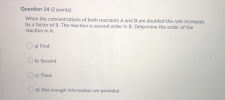 Question 14 (2 points) When the concentrations of both reactants A and B are doubled the rate increases by a factor of 8. The reaction is second order in B. Determine the order of the reaction in A. O a) First Ob) Second Oc) Third d) Not enough information are provided
A chemical reaction has reached equilibrium when A) the concentrations of reactants and products are equal. B) all...
 A chemical reaction has reached equilibrium when A) the concentrations of reactants and products are equal. B) all reactants have been converted to products. all products have been removed from the reaction mixture. D) the catalyst has been used up. E) the rate of the forward reaction equals the rate of the reverse reaction. 6) An equilibrium in which all the components are gases is a A) heterogeneous equilibrium. D) homogeneous B) liquid C) catalytic E) reversible 7) The equilibrium...
The concentrations of reactants and products for a chemical reaction can be calculated if the equillbrium...
 The concentrations of reactants and products for a chemical reaction can be calculated if the equillbrium constant for the reaction and the starting
39. A reaction in which A, B, and C react to form products is first order...
 39. A reaction in which A, B, and C react to form products is first order in A, second order in B, and zero order in C. a. Write a rate law for the reaction. b. What is the overall order of the reaction? c. By what factor does the reaction rate change if [A] is doubled (and the other reactant concentrations are held constant)? d. By what factor does the reaction rate change if [B] is doubled (and the...
For the reaction A+B+C→D+E, the initial reaction rate was measured for various initial concentrations of reactants....
For the reaction A+B+C→D+E, the initial reaction rate was measured for various initial concentrations of reactants. What is the reaction order with respect to B? Also, how do you find the value of the rate constant k for this reaction? Trial [A] (M) [B] (M) [C] (M) Initial rate (M/s) 1 0.30 0.30 0.30 9.0×10⁻⁵ 2 0.30 0.30 0.90 2.7×10⁻⁴ 3 0.60 0.30 0.30 3.6×10⁻⁴ 4 0.60 0.60 0.30 3.6×10⁻⁴
 6. For the reaction: C2H4Br2 3 KI C2H4+2 KBr + KI3 Initial rate data at 60 "C are 0.500 0.500 1.50 1.80 7.20 1.80 0.269 1.08 0.807 The rate law is A) rate-kKI B) rate-C2H4Br2l G) rate KI2 D) rate- kKIIC2H4Br2] E) rate kIKIIC2H4Br2 7. Choose the INCORRECT answer. The rate of a chemical reaction: A) usually is increased when the concentration of one of the reactants is increased B) is dependent on temperature C) may be increased by certain...
 During a chemical reaction, what defines when the concentrations of the reactants and products reach a constant level? A) rate law B) rate constant C) equilibrium D) elementary process E) reversible reaction
 Question 14 (2 points) When the concentrations of both reactants A and B are doubled the rate increases by a factor of 8. The reaction is second order in B. Determine the order of the reaction in A. O a) First Ob) Second Oc) Third d) Not enough information are provided
 A chemical reaction has reached equilibrium when A) the concentrations of reactants and products are equal. B) all reactants have been converted to products. all products have been removed from the reaction mixture. D) the catalyst has been used up. E) the rate of the forward reaction equals the rate of the reverse reaction. 6) An equilibrium in which all the components are gases is a A) heterogeneous equilibrium. D) homogeneous B) liquid C) catalytic E) reversible 7) The equilibrium...
 The concentrations of reactants and products for a chemical reaction can be calculated if the equillbrium constant for the reaction and the starting
 39. A reaction in which A, B, and C react to form products is first order in A, second order in B, and zero order in C. a. Write a rate law for the reaction. b. What is the overall order of the reaction? c. By what factor does the reaction rate change if [A] is doubled (and the other reactant concentrations are held constant)? d. By what factor does the reaction rate change if [B] is doubled (and the...
Most questions answered within 3 hours.
-
Where is the error in this code sequence?
String s1 = "Hello";
String s2 = "ello";...
asked 11 months ago -
Financial data for Joel de Paris, Inc., for last year
follow:
Joel de Paris, Inc.
Balance...
asked 11 months ago -
Consider this reaction:
Al2(SO4)3 (aq)+ BaCl3
(aq) Al2Cl6 (aq)- +
3BaSO4(s) . What is the...
asked 11 months ago -
Suppose that Savneet is considering increasing her
recent random sample from 20 car rentals to 40...
asked 11 months ago -
Trucks arrive at an unloading terminal at an average rate of 120
per hour.
Trucks arrive...
asked 11 months ago -
Why are methanol and ethanol completely soluble in water while
octanol is not very little soluble....
asked 11 months ago -
A facilities manager at a university reads in a research report
that the mean amount of...
asked 11 months ago -
When the CuSO4 is rehydrated by adding water to the anhydrous
compound, is this an endothermic...
asked 11 months ago -
A ray of sunlight is passing from diamond into crown glass; the
angle of incidence is...
asked 11 months ago -
A block of mass 0.249 kg is placed on top of a light, vertical
spring of...
asked 11 months ago -
how do the kidneys compensate in the presences of acidosis
a) trigger hyperventilate
b) reserve acid...
asked 11 months ago -
Question 501 pts
The rental rate of capital to the firm increases. Which of the
following...
asked 11 months ago