
Homework Answers
Add Answer to:
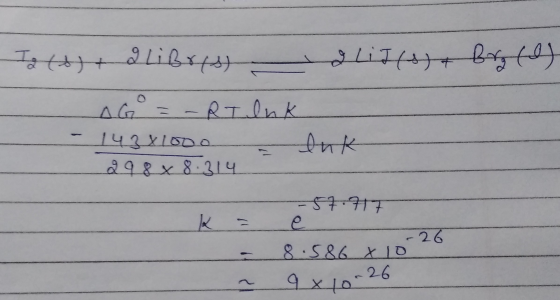
to t o 10. What is the equilibrium constant of the following reaction at 25°C? 1(s)...
The equilibrium constant for the reaction Agl(s) — Ag+ (aq) +1 (aq) is the solubility product...
 The equilibrium constant for the reaction Agl(s) — Ag+ (aq) +1 (aq) is the solubility product constant, Ksp = 8.3 x 10⁻¹⁷ at 25°C. Calculate AG for the reaction when [Ag+]=1.5 x 10⁻³ M and [Br] =1.5 x 10⁻² M. Is the reaction spontaneous or nonspontaneous at these concentrations? AG = 98 kJ/mol, spontaneous AG = 92 kJ/mol, nonspontaneous AG = -65 kJ/mol, spontaneous AG = 65 kJ/mol, nonspontaneous AG = -92 kJ/mol, spontaneous
What is the value of the equilibrium constant for the following reaction at 25 °C? For...
What is the value of the equilibrium constant for the following reaction at 25 °C? For H2CO3(aq), Ka1 is 4.3 x 10⁻⁷ and Ka2 is 5.6 x 10⁻¹¹. HCO3−(aq) + OH−(aq) ⇌ CO32−(aq) + H2O(ℓ)
1 What is the equilibrium constant for a reaction at temperature 89.1 °C if the equilibrium...
1 What is the equilibrium constant for a reaction at temperature 89.1 °C if the equilibrium constant at 22.6 °C is 49.93? For this reaction, ΔrH = -21.1 kJ mol-1 . 2 What is the ΔrG° for the following reaction (in kJ mol-1)? C6H12O6(s, glucose) + 6 O2 (g) ⇌6 CO2 (g)+ 6 H2O (l) 3 What is the ΔrG° for the following reaction (in kJ mol-1)? 2 NO2 (g) ⇌N2O4 (g) 4 What is the ΔrG for the following...
If the equilibrium constant (Keq) for a reaction (CaCO3(s) → Ca2+ + CO32-) at 25 °C...
If the equilibrium constant (Keq) for a reaction (CaCO3(s) → Ca2+ + CO32-) at 25 °C is 3.3*10-9, what is the ΔG° for the reaction (round your answer to the nearest kJ/mol)?
Consider the following reaction and its AGⓇ at 25 °C. Mg(s) + Ni2+(aq) — Mg2+(aq) +...
 Consider the following reaction and its AGⓇ at 25 °C. Mg(s) + Ni2+(aq) — Mg2+(aq) + Ni(s) AG° = -408.0 kJ/mol Calculate the standard cell potential, Ecell, for the reaction. Fo Celi Calculate the equilibrium constant, K, for the reaction.
Determine the equilibrium constant (Keq) at 25°C for the reaction?
Determine the equilibrium constant (Keq) at 25°C for the reaction?Cl2(g) + 2Br- (aq) -> Cl- (aq) + Br2(l)A. 1.5 × 10⁻¹⁰ B. 6.3 × 10⁹ C. 1.3 × 1041 D. 8.1 × 10⁴ E. 9.8
(a) For the reaction 2 A(aq) ⇋ 2 B(g) + C(g), the equilibrium constant is 5.35...
(a) For the reaction 2 A(aq) ⇋ 2 B(g) + C(g), the equilibrium constant is 5.35 at 25.0oC. If the concentrations of B(aq) and C(aq) are each 0.228 M, what concentration of A(aq) is required to have a ΔG value of -10.0 kJ/mol? (b)To a 88.8 mL aqueous solution of NaOH, we add an excess of Mn(NO3)2 and produce 0.074 g of Mn(OH)2(s). What was the original pH of the NaOH solution?
(a) For the reaction 2 A(aq) ⇋ 2 B(g) + C(g), the equilibrium constant is 5.04...
(a) For the reaction 2 A(aq) ⇋ 2 B(g) + C(g), the equilibrium constant is 5.04 at 25.0oC. If the concentrations of B(aq) and C(aq) are each 0.256 M, what concentration of A(aq) is required to have a ΔG value of -10.0 kJ/mol? (b) To a 88.8 mL aqueous solution of NaOH, we add an excess of Mn(NO3)2 and produce 0.076 g of Mn(OH)2(s). What was the original pH of the NaOH solution?
(a) For the reaction 2 A(aq) ⇋ 2 B(g) + C(g), the equilibrium constant is 5.51...
(a) For the reaction 2 A(aq) ⇋ 2 B(g) + C(g), the equilibrium constant is 5.51 at 25.0oC. If the concentrations of B(aq) and C(aq) are each 0.234 M, what concentration of A(aq) is required to have a ΔG value of -10.0 kJ/mol? (b) To a 88.8 mL aqueous solution of NaOH, we add an excess of Mn(NO3)2 and produce 0.076 g of Mn(OH)2(s). What was the original pH of the NaOH solution?
(a) For the reaction 2 A(aq) ⇋ 2 B(g) + C(g), the equilibrium constant is 5.96...
(a) For the reaction 2 A(aq) ⇋ 2 B(g) + C(g), the equilibrium constant is 5.96 at 25.0oC. If the concentrations of B(aq) and C(aq) are each 0.224 M, what concentration of A(aq) is required to have a ΔG value of -10.0 kJ/mol? (b) To a 88.8 mL aqueous solution of NaOH, we add an excess of Mn(NO3)2 and produce 0.088 g of Mn(OH)2(s). What was the original pH of the NaOH solution?
 The equilibrium constant for the reaction Agl(s) — Ag+ (aq) +1 (aq) is the solubility product constant, Ksp = 8.3 x 10⁻¹⁷ at 25°C. Calculate AG for the reaction when [Ag+]=1.5 x 10⁻³ M and [Br] =1.5 x 10⁻² M. Is the reaction spontaneous or nonspontaneous at these concentrations? AG = 98 kJ/mol, spontaneous AG = 92 kJ/mol, nonspontaneous AG = -65 kJ/mol, spontaneous AG = 65 kJ/mol, nonspontaneous AG = -92 kJ/mol, spontaneous
 Consider the following reaction and its AGⓇ at 25 °C. Mg(s) + Ni2+(aq) — Mg2+(aq) + Ni(s) AG° = -408.0 kJ/mol Calculate the standard cell potential, Ecell, for the reaction. Fo Celi Calculate the equilibrium constant, K, for the reaction.
Most questions answered within 3 hours.
-
Where is the error in this code sequence?
String s1 = "Hello";
String s2 = "ello";...
asked 11 months ago -
Financial data for Joel de Paris, Inc., for last year
follow:
Joel de Paris, Inc.
Balance...
asked 11 months ago -
Consider this reaction:
Al2(SO4)3 (aq)+ BaCl3
(aq) Al2Cl6 (aq)- +
3BaSO4(s) . What is the...
asked 11 months ago -
Suppose that Savneet is considering increasing her
recent random sample from 20 car rentals to 40...
asked 11 months ago -
Trucks arrive at an unloading terminal at an average rate of 120
per hour.
Trucks arrive...
asked 11 months ago -
Why are methanol and ethanol completely soluble in water while
octanol is not very little soluble....
asked 11 months ago -
A facilities manager at a university reads in a research report
that the mean amount of...
asked 11 months ago -
When the CuSO4 is rehydrated by adding water to the anhydrous
compound, is this an endothermic...
asked 11 months ago -
A ray of sunlight is passing from diamond into crown glass; the
angle of incidence is...
asked 11 months ago -
A block of mass 0.249 kg is placed on top of a light, vertical
spring of...
asked 11 months ago -
how do the kidneys compensate in the presences of acidosis
a) trigger hyperventilate
b) reserve acid...
asked 11 months ago -
Question 501 pts
The rental rate of capital to the firm increases. Which of the
following...
asked 11 months ago