
Homework Answers
Add Answer to:
Consider the solubilities of a particular solute at two different temperatures. Temperature (°C) 20.0 30.0 Solubility...
Consider the solubilities of a particular solute at two different temperatures. Temperature (∘C) Solubility (g/100 g...
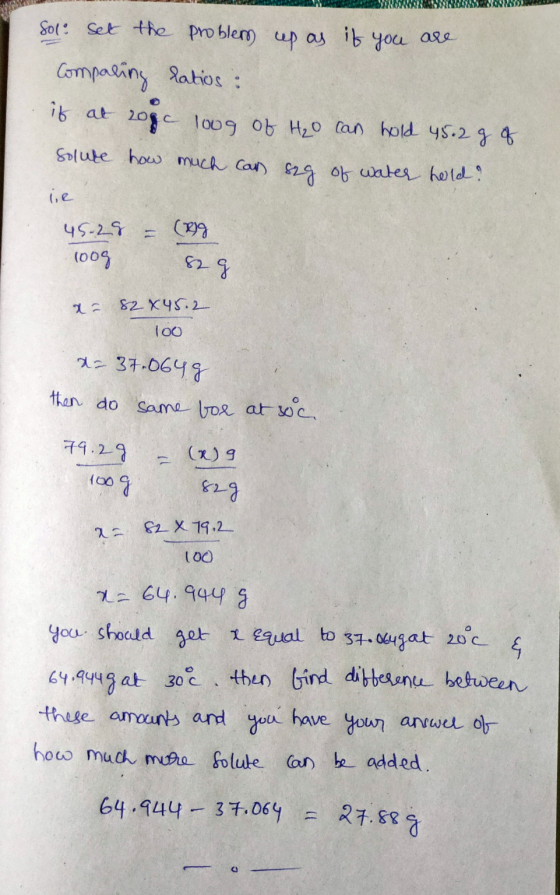
Consider the solubilities of a particular solute at two different temperatures. Temperature (∘C) Solubility (g/100 g H2O) 20.0 25.4 30.0 68.9 Suppose a saturated solution of this solute was made using 66.0 g H2O at 20.0 °C. How much more solute can be added if the temperature is increased to 30.0 ∘C? mass: g
Here are the solubilities of a particular solute at two different temperatures. Temp Solubility (C) ...
Here are the solubilities of a particular solute at two different temperatures. Temp Solubility (C) (g/100gH2O) 20.0 43.4 30.0 72.4 Suppose that you have made a saturated solution of this solute using 46.0 g of water at 20.0 °C. How much more solute can you add if the temperature is increased to 30.0 °C?
Here are the solubilities of a particular solute at two different temperatures. Temperature (Celsius) Solubility (g/100...
Here are the solubilities of a particular solute at two different temperatures. Temperature (Celsius) Solubility (g/100 g H20) 20 40.9 30 83.5 Suppose that you have made a saturated solution of this solute using 75.0 g of water at 20.0 °C. How much more solute can you add if the temperature is increased to 30.0 °C?
Suppose a saturated solution of this solute was made using 64.064.0 g of water at 20.0...
Suppose a saturated solution of this solute was made using 64.064.0 g of water at 20.0 °C. How much more solute can be added if the temperature is increased to 30.0 °C?
Temperature (∘C) Solubility (g/100 g H2O) 20 11.0 30 23.0 You have prepared a saturated solution...
Temperature (∘C) Solubility (g/100 g H2O) 20 11.0 30 23.0 You have prepared a saturated solution of X at 20∘C using 27.0 g of water. How much more solute can be dissolved if the temperature is increased to 30∘C? Express your answer with the appropriate units.
Solubility (g solute in 100 mL H2O) OP 3 According to your data, is the graph...
 Solubility (g solute in 100 mL H2O) OP 3 According to your data, is the graph below consistent with the relative solubilities of NaCl and KNO3 at different temperatures? Explain your answer. 100 90 80 70 60 KNO3 50 40 30- NaCl 20 10 0 10 20 30 40 50 60 70 80 90 100 Temperature (°C)
Saturated, Unsaturated & Supersaturated Solutions Solution, in which the concentration of solute is that determined by...
 Saturated, Unsaturated & Supersaturated Solutions Solution, in which the concentration of solute is that determined by its solubility (at given temperature) is called SATURATED solution. One cannot add more solute to such a solution. We also say that a saturated solution is in equilibrium with pure solute: If we add solid Nacl to an already saturated solution of NaCl, that solid remains in equilibrium with dissolved Naci. Solution containing less solute than would be in the saturated solution, is UNSATURATED...
Please solve A B and C. Show each step to the solutions. I attached the answers...
 Please solve A B and C. Show each step to the solutions. I
attached the answers for B but am not sure how to get to these
solutions.
please solve A B and C. Show each step to the solutions 6.82. A salt A is soluble in a solvent S. A conductivity meter used to measure the solute concentration in A-S solutions is calibrated by dissolving a known quantity of A in S, adding more S to bring the solution...
Please solve A B and C. Show each step to the solutions. I
attached the answers for B but am not sure how to get to these
solutions.
please solve A B and C. Show each step to the solutions 6.82. A salt A is soluble in a solvent S. A conductivity meter used to measure the solute concentration in A-S solutions is calibrated by dissolving a known quantity of A in S, adding more S to bring the solution...
please help me answer question 1 to 3, thank you Chapter 9, Solutions, Review & Extra Credit. 2 Points for each XC c...
 please help me answer question 1 to 3,
thank you
Chapter 9, Solutions, Review & Extra Credit. 2 Points for each XC correct answer; 6 points total, max. Partial Credit given. Suggestions...work in teams [it will improve the learning experience] 1. Solutions-A solution forms when a solute (the smaller quantity) dissolves in a solvent (the larger quantity). In a solution, the particles of solute are evenly distributed in the solvent. A solute may be a gas, liquid or solid. A...
please help me answer question 1 to 3,
thank you
Chapter 9, Solutions, Review & Extra Credit. 2 Points for each XC correct answer; 6 points total, max. Partial Credit given. Suggestions...work in teams [it will improve the learning experience] 1. Solutions-A solution forms when a solute (the smaller quantity) dissolves in a solvent (the larger quantity). In a solution, the particles of solute are evenly distributed in the solvent. A solute may be a gas, liquid or solid. A...
9) An increase in the temperature of a solution usually A) increases the boiling point. B)...
 9) An increase in the temperature of a solution usually A) increases the boiling point. B) increases the solubility of a gas in the solution. C) increases the solubility of a solid solute in the solution. D) decreases the solubility of a solid solute in the solution. E) decreases the solubility of a liquid solute in the solution. 10) The solubility of Kl is 50 g in 100 g of H20 at 20°C. If 110 grams of Kl are added...
 Solubility (g solute in 100 mL H2O) OP 3 According to your data, is the graph below consistent with the relative solubilities of NaCl and KNO3 at different temperatures? Explain your answer. 100 90 80 70 60 KNO3 50 40 30- NaCl 20 10 0 10 20 30 40 50 60 70 80 90 100 Temperature (°C)
 Saturated, Unsaturated & Supersaturated Solutions Solution, in which the concentration of solute is that determined by its solubility (at given temperature) is called SATURATED solution. One cannot add more solute to such a solution. We also say that a saturated solution is in equilibrium with pure solute: If we add solid Nacl to an already saturated solution of NaCl, that solid remains in equilibrium with dissolved Naci. Solution containing less solute than would be in the saturated solution, is UNSATURATED...
 Please solve A B and C. Show each step to the solutions. I
attached the answers for B but am not sure how to get to these
solutions.
please solve A B and C. Show each step to the solutions 6.82. A salt A is soluble in a solvent S. A conductivity meter used to measure the solute concentration in A-S solutions is calibrated by dissolving a known quantity of A in S, adding more S to bring the solution...
Please solve A B and C. Show each step to the solutions. I
attached the answers for B but am not sure how to get to these
solutions.
please solve A B and C. Show each step to the solutions 6.82. A salt A is soluble in a solvent S. A conductivity meter used to measure the solute concentration in A-S solutions is calibrated by dissolving a known quantity of A in S, adding more S to bring the solution...
 please help me answer question 1 to 3,
thank you
Chapter 9, Solutions, Review & Extra Credit. 2 Points for each XC correct answer; 6 points total, max. Partial Credit given. Suggestions...work in teams [it will improve the learning experience] 1. Solutions-A solution forms when a solute (the smaller quantity) dissolves in a solvent (the larger quantity). In a solution, the particles of solute are evenly distributed in the solvent. A solute may be a gas, liquid or solid. A...
please help me answer question 1 to 3,
thank you
Chapter 9, Solutions, Review & Extra Credit. 2 Points for each XC correct answer; 6 points total, max. Partial Credit given. Suggestions...work in teams [it will improve the learning experience] 1. Solutions-A solution forms when a solute (the smaller quantity) dissolves in a solvent (the larger quantity). In a solution, the particles of solute are evenly distributed in the solvent. A solute may be a gas, liquid or solid. A...
 9) An increase in the temperature of a solution usually A) increases the boiling point. B) increases the solubility of a gas in the solution. C) increases the solubility of a solid solute in the solution. D) decreases the solubility of a solid solute in the solution. E) decreases the solubility of a liquid solute in the solution. 10) The solubility of Kl is 50 g in 100 g of H20 at 20°C. If 110 grams of Kl are added...
Most questions answered within 3 hours.
-
Where is the error in this code sequence?
String s1 = "Hello";
String s2 = "ello";...
asked 10 months ago -
Financial data for Joel de Paris, Inc., for last year
follow:
Joel de Paris, Inc.
Balance...
asked 10 months ago -
Consider this reaction:
Al2(SO4)3 (aq)+ BaCl3
(aq) Al2Cl6 (aq)- +
3BaSO4(s) . What is the...
asked 10 months ago -
Suppose that Savneet is considering increasing her
recent random sample from 20 car rentals to 40...
asked 10 months ago -
Trucks arrive at an unloading terminal at an average rate of 120
per hour.
Trucks arrive...
asked 10 months ago -
Why are methanol and ethanol completely soluble in water while
octanol is not very little soluble....
asked 10 months ago -
A facilities manager at a university reads in a research report
that the mean amount of...
asked 10 months ago -
When the CuSO4 is rehydrated by adding water to the anhydrous
compound, is this an endothermic...
asked 10 months ago -
A ray of sunlight is passing from diamond into crown glass; the
angle of incidence is...
asked 10 months ago -
A block of mass 0.249 kg is placed on top of a light, vertical
spring of...
asked 10 months ago -
how do the kidneys compensate in the presences of acidosis
a) trigger hyperventilate
b) reserve acid...
asked 10 months ago -
Question 501 pts
The rental rate of capital to the firm increases. Which of the
following...
asked 10 months ago