
Homework Answers
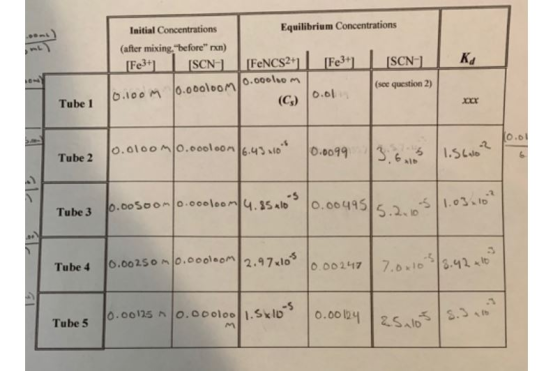
![I am using given values (information) Fest & Son - FeSONT net imic equation - equilibrium constant k = [product] Reactant -](http://img.homeworklib.com/questions/0f46b920-d0af-11eb-a9a1-eb817d8fa017.png?x-oss-process=image/resize,w_560)

Add Answer to:
I need help with the formation constant (Kf) in question 3 at
the bottom. anything else...
equilibrium help!! What is the equilibrium constant for the reaction CO(g) + 3 H2(g) - CH4(g)...
 equilibrium help!!
What is the equilibrium constant for the reaction CO(g) + 3 H2(g) - CH4(g) + H2O(g) if at 20 °C the equilibrium molar concentrations are [CO] -0.613, [H2] = 1.839, (CH4) = 0.387, and [H20) - 0.387? Format Β Ι Ο The reaction for the formation of the diamine-silver ion is as follows: Ag (aq) + 2NH3(aq) + Ag(NH3)2(aq) a. Write the equilibrium constant expression for this reaction. for the above b. An experiment was carried out to...
equilibrium help!!
What is the equilibrium constant for the reaction CO(g) + 3 H2(g) - CH4(g) + H2O(g) if at 20 °C the equilibrium molar concentrations are [CO] -0.613, [H2] = 1.839, (CH4) = 0.387, and [H20) - 0.387? Format Β Ι Ο The reaction for the formation of the diamine-silver ion is as follows: Ag (aq) + 2NH3(aq) + Ag(NH3)2(aq) a. Write the equilibrium constant expression for this reaction. for the above b. An experiment was carried out to...
please correct me If I did anything wrong. im very confused on this. • Determining k...
 please correct me If I did anything wrong. im very confused on
this.
• Determining k in Beer's Law 2. Determining the equilibrium constant Test Tube No. Absorbance Test Tube No. Absorbance 0,060 이79 0.253 0319 0.400 0.120 0.268 0.361 0.461 0.695 Post Laboratory Questions 1. Complete the following table and calculate k-value for the Beer's Law. All concentrations should be in M. [Fe(SCN)2) Absorbance CA Test Tube No. Diluted Fe(NO3)2 (mL) 0 . 2 3 4 s Reference 1.0...
please correct me If I did anything wrong. im very confused on
this.
• Determining k in Beer's Law 2. Determining the equilibrium constant Test Tube No. Absorbance Test Tube No. Absorbance 0,060 이79 0.253 0319 0.400 0.120 0.268 0.361 0.461 0.695 Post Laboratory Questions 1. Complete the following table and calculate k-value for the Beer's Law. All concentrations should be in M. [Fe(SCN)2) Absorbance CA Test Tube No. Diluted Fe(NO3)2 (mL) 0 . 2 3 4 s Reference 1.0...
need help with all parts of question 2. thank you :) equivalence points and the pH...
 need help with all parts of question 2. thank you :)
equivalence points and the pH at the half equivalence points for the three titration regions. Question 2 Part A Given the Ksp = 2.0 x 10⁻²⁹ for the sparingly soluble salt, calcium phosphate (Ca3(PO4)2), determine the molar solubility of the salt in a solution that is 0.20 M in calcium perchlorate, Ca(C104)2. Part B The cation, Co2+, is able to form a complex ion, (Co(SCN)4] 2-, with the thiocyanate...
need help with all parts of question 2. thank you :)
equivalence points and the pH at the half equivalence points for the three titration regions. Question 2 Part A Given the Ksp = 2.0 x 10⁻²⁹ for the sparingly soluble salt, calcium phosphate (Ca3(PO4)2), determine the molar solubility of the salt in a solution that is 0.20 M in calcium perchlorate, Ca(C104)2. Part B The cation, Co2+, is able to form a complex ion, (Co(SCN)4] 2-, with the thiocyanate...
Assuming 5mL of NaCl solution is used, what will be equilibrium constant? Please provide explanation for steps. Than...
 Assuming 5mL of NaCl solution is used, what will be
equilibrium constant? Please provide explanation for steps.
Thank you!
1. Using a graduated cylinder to measure volumes, combine 3.0 mL of 0.10 M AgNO, with 3.0 ml of 1.0 M NH3 in a 15 x 150 mm test tube. Swirl to combine and set aside. 2. Prepare 0.02 M NaCI. Pour 0.1 M NaCl into a graduated cylinder to the 2-mL mark. Record the exact volume to two decimal places....
Assuming 5mL of NaCl solution is used, what will be
equilibrium constant? Please provide explanation for steps.
Thank you!
1. Using a graduated cylinder to measure volumes, combine 3.0 mL of 0.10 M AgNO, with 3.0 ml of 1.0 M NH3 in a 15 x 150 mm test tube. Swirl to combine and set aside. 2. Prepare 0.02 M NaCI. Pour 0.1 M NaCl into a graduated cylinder to the 2-mL mark. Record the exact volume to two decimal places....
Can't figure out the concentration of the complex of solns. 10, 11, 12, 13, & 14. Modern...
 Can't figure out the concentration of the complex of
solns. 10, 11, 12, 13, & 14.
Modern Experimental Chemistry Chemistry 153 The Iron(III) Thiocyanate Complex Purpose of the Experiment To determine the chemical formula of a complex ion and measure its formation equilibrium constant Equipment Spectro Vis spectrophotometer and LabQuest, cuvette, 25-mL buret (3), ring stand, buret clamp (2), 50-mL beaker (3), small plastic beakers Reagents SCN, as KSCN, 0.00200 M solution Fe; as Fe(NO), 0.00200 M solution and a...
Can't figure out the concentration of the complex of
solns. 10, 11, 12, 13, & 14.
Modern Experimental Chemistry Chemistry 153 The Iron(III) Thiocyanate Complex Purpose of the Experiment To determine the chemical formula of a complex ion and measure its formation equilibrium constant Equipment Spectro Vis spectrophotometer and LabQuest, cuvette, 25-mL buret (3), ring stand, buret clamp (2), 50-mL beaker (3), small plastic beakers Reagents SCN, as KSCN, 0.00200 M solution Fe; as Fe(NO), 0.00200 M solution and a...
Introduction to Equilibrium Lab report Please help answering the question #2 (a,b,c,d) Thanks! ...
 Introduction to Equilibrium Lab report
Please help answering the question #2 (a,b,c,d)
Thanks!
Question
Procedure
Notebook
Complex ion equilibrium 1. Formation of the complex ion: 38 a) What evidence was there that a new chemical substance had formed? b) How did the reaction change the initial iron and thiocyanate concentrations? Would the reacon av tken place ifthe proportions hadtbenhioneric raior? 2. Adding and removing reactants: a) What effecet did adding the reactants (Fe' or SCN-) have on he briumcmposition? evidence...
Introduction to Equilibrium Lab report
Please help answering the question #2 (a,b,c,d)
Thanks!
Question
Procedure
Notebook
Complex ion equilibrium 1. Formation of the complex ion: 38 a) What evidence was there that a new chemical substance had formed? b) How did the reaction change the initial iron and thiocyanate concentrations? Would the reacon av tken place ifthe proportions hadtbenhioneric raior? 2. Adding and removing reactants: a) What effecet did adding the reactants (Fe' or SCN-) have on he briumcmposition? evidence...
Could you please help me with calculating the initial concentrations, and please tell me if I...
 Could you please help me with calculating the initial
concentrations, and please tell me if I did table 4 correctly. I
would like to see one or two calculations for the second bullet so
I can figure out how to do them all. Thank you!
13. Use a 3.00 mL pipette to deliver 0.0020 M Fe(NO3)3 solution and burettes to deliver the required volumes of KSCN solution and DI water into clean and dry test tubes. Note that this set...
Could you please help me with calculating the initial
concentrations, and please tell me if I did table 4 correctly. I
would like to see one or two calculations for the second bullet so
I can figure out how to do them all. Thank you!
13. Use a 3.00 mL pipette to deliver 0.0020 M Fe(NO3)3 solution and burettes to deliver the required volumes of KSCN solution and DI water into clean and dry test tubes. Note that this set...
pls help step by step. Anyone of them would be appreciated as i sm confused with...
 pls help step by step. Anyone of them would be
appreciated as i sm confused with all three.
1. Iron (III) hydroxide, Fe(OH)3, is measured to have Ksp 4.0x10-38 Calculate the mass of iron (III) hydroxide dissolved in 1.00L of a saturated Fe(OH)3 solution. a. b. In a solution of ethylene diamine tetraacetic acid (EDTA4), Fe3+ can form a complex ion, Fe(EDTA)1 with a formation constant of Kr 1.7x1024, What is the equilibrium constant for the solvation of solid Fe(OH)3...
pls help step by step. Anyone of them would be
appreciated as i sm confused with all three.
1. Iron (III) hydroxide, Fe(OH)3, is measured to have Ksp 4.0x10-38 Calculate the mass of iron (III) hydroxide dissolved in 1.00L of a saturated Fe(OH)3 solution. a. b. In a solution of ethylene diamine tetraacetic acid (EDTA4), Fe3+ can form a complex ion, Fe(EDTA)1 with a formation constant of Kr 1.7x1024, What is the equilibrium constant for the solvation of solid Fe(OH)3...
i need help with this lab please. can i get someone to answer the entire thing....
 i need help with this lab please. can i get someone to answer
the entire thing. thank you
Instructor Equilibria of Coordination Compounds OBSERVATIONS AND DATA 1. The formation of complex ions with ammonia The net ionic equation for the reaction of excess Cuso, with NH, is 24 Cu2+ + 4NH3 [cu (NH3)4] The predicted effect on the reaction above of adding excess NH, (based on Le Châtelier's principle) is The reaction will shift to the night and product formation...
i need help with this lab please. can i get someone to answer
the entire thing. thank you
Instructor Equilibria of Coordination Compounds OBSERVATIONS AND DATA 1. The formation of complex ions with ammonia The net ionic equation for the reaction of excess Cuso, with NH, is 24 Cu2+ + 4NH3 [cu (NH3)4] The predicted effect on the reaction above of adding excess NH, (based on Le Châtelier's principle) is The reaction will shift to the night and product formation...
please help asap and the values are from the procedure there is no additional info QUESTION. PROCEDURE 1. Obtai...
 please help asap and the values are from the procedure there is no
additional info
QUESTION.
PROCEDURE 1. Obtain seven spectrophotometer tubes, three 5 mL pipets and seven 125 mL Erlenmeyer flasks. One for the blank and six sample test tubes. Make sure to label the test tubes with appropriated calculated concentration. Label one flask as NaSCN 2. Pipet 5 mL of 0.00020 M NaSCN into Erlenmeyer flask #1. Pipet 5 mL of 0.20 M Fe(NO3)3 into Erlenmeyer flask #1....
please help asap and the values are from the procedure there is no
additional info
QUESTION.
PROCEDURE 1. Obtain seven spectrophotometer tubes, three 5 mL pipets and seven 125 mL Erlenmeyer flasks. One for the blank and six sample test tubes. Make sure to label the test tubes with appropriated calculated concentration. Label one flask as NaSCN 2. Pipet 5 mL of 0.00020 M NaSCN into Erlenmeyer flask #1. Pipet 5 mL of 0.20 M Fe(NO3)3 into Erlenmeyer flask #1....
 equilibrium help!!
What is the equilibrium constant for the reaction CO(g) + 3 H2(g) - CH4(g) + H2O(g) if at 20 °C the equilibrium molar concentrations are [CO] -0.613, [H2] = 1.839, (CH4) = 0.387, and [H20) - 0.387? Format Β Ι Ο The reaction for the formation of the diamine-silver ion is as follows: Ag (aq) + 2NH3(aq) + Ag(NH3)2(aq) a. Write the equilibrium constant expression for this reaction. for the above b. An experiment was carried out to...
equilibrium help!!
What is the equilibrium constant for the reaction CO(g) + 3 H2(g) - CH4(g) + H2O(g) if at 20 °C the equilibrium molar concentrations are [CO] -0.613, [H2] = 1.839, (CH4) = 0.387, and [H20) - 0.387? Format Β Ι Ο The reaction for the formation of the diamine-silver ion is as follows: Ag (aq) + 2NH3(aq) + Ag(NH3)2(aq) a. Write the equilibrium constant expression for this reaction. for the above b. An experiment was carried out to...
 please correct me If I did anything wrong. im very confused on
this.
• Determining k in Beer's Law 2. Determining the equilibrium constant Test Tube No. Absorbance Test Tube No. Absorbance 0,060 이79 0.253 0319 0.400 0.120 0.268 0.361 0.461 0.695 Post Laboratory Questions 1. Complete the following table and calculate k-value for the Beer's Law. All concentrations should be in M. [Fe(SCN)2) Absorbance CA Test Tube No. Diluted Fe(NO3)2 (mL) 0 . 2 3 4 s Reference 1.0...
please correct me If I did anything wrong. im very confused on
this.
• Determining k in Beer's Law 2. Determining the equilibrium constant Test Tube No. Absorbance Test Tube No. Absorbance 0,060 이79 0.253 0319 0.400 0.120 0.268 0.361 0.461 0.695 Post Laboratory Questions 1. Complete the following table and calculate k-value for the Beer's Law. All concentrations should be in M. [Fe(SCN)2) Absorbance CA Test Tube No. Diluted Fe(NO3)2 (mL) 0 . 2 3 4 s Reference 1.0...
 need help with all parts of question 2. thank you :)
equivalence points and the pH at the half equivalence points for the three titration regions. Question 2 Part A Given the Ksp = 2.0 x 10⁻²⁹ for the sparingly soluble salt, calcium phosphate (Ca3(PO4)2), determine the molar solubility of the salt in a solution that is 0.20 M in calcium perchlorate, Ca(C104)2. Part B The cation, Co2+, is able to form a complex ion, (Co(SCN)4] 2-, with the thiocyanate...
need help with all parts of question 2. thank you :)
equivalence points and the pH at the half equivalence points for the three titration regions. Question 2 Part A Given the Ksp = 2.0 x 10⁻²⁹ for the sparingly soluble salt, calcium phosphate (Ca3(PO4)2), determine the molar solubility of the salt in a solution that is 0.20 M in calcium perchlorate, Ca(C104)2. Part B The cation, Co2+, is able to form a complex ion, (Co(SCN)4] 2-, with the thiocyanate...
 Assuming 5mL of NaCl solution is used, what will be
equilibrium constant? Please provide explanation for steps.
Thank you!
1. Using a graduated cylinder to measure volumes, combine 3.0 mL of 0.10 M AgNO, with 3.0 ml of 1.0 M NH3 in a 15 x 150 mm test tube. Swirl to combine and set aside. 2. Prepare 0.02 M NaCI. Pour 0.1 M NaCl into a graduated cylinder to the 2-mL mark. Record the exact volume to two decimal places....
Assuming 5mL of NaCl solution is used, what will be
equilibrium constant? Please provide explanation for steps.
Thank you!
1. Using a graduated cylinder to measure volumes, combine 3.0 mL of 0.10 M AgNO, with 3.0 ml of 1.0 M NH3 in a 15 x 150 mm test tube. Swirl to combine and set aside. 2. Prepare 0.02 M NaCI. Pour 0.1 M NaCl into a graduated cylinder to the 2-mL mark. Record the exact volume to two decimal places....
 Can't figure out the concentration of the complex of
solns. 10, 11, 12, 13, & 14.
Modern Experimental Chemistry Chemistry 153 The Iron(III) Thiocyanate Complex Purpose of the Experiment To determine the chemical formula of a complex ion and measure its formation equilibrium constant Equipment Spectro Vis spectrophotometer and LabQuest, cuvette, 25-mL buret (3), ring stand, buret clamp (2), 50-mL beaker (3), small plastic beakers Reagents SCN, as KSCN, 0.00200 M solution Fe; as Fe(NO), 0.00200 M solution and a...
Can't figure out the concentration of the complex of
solns. 10, 11, 12, 13, & 14.
Modern Experimental Chemistry Chemistry 153 The Iron(III) Thiocyanate Complex Purpose of the Experiment To determine the chemical formula of a complex ion and measure its formation equilibrium constant Equipment Spectro Vis spectrophotometer and LabQuest, cuvette, 25-mL buret (3), ring stand, buret clamp (2), 50-mL beaker (3), small plastic beakers Reagents SCN, as KSCN, 0.00200 M solution Fe; as Fe(NO), 0.00200 M solution and a...
 Introduction to Equilibrium Lab report
Please help answering the question #2 (a,b,c,d)
Thanks!
Question
Procedure
Notebook
Complex ion equilibrium 1. Formation of the complex ion: 38 a) What evidence was there that a new chemical substance had formed? b) How did the reaction change the initial iron and thiocyanate concentrations? Would the reacon av tken place ifthe proportions hadtbenhioneric raior? 2. Adding and removing reactants: a) What effecet did adding the reactants (Fe' or SCN-) have on he briumcmposition? evidence...
Introduction to Equilibrium Lab report
Please help answering the question #2 (a,b,c,d)
Thanks!
Question
Procedure
Notebook
Complex ion equilibrium 1. Formation of the complex ion: 38 a) What evidence was there that a new chemical substance had formed? b) How did the reaction change the initial iron and thiocyanate concentrations? Would the reacon av tken place ifthe proportions hadtbenhioneric raior? 2. Adding and removing reactants: a) What effecet did adding the reactants (Fe' or SCN-) have on he briumcmposition? evidence...
 Could you please help me with calculating the initial
concentrations, and please tell me if I did table 4 correctly. I
would like to see one or two calculations for the second bullet so
I can figure out how to do them all. Thank you!
13. Use a 3.00 mL pipette to deliver 0.0020 M Fe(NO3)3 solution and burettes to deliver the required volumes of KSCN solution and DI water into clean and dry test tubes. Note that this set...
Could you please help me with calculating the initial
concentrations, and please tell me if I did table 4 correctly. I
would like to see one or two calculations for the second bullet so
I can figure out how to do them all. Thank you!
13. Use a 3.00 mL pipette to deliver 0.0020 M Fe(NO3)3 solution and burettes to deliver the required volumes of KSCN solution and DI water into clean and dry test tubes. Note that this set...
 pls help step by step. Anyone of them would be
appreciated as i sm confused with all three.
1. Iron (III) hydroxide, Fe(OH)3, is measured to have Ksp 4.0x10-38 Calculate the mass of iron (III) hydroxide dissolved in 1.00L of a saturated Fe(OH)3 solution. a. b. In a solution of ethylene diamine tetraacetic acid (EDTA4), Fe3+ can form a complex ion, Fe(EDTA)1 with a formation constant of Kr 1.7x1024, What is the equilibrium constant for the solvation of solid Fe(OH)3...
pls help step by step. Anyone of them would be
appreciated as i sm confused with all three.
1. Iron (III) hydroxide, Fe(OH)3, is measured to have Ksp 4.0x10-38 Calculate the mass of iron (III) hydroxide dissolved in 1.00L of a saturated Fe(OH)3 solution. a. b. In a solution of ethylene diamine tetraacetic acid (EDTA4), Fe3+ can form a complex ion, Fe(EDTA)1 with a formation constant of Kr 1.7x1024, What is the equilibrium constant for the solvation of solid Fe(OH)3...
 i need help with this lab please. can i get someone to answer
the entire thing. thank you
Instructor Equilibria of Coordination Compounds OBSERVATIONS AND DATA 1. The formation of complex ions with ammonia The net ionic equation for the reaction of excess Cuso, with NH, is 24 Cu2+ + 4NH3 [cu (NH3)4] The predicted effect on the reaction above of adding excess NH, (based on Le Châtelier's principle) is The reaction will shift to the night and product formation...
i need help with this lab please. can i get someone to answer
the entire thing. thank you
Instructor Equilibria of Coordination Compounds OBSERVATIONS AND DATA 1. The formation of complex ions with ammonia The net ionic equation for the reaction of excess Cuso, with NH, is 24 Cu2+ + 4NH3 [cu (NH3)4] The predicted effect on the reaction above of adding excess NH, (based on Le Châtelier's principle) is The reaction will shift to the night and product formation...
 please help asap and the values are from the procedure there is no
additional info
QUESTION.
PROCEDURE 1. Obtain seven spectrophotometer tubes, three 5 mL pipets and seven 125 mL Erlenmeyer flasks. One for the blank and six sample test tubes. Make sure to label the test tubes with appropriated calculated concentration. Label one flask as NaSCN 2. Pipet 5 mL of 0.00020 M NaSCN into Erlenmeyer flask #1. Pipet 5 mL of 0.20 M Fe(NO3)3 into Erlenmeyer flask #1....
please help asap and the values are from the procedure there is no
additional info
QUESTION.
PROCEDURE 1. Obtain seven spectrophotometer tubes, three 5 mL pipets and seven 125 mL Erlenmeyer flasks. One for the blank and six sample test tubes. Make sure to label the test tubes with appropriated calculated concentration. Label one flask as NaSCN 2. Pipet 5 mL of 0.00020 M NaSCN into Erlenmeyer flask #1. Pipet 5 mL of 0.20 M Fe(NO3)3 into Erlenmeyer flask #1....
Most questions answered within 3 hours.
-
Where is the error in this code sequence?
String s1 = "Hello";
String s2 = "ello";...
asked 10 months ago -
Financial data for Joel de Paris, Inc., for last year
follow:
Joel de Paris, Inc.
Balance...
asked 10 months ago -
Consider this reaction:
Al2(SO4)3 (aq)+ BaCl3
(aq) Al2Cl6 (aq)- +
3BaSO4(s) . What is the...
asked 10 months ago -
Suppose that Savneet is considering increasing her
recent random sample from 20 car rentals to 40...
asked 10 months ago -
Trucks arrive at an unloading terminal at an average rate of 120
per hour.
Trucks arrive...
asked 10 months ago -
Why are methanol and ethanol completely soluble in water while
octanol is not very little soluble....
asked 10 months ago -
A facilities manager at a university reads in a research report
that the mean amount of...
asked 10 months ago -
When the CuSO4 is rehydrated by adding water to the anhydrous
compound, is this an endothermic...
asked 10 months ago -
A ray of sunlight is passing from diamond into crown glass; the
angle of incidence is...
asked 10 months ago -
A block of mass 0.249 kg is placed on top of a light, vertical
spring of...
asked 10 months ago -
how do the kidneys compensate in the presences of acidosis
a) trigger hyperventilate
b) reserve acid...
asked 10 months ago -
Question 501 pts
The rental rate of capital to the firm increases. Which of the
following...
asked 10 months ago