
Homework Answers
Hope it helps...pls do upvote
Add Answer to:
A student studies the reaction: A - Products. Using the table of initial concentrations and rates...
A student studies the reaction: A Products. Using the table of initial concentrations and rates below,...
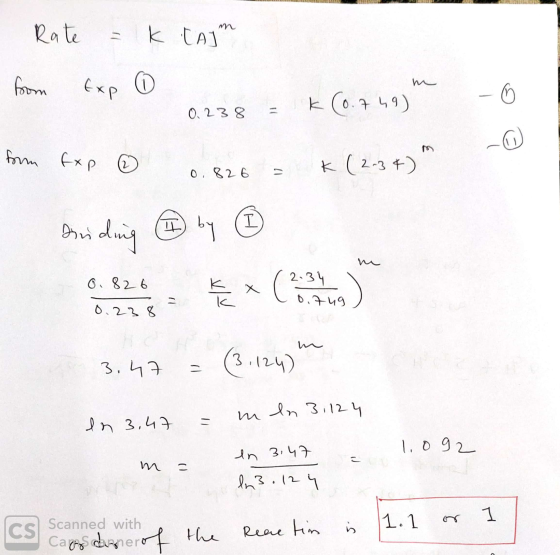
 A student studies the reaction: A Products. Using the table of initial concentrations and rates below, find the order of the reaction with respect to reactant A. [Alinitial Rate Experiment 1 0.749 M 0.238 M.s Experiment 2 2.34 M 0.826 Mos
The reaction X + Y → products was studied using the method of initial rates. The...
The reaction X + Y → products was studied using the method of initial rates. The initial rate of consumption of X was measured in three different experiments. Data are provided below. Expt [X]0 (in mol L−1) [Y]0 (in mol L−1) Initial Rate (in mol L−1 min−1) 1 0.500 0.500 0.4338 2 1.25 0.500 1.084 3 0.500 0.750 0.9759 What is the order of the reaction with respect to X? (Enter an integer.) What is the order of the reaction...
Rate laws are commonly determined using a table of various initial concentrations and initial rates. The...
Rate laws are commonly determined using a table of various initial concentrations and initial rates. The experimental data measured for reaction A --> 2 B + C at 25 ◦C are listed in the following table. [A]0, (M) r (M/s) 0.45, 6.165 × 10⁻³ 0.9, 1.233 × 10⁻² 1.8, 2.466 × 10⁻² 3.6 ? (a) Determine the order of the reaction. Explain why. (b) Determine the rate constant (including the unit). (c) Determine the missing rate in the table above....
1. Given the table of initial rates below, solve the rate law for the reaction: A...
1. Given the table of initial rates below, solve the rate law for the reaction: A + B + C →→ D + E Trial [A], M [B], M [C], M Initial Rate, M/s 1 0.15 0.10 0.25 0.018 2 0.30 0.10 0.25 0.018 3 0.15 0.10 0.50 0.036 4 0.30 0.20 0.25 0.072 b. What is the order with respect to B? d. What is the value of the rate constant? e. What are the units of the rate...
For the reaction A+B+C→D+E, the initial reaction rate was measured for various initial concentrations of reactants....
For the reaction A+B+C→D+E, the initial reaction rate was measured for various initial concentrations of reactants. The following data were collected: Trial [A] (M) [B] (M) [C] (M) Initial rate (M/s) 1 0.40 0.40 0.40 1.2×10⁻⁴ 2 0.40 0.40 1.20 3.6×10⁻⁴ 3 0.80 0.40 0.40 4.8×10⁻⁴ 4 0.80 0.80 0.40 4.8×10⁻⁴ Rate law equation The rate of a chemical reaction depends on the concentrations of the reactants. For the general reaction between A and B, aA+bB⇌cC+dD The dependence of the...
The initial rates of reaction between an organic bromide, Y, and hydroxide ion, were measured as...
 The initial rates of reaction between an organic bromide, Y, and hydroxide ion, were measured as a function of initial concentrations: [Y]./M [OH)./M Initial rate/M's! 0.002 0.001 0.015 0.004 0.001 0.030 0.002 0.002 0.015 What are the orders of reaction with respect to Y and OH ?
PW 5) Consider the following reaction and the data of initial rates measured using different concentrations...
 PW 5) Consider the following reaction and the data of initial rates measured using different concentrations of reactants. [10 pt) 2 NO(g) + O2(g) → 2 NO2(g) [NO]i (M) 0.030 0.030 0.060 [O2li (M) 0.0055 0.0110 0.0055 Initial Rate (Mºs-1) 8.55 x 10⁻³ 1.71 x 10⁻² 3.42 x 10⁻² a) Determine the reaction order of the chemical reaction. [5 pt] b) Calculate the rate constant (k) including the unit and write the rate law of the reaction. TS 1
For the reaction A+B+C→D+E, the initial reaction rate was measured for various initial concentrations of reactants....
For the reaction A+B+C→D+E, the initial reaction rate was measured for various initial concentrations of reactants. The following data were collected: Trial [A] (M) [B] (M) [C] (M) Initial rate (M/s) 1 0.40 0.40 0.40 1.2×10⁻⁴ 2 0.40 0.40 1.20 3.6×10⁻⁴ 3 0.80 0.40 0.40 4.8×10⁻⁴ 4 0.80 0.80 0.40 4.8×10⁻⁴ Rate law equation The rate of a chemical reaction depends on the concentrations of the reactants. For the general reaction between Aand B, aA+bB⇌cC+dD The dependence of the reaction...
Experiment 21 Advance Study Assignment: Rates of Chemical Reactions, II. A Clock Reaction 1. A student...
Experiment 21 Advance Study Assignment: Rates of Chemical Reactions, II. A Clock Reaction 1. A student studied the clock reaction described in this experiment. She set up Reaction Mixture 4 by mixing 10 mL 0.010 M KI, 10 mL 0.001 M Na2S2O3, 10 mL 0.040 M KBrO3, and 20 mL 0.10 M HCl using the procedure given. It took about 21 seconds for the color to turn blue. a. She found the concentrations of each reactant in the reacting mixture...
2. When using the method of initial rates to determine the reaction order of each individual...
2. When using the method of initial rates to determine the reaction order of each individual reactant, why must data only be used in which one reactant is changing concentration but not the other reactants? 3. Briefly explain why the number of total drops being mixed in each experiment is kept constant throughout all five experiments. 4. Sketch a molecular‐level picture that illustrates why reaction rate increases when the concentration of a reactant is increased. Note – this might be...
 A student studies the reaction: A Products. Using the table of initial concentrations and rates below, find the order of the reaction with respect to reactant A. [Alinitial Rate Experiment 1 0.749 M 0.238 M.s Experiment 2 2.34 M 0.826 Mos
 The initial rates of reaction between an organic bromide, Y, and hydroxide ion, were measured as a function of initial concentrations: [Y]./M [OH)./M Initial rate/M's! 0.002 0.001 0.015 0.004 0.001 0.030 0.002 0.002 0.015 What are the orders of reaction with respect to Y and OH ?
 PW 5) Consider the following reaction and the data of initial rates measured using different concentrations of reactants. [10 pt) 2 NO(g) + O2(g) → 2 NO2(g) [NO]i (M) 0.030 0.030 0.060 [O2li (M) 0.0055 0.0110 0.0055 Initial Rate (Mºs-1) 8.55 x 10⁻³ 1.71 x 10⁻² 3.42 x 10⁻² a) Determine the reaction order of the chemical reaction. [5 pt] b) Calculate the rate constant (k) including the unit and write the rate law of the reaction. TS 1
Most questions answered within 3 hours.
-
Where is the error in this code sequence?
String s1 = "Hello";
String s2 = "ello";...
asked 10 months ago -
Financial data for Joel de Paris, Inc., for last year
follow:
Joel de Paris, Inc.
Balance...
asked 10 months ago -
Consider this reaction:
Al2(SO4)3 (aq)+ BaCl3
(aq) Al2Cl6 (aq)- +
3BaSO4(s) . What is the...
asked 10 months ago -
Suppose that Savneet is considering increasing her
recent random sample from 20 car rentals to 40...
asked 10 months ago -
Trucks arrive at an unloading terminal at an average rate of 120
per hour.
Trucks arrive...
asked 10 months ago -
Why are methanol and ethanol completely soluble in water while
octanol is not very little soluble....
asked 10 months ago -
A facilities manager at a university reads in a research report
that the mean amount of...
asked 10 months ago -
When the CuSO4 is rehydrated by adding water to the anhydrous
compound, is this an endothermic...
asked 10 months ago -
A ray of sunlight is passing from diamond into crown glass; the
angle of incidence is...
asked 10 months ago -
A block of mass 0.249 kg is placed on top of a light, vertical
spring of...
asked 10 months ago -
how do the kidneys compensate in the presences of acidosis
a) trigger hyperventilate
b) reserve acid...
asked 10 months ago -
Question 501 pts
The rental rate of capital to the firm increases. Which of the
following...
asked 10 months ago