
Homework Answers

Add Answer to:
1. ClicUUUUUUUL COLUL LUPIdluci 6.50. The behavior of 485 mL of an ideal gas in response...
The pressure on a sample of an ideal gas is increased from 715 mmHg to 3.55...
The pressure on a sample of an ideal gas is increased from 715 mmHg to 3.55 atm at constant temperature. If the initial volume of the gas is 474.0 mL, what is the final volume (mL) of the gas?
An ideal gas (which is a hypothetical gas that conforms to the laws governing gas behavior)...
An ideal gas (which is a hypothetical gas that conforms to the laws governing gas behavior) is confined in a container with a massless piston at the top. A massless wire is attached to the piston. When an external pressure of 2.00 atm is applied to the wire, the gas compresses from 5.40 to 2.70L. When the external pressure is increased to 2.50 atm, the gas further compresses from 2.70 to 2.16 L. In a seperate experiment with the same...
Gas Behavior and Intermolecular Forces 1. The pressure exerted by a gas in a container is...
 Gas Behavior and Intermolecular Forces 1. The pressure exerted by a gas in a container is due to the collisions of the gas particles with the walls of a container. The illustration depicts a gas in a container with a movable piston. Consider each of the following changes and determine how the gas pressure will be affected. Your answer should indicate whether the pressure is increased, decreased or not changed. You should also provide an explanation. A The piston is...
A movable piston traps 0.205 moles of an ideal gas in a vertical cylinder. As the...
A movable piston traps 0.205 moles of an ideal gas in a vertical cylinder. As the temperature of the gas is decreased from 511 ◦C to 24.0◦C, the piston slides without friction, reducing the volume of the gas so that its pressure remains constant. Find the work (J) done on the gas in the piston. Hint: Use the ideal gas law to change W = −P∆V to an expression using n and T. Be sure to include the sign of...
An ideal gas (which is is a hypothetical gas that conforms to the laws governing gas...
An ideal gas (which is is a hypothetical gas that conforms to the laws governing gas behavior) confined to a container with a massless piston at the top. (Figure 2) A massless wire is attached to the piston. When an external pressure of 2.00 atm is applied to the wire, the gas compresses from 5.90 to 2.95 L . When the external pressure is increased to 2.50 atm, the gas further compresses from 2.95 to 2.36 L . In a...
An ideal gas (which is is a hypothetical gas that conforms to the laws governing gas...
An ideal gas (which is is a hypothetical gas that conforms to the laws governing gas behavior) confined to a container with a massless piston at the top. (Figure 2) A massless wire is attached to the piston. When an external pressure of 2.00 atm is applied to the wire, the gas compresses from 6.60 to 3.30 L . When the external pressure is increased to 2.50 atm, the gas further compresses from 3.30 to 2.64 L . In a...
An ideal gas (which is is a hypothetical gas that conforms to the laws governing gas...
An ideal gas (which is is a hypothetical gas that conforms to the laws governing gas behavior) confined to a container with a mass less piston at the top. (Figure 2) A mass less wire is attached to the piston. When an external pressure of 2.00 atm is applied to the wire, the gas compresses from 5.90 to 2.95 LL . When the external pressure is increased to 2.50 atm, the gas further compresses from 2.95 to 2.36 L ....
Af constant volume, the temperature of 40 atom of gas was 190°c. The temperature is increased...
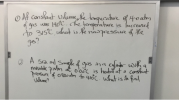 Af constant volume, the temperature of 40 atom of gas was 190°c. The temperature is increased to 315c, what is the new pressure of the gas? 2 A 510 ml Sample of gas na cylinder with a movable piston at oooc is heated at a constant pressure of 0.800 atm to 410c. what is its find sheme?
Part C An ideal gas (which is is a hypothetical gas that conforms to the laws...
Part C An ideal gas (which is is a hypothetical gas that conforms to the laws governing gas behavior) confined to a container with a massless piston at the top. (Figure 2) A massless wire is attached to the piston. When an external pressure of 2.00 atm is applied to the wire, the gas compresses from 4.90 to 2.45 L . When the external pressure is increased to 2.50 atm, the gas further compresses from 2.45 to 1.96 L ....
An ideal gas (which is is a hypothetical gas that conforms to the laws governing gas...
 An ideal gas (which is is a hypothetical gas that conforms to the laws governing gas behavior) confined to a container with a massless piston at the top. (Figure 2) A massless wire is attached to the piston. When an external pressure of 2.00 atm is applied to the wire, the gas compresses from 4.90 to 2.45 L. When the external pressure is increased to 2.50 atm, the gas further compresses from 2.45 to 1.96 L. In a separate experiment...
 Gas Behavior and Intermolecular Forces 1. The pressure exerted by a gas in a container is due to the collisions of the gas particles with the walls of a container. The illustration depicts a gas in a container with a movable piston. Consider each of the following changes and determine how the gas pressure will be affected. Your answer should indicate whether the pressure is increased, decreased or not changed. You should also provide an explanation. A The piston is...
 Af constant volume, the temperature of 40 atom of gas was 190°c. The temperature is increased to 315c, what is the new pressure of the gas? 2 A 510 ml Sample of gas na cylinder with a movable piston at oooc is heated at a constant pressure of 0.800 atm to 410c. what is its find sheme?
 An ideal gas (which is is a hypothetical gas that conforms to the laws governing gas behavior) confined to a container with a massless piston at the top. (Figure 2) A massless wire is attached to the piston. When an external pressure of 2.00 atm is applied to the wire, the gas compresses from 4.90 to 2.45 L. When the external pressure is increased to 2.50 atm, the gas further compresses from 2.45 to 1.96 L. In a separate experiment...
Most questions answered within 3 hours.
-
Where is the error in this code sequence?
String s1 = "Hello";
String s2 = "ello";...
asked 10 months ago -
Financial data for Joel de Paris, Inc., for last year
follow:
Joel de Paris, Inc.
Balance...
asked 10 months ago -
Consider this reaction:
Al2(SO4)3 (aq)+ BaCl3
(aq) Al2Cl6 (aq)- +
3BaSO4(s) . What is the...
asked 10 months ago -
Suppose that Savneet is considering increasing her
recent random sample from 20 car rentals to 40...
asked 10 months ago -
Trucks arrive at an unloading terminal at an average rate of 120
per hour.
Trucks arrive...
asked 10 months ago -
Why are methanol and ethanol completely soluble in water while
octanol is not very little soluble....
asked 10 months ago -
A facilities manager at a university reads in a research report
that the mean amount of...
asked 10 months ago -
When the CuSO4 is rehydrated by adding water to the anhydrous
compound, is this an endothermic...
asked 10 months ago -
A ray of sunlight is passing from diamond into crown glass; the
angle of incidence is...
asked 10 months ago -
A block of mass 0.249 kg is placed on top of a light, vertical
spring of...
asked 10 months ago -
how do the kidneys compensate in the presences of acidosis
a) trigger hyperventilate
b) reserve acid...
asked 10 months ago -
Question 501 pts
The rental rate of capital to the firm increases. Which of the
following...
asked 10 months ago