



 It's a weak acid strong base titration
Homework Answers
1.) Decrease. This is so as the concentration of weak acid increases, it is more dissociated as per equilibrium Eq.
HA + H2O= H3O+ + A- (a)
Hence, Ka (pH at half equivalence) which is equal to [H3O+] [A-]/[HA] would increase which would decrease pKa value given by -log Ka.
2.) Increase. This is so as more Ka value means acid is stronger. More of H+ ions are being formed. Hence, to neutralize a stronger acid, more volume of NaOH will be required.
3.) Increase. Higher the concentration of weak acid, more of H+ ions are being generated as per Eq. (a). Hence, larger volume of NaOH will be required to neutralize the acid completely.
4.) Decrease. pH at half equivalence is pKa which is -log pKa. If value of Ka increases, pKa will decrease.
5.) Stay the same. pH at half equivalence is pKa which is dependent on the type of acid, its concentration and hence, concentration of H+ ions produced. It is the property of an acid. It is independent of the concentration of NaOH used.
6.) Decrease. Increasing NaOH concentration would require lesser volume of NaOH to neutralize the acid completely as for the same concentration of H+ ions, higher concentration of NaOH gives more OH- ions to neutralize at lower amount.
Add Answer to:
It's a weak acid strong base titration
Experiment 4: Identification of an unknown acid by titration...
In this experiment, you will titrate an unknown acid with a base. It will be important...
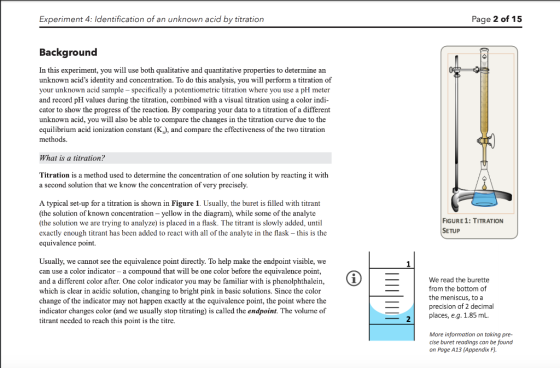
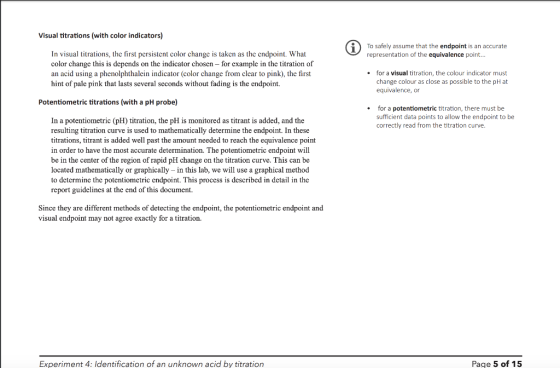
In this experiment, you will titrate an unknown acid with a base. It will be important for you to understand certain things about this titration in order to identify successfully your unknown. For all of the following questions, assume you are titrating an unknown monoprotic acid, HA, with NaOH solution. 0.146 g of HA is added to a beaker and made into a solution with ~100 mL of distilled water. As the titration proceeds, you keep track of the pH...
3. 0.7253 g sample containing an unknown weak acid HA was dissolved in 50 mL water...
3. 0.7253 g sample containing an unknown weak acid HA was dissolved in 50 mL water and titrated against 0.1555 M NaOH, requiring 48.11 mL to of NaOH to reach the end-point. During the titration reaction, the pH of the solution is 3.77 when half of the HA is neutralized and the equivalence-point pH is 8.33. (a) State two ways to standardize the NaOH used in the titration. (b) Suggest and explain an indicator that can be used in the...
To learn about titration types and how to calculate pH at different points of titration. In an acid-base titration, a...
 To learn about titration types
and how to calculate pH at different points of titration. In an
acid-base titration, a titrant (solution of a base or acid) is
added slowly to an analyte (solution of an acid or base). The
titration is often monitored using a pH meter. A plot of pH as a
function of the volume of titrant added is called a pH titration
curve. Prior to the titration, the pH is determined by the
concentration of the...
To learn about titration types
and how to calculate pH at different points of titration. In an
acid-base titration, a titrant (solution of a base or acid) is
added slowly to an analyte (solution of an acid or base). The
titration is often monitored using a pH meter. A plot of pH as a
function of the volume of titrant added is called a pH titration
curve. Prior to the titration, the pH is determined by the
concentration of the...
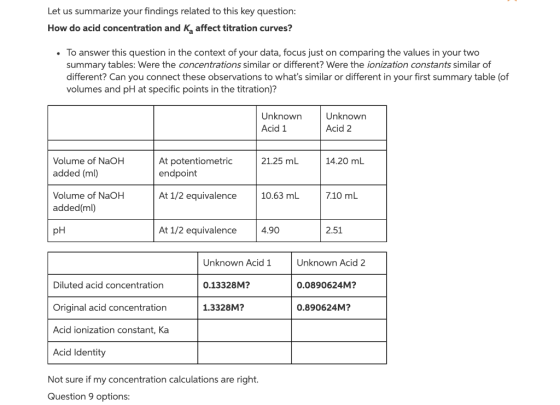
The data for the titration of 25.00 mL of Unknown Acid Sample #80 with 0.1508 M...
 The data for the titration of 25.00 mL of Unknown Acid
Sample #80 with 0.1508 M NaOH (aq) was
plotted on the graph below.
To help with your analysis we have summarized some of the key
numerical values that were determined from the original data -
using the methods on Page 13 of your lab manual to graphically
determine the equivalence point.
Unknown #27
Volume of NaOH added at the potentiometric endpoint (mL)
21.25 mL
Volume of NaOH added at...
The data for the titration of 25.00 mL of Unknown Acid
Sample #80 with 0.1508 M NaOH (aq) was
plotted on the graph below.
To help with your analysis we have summarized some of the key
numerical values that were determined from the original data -
using the methods on Page 13 of your lab manual to graphically
determine the equivalence point.
Unknown #27
Volume of NaOH added at the potentiometric endpoint (mL)
21.25 mL
Volume of NaOH added at...
Titration of weak acid with strong base pre-lab Answers can only be entered/graded between 2019-10-24 and...
 Titration of weak acid with strong base pre-lab
Answers can only be entered/graded between 2019-10-24 and 2019-10-29 A student peforms a titration, titrating 25.00 mL of a weak monoprotic acid, HA, with a 1.12 M solution of NaOH. They collect data, plot a titration curve and determine the values given in the below table. ml NaOH PH added Half-way Point 17.97 3.66 Equivalence point 35.938.65 How many moles of NaOH have been added at the equivalence point? r mol correct...
Titration of weak acid with strong base pre-lab
Answers can only be entered/graded between 2019-10-24 and 2019-10-29 A student peforms a titration, titrating 25.00 mL of a weak monoprotic acid, HA, with a 1.12 M solution of NaOH. They collect data, plot a titration curve and determine the values given in the below table. ml NaOH PH added Half-way Point 17.97 3.66 Equivalence point 35.938.65 How many moles of NaOH have been added at the equivalence point? r mol correct...
Part A: Calculating a Theoretical Titration Curve (Weak Acid - Strong Base) Consider the titration of...
 Part A: Calculating a Theoretical Titration Curve (Weak Acid - Strong Base) Consider the titration of 50.00 mL of 0.05 M acetic acid with 0.1 M NaOH. Calculate the pH of the resulting solution at the following points during the titration (given as volume of NaOH added). Volume NaOH pH of analyte 0.00 15.00 20.00 24.00 24.50 mL at equivalence point 40.00
A student peforms a titration, titrating 25.00 mL of a weak monoprotic acid, HA, with a...
 A student peforms a titration, titrating 25.00 mL of a weak monoprotic acid, HA, with a 1.24 M solution of NaOH. They collect data, plot a titration curve and determine the values given in the below table. ml NaOH added pH Half-way Point 18.73 3.60 Equivalence point 37.45 8.59 How many moles of NaOH have been added at the equivalence point? mol What is the total volume of the solution at the equivalence point? mL During the titration the following...
A student peforms a titration, titrating 25.00 mL of a weak monoprotic acid, HA, with a...
 A student peforms a titration, titrating 25.00 mL of a weak monoprotic acid, HA, with a 1.18 M solution of NaOH. They collect data, plot a titration curve and determine the values given in the below table. ml NaOH added pH Half-way Point 18.77 3.83 Equivalence point 37.54 8.73 How many moles of NaOH have been added at the equivalence point? mol What is the total volume of the solution at the equivalence point? mL During the titration the following...
A student peforms a titration, titrating 25.00 mL of a weak monoprotic acid, HA, with a...
A student peforms a titration, titrating 25.00 mL of a weak monoprotic acid, HA, with a 1.22 M solution of NaOH. They collect data, plot a titration curve and determine the values given in the below table. ml NaOH added pH Half-way Point 18.34 4.06 Equivalence point 36.68 8.84 How many moles of NaOH have been added at the equivalence point? mol What is the total volume of the solution at the equivalence point? mL During the titration the following...
During a titration of a weak base with a strong acid, you are slowing converting molecules...
 During a titration of a weak base with a strong acid, you are slowing converting molecules of the weak base into molecules of its conjugate acid. For the hypothetical weak base, B we see the following: B (aq) + H30+ (aq) - BH+ (aq) + H20 (1) In the problem below you will be adding some strong acid, but not enough to reach the endpoint of the titration. 2.00 mL of hydrochloric acid added to the weak base 2.00M hydrochloric...
 To learn about titration types
and how to calculate pH at different points of titration. In an
acid-base titration, a titrant (solution of a base or acid) is
added slowly to an analyte (solution of an acid or base). The
titration is often monitored using a pH meter. A plot of pH as a
function of the volume of titrant added is called a pH titration
curve. Prior to the titration, the pH is determined by the
concentration of the...
To learn about titration types
and how to calculate pH at different points of titration. In an
acid-base titration, a titrant (solution of a base or acid) is
added slowly to an analyte (solution of an acid or base). The
titration is often monitored using a pH meter. A plot of pH as a
function of the volume of titrant added is called a pH titration
curve. Prior to the titration, the pH is determined by the
concentration of the...
 The data for the titration of 25.00 mL of Unknown Acid
Sample #80 with 0.1508 M NaOH (aq) was
plotted on the graph below.
To help with your analysis we have summarized some of the key
numerical values that were determined from the original data -
using the methods on Page 13 of your lab manual to graphically
determine the equivalence point.
Unknown #27
Volume of NaOH added at the potentiometric endpoint (mL)
21.25 mL
Volume of NaOH added at...
The data for the titration of 25.00 mL of Unknown Acid
Sample #80 with 0.1508 M NaOH (aq) was
plotted on the graph below.
To help with your analysis we have summarized some of the key
numerical values that were determined from the original data -
using the methods on Page 13 of your lab manual to graphically
determine the equivalence point.
Unknown #27
Volume of NaOH added at the potentiometric endpoint (mL)
21.25 mL
Volume of NaOH added at...
 Titration of weak acid with strong base pre-lab
Answers can only be entered/graded between 2019-10-24 and 2019-10-29 A student peforms a titration, titrating 25.00 mL of a weak monoprotic acid, HA, with a 1.12 M solution of NaOH. They collect data, plot a titration curve and determine the values given in the below table. ml NaOH PH added Half-way Point 17.97 3.66 Equivalence point 35.938.65 How many moles of NaOH have been added at the equivalence point? r mol correct...
Titration of weak acid with strong base pre-lab
Answers can only be entered/graded between 2019-10-24 and 2019-10-29 A student peforms a titration, titrating 25.00 mL of a weak monoprotic acid, HA, with a 1.12 M solution of NaOH. They collect data, plot a titration curve and determine the values given in the below table. ml NaOH PH added Half-way Point 17.97 3.66 Equivalence point 35.938.65 How many moles of NaOH have been added at the equivalence point? r mol correct...
 Part A: Calculating a Theoretical Titration Curve (Weak Acid - Strong Base) Consider the titration of 50.00 mL of 0.05 M acetic acid with 0.1 M NaOH. Calculate the pH of the resulting solution at the following points during the titration (given as volume of NaOH added). Volume NaOH pH of analyte 0.00 15.00 20.00 24.00 24.50 mL at equivalence point 40.00
 A student peforms a titration, titrating 25.00 mL of a weak monoprotic acid, HA, with a 1.24 M solution of NaOH. They collect data, plot a titration curve and determine the values given in the below table. ml NaOH added pH Half-way Point 18.73 3.60 Equivalence point 37.45 8.59 How many moles of NaOH have been added at the equivalence point? mol What is the total volume of the solution at the equivalence point? mL During the titration the following...
 A student peforms a titration, titrating 25.00 mL of a weak monoprotic acid, HA, with a 1.18 M solution of NaOH. They collect data, plot a titration curve and determine the values given in the below table. ml NaOH added pH Half-way Point 18.77 3.83 Equivalence point 37.54 8.73 How many moles of NaOH have been added at the equivalence point? mol What is the total volume of the solution at the equivalence point? mL During the titration the following...
 During a titration of a weak base with a strong acid, you are slowing converting molecules of the weak base into molecules of its conjugate acid. For the hypothetical weak base, B we see the following: B (aq) + H30+ (aq) - BH+ (aq) + H20 (1) In the problem below you will be adding some strong acid, but not enough to reach the endpoint of the titration. 2.00 mL of hydrochloric acid added to the weak base 2.00M hydrochloric...
Most questions answered within 3 hours.
-
Where is the error in this code sequence?
String s1 = "Hello";
String s2 = "ello";...
asked 11 months ago -
Financial data for Joel de Paris, Inc., for last year
follow:
Joel de Paris, Inc.
Balance...
asked 11 months ago -
Consider this reaction:
Al2(SO4)3 (aq)+ BaCl3
(aq) Al2Cl6 (aq)- +
3BaSO4(s) . What is the...
asked 11 months ago -
Suppose that Savneet is considering increasing her
recent random sample from 20 car rentals to 40...
asked 11 months ago -
Trucks arrive at an unloading terminal at an average rate of 120
per hour.
Trucks arrive...
asked 11 months ago -
Why are methanol and ethanol completely soluble in water while
octanol is not very little soluble....
asked 11 months ago -
A facilities manager at a university reads in a research report
that the mean amount of...
asked 11 months ago -
When the CuSO4 is rehydrated by adding water to the anhydrous
compound, is this an endothermic...
asked 11 months ago -
A ray of sunlight is passing from diamond into crown glass; the
angle of incidence is...
asked 11 months ago -
A block of mass 0.249 kg is placed on top of a light, vertical
spring of...
asked 11 months ago -
how do the kidneys compensate in the presences of acidosis
a) trigger hyperventilate
b) reserve acid...
asked 11 months ago -
Question 501 pts
The rental rate of capital to the firm increases. Which of the
following...
asked 11 months ago