

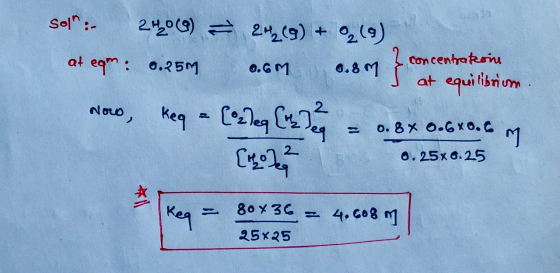
![For the reaction 2 H,0(g) = 2H2(g) + O2(g) the equilibrium concentrations were found to be [H,O] = 0.250 M, [H] = 0.600 M, an](http://img.homeworklib.com/questions/f8c4ecf0-d143-11eb-b4d8-4571daaec6fd.png?x-oss-process=image/resize,w_560)
Homework Answers
Solution for Question No.1 :
3 amino acids (arginine, lysine and
tryptophan) have hydrogen donor atoms in their
side chains. 2 amino acids (aspartic acid, glutamic acid) have
hydrogen acceptor atoms in their side chain. 6 amino acids
(asparagine, glutamine, histidine, serine,
threonine and tyrosine) have both hydrogen donor
and acceptor atoms in their side chains.
Add Answer to:
please solve all.
Hydrogen bonds are noncovalent interactions between a hydrogen atom with a partial positive...
1) A hydrogen bond is A) an attraction between a hydrogen atom attached to N, O, or F and an N, O, or Fatom on anot...
 1) A hydrogen bond is A) an attraction between a hydrogen atom attached to N, O, or F and an N, O, or Fatom on anothe molecule. B) a covalent bond between H and O. c) an ionic bond between H and another atom. D) a bond that is stronger than a covalent bond. E) the polar O-H bond in water. 2) Which of the following molecules can form hydrogen bonds? A) CH4 B) NaH C) NH3 D) BH3 E)...
1)Match the name of each amino acid with one of its characteristics. 2)has a hydroxy group...
1)Match the name of each amino acid with one of its characteristics. 2)has a hydroxy group its aromatic side chain 3)has a sulfur atom in its side chain that can form disulfide bonds its side chain is a nonpolar isopropyl group 4)it has the smallest acidic side chain 5)this amino acid has the smallest side chain of all, a hydrogen atom 6)its side chain is a methyl group its side chain of 3 carbons forms a 5-membered ring with the...
Answer all 170 Test 18 Name 1. During the perlod of 2. During Chemical Evolution, elemerts...
 Answer all
170 Test 18 Name 1. During the perlod of 2. During Chemical Evolution, elemerts reacted with each other to form smaliInorganic molecules As a resut which of the followig 3. In the theory of chemical evolution, the formation of th proto cell with a phospholipid bilayer was important because a) the t e Chemical Ewoludion tour elements made up 9e% f the molecus ws s not one of these elements? a) Oxygen,(0), bj Niterogen (N, cj Neon ("e),...
Answer all
170 Test 18 Name 1. During the perlod of 2. During Chemical Evolution, elemerts reacted with each other to form smaliInorganic molecules As a resut which of the followig 3. In the theory of chemical evolution, the formation of th proto cell with a phospholipid bilayer was important because a) the t e Chemical Ewoludion tour elements made up 9e% f the molecus ws s not one of these elements? a) Oxygen,(0), bj Niterogen (N, cj Neon ("e),...
Please complete for Tuesday, we will go through the questions and mark them in class. pg 156 - 4.23,...
 Please complete for Tuesday, we will go through the questions and mark them in class. pg 156 - 4.23, 4.24, 4.26 pg 170 - 4.29, 4.31, pg 171-4.36 pg 175 - 4.59 pg 176- 4.74, 4.75, 4.80 pg 177-4.81, 4.82 pg 188- 5.1, 5.4, 5.5, 5.6, 5.11 - Using Table 5.1 pg 198-5.22, 5.25 pg 203 - 5.29 pg 206 - 5.37 pg 209 - 5.39 pg 2.14 5.61 pg 235-6.11, 6.14, 6.16 156 CHAPTER 4 Introduction to Organic Compounds...
 1) A hydrogen bond is A) an attraction between a hydrogen atom attached to N, O, or F and an N, O, or Fatom on anothe molecule. B) a covalent bond between H and O. c) an ionic bond between H and another atom. D) a bond that is stronger than a covalent bond. E) the polar O-H bond in water. 2) Which of the following molecules can form hydrogen bonds? A) CH4 B) NaH C) NH3 D) BH3 E)...
 Answer all
170 Test 18 Name 1. During the perlod of 2. During Chemical Evolution, elemerts reacted with each other to form smaliInorganic molecules As a resut which of the followig 3. In the theory of chemical evolution, the formation of th proto cell with a phospholipid bilayer was important because a) the t e Chemical Ewoludion tour elements made up 9e% f the molecus ws s not one of these elements? a) Oxygen,(0), bj Niterogen (N, cj Neon ("e),...
Answer all
170 Test 18 Name 1. During the perlod of 2. During Chemical Evolution, elemerts reacted with each other to form smaliInorganic molecules As a resut which of the followig 3. In the theory of chemical evolution, the formation of th proto cell with a phospholipid bilayer was important because a) the t e Chemical Ewoludion tour elements made up 9e% f the molecus ws s not one of these elements? a) Oxygen,(0), bj Niterogen (N, cj Neon ("e),...
 Please complete for Tuesday, we will go through the questions and mark them in class. pg 156 - 4.23, 4.24, 4.26 pg 170 - 4.29, 4.31, pg 171-4.36 pg 175 - 4.59 pg 176- 4.74, 4.75, 4.80 pg 177-4.81, 4.82 pg 188- 5.1, 5.4, 5.5, 5.6, 5.11 - Using Table 5.1 pg 198-5.22, 5.25 pg 203 - 5.29 pg 206 - 5.37 pg 209 - 5.39 pg 2.14 5.61 pg 235-6.11, 6.14, 6.16 156 CHAPTER 4 Introduction to Organic Compounds...
Most questions answered within 3 hours.
-
Where is the error in this code sequence?
String s1 = "Hello";
String s2 = "ello";...
asked 10 months ago -
Financial data for Joel de Paris, Inc., for last year
follow:
Joel de Paris, Inc.
Balance...
asked 10 months ago -
Consider this reaction:
Al2(SO4)3 (aq)+ BaCl3
(aq) Al2Cl6 (aq)- +
3BaSO4(s) . What is the...
asked 10 months ago -
Suppose that Savneet is considering increasing her
recent random sample from 20 car rentals to 40...
asked 10 months ago -
Trucks arrive at an unloading terminal at an average rate of 120
per hour.
Trucks arrive...
asked 10 months ago -
Why are methanol and ethanol completely soluble in water while
octanol is not very little soluble....
asked 10 months ago -
A facilities manager at a university reads in a research report
that the mean amount of...
asked 10 months ago -
When the CuSO4 is rehydrated by adding water to the anhydrous
compound, is this an endothermic...
asked 10 months ago -
A ray of sunlight is passing from diamond into crown glass; the
angle of incidence is...
asked 10 months ago -
A block of mass 0.249 kg is placed on top of a light, vertical
spring of...
asked 10 months ago -
how do the kidneys compensate in the presences of acidosis
a) trigger hyperventilate
b) reserve acid...
asked 10 months ago -
Question 501 pts
The rental rate of capital to the firm increases. Which of the
following...
asked 10 months ago