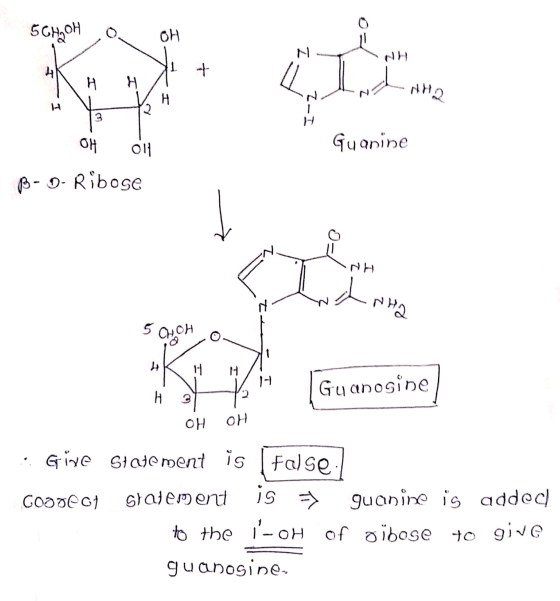
When the base guanine is added to the 2'-OH of the monosaccharide ribose, the product is...
When the base guanine is added to the 2'-OH of the monosaccharide ribose, the product is guanosine.
Question 15 options:
| True | |
| False |
Homework Answers
Add Answer to:
When the base guanine is added to the 2'-OH of the
monosaccharide ribose, the product is...
RNA differs from DNA in that it: all of the above contains ribose sugar contains uracil...
RNA differs from DNA in that it: all of the above contains ribose sugar contains uracil is usually found as a single-stranded molecule in cells Question 21 pts The correct order of steps in a PCR cycle is: Extension, denaturation, annealing Annealing, extension, denaturation Annealing, denaturation, extension Denaturation, annealing, extension The goal of the polymerase chain reaction (PCR) is to: Amplify a small amount of DNA sequence Cleave DNA molecules Digest bacterial plasmids Sequence DNA Which of the following is...
Question 5 (1 point) In DNA base pairing, T (thymine) always pairs with G (guanine). True...
 Question 5 (1 point) In DNA base pairing, T (thymine) always pairs with G (guanine). True False Question 6 (1 point) Lead time bias can account for the apparent improvement in 5-year survival rates due to early diagnosis. True False Question 7 (1 point) Death rates due to breast cancer have risen steadily for the past 50 years due to an increase in estrogen in our environment. True False Question 8 (1 point) Malignant tumors tend to have cells that...
At what pH will 0.20 M Ca(OH)2 begin to precipitate if a strong base is added...
 At what pH will 0.20 M Ca(OH)2 begin to precipitate if a strong base is added to the solution? Ksp = 6.5 x 10⁶ for Ca(OH)2. Show all work.
2. When sodium methoxide is added to 2-bromopentane the main elimination product is 2-pentene, but when...
 2. When sodium methoxide is added to 2-bromopentane the main elimination product is 2-pentene, but when sodium methoxide added to 2-fluoropentane the main elimination product is 1-pentene. Explain the observed difference in selectivity between these two reactions Br NaOMe MeOH MeOH 3. When the trans-diastereomer of the compound shown below is allowed to react with tert-butoxide the only observed elimination product is 3-methylcyclohexene, but when the cis-diastereomer is eliminated a mixture of 1-methylcyclohexene and 3-methylcyclohexene is observed (- methylcyclohexene is...
There are 64 mRNA codons which are used to synthesis proteins. Question 24 options: A) True...
There are 64 mRNA codons which are used to synthesis proteins. Question 24 options: A) True B) False If 30% of an organism's DNA is thymine, then 30% is guanine. Question 20 options: A) True B) False 1. How many base pairs are in DNA. 2. The __________ of a virus is enclosed by a _______capsid options: membrane; protein nucleic acid; membrane protein; nucleic acid nucleic acid; protein 3. All bacteria are pathogenic to humans. True False 4. DNA polymerase...
group on the 13. In double-stranded DNA, a pyrimidine group on one strand base pairs with...
 group on the 13. In double-stranded DNA, a pyrimidine group on one strand base pairs with a other strand; the two strands are oriented in directions. a. purine, parallel b. purine, antiparallel c. pyrimidine, parallel d. pyrimidine, antiparallel Questions 14 and 15 refer to the following information: A disaccharide composed of arabinose and xylose gives arabinose and xylonic acid by reaction with Bry-water followed by hydrolysis. Reaction of its methyl glycoside with iodomethane under basic conditions followed by hydrolysis gives...
Question 11 2 pts What is the organic product of the following acid-base reaction? OH H-CI...
 Question 11 2 pts What is the organic product of the following acid-base reaction? OH H-CI ? HqN H2N OH HUN o OH HỌN o OH HN O HN
need help Question 33 (1 point) A nucleotide contains: 1) A nitrogenous base 2) A monosaccharide...
 need help
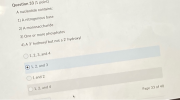
Question 33 (1 point) A nucleotide contains: 1) A nitrogenous base 2) A monosaccharide 3) One or more phosphates 4) A 3' hydroxyl but not a 2' hydroxyl O1,2, 3, and 4 1, 2, and 3 1 and 2 1, 2, and 4 Page 33 of 40
need help
Question 33 (1 point) A nucleotide contains: 1) A nitrogenous base 2) A monosaccharide 3) One or more phosphates 4) A 3' hydroxyl but not a 2' hydroxyl O1,2, 3, and 4 1, 2, and 3 1 and 2 1, 2, and 4 Page 33 of 40
bio 151 please and thank you QUESTION 8 When looking at one DNA nucleotide, the phosphate...
 bio 151 please and thank you
QUESTION 8 When looking at one DNA nucleotide, the phosphate group is located on carbon #1 of the sugar. True False QUESTION 9 Which statement below is TRUE? thymine and adenine both have double ring bases O guanine is a smaller base than cytosine cytosine and thymine are both pyrimidine bases O adenine and guanine are complementary base pairs QUESTION 13 Which enzyme below is associated with 'unzipping" the DNA? ODNA Helicase Primase O...
bio 151 please and thank you
QUESTION 8 When looking at one DNA nucleotide, the phosphate group is located on carbon #1 of the sugar. True False QUESTION 9 Which statement below is TRUE? thymine and adenine both have double ring bases O guanine is a smaller base than cytosine cytosine and thymine are both pyrimidine bases O adenine and guanine are complementary base pairs QUESTION 13 Which enzyme below is associated with 'unzipping" the DNA? ODNA Helicase Primase O...
The solubility-product constant for Zn(OH)2 is Ksp=3.00×10⁻¹⁶. The formation constant for the hydroxo complex, Zn(OH)42−, is...
The solubility-product constant for Zn(OH)2 is Ksp=3.00×10⁻¹⁶. The formation constant for the hydroxo complex, Zn(OH)42−, is Kf=4.60×10¹⁷. A solubility-product constant, Ksp, corresponds to a reaction with the following general format: salt(s)⇌cation(aq)+anion(aq) A formation constant, Kf, corresponds to a reaction with the following general format: metal ion(aq)+Lewis base(aq)⇌complex ion(aq) Part A When Zn(OH)2(s) was added to 1.00 L of a basic solution, 1.11×10⁻² mol of the solid dissolved. What is the concentration of OH− in the final solution?
 Question 5 (1 point) In DNA base pairing, T (thymine) always pairs with G (guanine). True False Question 6 (1 point) Lead time bias can account for the apparent improvement in 5-year survival rates due to early diagnosis. True False Question 7 (1 point) Death rates due to breast cancer have risen steadily for the past 50 years due to an increase in estrogen in our environment. True False Question 8 (1 point) Malignant tumors tend to have cells that...
 At what pH will 0.20 M Ca(OH)2 begin to precipitate if a strong base is added to the solution? Ksp = 6.5 x 10⁶ for Ca(OH)2. Show all work.
 2. When sodium methoxide is added to 2-bromopentane the main elimination product is 2-pentene, but when sodium methoxide added to 2-fluoropentane the main elimination product is 1-pentene. Explain the observed difference in selectivity between these two reactions Br NaOMe MeOH MeOH 3. When the trans-diastereomer of the compound shown below is allowed to react with tert-butoxide the only observed elimination product is 3-methylcyclohexene, but when the cis-diastereomer is eliminated a mixture of 1-methylcyclohexene and 3-methylcyclohexene is observed (- methylcyclohexene is...
 group on the 13. In double-stranded DNA, a pyrimidine group on one strand base pairs with a other strand; the two strands are oriented in directions. a. purine, parallel b. purine, antiparallel c. pyrimidine, parallel d. pyrimidine, antiparallel Questions 14 and 15 refer to the following information: A disaccharide composed of arabinose and xylose gives arabinose and xylonic acid by reaction with Bry-water followed by hydrolysis. Reaction of its methyl glycoside with iodomethane under basic conditions followed by hydrolysis gives...
 Question 11 2 pts What is the organic product of the following acid-base reaction? OH H-CI ? HqN H2N OH HUN o OH HỌN o OH HN O HN
 need help
Question 33 (1 point) A nucleotide contains: 1) A nitrogenous base 2) A monosaccharide 3) One or more phosphates 4) A 3' hydroxyl but not a 2' hydroxyl O1,2, 3, and 4 1, 2, and 3 1 and 2 1, 2, and 4 Page 33 of 40
need help
Question 33 (1 point) A nucleotide contains: 1) A nitrogenous base 2) A monosaccharide 3) One or more phosphates 4) A 3' hydroxyl but not a 2' hydroxyl O1,2, 3, and 4 1, 2, and 3 1 and 2 1, 2, and 4 Page 33 of 40
 bio 151 please and thank you
QUESTION 8 When looking at one DNA nucleotide, the phosphate group is located on carbon #1 of the sugar. True False QUESTION 9 Which statement below is TRUE? thymine and adenine both have double ring bases O guanine is a smaller base than cytosine cytosine and thymine are both pyrimidine bases O adenine and guanine are complementary base pairs QUESTION 13 Which enzyme below is associated with 'unzipping" the DNA? ODNA Helicase Primase O...
bio 151 please and thank you
QUESTION 8 When looking at one DNA nucleotide, the phosphate group is located on carbon #1 of the sugar. True False QUESTION 9 Which statement below is TRUE? thymine and adenine both have double ring bases O guanine is a smaller base than cytosine cytosine and thymine are both pyrimidine bases O adenine and guanine are complementary base pairs QUESTION 13 Which enzyme below is associated with 'unzipping" the DNA? ODNA Helicase Primase O...
Most questions answered within 3 hours.
-
Where is the error in this code sequence?
String s1 = "Hello";
String s2 = "ello";...
asked 11 months ago -
Financial data for Joel de Paris, Inc., for last year
follow:
Joel de Paris, Inc.
Balance...
asked 11 months ago -
Consider this reaction:
Al2(SO4)3 (aq)+ BaCl3
(aq) Al2Cl6 (aq)- +
3BaSO4(s) . What is the...
asked 11 months ago -
Suppose that Savneet is considering increasing her
recent random sample from 20 car rentals to 40...
asked 11 months ago -
Trucks arrive at an unloading terminal at an average rate of 120
per hour.
Trucks arrive...
asked 11 months ago -
Why are methanol and ethanol completely soluble in water while
octanol is not very little soluble....
asked 11 months ago -
A facilities manager at a university reads in a research report
that the mean amount of...
asked 11 months ago -
When the CuSO4 is rehydrated by adding water to the anhydrous
compound, is this an endothermic...
asked 11 months ago -
A ray of sunlight is passing from diamond into crown glass; the
angle of incidence is...
asked 11 months ago -
A block of mass 0.249 kg is placed on top of a light, vertical
spring of...
asked 11 months ago -
how do the kidneys compensate in the presences of acidosis
a) trigger hyperventilate
b) reserve acid...
asked 11 months ago -
Question 501 pts
The rental rate of capital to the firm increases. Which of the
following...
asked 11 months ago