4. When elements combine to form compounds: EXPLAIN ANSWER A). Their properties do not change B)....
4. When elements combine to form compounds: EXPLAIN ANSWER
A). Their properties do not change
B). Their properties change completely
C). Their properties are completely random
D). Their properties are an average of all elements in the compound
E). None of the above
Homework Answers
B) Their properties change completely
when elements combine to form compounds, their individual properties are lost.
Add Answer to:
4. When elements combine to form compounds: EXPLAIN ANSWER
A). Their properties do not change
B)....
When elements combine to form compounds, those compounds have the properties that are completely differnet from...
When elements combine to form compounds, those compounds have the properties that are completely differnet from those of the elementos from which they were made. (TRUE OR FALSE)
Do elements always combine in the same proportions by mass when they form a given compound?
Do elements always combine in the same proportions by mass when they form a given compound?
7. Two elements, chocolatonium (Ch) and aprilium (Ap), combine to form several compounds. Two of these are ChAp2 an...
 7. Two elements, chocolatonium (Ch) and aprilium (Ap), combine to form several compounds. Two of these are ChAp2 and ChaAps. A sample of ChaAps contains 275 g Ch and 433 g Ap. a. Find the relative mass of Ch to Ap in Ch2Aps. b. Find the relative mass of Ch to Ap in Ch2Aps if the mass of Ap is exactly 45 amu. c. How many grams of Ch can combine with 126 g Ap in ChaAps using the new...
Name: Naming Molecular Compounds 1. Nitrogen and oxygen combine to form many different compounds. How would you nam...
 Name: Naming Molecular Compounds 1. Nitrogen and oxygen combine to form many different compounds. How would you name find the formula each of the following according to the IUPAC rules: a. N20 (laughing gas) b. NO (a cellular signaling molecule) c. NO2 (a toxic brown gas) d. diphosphorus pentoxide (used to speed up certain chemical reactions) 4. Concept check: Each of the following compounds is incorrectly named. What is wrong with each name and what is the correct name for...
Lattice energy is _______. a.) the energy given off when gaseous ions combine to form one...
Lattice energy is _______. a.) the energy given off when gaseous ions combine to form one mole of an ionic solid b.) the energy required to convert a mole of ionic solid into its constituent ions in the gas phase c.) the sum of ionization energies of the components in an ionic solid d.) the sum of electron affinities of the components in an ionic solid e.) the energy required to produce one mole of an ionic compound from its...
The ionization energy of Group 2 elements decrease and the radii decrease down the group. Therefore a. The metals a...
 The ionization energy of Group 2 elements decrease and the radii decrease down the group. Therefore a. The metals are less easily oxidized down the group b. The metals are more easily oxidized down the group c. Redox properties do not change systematically down the group Which Group 2 element DOES NOT form ionic hydrides? a. Ca b. Sr e. Be What is the pH of a saturated solution of Ca(OH)? The solubility of Ca(OH) is 2.1x10⁻³M a. 11.02 b....
Answer the following question as "every time, never or occasionally" true. Explain your answer. A) Compounds...
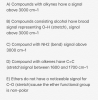 Answer the following question as "every time, never or
occasionally" true. Explain your answer.
A) Compounds with alkynes have a signal above 3000 cm-1 B) Compounds consisting alcohol have broad signal representing O-H (stretch), signal above 3000 cm-1 C) Compound with NH2 (bend) signal above 3000 cm-1 D) Compound with alkenes have C=C (stretch) signal between 1600 and 1700 cm-1 E) Ethers do not have a noticeable signal for C-O (stretch)cause the ether functional group is non-polar
Answer the following question as "every time, never or
occasionally" true. Explain your answer.
A) Compounds with alkynes have a signal above 3000 cm-1 B) Compounds consisting alcohol have broad signal representing O-H (stretch), signal above 3000 cm-1 C) Compound with NH2 (bend) signal above 3000 cm-1 D) Compound with alkenes have C=C (stretch) signal between 1600 and 1700 cm-1 E) Ethers do not have a noticeable signal for C-O (stretch)cause the ether functional group is non-polar
Both please 15) Jslig your understandng ot honvions combine to form lonic compounds, which one of...
 Both please
15) Jslig your understandng ot honvions combine to form lonic compounds, which one of the following is a correct formula unit? a. KBrs b. Ba2Se c. Ca202 d. MgOH e. Al(OH)3 16) What is the correct formula for Titanium (IV) Sulfite? a. Ti(S04)2 b. Ti(SO3)2 c. Ti4(S03) d. Tiz(S04)4 e. Tisz
Both please
15) Jslig your understandng ot honvions combine to form lonic compounds, which one of the following is a correct formula unit? a. KBrs b. Ba2Se c. Ca202 d. MgOH e. Al(OH)3 16) What is the correct formula for Titanium (IV) Sulfite? a. Ti(S04)2 b. Ti(SO3)2 c. Ti4(S03) d. Tiz(S04)4 e. Tisz
Which of the following elements can form compounds with an expanded octet? C F As Li...
Which of the following elements can form compounds with an expanded octet? C F As Li All of the above elements can form compounds with an expanded octet. What is the molar mass of oxygen gas? 1.20 × 10²³ g/mol 32.0 g/mol 6.02 × 10²³ g/mol 16.0 g/mol How many lone pairs of electrons are on the As atom in AsF3? How many lone pairs of electrons are on the As atom in AsF3? 0 1 2 3 What is...
Elements which are most likely to form an ionic compound if they are allowed to react...
Elements which are most likely to form an ionic compound if they are allowed to react with each other are A. Nonmetal and nonmetal B. Metal and a metal C. Metal and Nonmetal D. None of the above
 7. Two elements, chocolatonium (Ch) and aprilium (Ap), combine to form several compounds. Two of these are ChAp2 and ChaAps. A sample of ChaAps contains 275 g Ch and 433 g Ap. a. Find the relative mass of Ch to Ap in Ch2Aps. b. Find the relative mass of Ch to Ap in Ch2Aps if the mass of Ap is exactly 45 amu. c. How many grams of Ch can combine with 126 g Ap in ChaAps using the new...
 Name: Naming Molecular Compounds 1. Nitrogen and oxygen combine to form many different compounds. How would you name find the formula each of the following according to the IUPAC rules: a. N20 (laughing gas) b. NO (a cellular signaling molecule) c. NO2 (a toxic brown gas) d. diphosphorus pentoxide (used to speed up certain chemical reactions) 4. Concept check: Each of the following compounds is incorrectly named. What is wrong with each name and what is the correct name for...
 The ionization energy of Group 2 elements decrease and the radii decrease down the group. Therefore a. The metals are less easily oxidized down the group b. The metals are more easily oxidized down the group c. Redox properties do not change systematically down the group Which Group 2 element DOES NOT form ionic hydrides? a. Ca b. Sr e. Be What is the pH of a saturated solution of Ca(OH)? The solubility of Ca(OH) is 2.1x10⁻³M a. 11.02 b....
 Answer the following question as "every time, never or
occasionally" true. Explain your answer.
A) Compounds with alkynes have a signal above 3000 cm-1 B) Compounds consisting alcohol have broad signal representing O-H (stretch), signal above 3000 cm-1 C) Compound with NH2 (bend) signal above 3000 cm-1 D) Compound with alkenes have C=C (stretch) signal between 1600 and 1700 cm-1 E) Ethers do not have a noticeable signal for C-O (stretch)cause the ether functional group is non-polar
Answer the following question as "every time, never or
occasionally" true. Explain your answer.
A) Compounds with alkynes have a signal above 3000 cm-1 B) Compounds consisting alcohol have broad signal representing O-H (stretch), signal above 3000 cm-1 C) Compound with NH2 (bend) signal above 3000 cm-1 D) Compound with alkenes have C=C (stretch) signal between 1600 and 1700 cm-1 E) Ethers do not have a noticeable signal for C-O (stretch)cause the ether functional group is non-polar
 Both please
15) Jslig your understandng ot honvions combine to form lonic compounds, which one of the following is a correct formula unit? a. KBrs b. Ba2Se c. Ca202 d. MgOH e. Al(OH)3 16) What is the correct formula for Titanium (IV) Sulfite? a. Ti(S04)2 b. Ti(SO3)2 c. Ti4(S03) d. Tiz(S04)4 e. Tisz
Both please
15) Jslig your understandng ot honvions combine to form lonic compounds, which one of the following is a correct formula unit? a. KBrs b. Ba2Se c. Ca202 d. MgOH e. Al(OH)3 16) What is the correct formula for Titanium (IV) Sulfite? a. Ti(S04)2 b. Ti(SO3)2 c. Ti4(S03) d. Tiz(S04)4 e. Tisz
Most questions answered within 3 hours.
-
Where is the error in this code sequence?
String s1 = "Hello";
String s2 = "ello";...
asked 10 months ago -
Financial data for Joel de Paris, Inc., for last year
follow:
Joel de Paris, Inc.
Balance...
asked 10 months ago -
Consider this reaction:
Al2(SO4)3 (aq)+ BaCl3
(aq) Al2Cl6 (aq)- +
3BaSO4(s) . What is the...
asked 10 months ago -
Suppose that Savneet is considering increasing her
recent random sample from 20 car rentals to 40...
asked 10 months ago -
Trucks arrive at an unloading terminal at an average rate of 120
per hour.
Trucks arrive...
asked 10 months ago -
Why are methanol and ethanol completely soluble in water while
octanol is not very little soluble....
asked 10 months ago -
A facilities manager at a university reads in a research report
that the mean amount of...
asked 10 months ago -
When the CuSO4 is rehydrated by adding water to the anhydrous
compound, is this an endothermic...
asked 10 months ago -
A ray of sunlight is passing from diamond into crown glass; the
angle of incidence is...
asked 10 months ago -
A block of mass 0.249 kg is placed on top of a light, vertical
spring of...
asked 10 months ago -
how do the kidneys compensate in the presences of acidosis
a) trigger hyperventilate
b) reserve acid...
asked 10 months ago -
Question 501 pts
The rental rate of capital to the firm increases. Which of the
following...
asked 10 months ago