In an ester, what feature further increases the electrophilicity of the carbonyl carbon?
In an ester, what feature further increases the electrophilicity of the carbonyl carbon?
Homework Answers

Add Answer to:
In an ester, what feature further increases the electrophilicity
of the carbonyl carbon?
R-OTs reacted with Cyanide produces: O An Ester O A Carbonyl Carbon O An Alcohol O...
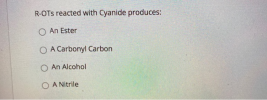 R-OTs reacted with Cyanide produces: O An Ester O A Carbonyl Carbon O An Alcohol O A Nitrile
Hello, can you please help me out with these problems. Thanks in advance. When a zinc-containing enzyme hydrolyzes a peptide bond, what does the zinc 45. do to promote the hydrolysis? Zn O H20 Lys Va...
 Hello, can you please help me out with these problems. Thanks in
advance.
When a zinc-containing enzyme hydrolyzes a peptide bond, what does the zinc 45. do to promote the hydrolysis? Zn O H20 Lys Val Asp) Leu Pro It increases the electrophilicity of the carbonyl carbon. (A) (B) (C) (D) It increases the nucleophilicity of the carbonyl carbon It decreases the electrophilicity of the carbonyl carbon. It decreases the nucleophilicity of the carbonyl carbon. 46. Which acid catalyzed reagent...
Hello, can you please help me out with these problems. Thanks in
advance.
When a zinc-containing enzyme hydrolyzes a peptide bond, what does the zinc 45. do to promote the hydrolysis? Zn O H20 Lys Val Asp) Leu Pro It increases the electrophilicity of the carbonyl carbon. (A) (B) (C) (D) It increases the nucleophilicity of the carbonyl carbon It decreases the electrophilicity of the carbonyl carbon. It decreases the nucleophilicity of the carbonyl carbon. 46. Which acid catalyzed reagent...
We saw in this experiment that an ester group with the carbonyl carbon attached to the...
 We saw in this experiment that an ester group with the carbonyl carbon attached to the benzene ring serves as a meta-director, resulting in methyl Meta-nitrobenzoate as the major product of the reaction. Given that a methoxy (-OCH_3) group attached to the benzene ring serves as an orthopara director, draw the major products of the reaction shown below. Use your pre-lab lecture notes to answer this question. Explain using the resonance structures (referred to as the "sigma complex") why the...
Provide answers AND briefly rationalize your answers - cont'd 6. Rank the carbonyl electrophilicity from low...
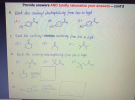 Provide answers AND briefly rationalize your answers - cont'd 6. Rank the carbonyl electrophilicity from low to high HO 7. Rank the carbenyl electricha reactivity from low to high 8. Rank the car beryl electropidicity from low to high (A) (B) El CHOOSE THE 10. Caso o cho con
In #5 (carboxylic acid), why doesn't the AlH4(-) attack the carbonyl carbon and proceed to the...
 In #5 (carboxylic acid), why doesn't the AlH4(-) attack the
carbonyl carbon and proceed to the tetrahedral intermediate...why
does it instead attack the hydroxy group to form O-AlH3 and then
does an H(-) attack on the carbonyl carbon?
On the other hand, in #1 (ester), the ALH4(-) attacks the
carbonyl carbon...tetrahedral intermediate, OCH3 leaving group,
etc. (this is the mechanism I expected #5 to be)
03 O-Al H-Al-H H-Al-H H-Al-H OH
In #5 (carboxylic acid), why doesn't the AlH4(-) attack the
carbonyl carbon and proceed to the tetrahedral intermediate...why
does it instead attack the hydroxy group to form O-AlH3 and then
does an H(-) attack on the carbonyl carbon?
On the other hand, in #1 (ester), the ALH4(-) attacks the
carbonyl carbon...tetrahedral intermediate, OCH3 leaving group,
etc. (this is the mechanism I expected #5 to be)
03 O-Al H-Al-H H-Al-H H-Al-H OH
If an ester labeled in the carbonyl oxygen with 18O is reacted with aqueous NaOH, what...
If an ester labeled in the carbonyl oxygen with 18O is reacted with aqueous NaOH, what would be the result? Hint 1. How to reason this out In light of the addition-elimination mechanism, consider the fate of the tetrahedral intermediates formed in the reaction. ANSWER: Recovered ester would have less of the label than at the beginning of the reaction. The alcohol from the hydrolysis would contain the 18O label. Recovered ester would now have the 18O in the alkoxy...
Question 5 4 pts Choose the correct statement(s) concerning the protonation of an ester carbonyl group....
 Question 5 4 pts Choose the correct statement(s) concerning the protonation of an ester carbonyl group. (choose all correct answers) The carbonyl carbon will have an increased partial positive charge. Subsequent nucleophilic attack will result in the loss of an alkoxide anion, as a leaving group. The resulting species will be more electrophilic. The resulting species will be more nucleophilic
Benzocaine IR spectrum ester carbonyl
When looking at the IR spectrum for benzocaine, the carbonyl group for the ester is very low on the spectrum compared to other esters on other spectrums. Can it be explained why?
The powerful electron-withdrawing property of a carbonyl group increases the acidity of α-protons (i.e., protons attached...
 The powerful electron-withdrawing property of a carbonyl group
increases the acidity of α-protons (i.e., protons attached to a
carbon that is adjacent to the carbonyl group). The effect varies
depending on what else is attached to the carbonyl, and whether
there is a second carbonyl group attached to the α-carbon. Rank the
following structures from highest acidity (lowest pKa value) to
lowest acidity (highest pKa value).
The powerful electron-withdrawing property of a carbonyl group
increases the acidity of α-protons (i.e., protons attached to a
carbon that is adjacent to the carbonyl group). The effect varies
depending on what else is attached to the carbonyl, and whether
there is a second carbonyl group attached to the α-carbon. Rank the
following structures from highest acidity (lowest pKa value) to
lowest acidity (highest pKa value).
Both aldehydes and ketones contain carbonyl groups: In aldehydes, the carbonyl carbon atom is bonded to...
 Both aldehydes and ketones contain carbonyl groups: In
aldehydes, the carbonyl carbon atom is bonded to a hydrogen atom,
whereas in ketones the carbonyl carbon atom is bonded to another
carbon atom. Determine which of the following statements are true.
Select (check) the correct statements.Both aldehydes and ketones
contain carbonyl groups: In aldehydes, the carbonyl carbon atom is
bonded to a hydrogen atom, whereas in ketones the carbonyl carbon
atom is bonded to another carbon atom. Determine which of the...
Both aldehydes and ketones contain carbonyl groups: In
aldehydes, the carbonyl carbon atom is bonded to a hydrogen atom,
whereas in ketones the carbonyl carbon atom is bonded to another
carbon atom. Determine which of the following statements are true.
Select (check) the correct statements.Both aldehydes and ketones
contain carbonyl groups: In aldehydes, the carbonyl carbon atom is
bonded to a hydrogen atom, whereas in ketones the carbonyl carbon
atom is bonded to another carbon atom. Determine which of the...
 R-OTs reacted with Cyanide produces: O An Ester O A Carbonyl Carbon O An Alcohol O A Nitrile
 Hello, can you please help me out with these problems. Thanks in
advance.
When a zinc-containing enzyme hydrolyzes a peptide bond, what does the zinc 45. do to promote the hydrolysis? Zn O H20 Lys Val Asp) Leu Pro It increases the electrophilicity of the carbonyl carbon. (A) (B) (C) (D) It increases the nucleophilicity of the carbonyl carbon It decreases the electrophilicity of the carbonyl carbon. It decreases the nucleophilicity of the carbonyl carbon. 46. Which acid catalyzed reagent...
Hello, can you please help me out with these problems. Thanks in
advance.
When a zinc-containing enzyme hydrolyzes a peptide bond, what does the zinc 45. do to promote the hydrolysis? Zn O H20 Lys Val Asp) Leu Pro It increases the electrophilicity of the carbonyl carbon. (A) (B) (C) (D) It increases the nucleophilicity of the carbonyl carbon It decreases the electrophilicity of the carbonyl carbon. It decreases the nucleophilicity of the carbonyl carbon. 46. Which acid catalyzed reagent...
 We saw in this experiment that an ester group with the carbonyl carbon attached to the benzene ring serves as a meta-director, resulting in methyl Meta-nitrobenzoate as the major product of the reaction. Given that a methoxy (-OCH_3) group attached to the benzene ring serves as an orthopara director, draw the major products of the reaction shown below. Use your pre-lab lecture notes to answer this question. Explain using the resonance structures (referred to as the "sigma complex") why the...
 Provide answers AND briefly rationalize your answers - cont'd 6. Rank the carbonyl electrophilicity from low to high HO 7. Rank the carbenyl electricha reactivity from low to high 8. Rank the car beryl electropidicity from low to high (A) (B) El CHOOSE THE 10. Caso o cho con
 In #5 (carboxylic acid), why doesn't the AlH4(-) attack the
carbonyl carbon and proceed to the tetrahedral intermediate...why
does it instead attack the hydroxy group to form O-AlH3 and then
does an H(-) attack on the carbonyl carbon?
On the other hand, in #1 (ester), the ALH4(-) attacks the
carbonyl carbon...tetrahedral intermediate, OCH3 leaving group,
etc. (this is the mechanism I expected #5 to be)
03 O-Al H-Al-H H-Al-H H-Al-H OH
In #5 (carboxylic acid), why doesn't the AlH4(-) attack the
carbonyl carbon and proceed to the tetrahedral intermediate...why
does it instead attack the hydroxy group to form O-AlH3 and then
does an H(-) attack on the carbonyl carbon?
On the other hand, in #1 (ester), the ALH4(-) attacks the
carbonyl carbon...tetrahedral intermediate, OCH3 leaving group,
etc. (this is the mechanism I expected #5 to be)
03 O-Al H-Al-H H-Al-H H-Al-H OH
 Question 5 4 pts Choose the correct statement(s) concerning the protonation of an ester carbonyl group. (choose all correct answers) The carbonyl carbon will have an increased partial positive charge. Subsequent nucleophilic attack will result in the loss of an alkoxide anion, as a leaving group. The resulting species will be more electrophilic. The resulting species will be more nucleophilic
 The powerful electron-withdrawing property of a carbonyl group
increases the acidity of α-protons (i.e., protons attached to a
carbon that is adjacent to the carbonyl group). The effect varies
depending on what else is attached to the carbonyl, and whether
there is a second carbonyl group attached to the α-carbon. Rank the
following structures from highest acidity (lowest pKa value) to
lowest acidity (highest pKa value).
The powerful electron-withdrawing property of a carbonyl group
increases the acidity of α-protons (i.e., protons attached to a
carbon that is adjacent to the carbonyl group). The effect varies
depending on what else is attached to the carbonyl, and whether
there is a second carbonyl group attached to the α-carbon. Rank the
following structures from highest acidity (lowest pKa value) to
lowest acidity (highest pKa value).
 Both aldehydes and ketones contain carbonyl groups: In
aldehydes, the carbonyl carbon atom is bonded to a hydrogen atom,
whereas in ketones the carbonyl carbon atom is bonded to another
carbon atom. Determine which of the following statements are true.
Select (check) the correct statements.Both aldehydes and ketones
contain carbonyl groups: In aldehydes, the carbonyl carbon atom is
bonded to a hydrogen atom, whereas in ketones the carbonyl carbon
atom is bonded to another carbon atom. Determine which of the...
Both aldehydes and ketones contain carbonyl groups: In
aldehydes, the carbonyl carbon atom is bonded to a hydrogen atom,
whereas in ketones the carbonyl carbon atom is bonded to another
carbon atom. Determine which of the following statements are true.
Select (check) the correct statements.Both aldehydes and ketones
contain carbonyl groups: In aldehydes, the carbonyl carbon atom is
bonded to a hydrogen atom, whereas in ketones the carbonyl carbon
atom is bonded to another carbon atom. Determine which of the...
Most questions answered within 3 hours.
-
Where is the error in this code sequence?
String s1 = "Hello";
String s2 = "ello";...
asked 10 months ago -
Financial data for Joel de Paris, Inc., for last year
follow:
Joel de Paris, Inc.
Balance...
asked 10 months ago -
Consider this reaction:
Al2(SO4)3 (aq)+ BaCl3
(aq) Al2Cl6 (aq)- +
3BaSO4(s) . What is the...
asked 10 months ago -
Suppose that Savneet is considering increasing her
recent random sample from 20 car rentals to 40...
asked 10 months ago -
Trucks arrive at an unloading terminal at an average rate of 120
per hour.
Trucks arrive...
asked 10 months ago -
Why are methanol and ethanol completely soluble in water while
octanol is not very little soluble....
asked 10 months ago -
A facilities manager at a university reads in a research report
that the mean amount of...
asked 10 months ago -
When the CuSO4 is rehydrated by adding water to the anhydrous
compound, is this an endothermic...
asked 10 months ago -
A ray of sunlight is passing from diamond into crown glass; the
angle of incidence is...
asked 10 months ago -
A block of mass 0.249 kg is placed on top of a light, vertical
spring of...
asked 10 months ago -
how do the kidneys compensate in the presences of acidosis
a) trigger hyperventilate
b) reserve acid...
asked 10 months ago -
Question 501 pts
The rental rate of capital to the firm increases. Which of the
following...
asked 10 months ago