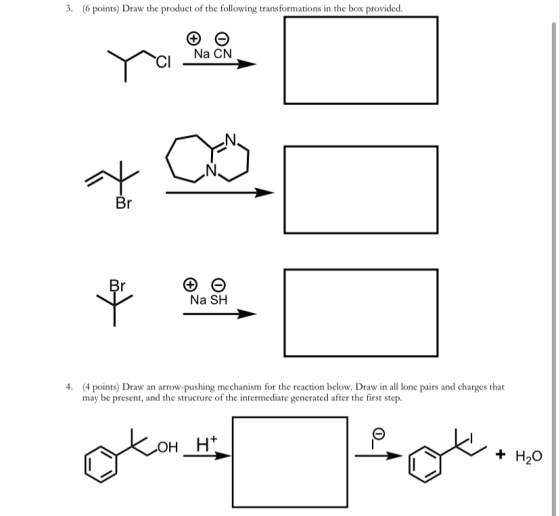
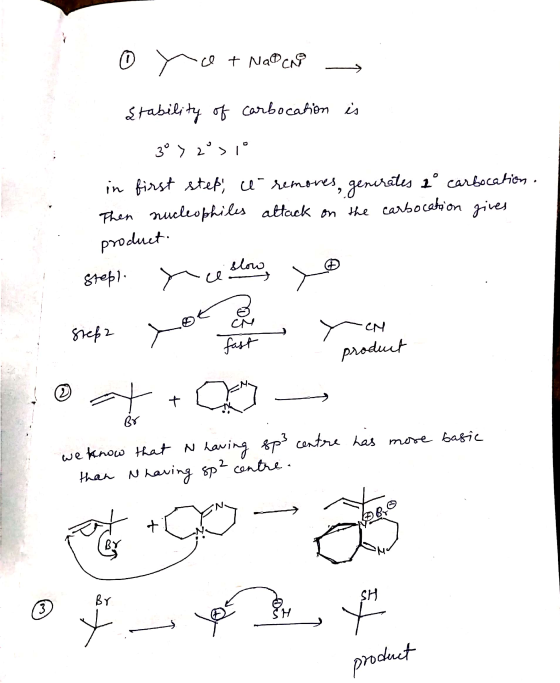
can you please answer all three parts of question 3 with an explanation on how you figured it out?
Homework Answers
Add Answer to:
can you please answer all three parts of question 3 with an
explanation on how you...
PLEASE ANSWER ALL A-G, will give thumbs up!! FOR A, just need explanation why reaction occurs...
 PLEASE ANSWER ALL A-G, will
give thumbs up!! FOR A, just need explanation why reaction occurs
at C2 position rather than C3, already have mechanism drawn...
PLEASE EXPLAIN OR AT LEAST
JUST ANSWER ALL ASAP, BEFORE TOMORROW!!
10. Furan, an aromatic heterocycle, is capable of undergoing electrophilic aromatic substitution. When furan is treated with an acid chloride in the presence of a Lewis acid, Friedel-Crafts acylation occurs in which the electrophile is installed exclusively at the C2 position. Provide...
PLEASE ANSWER ALL A-G, will
give thumbs up!! FOR A, just need explanation why reaction occurs
at C2 position rather than C3, already have mechanism drawn...
PLEASE EXPLAIN OR AT LEAST
JUST ANSWER ALL ASAP, BEFORE TOMORROW!!
10. Furan, an aromatic heterocycle, is capable of undergoing electrophilic aromatic substitution. When furan is treated with an acid chloride in the presence of a Lewis acid, Friedel-Crafts acylation occurs in which the electrophile is installed exclusively at the C2 position. Provide...
Below is the SN1 reaction of (S)-2-iodopentane and bromide (Br–). Complete the mechanism by providing the...
 Below is the SN1 reaction of
(S)-2-iodopentane and bromide (Br–). Complete
the mechanism by providing the missing curved arrow notation, lone
pairs of electrons, and nonzero formal charges. Be sure to draw the
two organic products that will be produced in the third box.
16 Question (3 points) @ See page 407 Below is the Sn1 reaction of (9)-2-iodopentane and bromide (Br). Complete the mechanism by providing the missing curved arrow notation, lone pairs of electrons, and nonzero formal charges....
Below is the SN1 reaction of
(S)-2-iodopentane and bromide (Br–). Complete
the mechanism by providing the missing curved arrow notation, lone
pairs of electrons, and nonzero formal charges. Be sure to draw the
two organic products that will be produced in the third box.
16 Question (3 points) @ See page 407 Below is the Sn1 reaction of (9)-2-iodopentane and bromide (Br). Complete the mechanism by providing the missing curved arrow notation, lone pairs of electrons, and nonzero formal charges....
Please help me find the correct reaction including lone pairs and charges! Thank you Testbank, Question...
 Please help me find the correct reaction including lone pairs
and charges! Thank you
Testbank, Question 122 Your answer is incorrect. Try again. Predict the product(s) for the following reaction and draw the curved arrow mechanism. Include Lone Pairs in you BF H3C All Rights Reserved. A Division of MacBook Pro 2 3 4 7
Please help me find the correct reaction including lone pairs
and charges! Thank you
Testbank, Question 122 Your answer is incorrect. Try again. Predict the product(s) for the following reaction and draw the curved arrow mechanism. Include Lone Pairs in you BF H3C All Rights Reserved. A Division of MacBook Pro 2 3 4 7
please complete all 3 parts! 2. (19pts) The al cohol dehydration product below is of the...
 please complete all 3 parts!
2. (19pts) The al cohol dehydration product below is of the El type elimination. (i) Draw all of the alkene products that could possibly form. (ii) Circle the major alkene product expected. (ii) Draw a complete curved arrow-pushing mechanism illustrating how the major product is formed. Be sure to include all arrows, intermediate structures, and formal charges. (part i-9pts; part ii- 2pts; part iii - 8pts) H-O-S-O-H (catalyst) Он Draw the possible products and circle...
please complete all 3 parts!
2. (19pts) The al cohol dehydration product below is of the El type elimination. (i) Draw all of the alkene products that could possibly form. (ii) Circle the major alkene product expected. (ii) Draw a complete curved arrow-pushing mechanism illustrating how the major product is formed. Be sure to include all arrows, intermediate structures, and formal charges. (part i-9pts; part ii- 2pts; part iii - 8pts) H-O-S-O-H (catalyst) Он Draw the possible products and circle...
Don’t forget lone pairs and no zero charges, thank you so much!! Draw a mechanism, using...
 Don’t forget lone
pairs and no zero charges, thank you so much!!
Draw a mechanism, using curved arrow notation, for the haloform reaction involving3,3-dimethylbutanone bromine, and hydroxide ion. In each box you also need to complete the t-butyl containing structure (including all lone pairs of electrons and any nonzero formal charges). The reagent you need for each step is already included in the box for that step. Do not draw curved arrows in the last box C2 and HO Three...
Don’t forget lone
pairs and no zero charges, thank you so much!!
Draw a mechanism, using curved arrow notation, for the haloform reaction involving3,3-dimethylbutanone bromine, and hydroxide ion. In each box you also need to complete the t-butyl containing structure (including all lone pairs of electrons and any nonzero formal charges). The reagent you need for each step is already included in the box for that step. Do not draw curved arrows in the last box C2 and HO Three...
Need help with all 4 of these synthesis reactions. Br in first question and wants to...
 Need help with all 4 of these synthesis
reactions.
Br in first question and wants to see all arrow pushing,
intermediates and products.
Last three just want the numbered reagents and the
intermediate products after each step. No arrow pushing.
Homework #1 Name: 1. Explain with a mechanism the observation of the given products. (Hint: You will need the full reaction mechonism including all intermediates and reogents, Show the proper use of electron pushing arrows.) HBr 2. Propose an efficient...
Need help with all 4 of these synthesis
reactions.
Br in first question and wants to see all arrow pushing,
intermediates and products.
Last three just want the numbered reagents and the
intermediate products after each step. No arrow pushing.
Homework #1 Name: 1. Explain with a mechanism the observation of the given products. (Hint: You will need the full reaction mechonism including all intermediates and reogents, Show the proper use of electron pushing arrows.) HBr 2. Propose an efficient...
Provide a detailed, stepwise mechanism for the reaction below. (CH3)2CHCH2CH2CH2I+CN??(CH3)2CHCH2CH2CH2CN+I? *Please...
 Provide a detailed, stepwise mechanism for the reaction
below.
(CH3)2CHCH2CH2CH2I+CN??(CH3)2CHCH2CH2CH2CN+I?
*Please show arrow pushing*
Provide a detailed, stepwise mechanism for the reaction bel (CH3)2CHCH2CH2CHICN(CH3)2CHCH2 CH2 CH2CN+I Draw all missing reactants and/or products in the appropriate boxes by placing atoms on the canvas and connecting them with bonds. Add charges where needed. Electron flow arrows should start on an atom or a bond and should end on an atom, bond, or location where a new bond should be created. C1 Br...
Provide a detailed, stepwise mechanism for the reaction
below.
(CH3)2CHCH2CH2CH2I+CN??(CH3)2CHCH2CH2CH2CN+I?
*Please show arrow pushing*
Provide a detailed, stepwise mechanism for the reaction bel (CH3)2CHCH2CH2CHICN(CH3)2CHCH2 CH2 CH2CN+I Draw all missing reactants and/or products in the appropriate boxes by placing atoms on the canvas and connecting them with bonds. Add charges where needed. Electron flow arrows should start on an atom or a bond and should end on an atom, bond, or location where a new bond should be created. C1 Br...
15 Question (3 points) This molecule undergoes an S2 mechanism. Provide the missing parts of the mechanism in the f...
 15 Question (3 points) This molecule undergoes an S2 mechanism. Provide the missing parts of the mechanism in the first two boxes. Draw ONLY the major organic substitution product in the final box (do not draw any inorganic byproducts). 4th attempt aliul See Periodic Table See Hint H-C: Draw the organic product with all applicable lone pair electrons and nonzero formal charges.
i need steps 3.4,6 please 11. 20/19 23 Question See page 1062 points) Provide the missing...
 i need steps 3.4,6 please
11. 20/19 23 Question See page 1062 points) Provide the missing curved arrows and structures to complete the mechanism of the Fischer esterification. Your structures should indude all nonzero formal charges and one pairs of electrons. The reagents you need for each mechanistic step are provided in each box. 29th attempt See Periodic Table See Hint op Draw the organic intermediate with lone pair electrons and non-zero formal charges. Add the curved arrow notation.
i need steps 3.4,6 please
11. 20/19 23 Question See page 1062 points) Provide the missing curved arrows and structures to complete the mechanism of the Fischer esterification. Your structures should indude all nonzero formal charges and one pairs of electrons. The reagents you need for each mechanistic step are provided in each box. 29th attempt See Periodic Table See Hint op Draw the organic intermediate with lone pair electrons and non-zero formal charges. Add the curved arrow notation.
9. For the compound below answer a b and c. a) b) c) (3 pts) is...
 9. For the compound below answer a b and c. a) b) c) (3 pts) is the molecule below an aromatic or anti-aromatic estem? (4 pts) How many electrons are in the aromatic anti aromatic bratem? (4 pts). Draw an arrow () to the lone pair electron(s) that are part of the aromatic (or anti-aromatic) system. 10. (18 pts-6 pts each) Fill in the major organic product(s) for the reactions below Br+FeBr ci + CH CH CH .. 3+ AICI:...
 PLEASE ANSWER ALL A-G, will
give thumbs up!! FOR A, just need explanation why reaction occurs
at C2 position rather than C3, already have mechanism drawn...
PLEASE EXPLAIN OR AT LEAST
JUST ANSWER ALL ASAP, BEFORE TOMORROW!!
10. Furan, an aromatic heterocycle, is capable of undergoing electrophilic aromatic substitution. When furan is treated with an acid chloride in the presence of a Lewis acid, Friedel-Crafts acylation occurs in which the electrophile is installed exclusively at the C2 position. Provide...
PLEASE ANSWER ALL A-G, will
give thumbs up!! FOR A, just need explanation why reaction occurs
at C2 position rather than C3, already have mechanism drawn...
PLEASE EXPLAIN OR AT LEAST
JUST ANSWER ALL ASAP, BEFORE TOMORROW!!
10. Furan, an aromatic heterocycle, is capable of undergoing electrophilic aromatic substitution. When furan is treated with an acid chloride in the presence of a Lewis acid, Friedel-Crafts acylation occurs in which the electrophile is installed exclusively at the C2 position. Provide...
 Below is the SN1 reaction of
(S)-2-iodopentane and bromide (Br–). Complete
the mechanism by providing the missing curved arrow notation, lone
pairs of electrons, and nonzero formal charges. Be sure to draw the
two organic products that will be produced in the third box.
16 Question (3 points) @ See page 407 Below is the Sn1 reaction of (9)-2-iodopentane and bromide (Br). Complete the mechanism by providing the missing curved arrow notation, lone pairs of electrons, and nonzero formal charges....
Below is the SN1 reaction of
(S)-2-iodopentane and bromide (Br–). Complete
the mechanism by providing the missing curved arrow notation, lone
pairs of electrons, and nonzero formal charges. Be sure to draw the
two organic products that will be produced in the third box.
16 Question (3 points) @ See page 407 Below is the Sn1 reaction of (9)-2-iodopentane and bromide (Br). Complete the mechanism by providing the missing curved arrow notation, lone pairs of electrons, and nonzero formal charges....
 Please help me find the correct reaction including lone pairs
and charges! Thank you
Testbank, Question 122 Your answer is incorrect. Try again. Predict the product(s) for the following reaction and draw the curved arrow mechanism. Include Lone Pairs in you BF H3C All Rights Reserved. A Division of MacBook Pro 2 3 4 7
Please help me find the correct reaction including lone pairs
and charges! Thank you
Testbank, Question 122 Your answer is incorrect. Try again. Predict the product(s) for the following reaction and draw the curved arrow mechanism. Include Lone Pairs in you BF H3C All Rights Reserved. A Division of MacBook Pro 2 3 4 7
 please complete all 3 parts!
2. (19pts) The al cohol dehydration product below is of the El type elimination. (i) Draw all of the alkene products that could possibly form. (ii) Circle the major alkene product expected. (ii) Draw a complete curved arrow-pushing mechanism illustrating how the major product is formed. Be sure to include all arrows, intermediate structures, and formal charges. (part i-9pts; part ii- 2pts; part iii - 8pts) H-O-S-O-H (catalyst) Он Draw the possible products and circle...
please complete all 3 parts!
2. (19pts) The al cohol dehydration product below is of the El type elimination. (i) Draw all of the alkene products that could possibly form. (ii) Circle the major alkene product expected. (ii) Draw a complete curved arrow-pushing mechanism illustrating how the major product is formed. Be sure to include all arrows, intermediate structures, and formal charges. (part i-9pts; part ii- 2pts; part iii - 8pts) H-O-S-O-H (catalyst) Он Draw the possible products and circle...
 Don’t forget lone
pairs and no zero charges, thank you so much!!
Draw a mechanism, using curved arrow notation, for the haloform reaction involving3,3-dimethylbutanone bromine, and hydroxide ion. In each box you also need to complete the t-butyl containing structure (including all lone pairs of electrons and any nonzero formal charges). The reagent you need for each step is already included in the box for that step. Do not draw curved arrows in the last box C2 and HO Three...
Don’t forget lone
pairs and no zero charges, thank you so much!!
Draw a mechanism, using curved arrow notation, for the haloform reaction involving3,3-dimethylbutanone bromine, and hydroxide ion. In each box you also need to complete the t-butyl containing structure (including all lone pairs of electrons and any nonzero formal charges). The reagent you need for each step is already included in the box for that step. Do not draw curved arrows in the last box C2 and HO Three...
 Need help with all 4 of these synthesis
reactions.
Br in first question and wants to see all arrow pushing,
intermediates and products.
Last three just want the numbered reagents and the
intermediate products after each step. No arrow pushing.
Homework #1 Name: 1. Explain with a mechanism the observation of the given products. (Hint: You will need the full reaction mechonism including all intermediates and reogents, Show the proper use of electron pushing arrows.) HBr 2. Propose an efficient...
Need help with all 4 of these synthesis
reactions.
Br in first question and wants to see all arrow pushing,
intermediates and products.
Last three just want the numbered reagents and the
intermediate products after each step. No arrow pushing.
Homework #1 Name: 1. Explain with a mechanism the observation of the given products. (Hint: You will need the full reaction mechonism including all intermediates and reogents, Show the proper use of electron pushing arrows.) HBr 2. Propose an efficient...
 Provide a detailed, stepwise mechanism for the reaction
below.
(CH3)2CHCH2CH2CH2I+CN??(CH3)2CHCH2CH2CH2CN+I?
*Please show arrow pushing*
Provide a detailed, stepwise mechanism for the reaction bel (CH3)2CHCH2CH2CHICN(CH3)2CHCH2 CH2 CH2CN+I Draw all missing reactants and/or products in the appropriate boxes by placing atoms on the canvas and connecting them with bonds. Add charges where needed. Electron flow arrows should start on an atom or a bond and should end on an atom, bond, or location where a new bond should be created. C1 Br...
Provide a detailed, stepwise mechanism for the reaction
below.
(CH3)2CHCH2CH2CH2I+CN??(CH3)2CHCH2CH2CH2CN+I?
*Please show arrow pushing*
Provide a detailed, stepwise mechanism for the reaction bel (CH3)2CHCH2CH2CHICN(CH3)2CHCH2 CH2 CH2CN+I Draw all missing reactants and/or products in the appropriate boxes by placing atoms on the canvas and connecting them with bonds. Add charges where needed. Electron flow arrows should start on an atom or a bond and should end on an atom, bond, or location where a new bond should be created. C1 Br...
 15 Question (3 points) This molecule undergoes an S2 mechanism. Provide the missing parts of the mechanism in the first two boxes. Draw ONLY the major organic substitution product in the final box (do not draw any inorganic byproducts). 4th attempt aliul See Periodic Table See Hint H-C: Draw the organic product with all applicable lone pair electrons and nonzero formal charges.
 i need steps 3.4,6 please
11. 20/19 23 Question See page 1062 points) Provide the missing curved arrows and structures to complete the mechanism of the Fischer esterification. Your structures should indude all nonzero formal charges and one pairs of electrons. The reagents you need for each mechanistic step are provided in each box. 29th attempt See Periodic Table See Hint op Draw the organic intermediate with lone pair electrons and non-zero formal charges. Add the curved arrow notation.
i need steps 3.4,6 please
11. 20/19 23 Question See page 1062 points) Provide the missing curved arrows and structures to complete the mechanism of the Fischer esterification. Your structures should indude all nonzero formal charges and one pairs of electrons. The reagents you need for each mechanistic step are provided in each box. 29th attempt See Periodic Table See Hint op Draw the organic intermediate with lone pair electrons and non-zero formal charges. Add the curved arrow notation.
 9. For the compound below answer a b and c. a) b) c) (3 pts) is the molecule below an aromatic or anti-aromatic estem? (4 pts) How many electrons are in the aromatic anti aromatic bratem? (4 pts). Draw an arrow () to the lone pair electron(s) that are part of the aromatic (or anti-aromatic) system. 10. (18 pts-6 pts each) Fill in the major organic product(s) for the reactions below Br+FeBr ci + CH CH CH .. 3+ AICI:...
Most questions answered within 3 hours.
-
Where is the error in this code sequence?
String s1 = "Hello";
String s2 = "ello";...
asked 11 months ago -
Financial data for Joel de Paris, Inc., for last year
follow:
Joel de Paris, Inc.
Balance...
asked 11 months ago -
Consider this reaction:
Al2(SO4)3 (aq)+ BaCl3
(aq) Al2Cl6 (aq)- +
3BaSO4(s) . What is the...
asked 11 months ago -
Suppose that Savneet is considering increasing her
recent random sample from 20 car rentals to 40...
asked 11 months ago -
Trucks arrive at an unloading terminal at an average rate of 120
per hour.
Trucks arrive...
asked 11 months ago -
Why are methanol and ethanol completely soluble in water while
octanol is not very little soluble....
asked 11 months ago -
A facilities manager at a university reads in a research report
that the mean amount of...
asked 11 months ago -
When the CuSO4 is rehydrated by adding water to the anhydrous
compound, is this an endothermic...
asked 11 months ago -
A ray of sunlight is passing from diamond into crown glass; the
angle of incidence is...
asked 11 months ago -
A block of mass 0.249 kg is placed on top of a light, vertical
spring of...
asked 11 months ago -
how do the kidneys compensate in the presences of acidosis
a) trigger hyperventilate
b) reserve acid...
asked 11 months ago -
Question 501 pts
The rental rate of capital to the firm increases. Which of the
following...
asked 11 months ago