
Homework Answers
Add Answer to:
id to locus in Chem, he i symer that is a The mechanism for the addition...
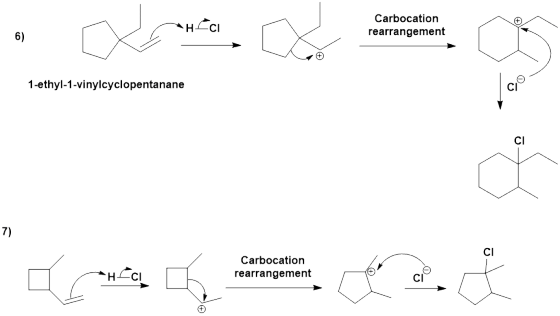
Provide the mechanism for the addition of hydrochloric acid to cyclobutylethene, which occurs through a ring...
Provide the mechanism for the addition of hydrochloric acid to cyclobutylethene, which occurs through a ring expansion mechanism. Indicate the transition state of the ring opening step using brackets and the ‡ symbol, the dashed lines for the bonds breaking and forming and indicate all partial charges with a δ(+/-). Also, indicate the "H" that is added in Markovnikov fashion to the double bond with lue color. Be sure that the reaction is neat and all bonds have propper angles.
(C) Protonation of alkene to form a carbocation followed by addition of bromide ion (D) Addition...
 (C) Protonation of alkene to form a carbocation followed by addition of bromide ion (D) Addition of the proton to one face of the alkene with simultaneous delivery of a bromide ion from a different molecule of H-Br. 11. Which compound is the strongest nmucleophile for reaction of methane methanesulfonate (CHOS0.CH) in methanol at room temperature? (You may assume that everything is soluble in methanol) (A) potassium bromide (B) cesium iodide (C) sodiam chloride (D) lithium flaoride 12. Which proton...
please answer the prelab excercise:) I tried doing it but I did not get very far Experiment 7: Grignard Reactio...
 please answer the prelab excercise:) I tried doing it but I did not
get very far
Experiment 7: Grignard Reaction. Introduction Discovered by French chemist Victor Grignard, the reaction that now bears his name is an example of the preparation of an organometallic reagent. In this lab, phenylmagnesium bromide is the Grignard of interest, and it will be added to an aldehyde to produce an alcohol. Lab Objectives 1. To study organometallic reagents in general. benzophenone. 2. To prepare phenylmagnesium...
please answer the prelab excercise:) I tried doing it but I did not
get very far
Experiment 7: Grignard Reaction. Introduction Discovered by French chemist Victor Grignard, the reaction that now bears his name is an example of the preparation of an organometallic reagent. In this lab, phenylmagnesium bromide is the Grignard of interest, and it will be added to an aldehyde to produce an alcohol. Lab Objectives 1. To study organometallic reagents in general. benzophenone. 2. To prepare phenylmagnesium...
 (C) Protonation of alkene to form a carbocation followed by addition of bromide ion (D) Addition of the proton to one face of the alkene with simultaneous delivery of a bromide ion from a different molecule of H-Br. 11. Which compound is the strongest nmucleophile for reaction of methane methanesulfonate (CHOS0.CH) in methanol at room temperature? (You may assume that everything is soluble in methanol) (A) potassium bromide (B) cesium iodide (C) sodiam chloride (D) lithium flaoride 12. Which proton...
 please answer the prelab excercise:) I tried doing it but I did not
get very far
Experiment 7: Grignard Reaction. Introduction Discovered by French chemist Victor Grignard, the reaction that now bears his name is an example of the preparation of an organometallic reagent. In this lab, phenylmagnesium bromide is the Grignard of interest, and it will be added to an aldehyde to produce an alcohol. Lab Objectives 1. To study organometallic reagents in general. benzophenone. 2. To prepare phenylmagnesium...
please answer the prelab excercise:) I tried doing it but I did not
get very far
Experiment 7: Grignard Reaction. Introduction Discovered by French chemist Victor Grignard, the reaction that now bears his name is an example of the preparation of an organometallic reagent. In this lab, phenylmagnesium bromide is the Grignard of interest, and it will be added to an aldehyde to produce an alcohol. Lab Objectives 1. To study organometallic reagents in general. benzophenone. 2. To prepare phenylmagnesium...
Most questions answered within 3 hours.
-
Where is the error in this code sequence?
String s1 = "Hello";
String s2 = "ello";...
asked 11 months ago -
Financial data for Joel de Paris, Inc., for last year
follow:
Joel de Paris, Inc.
Balance...
asked 11 months ago -
Consider this reaction:
Al2(SO4)3 (aq)+ BaCl3
(aq) Al2Cl6 (aq)- +
3BaSO4(s) . What is the...
asked 11 months ago -
Suppose that Savneet is considering increasing her
recent random sample from 20 car rentals to 40...
asked 11 months ago -
Trucks arrive at an unloading terminal at an average rate of 120
per hour.
Trucks arrive...
asked 11 months ago -
Why are methanol and ethanol completely soluble in water while
octanol is not very little soluble....
asked 11 months ago -
A facilities manager at a university reads in a research report
that the mean amount of...
asked 11 months ago -
When the CuSO4 is rehydrated by adding water to the anhydrous
compound, is this an endothermic...
asked 11 months ago -
A ray of sunlight is passing from diamond into crown glass; the
angle of incidence is...
asked 11 months ago -
A block of mass 0.249 kg is placed on top of a light, vertical
spring of...
asked 11 months ago -
how do the kidneys compensate in the presences of acidosis
a) trigger hyperventilate
b) reserve acid...
asked 11 months ago -
Question 501 pts
The rental rate of capital to the firm increases. Which of the
following...
asked 11 months ago