
Homework Answers
The circled answer is not correct.
The correct answer js option D.
For every enzyme or catalyst, there is an optimum temperature where the rate of reaction reaches the maximum. While increasing temperature the reaction rate increases because the collision rate favours the reaction. After reaching the optimum, the denaturing of enzyme takes place as enzymes are protein units which can unfold if temperature increases too much. Thus active sites get destroyed and reaction rate falls
Add Answer to:
which of the following best describe the behavior of the rate
(R) of starch going to...
Let’s say that enzyme X is the catalyst responsible for breaking starch down to individual glucose...
Let’s say that enzyme X is the catalyst responsible for breaking starch down to individual glucose molecules. Which of the following things can happen to the starch and enzyme system if you raise the temperature? Enzyme X catalyzed Starch -------------------------------> many glucose molecules a) The rate of the reaction of starch going to glucose will increase. b) Nothing should happen since a catalyst does not affect the equilibrium. c) The enzyme could stop working effectively because the folded form would...
In order to measure the rate of this reaction, we utilized the fact that starch -...
 In order to measure the rate of this reaction, we utilized the fact that starch - in the presence of iodine has a distinct dark blue color while the conversion of starch to its monomer leads to a more transparent/amber colored solution. While you used a simple visual analysis to verify the conversion, it is also possible to quantify the change in (starch) using a spectrophotometer. 1. Why/how was a spectrophotometer used for this purpose? EXPLAIN what this machine does...
Which of the diagrams illustrates the way in which the rate of an enzyme-controlled reaction depends...
 Which of the diagrams illustrates the way in which the rate of an enzyme-controlled reaction depends on substrate concentration? * А B Rate of reaction MÚN Substrate concentration A B D When starch and amylase are mixed in the presence of iodine solution, the blue-black colour rapidly disappears. This is due to the formation of which molecule? * glucose O glycogen sucrose O maltose Which of the following enzyme groups can catalyse oxidation reactions? * O phosphorylases isomerases hydrolases dehydrogenases...
Which of the following best describes the behavior of a "miserly" object? (A) As U increases,...
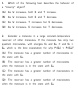 Which of the following best describes the behavior of a "miserly" object? (A) As U increases, both S and T increase. (B) As U increases, both S and T decrease. (C) As U increases, T increases but S decreases. (D) As U increases, S increases but T decreases. Consider a molecule in a large constant-temperature reservoir of other molecules. If the molecule has only two quantum microstates, with energies E_1 and E_0, if and E_1 > E_0, which is the...
8) Which of the following best describe Net Present Value (NPV), Internal Rate of Return (IRR)...
 8) Which of the following best describe Net Present Value (NPV), Internal Rate of Return (IRR) and Payback (PB): O d) None of these really describe how each of these 3 decision tools is used O b) NPV=bang for the buck; IRR= how long is my money at risk; PB-size of the prize O a) NPV=how long is my money at risk; IRR=size of the prize; PB=bang for the buck O c) NPV=size of the prize; IRR=bang for the buck;...
2. hypothesize the best conditions (pH and temperature) under which the enzyme chymotrypsin functions with an...
 2. hypothesize the best conditions (pH and temperature) under
which the enzyme chymotrypsin functions with an appropriate
reference. also, hypothesize what will occur in the presence of an
inhibitor and the type of inhibition.
EXPERIMENT 5: ENZYME ACTIVITY WITH a-CHYMOTRYPSIN Prelab Assignment 1. Prepare a flow chart, covering one half of the experimental work (either part A and C if your lab bench is on the window side of the lab or part B and D if your locker is...
2. hypothesize the best conditions (pH and temperature) under
which the enzyme chymotrypsin functions with an appropriate
reference. also, hypothesize what will occur in the presence of an
inhibitor and the type of inhibition.
EXPERIMENT 5: ENZYME ACTIVITY WITH a-CHYMOTRYPSIN Prelab Assignment 1. Prepare a flow chart, covering one half of the experimental work (either part A and C if your lab bench is on the window side of the lab or part B and D if your locker is...
For the first-order reaction X ⟶ products, which of the following graphs is best for determining...
For the first-order reaction X ⟶ products, which of the following graphs is best for determining the activation energy, Ea ? Note: The best choice is the one that yields a straight line graph with the slope directly proportional to Ea . In the options below, T is the kelvin temperature and t is time. (a) k versus 1/T (b) 1 / [X] versus t (c) ln k versus T (d) ln [X] versus t (e) [X] versus t (f)...
Fix the following passage by choosing the best option for each (#) from the multiple-choice list....
Fix the following passage by choosing the best option for each (#) from the multiple-choice list. There may be more than one correct answer - select the BEST answer. What I remember most about those days was working — we all worked (1) I started going out with my brothers, shining shoes. We would also take a bucket of water and some soap and wash whatever cars we could. My mother cooked for people (2) she sold lottery tickets, and...
1. Which of the following statements best describe Ampere's Law? a. The time rate of change...
 1. Which of the following statements best describe Ampere's Law? a. The time rate of change in the voltage is proportional to the current. b. The voltage drop across a capacitor is directly proportional to current. C. The voltage drops across a resistor directly proportional to the emf. d. The voltage drops across a resistor directly proportional to the current. 2. Which of the following statements best describe Faraday's Law of induction? a. The time rate of change in the...
1. Which of the following statements best describe Ampere's Law? The time rate of change in...
 1. Which of the following statements best describe Ampere's Law? The time rate of change in the voltage is proportional to the current. The voltage drop across a capacitor is directly proportional to current. The voltage drops across a resistor directly proportional to the emf. d. a. b. c. The voltage drops across a resistor directly proportional to the current. 2. Which of the following statements best describe Faraday's Law of induction? a. The time rate of change in the...
 In order to measure the rate of this reaction, we utilized the fact that starch - in the presence of iodine has a distinct dark blue color while the conversion of starch to its monomer leads to a more transparent/amber colored solution. While you used a simple visual analysis to verify the conversion, it is also possible to quantify the change in (starch) using a spectrophotometer. 1. Why/how was a spectrophotometer used for this purpose? EXPLAIN what this machine does...
 Which of the diagrams illustrates the way in which the rate of an enzyme-controlled reaction depends on substrate concentration? * А B Rate of reaction MÚN Substrate concentration A B D When starch and amylase are mixed in the presence of iodine solution, the blue-black colour rapidly disappears. This is due to the formation of which molecule? * glucose O glycogen sucrose O maltose Which of the following enzyme groups can catalyse oxidation reactions? * O phosphorylases isomerases hydrolases dehydrogenases...
 Which of the following best describes the behavior of a "miserly" object? (A) As U increases, both S and T increase. (B) As U increases, both S and T decrease. (C) As U increases, T increases but S decreases. (D) As U increases, S increases but T decreases. Consider a molecule in a large constant-temperature reservoir of other molecules. If the molecule has only two quantum microstates, with energies E_1 and E_0, if and E_1 > E_0, which is the...
 8) Which of the following best describe Net Present Value (NPV), Internal Rate of Return (IRR) and Payback (PB): O d) None of these really describe how each of these 3 decision tools is used O b) NPV=bang for the buck; IRR= how long is my money at risk; PB-size of the prize O a) NPV=how long is my money at risk; IRR=size of the prize; PB=bang for the buck O c) NPV=size of the prize; IRR=bang for the buck;...
 2. hypothesize the best conditions (pH and temperature) under
which the enzyme chymotrypsin functions with an appropriate
reference. also, hypothesize what will occur in the presence of an
inhibitor and the type of inhibition.
EXPERIMENT 5: ENZYME ACTIVITY WITH a-CHYMOTRYPSIN Prelab Assignment 1. Prepare a flow chart, covering one half of the experimental work (either part A and C if your lab bench is on the window side of the lab or part B and D if your locker is...
2. hypothesize the best conditions (pH and temperature) under
which the enzyme chymotrypsin functions with an appropriate
reference. also, hypothesize what will occur in the presence of an
inhibitor and the type of inhibition.
EXPERIMENT 5: ENZYME ACTIVITY WITH a-CHYMOTRYPSIN Prelab Assignment 1. Prepare a flow chart, covering one half of the experimental work (either part A and C if your lab bench is on the window side of the lab or part B and D if your locker is...
 1. Which of the following statements best describe Ampere's Law? a. The time rate of change in the voltage is proportional to the current. b. The voltage drop across a capacitor is directly proportional to current. C. The voltage drops across a resistor directly proportional to the emf. d. The voltage drops across a resistor directly proportional to the current. 2. Which of the following statements best describe Faraday's Law of induction? a. The time rate of change in the...
 1. Which of the following statements best describe Ampere's Law? The time rate of change in the voltage is proportional to the current. The voltage drop across a capacitor is directly proportional to current. The voltage drops across a resistor directly proportional to the emf. d. a. b. c. The voltage drops across a resistor directly proportional to the current. 2. Which of the following statements best describe Faraday's Law of induction? a. The time rate of change in the...
Most questions answered within 3 hours.
-
Where is the error in this code sequence?
String s1 = "Hello";
String s2 = "ello";...
asked 11 months ago -
Financial data for Joel de Paris, Inc., for last year
follow:
Joel de Paris, Inc.
Balance...
asked 11 months ago -
Consider this reaction:
Al2(SO4)3 (aq)+ BaCl3
(aq) Al2Cl6 (aq)- +
3BaSO4(s) . What is the...
asked 11 months ago -
Suppose that Savneet is considering increasing her
recent random sample from 20 car rentals to 40...
asked 11 months ago -
Trucks arrive at an unloading terminal at an average rate of 120
per hour.
Trucks arrive...
asked 11 months ago -
Why are methanol and ethanol completely soluble in water while
octanol is not very little soluble....
asked 11 months ago -
A facilities manager at a university reads in a research report
that the mean amount of...
asked 11 months ago -
When the CuSO4 is rehydrated by adding water to the anhydrous
compound, is this an endothermic...
asked 11 months ago -
A ray of sunlight is passing from diamond into crown glass; the
angle of incidence is...
asked 11 months ago -
A block of mass 0.249 kg is placed on top of a light, vertical
spring of...
asked 11 months ago -
how do the kidneys compensate in the presences of acidosis
a) trigger hyperventilate
b) reserve acid...
asked 11 months ago -
Question 501 pts
The rental rate of capital to the firm increases. Which of the
following...
asked 11 months ago