
Homework Answers
Add Answer to:
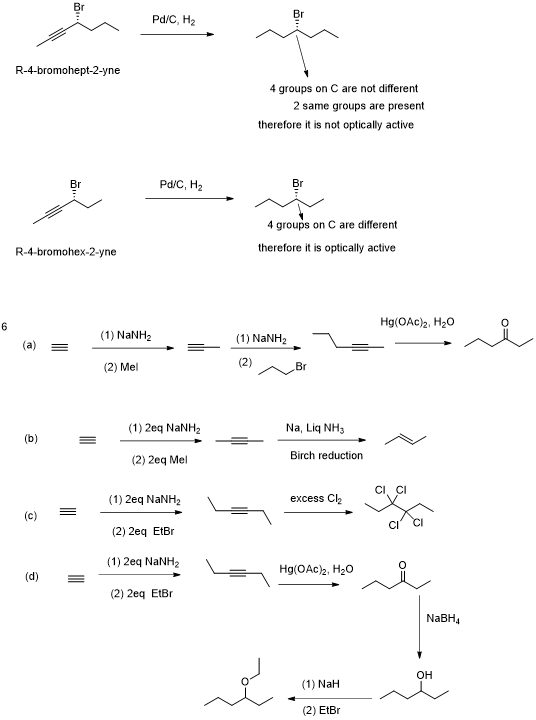
5. When (R)-4-bromohept-2-yne is treated with excess H2 in the presence of Pd/C, the product is...
B3: The following optically active oone optically active, one with no optical ac alkene, upon hydrogeraito explain this observation. n, yields two 4 pts H2 2 different products Pd/C CH3 B4: 1,3-...
 B3: The following optically active oone optically active, one with no optical ac alkene, upon hydrogeraito explain this observation. n, yields two 4 pts H2 2 different products Pd/C CH3 B4: 1,3-butadiene, when treated with HBr, gives a mix of two product neither of which is 4-bromobut-1-ene. Predict both these products using mechanism that involves a single carbocation intermediate: 4 4-bromobut-1-ene Anot formed! HBr C5: Terminal alkynes are moderately acidic synthetically. When pent-1-yne is treated with a strong base [sodium...
2. Draw the major product(s) formed when the optically active compound shown below is treated with...
 2. Draw the major product(s) formed when the optically active compound shown below is treated with H2O/H2SO4. Is the product optically active? Why or why not? (4 pts) optically active
Draw the product formed when 1-bromobutane is treated with cach reagent. 1. Li (2 equiv) 2....
 Draw the product formed when 1-bromobutane is treated with cach reagent. 1. Li (2 equiv) 2. Mg in (CHCH2):0 solvent 3. Li (2 equiv), then Cul (0.5 equiv) 4. The answer in (a), then H;O 5. The answer in (b), then D20 6. The answer in (a), then CH,CCH Draw the product formed when (CH3CH2CH2CH2) CuLi is treated with each compound. In so cases, no reaction occurs. CHн, ,then H,O Draw the product formed when the a.ß-unsaturated ketone A is...
2. Predict the product for the following transformations (show proper stereochemistry). Pd/C, H2 Me Me Pd/C,...
 2. Predict the product for the following transformations (show proper stereochemistry). Pd/C, H2 Me Me Pd/C, H2 Me Ph 4. Draw an abbreviated mechanism of the reaction shown below (you can symbolize the Pd/C as a surface, like the one drawn below) Hint. draw an intermediate similar to this: R H MeO H H2 (gas) R MeO metal surface metal surface Pd/C) (Pd/C)
FULL SCREEN PRINTER VERSION 4 BACK NE Integrated Problem 18.76 Benzene was treated with (R)-2-chlorobutane in...
 FULL SCREEN PRINTER VERSION 4 BACK NE Integrated Problem 18.76 Benzene was treated with (R)-2-chlorobutane in the presence of aluminum trichloride, and the resulting product mixture was found to be optically inactive. 18.41 18.42 em Get help answering Molecular Drawing questions. Draw the expected organic product(s) of the reaction assuming that conditions are chosen to favor monoalkylation. Using wedges and dashes, indicate the stereochemistry, 18.53 18.54 ? Edit SHOW HINT Choose the correct explanation, why the product mixture is optically...
Hc VCH Draw the organic product formed when CH3CH2CH2OH is treated with each reagent. a H2S04 (180°C) d SOC12, pyri...
 Hc VCH Draw the organic product formed when CH3CH2CH2OH is treated with each reagent. a H2S04 (180°C) d SOC12, pyridine Ig 1) NaH; 2) CH3CH2Br b NaH e PBr3 h 1) TSCI, pyridine; 2) NaSH c HBr f TsCl, pyridine 3. Draw the organic product formed when l-methylcyclohexanol is treaded with each reagent. In some cases, no reaction occurs. a KH c HBr Te NaHCO3 b Nacid HCI f 1) KH; 2) CH3CH2Br Draw two different routes to each of...
2. Fill in the missing reagent, product or catalyst. H2, Pd/C A. excess) CH2l2, Zn(Cu) B....
 2. Fill in the missing reagent, product or catalyst. H2, Pd/C A. excess) CH2l2, Zn(Cu) B. ether HIO4 C. H20, THF 2) NaHSO3
3) Show how hex-1-yne might be converted to: a. 1-bromohex-1-ene b. 1,1,2,2-tetrabromohexane C. 2-bromohex-1-ene d. 2-bromohexane...
 3) Show how hex-1-yne might be converted to: a. 1-bromohex-1-ene b. 1,1,2,2-tetrabromohexane C. 2-bromohex-1-ene d. 2-bromohexane e. 2,2-dibromohexane 4) For each compound, give the product(s) expected from (1) HgSo./H2SO4-catalyzed hydration and (2) hydroboration-oxidation. a. hex-1-yne b. hex-2-yne c. hex-3-yne d. cyclodecyne 5) Predict the product(s) you would expect from treatment of each compound with (1) dilute, neutral KMnO, and (2) warm, basic KMnO, then dilute acid. a. hex-1-yne b. hex-2-yne c. hex-3-yne d. 2-methylhex-3-yne e. But-1-ene → butan-2-ol 6) Show...
Please give the product structure expected when but-1-yne reacts with: 1. 1 mol H2/Ni 2. 2...
Please give the product structure expected when but-1-yne reacts with: 1. 1 mol H2/Ni 2. 2 mols H2/Ni 3. 1 mol Br2/ hexane (solvent) 4. 2 mols Br2/hexane (solvent) 5. 1 mol HCl (dry gas) 6. 2 mols HCl (dry gas) Please show your work with electron pushing arrows so I can understand how you got your answers? :)
Starting Material Reagent Major Product? H2, Pd/C 1) 050 2) aq. KHSO3 1) CH3CO3H 2) NaOH/H20...
 Starting Material Reagent Major Product? H2, Pd/C 1) 050 2) aq. KHSO3 1) CH3CO3H 2) NaOH/H20 Braz/H20 1) 0; 2) Zn/HOÁC Provide reagents and/or starting materials to accomplish the following transformations pH ن – EC–CH = ا سے ہی الا) CH3 0CH3 H.C ) م any alkene CH3 H3C- Hy, Pd/C CH3 optically active diterpene mixture of diastereomers 1) 0, 2) Zn/HOÁC нэс CH3 + 0 + 0 + H нас
 B3: The following optically active oone optically active, one with no optical ac alkene, upon hydrogeraito explain this observation. n, yields two 4 pts H2 2 different products Pd/C CH3 B4: 1,3-butadiene, when treated with HBr, gives a mix of two product neither of which is 4-bromobut-1-ene. Predict both these products using mechanism that involves a single carbocation intermediate: 4 4-bromobut-1-ene Anot formed! HBr C5: Terminal alkynes are moderately acidic synthetically. When pent-1-yne is treated with a strong base [sodium...
 2. Draw the major product(s) formed when the optically active compound shown below is treated with H2O/H2SO4. Is the product optically active? Why or why not? (4 pts) optically active
 Draw the product formed when 1-bromobutane is treated with cach reagent. 1. Li (2 equiv) 2. Mg in (CHCH2):0 solvent 3. Li (2 equiv), then Cul (0.5 equiv) 4. The answer in (a), then H;O 5. The answer in (b), then D20 6. The answer in (a), then CH,CCH Draw the product formed when (CH3CH2CH2CH2) CuLi is treated with each compound. In so cases, no reaction occurs. CHн, ,then H,O Draw the product formed when the a.ß-unsaturated ketone A is...
 2. Predict the product for the following transformations (show proper stereochemistry). Pd/C, H2 Me Me Pd/C, H2 Me Ph 4. Draw an abbreviated mechanism of the reaction shown below (you can symbolize the Pd/C as a surface, like the one drawn below) Hint. draw an intermediate similar to this: R H MeO H H2 (gas) R MeO metal surface metal surface Pd/C) (Pd/C)
 FULL SCREEN PRINTER VERSION 4 BACK NE Integrated Problem 18.76 Benzene was treated with (R)-2-chlorobutane in the presence of aluminum trichloride, and the resulting product mixture was found to be optically inactive. 18.41 18.42 em Get help answering Molecular Drawing questions. Draw the expected organic product(s) of the reaction assuming that conditions are chosen to favor monoalkylation. Using wedges and dashes, indicate the stereochemistry, 18.53 18.54 ? Edit SHOW HINT Choose the correct explanation, why the product mixture is optically...
 Hc VCH Draw the organic product formed when CH3CH2CH2OH is treated with each reagent. a H2S04 (180°C) d SOC12, pyridine Ig 1) NaH; 2) CH3CH2Br b NaH e PBr3 h 1) TSCI, pyridine; 2) NaSH c HBr f TsCl, pyridine 3. Draw the organic product formed when l-methylcyclohexanol is treaded with each reagent. In some cases, no reaction occurs. a KH c HBr Te NaHCO3 b Nacid HCI f 1) KH; 2) CH3CH2Br Draw two different routes to each of...
 2. Fill in the missing reagent, product or catalyst. H2, Pd/C A. excess) CH2l2, Zn(Cu) B. ether HIO4 C. H20, THF 2) NaHSO3
 3) Show how hex-1-yne might be converted to: a. 1-bromohex-1-ene b. 1,1,2,2-tetrabromohexane C. 2-bromohex-1-ene d. 2-bromohexane e. 2,2-dibromohexane 4) For each compound, give the product(s) expected from (1) HgSo./H2SO4-catalyzed hydration and (2) hydroboration-oxidation. a. hex-1-yne b. hex-2-yne c. hex-3-yne d. cyclodecyne 5) Predict the product(s) you would expect from treatment of each compound with (1) dilute, neutral KMnO, and (2) warm, basic KMnO, then dilute acid. a. hex-1-yne b. hex-2-yne c. hex-3-yne d. 2-methylhex-3-yne e. But-1-ene → butan-2-ol 6) Show...
 Starting Material Reagent Major Product? H2, Pd/C 1) 050 2) aq. KHSO3 1) CH3CO3H 2) NaOH/H20 Braz/H20 1) 0; 2) Zn/HOÁC Provide reagents and/or starting materials to accomplish the following transformations pH ن – EC–CH = ا سے ہی الا) CH3 0CH3 H.C ) م any alkene CH3 H3C- Hy, Pd/C CH3 optically active diterpene mixture of diastereomers 1) 0, 2) Zn/HOÁC нэс CH3 + 0 + 0 + H нас
Most questions answered within 3 hours.
-
Where is the error in this code sequence?
String s1 = "Hello";
String s2 = "ello";...
asked 10 months ago -
Financial data for Joel de Paris, Inc., for last year
follow:
Joel de Paris, Inc.
Balance...
asked 10 months ago -
Consider this reaction:
Al2(SO4)3 (aq)+ BaCl3
(aq) Al2Cl6 (aq)- +
3BaSO4(s) . What is the...
asked 10 months ago -
Suppose that Savneet is considering increasing her
recent random sample from 20 car rentals to 40...
asked 10 months ago -
Trucks arrive at an unloading terminal at an average rate of 120
per hour.
Trucks arrive...
asked 10 months ago -
Why are methanol and ethanol completely soluble in water while
octanol is not very little soluble....
asked 10 months ago -
A facilities manager at a university reads in a research report
that the mean amount of...
asked 10 months ago -
When the CuSO4 is rehydrated by adding water to the anhydrous
compound, is this an endothermic...
asked 10 months ago -
A ray of sunlight is passing from diamond into crown glass; the
angle of incidence is...
asked 10 months ago -
A block of mass 0.249 kg is placed on top of a light, vertical
spring of...
asked 10 months ago -
how do the kidneys compensate in the presences of acidosis
a) trigger hyperventilate
b) reserve acid...
asked 10 months ago -
Question 501 pts
The rental rate of capital to the firm increases. Which of the
following...
asked 10 months ago