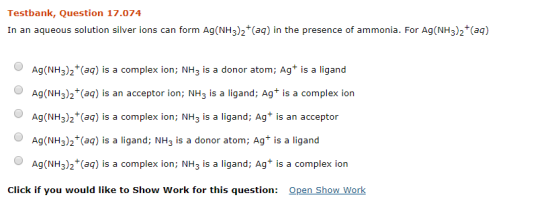
Testbank, Question 17.074
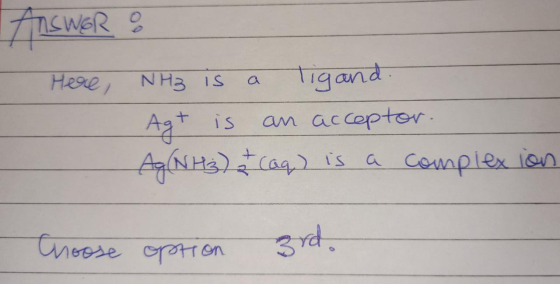
In an aqueous solution silver ions can form Ag(NH3)2+(aq) in the presence of ammonia. For Ag(NH3)2+(aq): (see photo)
Homework Answers
Add Answer to:
Testbank, Question 17.074
In an aqueous solution silver ions can form
Ag(NH3)2+(aq) in the
presence of...
Silver (I) ions in aqueous solutions react with NH3(aq) to form a complex ion according to...
Silver (I) ions in aqueous solutions react with NH3(aq) to form a complex ion according to the following reaction: Ag+ + 2NH3(aq) ---> Ag(NH3)2+ with a formation constant, Kf of 1.5 x 10⁷. Calculate the solubility in g/L, of AgCN(s) (Ksp = 2.2 x 10⁻¹⁶) in 0.75M NH3(aq)
In an ammonia solution, the silver ion, Ag, forms the colorless, but soluble diamminesilver(I) complex ion,...
 In an ammonia solution, the silver ion, Ag, forms the colorless, but soluble diamminesilver(I) complex ion, Ag(NH3)2. If ammonia is added to a solution that contains an AgCI precipitate, the solid dissolves completely. Write a net-ionic equation for the equilibrium involved and explain the shift that takes place. Choose the best answer. AgCl(s) +2 NH3(a)Ag(NH3)2 (aa) C(aq) Adding ammonia to AgCl(s) dissolves the solid by displacing chloride ions with ammonia molecules, forming a soluble complex ion Ag (a2 NH3(aq) Ag(NH32...
all 5&6 5.) Solid silver bromide , AgBr, can be dissolved by adding concentrated aqueous ammonia to give the water- soluble silver-ammonia complex ion. AgBr(s) + 2NH,(aq) U Ag(NH), (aq) + Br(a...
 all 5&6
5.) Solid silver bromide , AgBr, can be dissolved by adding concentrated aqueous ammonia to give the water- soluble silver-ammonia complex ion. AgBr(s) + 2NH,(aq) U Ag(NH), (aq) + Br(aq) (a) Show that this equation is the sum of two other equations, one representing the dissolution of AgBr into its component ions and the other representing the formation of the silver-ammonium complex from silver ion and ammonia (b) Calculate the equilibrium constant for the above reaction K,(AgBr) =...
all 5&6
5.) Solid silver bromide , AgBr, can be dissolved by adding concentrated aqueous ammonia to give the water- soluble silver-ammonia complex ion. AgBr(s) + 2NH,(aq) U Ag(NH), (aq) + Br(aq) (a) Show that this equation is the sum of two other equations, one representing the dissolution of AgBr into its component ions and the other representing the formation of the silver-ammonium complex from silver ion and ammonia (b) Calculate the equilibrium constant for the above reaction K,(AgBr) =...
Silver ions can be precipitated from aqueous solutions by the addition of aqueous chloride: Ag+(aq)+Cl−(aq)→AgCl(s) Silver...
Silver ions can be precipitated from aqueous solutions by the addition of aqueous chloride: Ag+(aq)+Cl−(aq)→AgCl(s) Silver chloride is virtually insoluble in water so that the reaction appears to go to completion. How many grams of solid NaCl must be added to 25.0 mL of 0.149 M AgNO3 solution to completely precipitate the silver?
Review equation 16.10 and step B2. Ag+1(aq) and NH3(aq) will form a soluble complex ion. Use...
Review equation 16.10 and step B2. Ag+1(aq) and NH3(aq) will form a soluble complex ion. Use rule 3 of Water-Insoluble Salts in Appendix E to determine what would happen if Ag+1(aq) was combined with KOH instead of NH3. Write the net ionic equation with phase subscripts, where K+1 is a spectator ion which is cancelled out. Equation 16.10: Ag^+(aq) + Cl^-(aq) ⇄ AgCl(s) ⇅ 2NH3(aq) [Ag(NH3)2]^+(aq) Step B2: Silver Chloride equilibrium. To the clear solution from part B.1, add 5...
Ag+ forms complex ions with NH3 and S2O32- according to the following equilibria: Ag+(aq) + 2...
Ag+ forms complex ions with NH3 and S2O32- according to the following equilibria: Ag+(aq) + 2 NH3(aq) = [Ag(NH3)2]+(aq) K = 1.7 x 10⁷ Ag+(aq) + 2 S2O32-(aq) = [Ag(S2O32-)2]3-(aq) K = 2.9 x 10¹³ Determine the value of K for the equilibrium: [Ag(S2O32-)2]3-(aq) + 2 NH3(aq) = [Ag(NH3)2]+(aq) + 2 S2O32-(aq) Using your K value as a guide, predict what would happen when 1 M NH3(aq) is added to a solution of [Ag(S2O32-)2]3-(aq). Explain your reasoning.
please help!! We were unable to transcribe this imageConsider the insoluble compound silver hydroxide, AgOH.The silver...
 please help!!
We were unable to transcribe this imageConsider the insoluble compound silver hydroxide, AgOH.The silver ion also forms a complex with ammonia. Write a balanced net ionic equation to show why the solubility of AgOH(s) increases in the presence of ammonia and calculate the equilibrium constant for this reaction. For Ag(NH3)2* K = 1.1*10'. Use the pull-down boxes to specify states such as (aq) or (s). Knet = Consider the insoluble compound iron(II) hydroxide. Fe(OH)2. The iron(II) ion also...
please help!!
We were unable to transcribe this imageConsider the insoluble compound silver hydroxide, AgOH.The silver ion also forms a complex with ammonia. Write a balanced net ionic equation to show why the solubility of AgOH(s) increases in the presence of ammonia and calculate the equilibrium constant for this reaction. For Ag(NH3)2* K = 1.1*10'. Use the pull-down boxes to specify states such as (aq) or (s). Knet = Consider the insoluble compound iron(II) hydroxide. Fe(OH)2. The iron(II) ion also...
2. With the precipitate (AgCl) still present in the test tube, add aqueous ammonia. The precipitate...
 2. With the precipitate (AgCl) still present in the test tube, add aqueous ammonia. The precipitate should disappear. This means that silver chloride is soluble in ammonia solution. It is soluble because silver ion and ammonia form a complex called diamminesilver (I) chloride, [Ag(NH3)2]Cl which in solution exists as [Ag(NH)2]* and Cl ions. You could have guessed that this would have happened if you looked over the Table A values of Kr at the end of this lab (and you...
A buffer solution contains a mixture of aqueous ammonia, NH3(aq), and ammonium chloride NH4Cl(aq). A small...
A buffer solution contains a mixture of aqueous ammonia, NH3(aq), and ammonium chloride NH4Cl(aq). A small amount of sodium hydroxide solution, NaOH(aq) is added. Which of the following correctly describes the buffering action occurring in this solution on mixing? A. Hydroxide ions are removed by reaction with NH3(aq) to give NH4OH (aq) B. Sodium ions are removed by reaction with Cl- to give NaCl C. The presence of NH3 (aq) prevents the NaOH from dissociating into ions D. Hydroxide ions...
Aluminum ion in solution reacts with water to form aqueous hexaaguaaluminum ()ion. Write this reaction below,...
 Aluminum ion in solution reacts with water to form aqueous hexaaguaaluminum ()ion. Write this reaction below, remember phases. Aluminum is more likely to form a hydrated complex than the other four ions remaining in solution, because of its relatively small size and high charge To separate the Group B2 ion, the solution first is made basic by adding ammonia. In the presence of this weak base the pH is adjusted to 9-10 and the group B ions form insoluble hydroxides....
 In an ammonia solution, the silver ion, Ag, forms the colorless, but soluble diamminesilver(I) complex ion, Ag(NH3)2. If ammonia is added to a solution that contains an AgCI precipitate, the solid dissolves completely. Write a net-ionic equation for the equilibrium involved and explain the shift that takes place. Choose the best answer. AgCl(s) +2 NH3(a)Ag(NH3)2 (aa) C(aq) Adding ammonia to AgCl(s) dissolves the solid by displacing chloride ions with ammonia molecules, forming a soluble complex ion Ag (a2 NH3(aq) Ag(NH32...
 all 5&6
5.) Solid silver bromide , AgBr, can be dissolved by adding concentrated aqueous ammonia to give the water- soluble silver-ammonia complex ion. AgBr(s) + 2NH,(aq) U Ag(NH), (aq) + Br(aq) (a) Show that this equation is the sum of two other equations, one representing the dissolution of AgBr into its component ions and the other representing the formation of the silver-ammonium complex from silver ion and ammonia (b) Calculate the equilibrium constant for the above reaction K,(AgBr) =...
all 5&6
5.) Solid silver bromide , AgBr, can be dissolved by adding concentrated aqueous ammonia to give the water- soluble silver-ammonia complex ion. AgBr(s) + 2NH,(aq) U Ag(NH), (aq) + Br(aq) (a) Show that this equation is the sum of two other equations, one representing the dissolution of AgBr into its component ions and the other representing the formation of the silver-ammonium complex from silver ion and ammonia (b) Calculate the equilibrium constant for the above reaction K,(AgBr) =...
 please help!!
We were unable to transcribe this imageConsider the insoluble compound silver hydroxide, AgOH.The silver ion also forms a complex with ammonia. Write a balanced net ionic equation to show why the solubility of AgOH(s) increases in the presence of ammonia and calculate the equilibrium constant for this reaction. For Ag(NH3)2* K = 1.1*10'. Use the pull-down boxes to specify states such as (aq) or (s). Knet = Consider the insoluble compound iron(II) hydroxide. Fe(OH)2. The iron(II) ion also...
please help!!
We were unable to transcribe this imageConsider the insoluble compound silver hydroxide, AgOH.The silver ion also forms a complex with ammonia. Write a balanced net ionic equation to show why the solubility of AgOH(s) increases in the presence of ammonia and calculate the equilibrium constant for this reaction. For Ag(NH3)2* K = 1.1*10'. Use the pull-down boxes to specify states such as (aq) or (s). Knet = Consider the insoluble compound iron(II) hydroxide. Fe(OH)2. The iron(II) ion also...
 2. With the precipitate (AgCl) still present in the test tube, add aqueous ammonia. The precipitate should disappear. This means that silver chloride is soluble in ammonia solution. It is soluble because silver ion and ammonia form a complex called diamminesilver (I) chloride, [Ag(NH3)2]Cl which in solution exists as [Ag(NH)2]* and Cl ions. You could have guessed that this would have happened if you looked over the Table A values of Kr at the end of this lab (and you...
 Aluminum ion in solution reacts with water to form aqueous hexaaguaaluminum ()ion. Write this reaction below, remember phases. Aluminum is more likely to form a hydrated complex than the other four ions remaining in solution, because of its relatively small size and high charge To separate the Group B2 ion, the solution first is made basic by adding ammonia. In the presence of this weak base the pH is adjusted to 9-10 and the group B ions form insoluble hydroxides....
Most questions answered within 3 hours.
-
Where is the error in this code sequence?
String s1 = "Hello";
String s2 = "ello";...
asked 10 months ago -
Financial data for Joel de Paris, Inc., for last year
follow:
Joel de Paris, Inc.
Balance...
asked 10 months ago -
Consider this reaction:
Al2(SO4)3 (aq)+ BaCl3
(aq) Al2Cl6 (aq)- +
3BaSO4(s) . What is the...
asked 10 months ago -
Suppose that Savneet is considering increasing her
recent random sample from 20 car rentals to 40...
asked 10 months ago -
Trucks arrive at an unloading terminal at an average rate of 120
per hour.
Trucks arrive...
asked 10 months ago -
Why are methanol and ethanol completely soluble in water while
octanol is not very little soluble....
asked 10 months ago -
A facilities manager at a university reads in a research report
that the mean amount of...
asked 10 months ago -
When the CuSO4 is rehydrated by adding water to the anhydrous
compound, is this an endothermic...
asked 10 months ago -
A ray of sunlight is passing from diamond into crown glass; the
angle of incidence is...
asked 10 months ago -
A block of mass 0.249 kg is placed on top of a light, vertical
spring of...
asked 10 months ago -
how do the kidneys compensate in the presences of acidosis
a) trigger hyperventilate
b) reserve acid...
asked 10 months ago -
Question 501 pts
The rental rate of capital to the firm increases. Which of the
following...
asked 10 months ago