

Homework Answers
Answer: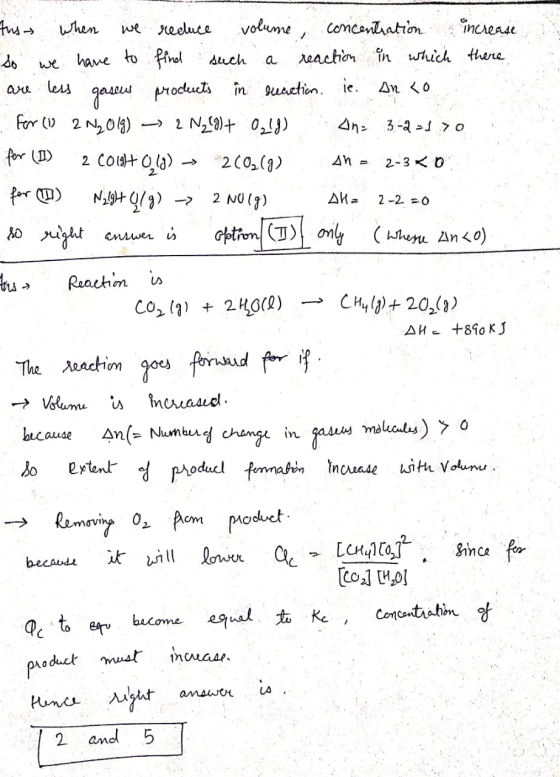
Add Answer to:
Which of the following equilibria will shift towards the formation of more products if the reaction...
Which of the following equilibria will shift towards the formation of more products if the reaction...
 Which of the following equilibria will shift towards the formation of more products if the reaction at equilibrium is compressed into half its volume? 1. 2N2O(g) = 2N2(g) + O2(g) II. 2CO(g) + O2(g) = 2CO2(g) III. N2(g) + O2(g) = 2NO(g) Both II and III. All three reactions will shift towards the formation of more products.
which of the following equilibrium systems will shift to the right towards the product when the...
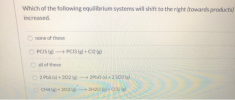 which of the following equilibrium systems will shift to the right
towards the product when the pressure is increased
Which of the following equilibrium systems will shift to the right (towards products) increased none of these PC15 (8) - PC13 (s) + C12 (8) all of these 2 Pb (s) + 302 (g) — 2PbO (s) + 2 502 (g) - CH4 (g) + 2O2 (g) → 2H20 (8) + CO2 (g)
which of the following equilibrium systems will shift to the right
towards the product when the pressure is increased
Which of the following equilibrium systems will shift to the right (towards products) increased none of these PC15 (8) - PC13 (s) + C12 (8) all of these 2 Pb (s) + 302 (g) — 2PbO (s) + 2 502 (g) - CH4 (g) + 2O2 (g) → 2H20 (8) + CO2 (g)
Which of the following equilibria will shift to the left when the temperature is increased? [AH...
 Which of the following equilibria will shift to the left when the temperature is increased? [AH (kl/mol) values are given in parentheses.] (Select all that apply.) (a) S + H2 SH2S AH(-20) (b) C + H2O 55CO + H2 AH (131) (c) H2 + CO2= H2O + CO NH(41) (d) MgO + CO2 = MgCO3 AH (–117) (e) 2CO + O2 = 2CO2 AH (-566)
2. A) Which way will the equilibrium of a reaction shift (towards reactants or products) if...
 2. A) Which way will the equilibrium of a reaction shift (towards reactants or products) if one of the products formed is a gas? Which way will the equilibrium of a reaction shift (towards reactants or products) if one of the reactants formed is a solid? B) Using what you just described above, examine the following reactions and apply Le Chatelier's principle. Which way will the equilibrium shift? (Towards reactants or products) Circle the dominate side of the reaction. Explain...
According to Le Chatelier’s Principle, does the equilibrium shift in the direction of products or reactants...
According to Le Chatelier’s Principle, does the equilibrium shift in the direction of products or reactants when O2 is added to the equilibrium mixture of each of the following reactions? 3O2 (g) ↔ 2O3 (g) 2. 2CO2 (g) ↔ 2CO (g) + O2 (g) 3. 2SO2 (g) + O2 (g) ↔ 2SO3 (g) 4. 2SO2 (g) + 2H2O (g) ↔ H2S (g) + 3O2 (g)
Which of the following would increase the yield of the products of the following endothermic reaction?...
Which of the following would increase the yield of the products of the following endothermic reaction? 2H2O(g) + 2Cl2(g) 4HCl(g) + O2(g) ΔH > 0 Question 14 options: 1) Decreasing the temperature of the reaction 2) Adding HCl to the reaction vessel 3) Decreasing the volume of the container 4) Removing Cl2(g) from the reaction vessel 5) Increasing the volume of the container
+2H2(g)+ CH4(g) +CO2(g)--2CO(g) Δ Predict which direction the equilibrium will shift (left, towards reactants or right,...
 +2H2(g)+ CH4(g) +CO2(g)--2CO(g) Δ Predict which direction the equilibrium will shift (left, towards reactants or right, towards products) when you perform the following actions: ft Left Shift Right Action Add CH4s to the reaction Add CO2 to the reaction Add CO to the reaction Add H2 to the reaction Remove CHs from the reaction Remove CO2 from the reaction Remove CO from the reaction Remove H2 from the reaction Increase pressure by reducing volume Cool the reaction mixture Heat the...
Calculate the heat of reaction in (kJ) for the following reaction: 2CO(g) + O2(g) --> 2CO2(g)...
Calculate the heat of reaction in (kJ) for the following reaction: 2CO(g) + O2(g) --> 2CO2(g) given the following data: C + 1/2O2 --> CO(g) delta H= -110.5 KJ/mol C + O2(g) --> CO2(g) delta H= -393.5 KJ/ mol
1. Determine Kp for the following reaction at 315 °C, given that Ke at the same...
 1. Determine Kp for the following reaction at 315 °C, given that Ke at the same temperature is 1.25 N: (g) +3 H: (g)2NHs (g) 2. Given the following stepwise equilibria, determine the net reaction and the value of Ks. 3. 3. Determine Qe for the following equilibria, compare to K, and state the direction of shift as either "towards products" or "towards reactants". a) H:(g) +h (g) 2 HI (g) Conditions: [H2]s [l;l = [HI] = 0.0020 M, T...
The following reaction is exothermic. Which change will shift the equilibrium to the right? 2 SO2...
 The following reaction is exothermic. Which change will shift the equilibrium to the right? 2 SO2 (g) + O2 (g) = 2 So, (9) o Adding So, Decreasing the volume of the reaction flask Removing O2 Heating the reaction QUESTION 11 A positive AGⓇ for a reaction implies The reaction is never spontaneous The products predominate at equilibrium The reaction is always spontaneous The reactants predominate at equilibrium ОО QUESTION 12 Which of the following is TRUE regarding AG and...
 Which of the following equilibria will shift towards the formation of more products if the reaction at equilibrium is compressed into half its volume? 1. 2N2O(g) = 2N2(g) + O2(g) II. 2CO(g) + O2(g) = 2CO2(g) III. N2(g) + O2(g) = 2NO(g) Both II and III. All three reactions will shift towards the formation of more products.
 which of the following equilibrium systems will shift to the right
towards the product when the pressure is increased
Which of the following equilibrium systems will shift to the right (towards products) increased none of these PC15 (8) - PC13 (s) + C12 (8) all of these 2 Pb (s) + 302 (g) — 2PbO (s) + 2 502 (g) - CH4 (g) + 2O2 (g) → 2H20 (8) + CO2 (g)
which of the following equilibrium systems will shift to the right
towards the product when the pressure is increased
Which of the following equilibrium systems will shift to the right (towards products) increased none of these PC15 (8) - PC13 (s) + C12 (8) all of these 2 Pb (s) + 302 (g) — 2PbO (s) + 2 502 (g) - CH4 (g) + 2O2 (g) → 2H20 (8) + CO2 (g)
 Which of the following equilibria will shift to the left when the temperature is increased? [AH (kl/mol) values are given in parentheses.] (Select all that apply.) (a) S + H2 SH2S AH(-20) (b) C + H2O 55CO + H2 AH (131) (c) H2 + CO2= H2O + CO NH(41) (d) MgO + CO2 = MgCO3 AH (–117) (e) 2CO + O2 = 2CO2 AH (-566)
 2. A) Which way will the equilibrium of a reaction shift (towards reactants or products) if one of the products formed is a gas? Which way will the equilibrium of a reaction shift (towards reactants or products) if one of the reactants formed is a solid? B) Using what you just described above, examine the following reactions and apply Le Chatelier's principle. Which way will the equilibrium shift? (Towards reactants or products) Circle the dominate side of the reaction. Explain...
 +2H2(g)+ CH4(g) +CO2(g)--2CO(g) Δ Predict which direction the equilibrium will shift (left, towards reactants or right, towards products) when you perform the following actions: ft Left Shift Right Action Add CH4s to the reaction Add CO2 to the reaction Add CO to the reaction Add H2 to the reaction Remove CHs from the reaction Remove CO2 from the reaction Remove CO from the reaction Remove H2 from the reaction Increase pressure by reducing volume Cool the reaction mixture Heat the...
 1. Determine Kp for the following reaction at 315 °C, given that Ke at the same temperature is 1.25 N: (g) +3 H: (g)2NHs (g) 2. Given the following stepwise equilibria, determine the net reaction and the value of Ks. 3. 3. Determine Qe for the following equilibria, compare to K, and state the direction of shift as either "towards products" or "towards reactants". a) H:(g) +h (g) 2 HI (g) Conditions: [H2]s [l;l = [HI] = 0.0020 M, T...
 The following reaction is exothermic. Which change will shift the equilibrium to the right? 2 SO2 (g) + O2 (g) = 2 So, (9) o Adding So, Decreasing the volume of the reaction flask Removing O2 Heating the reaction QUESTION 11 A positive AGⓇ for a reaction implies The reaction is never spontaneous The products predominate at equilibrium The reaction is always spontaneous The reactants predominate at equilibrium ОО QUESTION 12 Which of the following is TRUE regarding AG and...
Most questions answered within 3 hours.
-
Where is the error in this code sequence?
String s1 = "Hello";
String s2 = "ello";...
asked 10 months ago -
Financial data for Joel de Paris, Inc., for last year
follow:
Joel de Paris, Inc.
Balance...
asked 10 months ago -
Consider this reaction:
Al2(SO4)3 (aq)+ BaCl3
(aq) Al2Cl6 (aq)- +
3BaSO4(s) . What is the...
asked 10 months ago -
Suppose that Savneet is considering increasing her
recent random sample from 20 car rentals to 40...
asked 10 months ago -
Trucks arrive at an unloading terminal at an average rate of 120
per hour.
Trucks arrive...
asked 10 months ago -
Why are methanol and ethanol completely soluble in water while
octanol is not very little soluble....
asked 10 months ago -
A facilities manager at a university reads in a research report
that the mean amount of...
asked 10 months ago -
When the CuSO4 is rehydrated by adding water to the anhydrous
compound, is this an endothermic...
asked 10 months ago -
A ray of sunlight is passing from diamond into crown glass; the
angle of incidence is...
asked 10 months ago -
A block of mass 0.249 kg is placed on top of a light, vertical
spring of...
asked 10 months ago -
how do the kidneys compensate in the presences of acidosis
a) trigger hyperventilate
b) reserve acid...
asked 10 months ago -
Question 501 pts
The rental rate of capital to the firm increases. Which of the
following...
asked 10 months ago