
Homework Answers
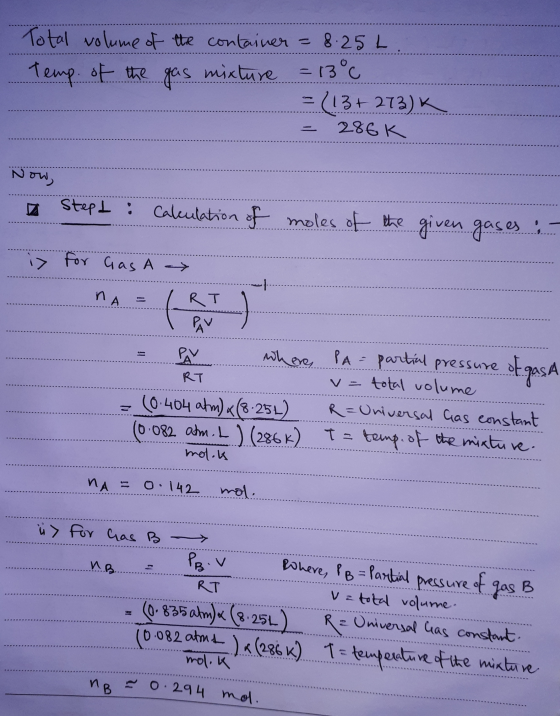
 since
the pressure of an ideal gas mixture only depends upon the number
of gas molecules in the container,we can use the total moles of gas
to calculate the total pressure using the ideal gas law.
since
the pressure of an ideal gas mixture only depends upon the number
of gas molecules in the container,we can use the total moles of gas
to calculate the total pressure using the ideal gas law.
Add Answer to:
A 8.25 L container holds a mixture of two gases at 13 °C. The partial pressures...
A 7.25 L container holds a mixture of two gases at 17 *C. The partial pressures...
 A 7.25 L container holds a mixture of two gases at 17 *C. The partial pressures of gas A and gas B, respectively, are 0.432 atm and 0.864 atm. If 0.130 mol of a third gas is added with no change in volume or temperature, what will the total pressure become? Protal
A 8.25 L container holds a mixture of two gases at 55 *C. The partial pressures...
 A 8.25 L container holds a mixture of two gases at 55 *C. The partial pressures of gas A and gas B, respectively, are 0.357 atm and 0.824 atm. If 0.200 mol of a third gas is added with no change in volume or temperature, what will the total pressure become? Ptotal = .824 atm
A 8.05-L container holds a mixture of two gases at 39 °C. The partial pressures of...
A 8.05-L container holds a mixture of two gases at 39 °C. The partial pressures of gas A and gas B, respectively, are 0.404 atm and 0.558 atm. If 0.180 mol of a third gas is added with no change in volume or temperature, what will the total pressure become?
A 8.30-L container holds a mixture of two gases at 29 °C. The partial pressures of...
 A 8.30-L container holds a mixture of two gases at 29 °C. The
partial pressures of gas A and gas B, respectively, are 0.361 atm
and 0.870 atm. If 0.180 mol of a third gas is added with no change
in volume or temperature, what will the total pressure become?
A 8.30-L container holds a mixture of two gases at 29 °C. The partial pressures of gas A and gas B respectively, are 0.361 atm and 0.870 atm. If 0.180...
A 8.30-L container holds a mixture of two gases at 29 °C. The
partial pressures of gas A and gas B, respectively, are 0.361 atm
and 0.870 atm. If 0.180 mol of a third gas is added with no change
in volume or temperature, what will the total pressure become?
A 8.30-L container holds a mixture of two gases at 29 °C. The partial pressures of gas A and gas B respectively, are 0.361 atm and 0.870 atm. If 0.180...
A 9.70 L container holds a mixture of two gases at 13 °C. The partial pressures...
 A 9.70 L container holds a mixture of two gases at 13 °C. The partial pressures of gas A and gas B, respectively, are 0.361 atm and 0.668 atm. If 0.170 mol of a third gas is added with no change in volume or temperature, what will the total pressure become? P = bus car policy MacBook Pro Н.
A 8.55-L container holds a mixture of two gases at 49 °C. The partial pressures of...
A 8.55-L container holds a mixture of two gases at 49 °C. The partial pressures of gas A and gas B, respectively, are 0.189 atm and 0.526 atm. If 0.170 mol of a third gas are added with no change in volume or temperature, what will the total pressure become? =atm
A 9.65 L container holds a mixture of two gases at 15 °C. The partial pressures...
A 9.65 L container holds a mixture of two gases at 15 °C. The partial pressures of gas A and gas B, respectively, are 0.390 atm and 0.777 atm. If 0.190 mol of a third gas is added with no change in volume or temperature, what will the total pressure become?
A 9.80 L container holds a mixture of two gases at 37 °C. The partial pressures...
A 9.80 L container holds a mixture of two gases at 37 °C. The partial pressures of gas A and gas B, respectively, are 0.215 atm and 0.802 atm. If 0.150 mol of a third gas is added with no change in volume or temperature, what will the total pressure become?
A 8.00 L container holds a mixture of two gases at 35 °C. The partial pressures...
A 8.00 L container holds a mixture of two gases at 35 °C. The partial pressures of gas A and gas B, respectively, are 0.377 atm and 0.648 atm. If 0.220 mol of a third gas is added with no change in volume or temperature, what will the total pressure become?
A 8.45-L container holds a mixture of two gases at 43 °C. The partial pressures of...
A 8.45-L container holds a mixture of two gases at 43 °C. The partial pressures of gas A and gas B, respectively, are 0.434 atm and 0.531 atm. If 0.160 mol of a third gas is added with no change in volume or temperature, what will the total pressure become?
 A 7.25 L container holds a mixture of two gases at 17 *C. The partial pressures of gas A and gas B, respectively, are 0.432 atm and 0.864 atm. If 0.130 mol of a third gas is added with no change in volume or temperature, what will the total pressure become? Protal
 A 8.25 L container holds a mixture of two gases at 55 *C. The partial pressures of gas A and gas B, respectively, are 0.357 atm and 0.824 atm. If 0.200 mol of a third gas is added with no change in volume or temperature, what will the total pressure become? Ptotal = .824 atm
 A 8.30-L container holds a mixture of two gases at 29 °C. The
partial pressures of gas A and gas B, respectively, are 0.361 atm
and 0.870 atm. If 0.180 mol of a third gas is added with no change
in volume or temperature, what will the total pressure become?
A 8.30-L container holds a mixture of two gases at 29 °C. The partial pressures of gas A and gas B respectively, are 0.361 atm and 0.870 atm. If 0.180...
A 8.30-L container holds a mixture of two gases at 29 °C. The
partial pressures of gas A and gas B, respectively, are 0.361 atm
and 0.870 atm. If 0.180 mol of a third gas is added with no change
in volume or temperature, what will the total pressure become?
A 8.30-L container holds a mixture of two gases at 29 °C. The partial pressures of gas A and gas B respectively, are 0.361 atm and 0.870 atm. If 0.180...
 A 9.70 L container holds a mixture of two gases at 13 °C. The partial pressures of gas A and gas B, respectively, are 0.361 atm and 0.668 atm. If 0.170 mol of a third gas is added with no change in volume or temperature, what will the total pressure become? P = bus car policy MacBook Pro Н.
Most questions answered within 3 hours.
-
Where is the error in this code sequence?
String s1 = "Hello";
String s2 = "ello";...
asked 11 months ago -
Financial data for Joel de Paris, Inc., for last year
follow:
Joel de Paris, Inc.
Balance...
asked 11 months ago -
Consider this reaction:
Al2(SO4)3 (aq)+ BaCl3
(aq) Al2Cl6 (aq)- +
3BaSO4(s) . What is the...
asked 11 months ago -
Suppose that Savneet is considering increasing her
recent random sample from 20 car rentals to 40...
asked 11 months ago -
Trucks arrive at an unloading terminal at an average rate of 120
per hour.
Trucks arrive...
asked 11 months ago -
Why are methanol and ethanol completely soluble in water while
octanol is not very little soluble....
asked 11 months ago -
A facilities manager at a university reads in a research report
that the mean amount of...
asked 11 months ago -
When the CuSO4 is rehydrated by adding water to the anhydrous
compound, is this an endothermic...
asked 11 months ago -
A ray of sunlight is passing from diamond into crown glass; the
angle of incidence is...
asked 11 months ago -
A block of mass 0.249 kg is placed on top of a light, vertical
spring of...
asked 11 months ago -
how do the kidneys compensate in the presences of acidosis
a) trigger hyperventilate
b) reserve acid...
asked 11 months ago -
Question 501 pts
The rental rate of capital to the firm increases. Which of the
following...
asked 11 months ago