The magnetic field in the certain region is .128 T, and...
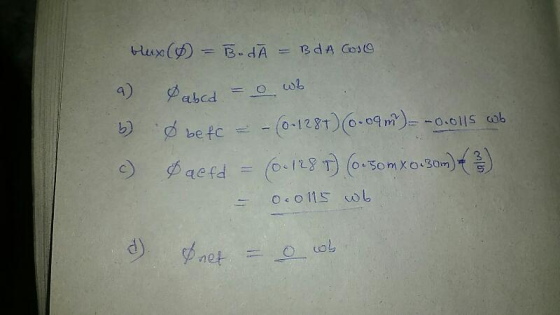
The magnetic field in the certain region is .128 T, and its direction is that of the +z axis in the figure below. What is the magnetic flux across the surface:
(A) abcd, befc, aefd;
(B) What is the net flux through all five surfaces that enclose the shaded volume?
Homework Answers
Part A The magnetic field B in a certain region is 0.2 T, and its direction...
 Part A The magnetic field B in a certain region is 0.2 T, and its direction is that of the + z-axis in the Figure (Figure 1). What is the magnetic flux across the surface abcd in the figure? VALOR O ? Babcd) = Wb Part B Figure ② 1 of 1 What is the magnetic flux across the surface befc? VALP O ? 30.0 cm 40.0 cm B(befc) = 30.0 cm Part C What is the magnetic flux across...
a) The magnetic field is a certain region varies with time given by B(t) =30e^ -2t...
a) The magnetic field is a certain region varies with time given by B(t) =30e^ -2t in Tesla. A 10cm * 15cm rectangular coil whose plane is perpendicular to the direction of the magnetic is placed in this field, find the magnetic flux as a function of time flux(t). b) A coil consists of 200 turns of wire. Each turn is a square of side d=18cm, and a uniform magnetic field directed perpendicular to the plane of the coil is...
- 30 cm is positioned as shown in the figure below. There is a uniform magnetic...
 - 30 cm is positioned as shown in the figure below. There is a uniform magnetic field throughout the region with components 8, +7.0 TB +6.0 T, and B, A cube of edge length +2.0 T (a) Calculate the flux through the shaded face of the cube Tema (b) What is the netux emerging from the volume enclosed by the cube (he, the net flux through all six faces IT m² Need Help? Read Master
Two flat surfaces are exposed to a uniform, horizontal magnetic field of magnitude 0.47 T. When...
Two flat surfaces are exposed to a uniform, horizontal magnetic field of magnitude 0.47 T. When viewed edge-on, the first surface is tilted at an angle of 23° from the horizontal, and a net magnetic flux of 9.2 x 10⁻⁴ Wb passes through it. The same net magnetic flux passes through the second surface. (a) Determine the area of the first surface. (b) Find the smallest possible value of the area of the second surface.
Two flat surfaces are exposed to a uniform, horizontal magnetic field of magnitude 0.20 T. When...
Two flat surfaces are exposed to a uniform, horizontal magnetic field of magnitude 0.20 T. When viewed edge-on, the first surface is tilted at an angle of 27° from the horizontal, and a net magnetic flux of 7.0 x 10⁻⁴ Wb passes through it. The same net magnetic flux passes through the second surface. (a) Determine the area of the first surface. (b) Find the smallest possible value of the area of the second surface.
Two flat surfaces are exposed to a uniform, horizontal magnetic field of magnitude 0.46 T. When...
 Two flat surfaces are exposed to a uniform, horizontal magnetic field of magnitude 0.46 T. When viewed edge-on, the first surface is tilted at an angle of 14° from the horizontal, and a net magnetic flux of 8.50 x 10⁻³ Wb passes through it. The same net magnetic flux passes through the second surface. (a) Determine the area of the first surface. m2 (b) Find the smallest possible value for the area of the second surface. m2
Please show steps with the graph. The magnetic field intensity is given in a certain region...
Please show steps with the graph. The magnetic field intensity is given in a certain region of space as H = [(x + 2y)/z2]ay + (2/z)az A/m. (a) Find ∇×H. (b) Find J. (c) Use J to find the total current passing through the surface z = 4, 1 ≤ x ≤ 2, 3 ≤ z ≤ 5, in the az direction. (d) Show that the same result is obtained using the other side of Stokes’ theorem.
In a certain region, the magnetic field is represented by the equation B = (a +...
 In a certain region, the magnetic field is represented by the equation B = (a + bt)ſ, where a = 3.50 mt and b = 4.30 mT/s. A circular coil of area 1.90 x 10⁻³ m2 and N = 5 turns is oriented in the x-z (horizontal) plane in this field region. Due to the change in magnetic flux, charge passes by a given point in the circuit at a rate of 6.45 mc/s. Determine the resistance of the coil....
a) In a certain region, u 5 sin 210 t a, A/m. Find the rate of...
 a) In a certain region, u 5 sin 210 t a, A/m. Find the rate of change of flux over the surface of 20 m2 2Ho, 3E0, the magnetic field intensity is given as H = E= b) In a certain region, J (za-4yaytxa) Find py if pv (x, 0, z, t) 0 cos wt A/m2 Solution:
The figure shows a region of uniform magnetic field directed into the page, surrounded by regions...
 The figure shows a region of uniform magnetic field directed
into the page, surrounded by regions where the magnetic field is
zero. A square coil of wire is moving to the right across the
figure in snapshots.
When the coil is moving out of the
region of non-zero magnetic field.
a) On the figure, draw the direction of the induced current in
the wire loop. If there is no induced current, explicitly state
that.
b) Draw the direction of the...
The figure shows a region of uniform magnetic field directed
into the page, surrounded by regions where the magnetic field is
zero. A square coil of wire is moving to the right across the
figure in snapshots.
When the coil is moving out of the
region of non-zero magnetic field.
a) On the figure, draw the direction of the induced current in
the wire loop. If there is no induced current, explicitly state
that.
b) Draw the direction of the...
 Part A The magnetic field B in a certain region is 0.2 T, and its direction is that of the + z-axis in the Figure (Figure 1). What is the magnetic flux across the surface abcd in the figure? VALOR O ? Babcd) = Wb Part B Figure ② 1 of 1 What is the magnetic flux across the surface befc? VALP O ? 30.0 cm 40.0 cm B(befc) = 30.0 cm Part C What is the magnetic flux across...
 - 30 cm is positioned as shown in the figure below. There is a uniform magnetic field throughout the region with components 8, +7.0 TB +6.0 T, and B, A cube of edge length +2.0 T (a) Calculate the flux through the shaded face of the cube Tema (b) What is the netux emerging from the volume enclosed by the cube (he, the net flux through all six faces IT m² Need Help? Read Master
 Two flat surfaces are exposed to a uniform, horizontal magnetic field of magnitude 0.46 T. When viewed edge-on, the first surface is tilted at an angle of 14° from the horizontal, and a net magnetic flux of 8.50 x 10⁻³ Wb passes through it. The same net magnetic flux passes through the second surface. (a) Determine the area of the first surface. m2 (b) Find the smallest possible value for the area of the second surface. m2
 In a certain region, the magnetic field is represented by the equation B = (a + bt)ſ, where a = 3.50 mt and b = 4.30 mT/s. A circular coil of area 1.90 x 10⁻³ m2 and N = 5 turns is oriented in the x-z (horizontal) plane in this field region. Due to the change in magnetic flux, charge passes by a given point in the circuit at a rate of 6.45 mc/s. Determine the resistance of the coil....
 a) In a certain region, u 5 sin 210 t a, A/m. Find the rate of change of flux over the surface of 20 m2 2Ho, 3E0, the magnetic field intensity is given as H = E= b) In a certain region, J (za-4yaytxa) Find py if pv (x, 0, z, t) 0 cos wt A/m2 Solution:
 The figure shows a region of uniform magnetic field directed
into the page, surrounded by regions where the magnetic field is
zero. A square coil of wire is moving to the right across the
figure in snapshots.
When the coil is moving out of the
region of non-zero magnetic field.
a) On the figure, draw the direction of the induced current in
the wire loop. If there is no induced current, explicitly state
that.
b) Draw the direction of the...
The figure shows a region of uniform magnetic field directed
into the page, surrounded by regions where the magnetic field is
zero. A square coil of wire is moving to the right across the
figure in snapshots.
When the coil is moving out of the
region of non-zero magnetic field.
a) On the figure, draw the direction of the induced current in
the wire loop. If there is no induced current, explicitly state
that.
b) Draw the direction of the...
Most questions answered within 3 hours.
-
Where is the error in this code sequence?
String s1 = "Hello";
String s2 = "ello";...
asked 11 months ago -
Financial data for Joel de Paris, Inc., for last year
follow:
Joel de Paris, Inc.
Balance...
asked 11 months ago -
Consider this reaction:
Al2(SO4)3 (aq)+ BaCl3
(aq) Al2Cl6 (aq)- +
3BaSO4(s) . What is the...
asked 11 months ago -
Suppose that Savneet is considering increasing her
recent random sample from 20 car rentals to 40...
asked 11 months ago -
Trucks arrive at an unloading terminal at an average rate of 120
per hour.
Trucks arrive...
asked 11 months ago -
Why are methanol and ethanol completely soluble in water while
octanol is not very little soluble....
asked 11 months ago -
A facilities manager at a university reads in a research report
that the mean amount of...
asked 11 months ago -
When the CuSO4 is rehydrated by adding water to the anhydrous
compound, is this an endothermic...
asked 11 months ago -
A ray of sunlight is passing from diamond into crown glass; the
angle of incidence is...
asked 11 months ago -
A block of mass 0.249 kg is placed on top of a light, vertical
spring of...
asked 11 months ago -
how do the kidneys compensate in the presences of acidosis
a) trigger hyperventilate
b) reserve acid...
asked 11 months ago -
Question 501 pts
The rental rate of capital to the firm increases. Which of the
following...
asked 11 months ago