(#5)
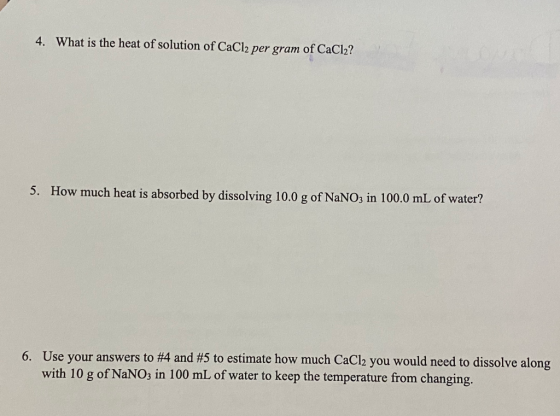
How much heat is absorbed by dissolving 10.0 g of NaNO3 in 100.0 mL of water?
Homework Answers
5. Mass of water used=Volume of water x density of water
=100 mL x 1 g/mL=100 g
Mass of solution=Mass of NaNO3 + mass of water
=10 g + 100 g=110 g
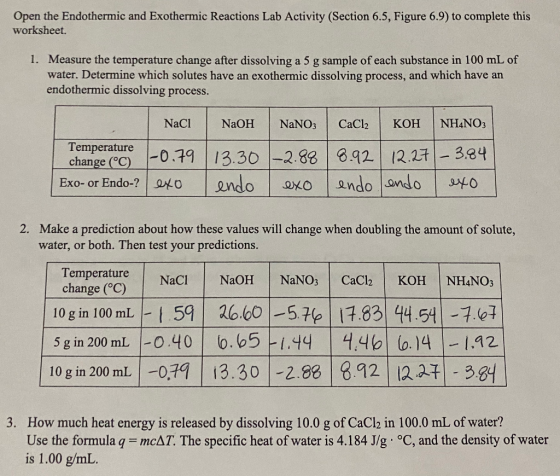
From table 1, fall in temperature of solution on adding 5 g NaNO3=-2.88°C (this means the dissolution of NaNO3 absorbs heat from the solution resulting in fall of temperature of solution)
So we predict (as given in table 2), fall in temperature of solution on adding 10 g (2 x 5g) NaNO3=-2.88°C x 2= -5.76°C
Given that we have to use specific heat of water c=4.184 J/g°C
To calculate Heat absorbed by dissolving 10.0 g NaNO3 in 100 mL water
Heat released from solution=Mass of solution x specific heat of solution x fall in temperature of solution
=110 g x 4.184 J/g°C x (-5.76 °C)
=-2650.98 J
So heat absorbed by dissolution of 10 g NaNO3 in solution=+2650.98 J
Add Answer to:
(#5)
How much heat is absorbed by dissolving 10.0 g of NaNO3 in 100.0
mL of...
(#3) How much heat energy is released by dissolving 10.0 g of CaCl2 in 100.0 mL...
 (#3) How much heat energy is released by dissolving 10.0 g of
CaCl2 in 100.0 mL of water?. Use formula q=mcAT. The specific heat
of water is 4.184J/g C, and the density os water is 1.00 g/mL.
Open the Endothermic and Exothermic Reactions Lab Activity (Section 6.5, Figure 6.9) to complete this worksheet. 1. Measure the temperature change after dissolving a 5 g sample of each substance in 100 mL of water. Determine which solutes have an exothermic dissolving process,...
(#3) How much heat energy is released by dissolving 10.0 g of
CaCl2 in 100.0 mL of water?. Use formula q=mcAT. The specific heat
of water is 4.184J/g C, and the density os water is 1.00 g/mL.
Open the Endothermic and Exothermic Reactions Lab Activity (Section 6.5, Figure 6.9) to complete this worksheet. 1. Measure the temperature change after dissolving a 5 g sample of each substance in 100 mL of water. Determine which solutes have an exothermic dissolving process,...
specific heat capacity 2. If 3.8 g of calcium chloride (CaCl2) is dissolved in 100.0 mL...
 specific heat capacity
2. If 3.8 g of calcium chloride (CaCl2) is dissolved in 100.0 mL of water, the following data are collected: starting temperature is 25.8 °C, final temperature after dissolving is 29.9 °C. Calculate the enthalpy of solution in Joules. You may assume a density of 1.00 g/mL for the solution and you may assume that the specific heat is that of water (this is a dilute solution) and is 4.18 J/(gx°C). Is this an endothermic or exothermic...
specific heat capacity
2. If 3.8 g of calcium chloride (CaCl2) is dissolved in 100.0 mL of water, the following data are collected: starting temperature is 25.8 °C, final temperature after dissolving is 29.9 °C. Calculate the enthalpy of solution in Joules. You may assume a density of 1.00 g/mL for the solution and you may assume that the specific heat is that of water (this is a dilute solution) and is 4.18 J/(gx°C). Is this an endothermic or exothermic...
If the temperature of 100.0 mL of water rises from 25.0°C to 32.0°C, how much heat...
 If the temperature of 100.0 mL of water rises from 25.0°C to 32.0°C, how much heat was added? Assume the density of water is 1.00 g/mL and the specific heat capacity of the water is 4.184 J/g°C. Include units and use the correct number of significant figures. Define the terms "exothermic" and "endothermic". What is the sign of AH associated with these two terms? Exothermic: Endothermic
LAB 10 PRE LAB WORKSHEET Specific Heat Capacity (C) The energy transferred as heat that is...
 LAB 10 PRE LAB WORKSHEET Specific Heat Capacity (C) The energy transferred as heat that is required to raise the temperature of 1 gram of a substance by 1 kelvin. q= - m x Cp X AT q=heat lost or gained, m= mass of solution (grams) Cp = the Specific Heat Capacity of a compound (J/g x °C)) AT = Tfinal-Tinitial AHsolution = 9 moles of salt 1. If 1.25 g of ammonium nitrate (NH4NO3) is dissolved in 25.0 mL...
How much heat must be absorbed by 100.0 g of water to raise its temperature from...
How much heat must be absorbed by 100.0 g of water to raise its temperature from 30.0 C to 100.0 C? a) 681 kJ b) 92.3 kJ c) 2,390 J d) 23.9 kJ
disregard the answers I put. please answer all parts of the question. 3. In Part A...
 disregard the answers I put. please answer all parts of the
question.
3. In Part A you dissolved CaCl2 in water. a. What happened to the temperature? Here we wten we added cache b. That means the calorimeter (circle one) ABSORBED/RELEASED heat. C. As a result, the reaction dissolving the CaCl2 (circle one) ABSORBED RELEASED heat. d. That means that dissolving CaCl2 is (circle one) ENDOTHERMIC/EXOTHERMIC, and e. AH for dissolving CaCl2 will be (circle one) POSITIVE/NEGATIVE. nplete the following...
disregard the answers I put. please answer all parts of the
question.
3. In Part A you dissolved CaCl2 in water. a. What happened to the temperature? Here we wten we added cache b. That means the calorimeter (circle one) ABSORBED/RELEASED heat. C. As a result, the reaction dissolving the CaCl2 (circle one) ABSORBED RELEASED heat. d. That means that dissolving CaCl2 is (circle one) ENDOTHERMIC/EXOTHERMIC, and e. AH for dissolving CaCl2 will be (circle one) POSITIVE/NEGATIVE. nplete the following...
A student masses 5.34 g of NH4Cl, and adds it to a calorimeter containing 100.0 mL...
A student masses 5.34 g of NH4Cl, and adds it to a calorimeter containing 100.0 mL of water at 21.0 oC. As the salt dissolves, the temperature drops to 17.6 oC. Calculate the ΔHsol of ammonium chloride in kJ/mol. Is the process endothermic or exothermic? Explain. Density of water 1.00g/mL. Specific heat of water = 4.184 J/g oC
0.50 g of calcium chloride (CaCl2) was added to a test tube holding 5 mL of...
0.50 g of calcium chloride (CaCl2) was added to a test tube holding 5 mL of distilled water. A temperature probe was placed in the test tube to record any change in temperature during the reaction. The baseline temperature of the water before adding the CaCl2 was 23.6 degrees Celsius. After the CaCl2 was added to the water the temperature of the solution peaked at 25.7 degrees Celsius. 1) Draw an energy diagram of the process and label the Energy...
6. (review) How much heat must be absorbed by 70.0 g of ice at -10.0 C...
 6. (review) How much heat must be absorbed by 70.0 g of ice at -10.0 C to transform it into 70.0 g of liquid water at 40.0 °C? The heat of fusion of ice is 333 kJ/kg. The specific heat of water is 4190 J/kg K, and the specific heat of ice is 2028 J/kg K
10. Given the thermochemical data below, what is the change in enthalpy when 10.0 g of...
 10. Given the thermochemical data below, what is the change in enthalpy when 10.0 g of H, are reacted? N; (g) + 3H2(g) → 2NH, (g): AH = -91.2 kJ (A) -452 kJ (B) +452 kJ (C) -151 kJ (D) -1357 kJ 11. Which of the following is NOT a state function? 1. Heat 2. Change in enthalpy 3. Change in internal energy 4. Change in pressure (A) 1 only (B) 2 only (C) 2 and 3 (D) 1 and...
 (#3) How much heat energy is released by dissolving 10.0 g of
CaCl2 in 100.0 mL of water?. Use formula q=mcAT. The specific heat
of water is 4.184J/g C, and the density os water is 1.00 g/mL.
Open the Endothermic and Exothermic Reactions Lab Activity (Section 6.5, Figure 6.9) to complete this worksheet. 1. Measure the temperature change after dissolving a 5 g sample of each substance in 100 mL of water. Determine which solutes have an exothermic dissolving process,...
(#3) How much heat energy is released by dissolving 10.0 g of
CaCl2 in 100.0 mL of water?. Use formula q=mcAT. The specific heat
of water is 4.184J/g C, and the density os water is 1.00 g/mL.
Open the Endothermic and Exothermic Reactions Lab Activity (Section 6.5, Figure 6.9) to complete this worksheet. 1. Measure the temperature change after dissolving a 5 g sample of each substance in 100 mL of water. Determine which solutes have an exothermic dissolving process,...
 specific heat capacity
2. If 3.8 g of calcium chloride (CaCl2) is dissolved in 100.0 mL of water, the following data are collected: starting temperature is 25.8 °C, final temperature after dissolving is 29.9 °C. Calculate the enthalpy of solution in Joules. You may assume a density of 1.00 g/mL for the solution and you may assume that the specific heat is that of water (this is a dilute solution) and is 4.18 J/(gx°C). Is this an endothermic or exothermic...
specific heat capacity
2. If 3.8 g of calcium chloride (CaCl2) is dissolved in 100.0 mL of water, the following data are collected: starting temperature is 25.8 °C, final temperature after dissolving is 29.9 °C. Calculate the enthalpy of solution in Joules. You may assume a density of 1.00 g/mL for the solution and you may assume that the specific heat is that of water (this is a dilute solution) and is 4.18 J/(gx°C). Is this an endothermic or exothermic...
 If the temperature of 100.0 mL of water rises from 25.0°C to 32.0°C, how much heat was added? Assume the density of water is 1.00 g/mL and the specific heat capacity of the water is 4.184 J/g°C. Include units and use the correct number of significant figures. Define the terms "exothermic" and "endothermic". What is the sign of AH associated with these two terms? Exothermic: Endothermic
 LAB 10 PRE LAB WORKSHEET Specific Heat Capacity (C) The energy transferred as heat that is required to raise the temperature of 1 gram of a substance by 1 kelvin. q= - m x Cp X AT q=heat lost or gained, m= mass of solution (grams) Cp = the Specific Heat Capacity of a compound (J/g x °C)) AT = Tfinal-Tinitial AHsolution = 9 moles of salt 1. If 1.25 g of ammonium nitrate (NH4NO3) is dissolved in 25.0 mL...
 disregard the answers I put. please answer all parts of the
question.
3. In Part A you dissolved CaCl2 in water. a. What happened to the temperature? Here we wten we added cache b. That means the calorimeter (circle one) ABSORBED/RELEASED heat. C. As a result, the reaction dissolving the CaCl2 (circle one) ABSORBED RELEASED heat. d. That means that dissolving CaCl2 is (circle one) ENDOTHERMIC/EXOTHERMIC, and e. AH for dissolving CaCl2 will be (circle one) POSITIVE/NEGATIVE. nplete the following...
disregard the answers I put. please answer all parts of the
question.
3. In Part A you dissolved CaCl2 in water. a. What happened to the temperature? Here we wten we added cache b. That means the calorimeter (circle one) ABSORBED/RELEASED heat. C. As a result, the reaction dissolving the CaCl2 (circle one) ABSORBED RELEASED heat. d. That means that dissolving CaCl2 is (circle one) ENDOTHERMIC/EXOTHERMIC, and e. AH for dissolving CaCl2 will be (circle one) POSITIVE/NEGATIVE. nplete the following...
 6. (review) How much heat must be absorbed by 70.0 g of ice at -10.0 C to transform it into 70.0 g of liquid water at 40.0 °C? The heat of fusion of ice is 333 kJ/kg. The specific heat of water is 4190 J/kg K, and the specific heat of ice is 2028 J/kg K
 10. Given the thermochemical data below, what is the change in enthalpy when 10.0 g of H, are reacted? N; (g) + 3H2(g) → 2NH, (g): AH = -91.2 kJ (A) -452 kJ (B) +452 kJ (C) -151 kJ (D) -1357 kJ 11. Which of the following is NOT a state function? 1. Heat 2. Change in enthalpy 3. Change in internal energy 4. Change in pressure (A) 1 only (B) 2 only (C) 2 and 3 (D) 1 and...
Most questions answered within 3 hours.
-
Where is the error in this code sequence?
String s1 = "Hello";
String s2 = "ello";...
asked 10 months ago -
Financial data for Joel de Paris, Inc., for last year
follow:
Joel de Paris, Inc.
Balance...
asked 10 months ago -
Consider this reaction:
Al2(SO4)3 (aq)+ BaCl3
(aq) Al2Cl6 (aq)- +
3BaSO4(s) . What is the...
asked 10 months ago -
Suppose that Savneet is considering increasing her
recent random sample from 20 car rentals to 40...
asked 10 months ago -
Trucks arrive at an unloading terminal at an average rate of 120
per hour.
Trucks arrive...
asked 10 months ago -
Why are methanol and ethanol completely soluble in water while
octanol is not very little soluble....
asked 10 months ago -
A facilities manager at a university reads in a research report
that the mean amount of...
asked 10 months ago -
When the CuSO4 is rehydrated by adding water to the anhydrous
compound, is this an endothermic...
asked 10 months ago -
A ray of sunlight is passing from diamond into crown glass; the
angle of incidence is...
asked 10 months ago -
A block of mass 0.249 kg is placed on top of a light, vertical
spring of...
asked 10 months ago -
how do the kidneys compensate in the presences of acidosis
a) trigger hyperventilate
b) reserve acid...
asked 10 months ago -
Question 501 pts
The rental rate of capital to the firm increases. Which of the
following...
asked 10 months ago