


Homework Answers
![I compound counting Method Covalent Jonic → 2x B8 2x(26) Brx2 By RxGH → 2X (6e |2x G H 5 Zo= [kr] 42²55² 16e- N-CSHS is what](http://img.homeworklib.com/questions/888e8ac0-d3b6-11eb-bb2b-c5fd27cd754f.png?x-oss-process=image/resize,w_560)
![8- Co 3620) 3460 on coco no q co 360 G- 3é 3x de lee- 18e- (dut belid bet loe- 3x F- 3E lye - Pd - [ko]4d10 0553 le- Horro Te](http://img.homeworklib.com/questions/898fc880-d3b6-11eb-afa5-97da562c38d5.png?x-oss-process=image/resize,w_560)
Add Answer to:
1) Use both the ionic and covalent counting systems as was done in the examples in...
Use both the ionic and covalent counting systems as was done in the examples in class...
 Use both the ionic and covalent
counting systems as was done in the examples in class to give
electron counts for the metal and each type of ligand. Use these to
determine the total electron count for these organometallic
compounds (watch for oxidation state of cationic
complexes! Also, not all are 18 e‐ ):
H2Cre.co HzCv"co ph3P ....phpPn3 PhP on- H HD. CH Co(73-C,Hz)(CO), HIC H Hac HOOC COOH Note: Divalent NR2 is an X ligand We were unable to transcribe...
Use both the ionic and covalent
counting systems as was done in the examples in class to give
electron counts for the metal and each type of ligand. Use these to
determine the total electron count for these organometallic
compounds (watch for oxidation state of cationic
complexes! Also, not all are 18 e‐ ):
H2Cre.co HzCv"co ph3P ....phpPn3 PhP on- H HD. CH Co(73-C,Hz)(CO), HIC H Hac HOOC COOH Note: Divalent NR2 is an X ligand We were unable to transcribe...
1) Use both the ionic and covalent counting systems as was done in the examples in...
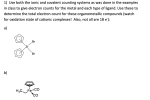 1) Use both the ionic and covalent counting systems as was done in the examples in class to give electron counts for the metal and each type of ligand. Use these to determine the total electron count for these organometallic compounds (watch for oxidation state of cationic complexes! Also, not all are 18 e*): a) b) H3cFe.co co PnP .BhP Php -00 H Co Co(m.C.Hg)(CO), ноос COOH Note: Divalent NR, is an X ligand Pdf ד
QUESTION 1 Which of the following chemical species exhibits both ionic and covalent bonding? B205 0...
 QUESTION 1 Which of the following chemical species exhibits both ionic and covalent bonding? B205 0 0 u B. 02- C2H5NO2 OP. 504² E. NH4C2H302 QUESTION 2 Match the electron configurations to the appropriate transition metal species. Some choices may be selected more than once. - Cu *[Kr]4d10552 RXej4f145d10 - Cult U - Ni2+ [Ar]4513010 [Kr]4d10 - Zn2+ E. [Ar]3d8 - . . Agt cd cd2+ * [Ar]3d10 - Aut QUESTION 3 Which of the following chemical species has non-polar...
 Use both the ionic and covalent
counting systems as was done in the examples in class to give
electron counts for the metal and each type of ligand. Use these to
determine the total electron count for these organometallic
compounds (watch for oxidation state of cationic
complexes! Also, not all are 18 e‐ ):
H2Cre.co HzCv"co ph3P ....phpPn3 PhP on- H HD. CH Co(73-C,Hz)(CO), HIC H Hac HOOC COOH Note: Divalent NR2 is an X ligand We were unable to transcribe...
Use both the ionic and covalent
counting systems as was done in the examples in class to give
electron counts for the metal and each type of ligand. Use these to
determine the total electron count for these organometallic
compounds (watch for oxidation state of cationic
complexes! Also, not all are 18 e‐ ):
H2Cre.co HzCv"co ph3P ....phpPn3 PhP on- H HD. CH Co(73-C,Hz)(CO), HIC H Hac HOOC COOH Note: Divalent NR2 is an X ligand We were unable to transcribe...
 1) Use both the ionic and covalent counting systems as was done in the examples in class to give electron counts for the metal and each type of ligand. Use these to determine the total electron count for these organometallic compounds (watch for oxidation state of cationic complexes! Also, not all are 18 e*): a) b) H3cFe.co co PnP .BhP Php -00 H Co Co(m.C.Hg)(CO), ноос COOH Note: Divalent NR, is an X ligand Pdf ד
 QUESTION 1 Which of the following chemical species exhibits both ionic and covalent bonding? B205 0 0 u B. 02- C2H5NO2 OP. 504² E. NH4C2H302 QUESTION 2 Match the electron configurations to the appropriate transition metal species. Some choices may be selected more than once. - Cu *[Kr]4d10552 RXej4f145d10 - Cult U - Ni2+ [Ar]4513010 [Kr]4d10 - Zn2+ E. [Ar]3d8 - . . Agt cd cd2+ * [Ar]3d10 - Aut QUESTION 3 Which of the following chemical species has non-polar...
Most questions answered within 3 hours.
-
Where is the error in this code sequence?
String s1 = "Hello";
String s2 = "ello";...
asked 10 months ago -
Financial data for Joel de Paris, Inc., for last year
follow:
Joel de Paris, Inc.
Balance...
asked 10 months ago -
Consider this reaction:
Al2(SO4)3 (aq)+ BaCl3
(aq) Al2Cl6 (aq)- +
3BaSO4(s) . What is the...
asked 10 months ago -
Suppose that Savneet is considering increasing her
recent random sample from 20 car rentals to 40...
asked 10 months ago -
Trucks arrive at an unloading terminal at an average rate of 120
per hour.
Trucks arrive...
asked 10 months ago -
Why are methanol and ethanol completely soluble in water while
octanol is not very little soluble....
asked 10 months ago -
A facilities manager at a university reads in a research report
that the mean amount of...
asked 10 months ago -
When the CuSO4 is rehydrated by adding water to the anhydrous
compound, is this an endothermic...
asked 10 months ago -
A ray of sunlight is passing from diamond into crown glass; the
angle of incidence is...
asked 10 months ago -
A block of mass 0.249 kg is placed on top of a light, vertical
spring of...
asked 10 months ago -
how do the kidneys compensate in the presences of acidosis
a) trigger hyperventilate
b) reserve acid...
asked 10 months ago -
Question 501 pts
The rental rate of capital to the firm increases. Which of the
following...
asked 10 months ago