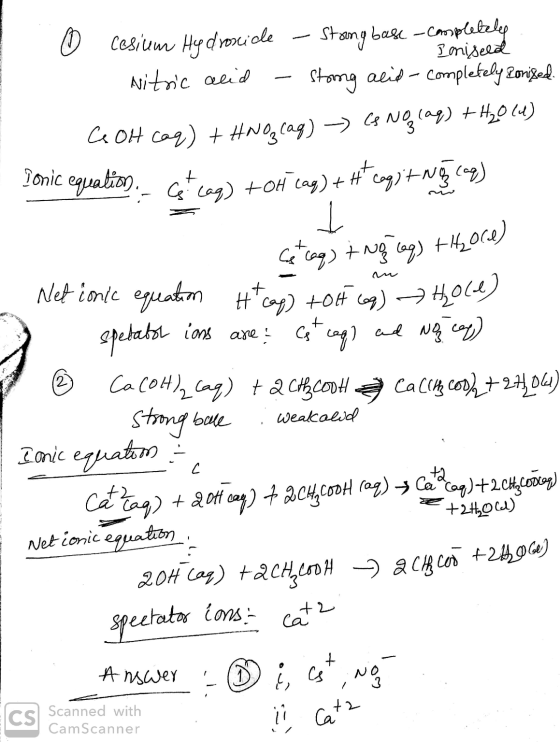
In the following acid-base reactions, identify the spectator ions, if any: (i) cesium hydroxide(aq) + nitric...
In the following acid-base reactions, identify the spectator
ions, if any:
(i) cesium hydroxide(aq) + nitric acid(aq)
-->
(ii) calcium hydroxide(aq) + acetic acid(aq)
-->
| A. |
(i) Cs+ and NO3- |
|
| B. |
(i) Cs+ and NO3- |
|
| C. |
(i) no spectator ions |
|
| D. |
(i) Cs+ and NO3- |
|
| E. |
(i) no spectator ions |
Can you explain how to figure this out step by step?
Homework Answers
Add Answer to:
In the following acid-base reactions, identify the spectator
ions, if any:
(i) cesium hydroxide(aq) + nitric...
Identify the spectator ions in the following reaction. Ca2+(aq) + 2NO3(aq) + 2Na+ (aq) + CO32-(aq)...
 Identify the spectator ions in the following reaction. Ca2+(aq) + 2NO3(aq) + 2Na+ (aq) + CO32-(aq) → CaCO3(s) + 2Na+(aq) + NO3(aq) a. Na+ and NO 3 - Ob. NO 3 - and CO 3 2- Oc. Ca 2+ and CO 3 d. Ca 2+ and Na+ e. Ca 2+ and NO 3
2. Balance the following equations. Identify each of the following reactions as belonging to one of...
 2. Balance the following equations. Identify each of the following reactions as belonging to one of the following categories: precipitation, acid-base (neutralization), or oxidation- reduction (8 points) a. H2SO4 (aq) + Fe(s) → FeSO4(aq) + H2(g) b. Ca(OH)2(aq) +HNO3(aq) → Ca(NO3)2(aq) + H2O(1) c.2 Fe(s) +3 Cl2(g) +2 FeCl3(s) d. AgNO3(aq) + CaCl2(aq) → AgCl(s) + Ca(NO3)2(aq) 3. Write the balanced molecular and net ionic equations for each of the following reactions. Identify the spectator ions. (6 points) a. Solid...
Writing Proton-Transfer Equations for Acid-Base Reactions •PROBLEM: Write balanced total and net ionic equations for the...
Writing Proton-Transfer Equations for Acid-Base Reactions •PROBLEM: Write balanced total and net ionic equations for the following reactions and use curved arrows to show how the proton transfer occurs. –(a) hydriodic acid (aq) + calcium hydroxide (aq) → Give the name and formula of the salt present when the water evaporates. –(b) potassium hydroxide (aq) + propionic acid (aq) → Note that propionic acid is a weak acid. Be sure to identify the spectator ions in this reaction.
Gas Forming Reactions Uu04 Sample Problem 4.13 net om same Practice Problem 4.9 Writing lonie Equations...
 Gas Forming Reactions Uu04 Sample Problem 4.13 net om same Practice Problem 4.9 Writing lonie Equations for Acid-Base Reactions Write balanced molecular, total ionic, and net ionic equations for the following acid-base reactions and identify the spectator ions (a) Br (a) hydriodic acid (aq) + calcium hydroxide (aq) - (b) barium hydroxide (aq) + sulfuric acid (aq) + Ba (OH)2 (aq) + H2SO4 (99) ► bos (aq) + H Sov- BaSO4 (5)+ 2 H2O (L) molecular equation + OH KE...
AI(NO3)3(aq) + Na3PO4(aq) → E. Neutralization Reactions 1. nitric acid(aq) + sodium hydroxide(aq) sodium nitrate(aq) +...
 AI(NO3)3(aq) + Na3PO4(aq) → E. Neutralization Reactions 1. nitric acid(aq) + sodium hydroxide(aq) sodium nitrate(aq) + water(1) HNO3(aq) + NaOH(aq) → 2. sulfuric acid(aq) + sodium hydroxide(aq) → sodium sulfate(aq) + water(1) H2SO4(aq) + NaOH(aq) → sodium phosphate(aq) + water(1) 3. phosphoric acid(aq) + sodium hydroxide(aq) H3PO4(aq) + NaOH(aq)
When solutions of acetic acid and magnesium hydroxide react, which of the following are spectator ions?...
When solutions of acetic acid and magnesium hydroxide react, which of the following are spectator ions? A) hydrogen ion B) acetate ion C) magnesium ion D) hydroxide ion E) none of these
Names: on Leanel Carere Chem 1410 3/29/18 Types of Reactions (Precipitation and Acid/Base) 1. Write the...
 Names: on Leanel Carere Chem 1410 3/29/18 Types of Reactions (Precipitation and Acid/Base) 1. Write the formula from the given name. Then on the basis of the general solubility rules, predict the solubility of the following compounds: a. zinc chloride b. lead(II) nitrate c. lead(lI) sulfate d. sodium iodide e. cobalt(II) sulfide f chromium(III) hydroxide g. magnesium carbonate h. ammonium carbonate 70 2. Write the molecular equation, complete ionic equation and net ionic equation for the reaction of Ni(NO3)2 +...
Identify the spectator ions present (if any) when aqueous solutions of AgNO3 and MgCl, are mixed....
 Identify the spectator ions present (if any) when aqueous solutions of AgNO3 and MgCl, are mixed. Periodic Table TABLE 8.1 Solubility Rules for Ionic Compounds in Water Compounds Containing the Following Ions Are Generally Soluble Exceptions Lit, Nat, Kt, and NHA None NO, and C2H30 None CI, Br, and When these ions pair with Agt, Hg2+, or Pb2+, the resulting compounds are insoluble. SO2- When SO 2 pairs with Sr?+, Ba²+, Pb2+, Ag+, or Ca't, the resulting compound is insoluble....
please write legible 1. Identify each of the following reactions as a precipitation reaction, an acid-base...
 please write legible
1. Identify each of the following reactions as a precipitation reaction, an acid-base reaction, or as a redox reaction + a. Pb(NO3)2 (aq) + 2 HCl(aq) PbCl (s) + 2 HNO, (aq) b. 2 Hxe + O2 + 2 H2O c. HNO, (aq) + KOH(aq) KNO, (aq) + H20 (1) d. Zna + 2HCl(a) - ZnClaraq) + Halle e. Ba?'(aq) + 2 Br(aq) + 2 Na(aq) + SO/"(aq) BaSO. (s) + 2 Na'(aq) + 2 Br" (aq)...
please write legible
1. Identify each of the following reactions as a precipitation reaction, an acid-base reaction, or as a redox reaction + a. Pb(NO3)2 (aq) + 2 HCl(aq) PbCl (s) + 2 HNO, (aq) b. 2 Hxe + O2 + 2 H2O c. HNO, (aq) + KOH(aq) KNO, (aq) + H20 (1) d. Zna + 2HCl(a) - ZnClaraq) + Halle e. Ba?'(aq) + 2 Br(aq) + 2 Na(aq) + SO/"(aq) BaSO. (s) + 2 Na'(aq) + 2 Br" (aq)...
EXP. 5 BUFFERS, TITRATION CURVES, AND INDICATORS LAB REPORT WORKSHEETS and/or molecules, include the spectator ions....
 EXP. 5 BUFFERS, TITRATION CURVES, AND INDICATORS LAB REPORT WORKSHEETS and/or molecules, include the spectator ions. Since water is the solvent, it is not considered a major species. CH₃COOH, OH- To decide which are the major species, consider what reactants were put into the titration beaker at each stage, and what, if any, chemical reactions between them have occurred. 110mL unknown i. Before any NaOH is added (at the start of the titration). Carefully think about what you have put...
 Identify the spectator ions in the following reaction. Ca2+(aq) + 2NO3(aq) + 2Na+ (aq) + CO32-(aq) → CaCO3(s) + 2Na+(aq) + NO3(aq) a. Na+ and NO 3 - Ob. NO 3 - and CO 3 2- Oc. Ca 2+ and CO 3 d. Ca 2+ and Na+ e. Ca 2+ and NO 3
 2. Balance the following equations. Identify each of the following reactions as belonging to one of the following categories: precipitation, acid-base (neutralization), or oxidation- reduction (8 points) a. H2SO4 (aq) + Fe(s) → FeSO4(aq) + H2(g) b. Ca(OH)2(aq) +HNO3(aq) → Ca(NO3)2(aq) + H2O(1) c.2 Fe(s) +3 Cl2(g) +2 FeCl3(s) d. AgNO3(aq) + CaCl2(aq) → AgCl(s) + Ca(NO3)2(aq) 3. Write the balanced molecular and net ionic equations for each of the following reactions. Identify the spectator ions. (6 points) a. Solid...
 Gas Forming Reactions Uu04 Sample Problem 4.13 net om same Practice Problem 4.9 Writing lonie Equations for Acid-Base Reactions Write balanced molecular, total ionic, and net ionic equations for the following acid-base reactions and identify the spectator ions (a) Br (a) hydriodic acid (aq) + calcium hydroxide (aq) - (b) barium hydroxide (aq) + sulfuric acid (aq) + Ba (OH)2 (aq) + H2SO4 (99) ► bos (aq) + H Sov- BaSO4 (5)+ 2 H2O (L) molecular equation + OH KE...
 AI(NO3)3(aq) + Na3PO4(aq) → E. Neutralization Reactions 1. nitric acid(aq) + sodium hydroxide(aq) sodium nitrate(aq) + water(1) HNO3(aq) + NaOH(aq) → 2. sulfuric acid(aq) + sodium hydroxide(aq) → sodium sulfate(aq) + water(1) H2SO4(aq) + NaOH(aq) → sodium phosphate(aq) + water(1) 3. phosphoric acid(aq) + sodium hydroxide(aq) H3PO4(aq) + NaOH(aq)
 Names: on Leanel Carere Chem 1410 3/29/18 Types of Reactions (Precipitation and Acid/Base) 1. Write the formula from the given name. Then on the basis of the general solubility rules, predict the solubility of the following compounds: a. zinc chloride b. lead(II) nitrate c. lead(lI) sulfate d. sodium iodide e. cobalt(II) sulfide f chromium(III) hydroxide g. magnesium carbonate h. ammonium carbonate 70 2. Write the molecular equation, complete ionic equation and net ionic equation for the reaction of Ni(NO3)2 +...
 Identify the spectator ions present (if any) when aqueous solutions of AgNO3 and MgCl, are mixed. Periodic Table TABLE 8.1 Solubility Rules for Ionic Compounds in Water Compounds Containing the Following Ions Are Generally Soluble Exceptions Lit, Nat, Kt, and NHA None NO, and C2H30 None CI, Br, and When these ions pair with Agt, Hg2+, or Pb2+, the resulting compounds are insoluble. SO2- When SO 2 pairs with Sr?+, Ba²+, Pb2+, Ag+, or Ca't, the resulting compound is insoluble....
 please write legible
1. Identify each of the following reactions as a precipitation reaction, an acid-base reaction, or as a redox reaction + a. Pb(NO3)2 (aq) + 2 HCl(aq) PbCl (s) + 2 HNO, (aq) b. 2 Hxe + O2 + 2 H2O c. HNO, (aq) + KOH(aq) KNO, (aq) + H20 (1) d. Zna + 2HCl(a) - ZnClaraq) + Halle e. Ba?'(aq) + 2 Br(aq) + 2 Na(aq) + SO/"(aq) BaSO. (s) + 2 Na'(aq) + 2 Br" (aq)...
please write legible
1. Identify each of the following reactions as a precipitation reaction, an acid-base reaction, or as a redox reaction + a. Pb(NO3)2 (aq) + 2 HCl(aq) PbCl (s) + 2 HNO, (aq) b. 2 Hxe + O2 + 2 H2O c. HNO, (aq) + KOH(aq) KNO, (aq) + H20 (1) d. Zna + 2HCl(a) - ZnClaraq) + Halle e. Ba?'(aq) + 2 Br(aq) + 2 Na(aq) + SO/"(aq) BaSO. (s) + 2 Na'(aq) + 2 Br" (aq)...
 EXP. 5 BUFFERS, TITRATION CURVES, AND INDICATORS LAB REPORT WORKSHEETS and/or molecules, include the spectator ions. Since water is the solvent, it is not considered a major species. CH₃COOH, OH- To decide which are the major species, consider what reactants were put into the titration beaker at each stage, and what, if any, chemical reactions between them have occurred. 110mL unknown i. Before any NaOH is added (at the start of the titration). Carefully think about what you have put...
Most questions answered within 3 hours.
-
Where is the error in this code sequence?
String s1 = "Hello";
String s2 = "ello";...
asked 10 months ago -
Financial data for Joel de Paris, Inc., for last year
follow:
Joel de Paris, Inc.
Balance...
asked 10 months ago -
Consider this reaction:
Al2(SO4)3 (aq)+ BaCl3
(aq) Al2Cl6 (aq)- +
3BaSO4(s) . What is the...
asked 10 months ago -
Suppose that Savneet is considering increasing her
recent random sample from 20 car rentals to 40...
asked 10 months ago -
Trucks arrive at an unloading terminal at an average rate of 120
per hour.
Trucks arrive...
asked 10 months ago -
Why are methanol and ethanol completely soluble in water while
octanol is not very little soluble....
asked 10 months ago -
A facilities manager at a university reads in a research report
that the mean amount of...
asked 10 months ago -
When the CuSO4 is rehydrated by adding water to the anhydrous
compound, is this an endothermic...
asked 10 months ago -
A ray of sunlight is passing from diamond into crown glass; the
angle of incidence is...
asked 10 months ago -
A block of mass 0.249 kg is placed on top of a light, vertical
spring of...
asked 10 months ago -
how do the kidneys compensate in the presences of acidosis
a) trigger hyperventilate
b) reserve acid...
asked 10 months ago -
Question 501 pts
The rental rate of capital to the firm increases. Which of the
following...
asked 10 months ago