
Homework Answers

Add Answer to:
If, for a particular process, AH = 54 and AS = 312k, the process will be:...
If, for a particular process, delta H = -214 kJ/mol and delta S = 450 J/mole...
 If, for a particular process, delta H = -214 kJ/mol
and delta S = 450 J/mole K, the process will be. Please show work
too, I am trying hard to understand!
< > Options Due Monday, Nov 25, 11:59pm EST © Explain how spontaneity is affected by temperature Question If, for a particular process, AH = -214 and AS - 450k the process will be: Select the correct answer below: O spontaneous at any temperature O nonspontaneous at any temperature...
If, for a particular process, delta H = -214 kJ/mol
and delta S = 450 J/mole K, the process will be. Please show work
too, I am trying hard to understand!
< > Options Due Monday, Nov 25, 11:59pm EST © Explain how spontaneity is affected by temperature Question If, for a particular process, AH = -214 and AS - 450k the process will be: Select the correct answer below: O spontaneous at any temperature O nonspontaneous at any temperature...
А B AH = TAS Energy AH TAS 263 283 273 Temperature (K) Using the graph...
 А B AH = TAS Energy AH TAS 263 283 273 Temperature (K) Using the graph above, select the most correct statement below. Area B is spontaneous and delta G<0 Area A is spontaneous and delta G<0 Area A is nonspontaneous and delta G<0 Area B is nonspontaneous and delta GO
Free Energy: Equilibrium Constant and Temperature Effects CHM1046 GEN CHEM WONLINE 619434 nergy: Equilibrium Consta...
 Free Energy: Equilibrium Constant and Temperature Effects CHM1046 GEN CHEM WONLINE 619434 nergy: Equilibrium Constant and lemperature Effects Explain How Spontaneity is Affected by Temperature Question Consider the process below. How does the spontaneity of the process depend on temperature? 2SnO (s) 2SnO(s)+02(g) 584 kl mori, dS-220 J K-1 mol-1 ΔΗ Select the correct answer below O nonspontaneous at all temperatures spontaneous at all temperatures spontaneous above a certain temperature and nonspontaneous below spontaneous below a certain temperature and nonspontaneous...
Under which of the following conditions is a process spontaneous at high temperatures and nonspontaneous at...
 Under which of the following conditions is a process spontaneous at high temperatures and nonspontaneous at low temperatures? Select the correct answer below: O AH and AS are both positive O AH and AS are both negative O ΔH is positive and Δ.S is negative O AH is negative and AS is positive
Describe spontaneous and nonspontaneous processes Question Which process is spontaneous? Select the correct answer below: the...
 Describe spontaneous and nonspontaneous processes Question Which process is spontaneous? Select the correct answer below: the radioactive decay of Tc-99 the radioactive decay of U-238 O the radioactive decay of C-14 all of the above Content attribution
If a process is endothermic with increasing disorder, then the reaction is Select all that are...
If a process is endothermic with increasing disorder, then the reaction is Select all that are True spontaneous only below a certain temperatures spontaneous at any temperature spontaneous only above a certain temperatures not spontaneous at any temperature
How does the spontaneity of the process below depend on temperature? PCI5(9)+H2O(g)POCI3(g) +2HCI(g) -126 kJ mol1,...
 How does the spontaneity of the process below depend on temperature? PCI5(9)+H2O(g)POCI3(g) +2HCI(g) -126 kJ mol1, AS = 146 J K-'mol1 ΔΗ Select the correct answer below: nonspontaneous at all temperatures spontaneous at all temperatures spontaneous at high temperatures and nonspontaneous at low temperatures spontaneous at low temperatures and nonspontaneous at high temperatures
Is the following process spontaneous? Is the following process spontaneous? O Yes, because AH> 0. No,...
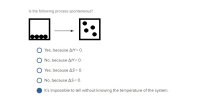 Is the following process spontaneous?
 O Yes, because AH> 0. No, because AH<0 O Yes, because AS O. O No, because AS< 0. It's impossible to tell without knowing the temperature of the system.
Is the following process spontaneous?
Is the following process spontaneous? O Yes, because AH> 0. No, because AH<0 O Yes, because AS O. O No, because AS< 0. It's impossible to tell without knowing the temperature of the system.
3. A certain process, AH = 178 kJ, and AS = 160 J/K. What is the...
 3. A certain process, AH = 178 kJ, and AS = 160 J/K. What is the minimum temperature at which the process will be spontaneous? (What assumptions must be made in order to answer this question?) (5) GAHTASN AG78 T XH TO/SO-ANSS 0-NA TAUVE DISTE oot CRI ADO TSE ORS 6se 2 yetet- Toe O dog CHRD 4EOnd
Which of the following describes the temperature dependence of the spontaneity of the reaction below? 2H202(0)...
 Which of the following describes the temperature dependence of the spontaneity of the reaction below? 2H202(0) 2H2O()+02(g) ΔΗ--196kl mol-1, AS-126 J K-1 mol-i Select the correct answer below: 0 O O O nonspontaneous at all temperatures spontaneous at all temperatures spontaneous at high temperatures and nonspontaneous at low temperatures spontaneous at low temperatures and nonspontaneous at high temperatures
 If, for a particular process, delta H = -214 kJ/mol
and delta S = 450 J/mole K, the process will be. Please show work
too, I am trying hard to understand!
< > Options Due Monday, Nov 25, 11:59pm EST © Explain how spontaneity is affected by temperature Question If, for a particular process, AH = -214 and AS - 450k the process will be: Select the correct answer below: O spontaneous at any temperature O nonspontaneous at any temperature...
If, for a particular process, delta H = -214 kJ/mol
and delta S = 450 J/mole K, the process will be. Please show work
too, I am trying hard to understand!
< > Options Due Monday, Nov 25, 11:59pm EST © Explain how spontaneity is affected by temperature Question If, for a particular process, AH = -214 and AS - 450k the process will be: Select the correct answer below: O spontaneous at any temperature O nonspontaneous at any temperature...
 А B AH = TAS Energy AH TAS 263 283 273 Temperature (K) Using the graph above, select the most correct statement below. Area B is spontaneous and delta G<0 Area A is spontaneous and delta G<0 Area A is nonspontaneous and delta G<0 Area B is nonspontaneous and delta GO
 Free Energy: Equilibrium Constant and Temperature Effects CHM1046 GEN CHEM WONLINE 619434 nergy: Equilibrium Constant and lemperature Effects Explain How Spontaneity is Affected by Temperature Question Consider the process below. How does the spontaneity of the process depend on temperature? 2SnO (s) 2SnO(s)+02(g) 584 kl mori, dS-220 J K-1 mol-1 ΔΗ Select the correct answer below O nonspontaneous at all temperatures spontaneous at all temperatures spontaneous above a certain temperature and nonspontaneous below spontaneous below a certain temperature and nonspontaneous...
 Under which of the following conditions is a process spontaneous at high temperatures and nonspontaneous at low temperatures? Select the correct answer below: O AH and AS are both positive O AH and AS are both negative O ΔH is positive and Δ.S is negative O AH is negative and AS is positive
 Describe spontaneous and nonspontaneous processes Question Which process is spontaneous? Select the correct answer below: the radioactive decay of Tc-99 the radioactive decay of U-238 O the radioactive decay of C-14 all of the above Content attribution
 How does the spontaneity of the process below depend on temperature? PCI5(9)+H2O(g)POCI3(g) +2HCI(g) -126 kJ mol1, AS = 146 J K-'mol1 ΔΗ Select the correct answer below: nonspontaneous at all temperatures spontaneous at all temperatures spontaneous at high temperatures and nonspontaneous at low temperatures spontaneous at low temperatures and nonspontaneous at high temperatures
 Is the following process spontaneous?
 O Yes, because AH> 0. No, because AH<0 O Yes, because AS O. O No, because AS< 0. It's impossible to tell without knowing the temperature of the system.
Is the following process spontaneous?
Is the following process spontaneous? O Yes, because AH> 0. No, because AH<0 O Yes, because AS O. O No, because AS< 0. It's impossible to tell without knowing the temperature of the system.
 3. A certain process, AH = 178 kJ, and AS = 160 J/K. What is the minimum temperature at which the process will be spontaneous? (What assumptions must be made in order to answer this question?) (5) GAHTASN AG78 T XH TO/SO-ANSS 0-NA TAUVE DISTE oot CRI ADO TSE ORS 6se 2 yetet- Toe O dog CHRD 4EOnd
 Which of the following describes the temperature dependence of the spontaneity of the reaction below? 2H202(0) 2H2O()+02(g) ΔΗ--196kl mol-1, AS-126 J K-1 mol-i Select the correct answer below: 0 O O O nonspontaneous at all temperatures spontaneous at all temperatures spontaneous at high temperatures and nonspontaneous at low temperatures spontaneous at low temperatures and nonspontaneous at high temperatures
Most questions answered within 3 hours.
-
Where is the error in this code sequence?
String s1 = "Hello";
String s2 = "ello";...
asked 10 months ago -
Financial data for Joel de Paris, Inc., for last year
follow:
Joel de Paris, Inc.
Balance...
asked 10 months ago -
Consider this reaction:
Al2(SO4)3 (aq)+ BaCl3
(aq) Al2Cl6 (aq)- +
3BaSO4(s) . What is the...
asked 10 months ago -
Suppose that Savneet is considering increasing her
recent random sample from 20 car rentals to 40...
asked 10 months ago -
Trucks arrive at an unloading terminal at an average rate of 120
per hour.
Trucks arrive...
asked 10 months ago -
Why are methanol and ethanol completely soluble in water while
octanol is not very little soluble....
asked 10 months ago -
A facilities manager at a university reads in a research report
that the mean amount of...
asked 10 months ago -
When the CuSO4 is rehydrated by adding water to the anhydrous
compound, is this an endothermic...
asked 10 months ago -
A ray of sunlight is passing from diamond into crown glass; the
angle of incidence is...
asked 10 months ago -
A block of mass 0.249 kg is placed on top of a light, vertical
spring of...
asked 10 months ago -
how do the kidneys compensate in the presences of acidosis
a) trigger hyperventilate
b) reserve acid...
asked 10 months ago -
Question 501 pts
The rental rate of capital to the firm increases. Which of the
following...
asked 10 months ago