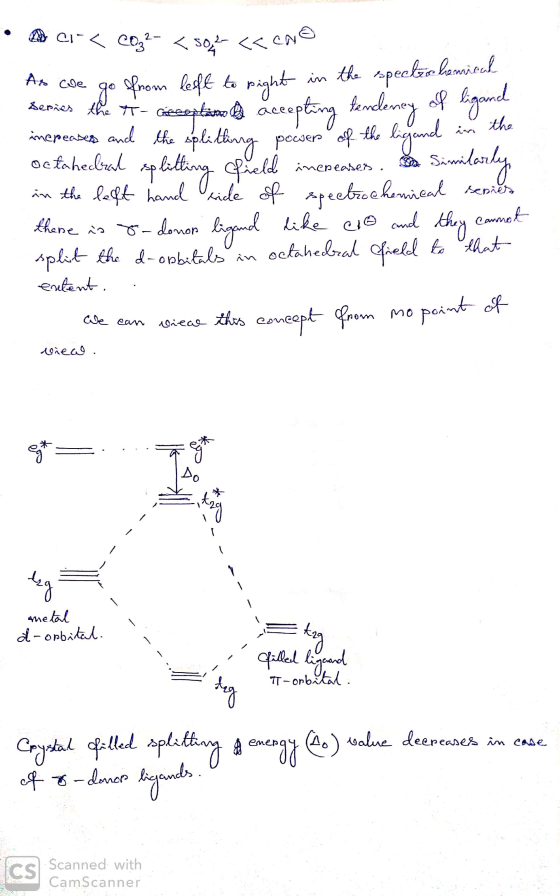
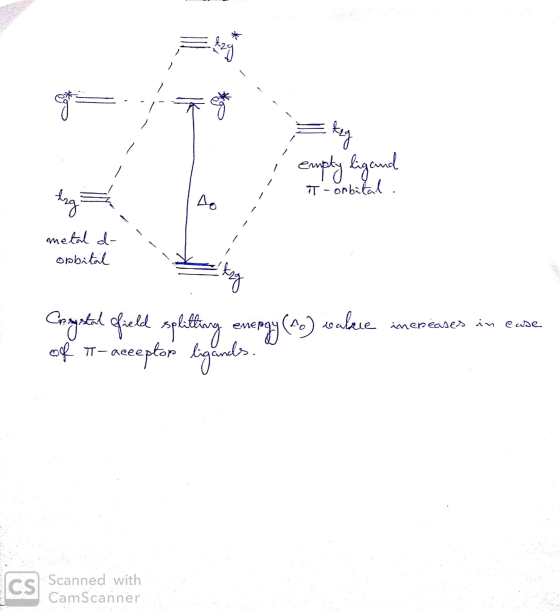
The position of the following species in the spectrochemical series is as follows. Cl- < CO32-...
The position of the following species in the spectrochemical series is as follows.
Cl- < CO32- < SO42- << CN-
Explain what effect this has on the relative octahedral splitting energy for these ligands.
Homework Answers
Add Answer to:
The position of the following species in the spectrochemical
series is as follows.
Cl- < CO32-...
Which of these three octahedral coordination compounds is/are paramagnetic? (Refer to the spectrochemical series below) (1)...
Which of these three octahedral coordination compounds is/are paramagnetic? (Refer to the spectrochemical series below) (1) [Sc(H2O)6] 3+ (2) [FeF6] 4– (3) [Mn(CN)6] 3– The spectrochemical series: Cl– < F– < H2O < NH3 < en < CN– (weak field/high spin) (strong field/low spin) Please explain.
6. Draw orbital-energy splitting diagrams and use the spectrochemical series to show the orbital occupancy for...
 6. Draw orbital-energy splitting diagrams and use the spectrochemical series to show the orbital occupancy for each of the following (assuming that H2O is a weak-field ligand): [Мось) INi(H2O)e] [Ni(CN)J2
The spectrochemical series is < Br<< Cl<F-<OH" <H2O <NH3 <en <NO2- < CN- The complex [Ni(Cl)c]...
 The spectrochemical series is < Br<< Cl<F-<OH" <H2O <NH3 <en <NO2- < CN- The complex [Ni(Cl)c] is green and the complex [Ni(en)]2+ is violet, where en corresponds to the ethylenediamine ligand. The reason for the difference in the color of these complexes is: Select one: A. The chloride ligand is green, and the ethylenediamine ligand is violet. B. The difference in the coordination numbers of the chloride complex and the en complex. C. The difference in the oxidation states of...
5. Use the spectrochemical series and the color of the following complex ions to write the...
 5. Use the spectrochemical series and the color of the following complex ions to write the electron configuration of the d orbitals showing the crystal field splitting. Use 5 horizontal lines for the orbitals, and use arrows to represent the electrons. You do not need to label the orbitals. a. [Mn(H2O)c] is pink (assume H2O is a weak-field ligand in this complex ion) b. [CoCla]? is blue (the complex is tetrahedral) C. [Fe(CN).]" is yellow d. (Co(NH3).]** is orange
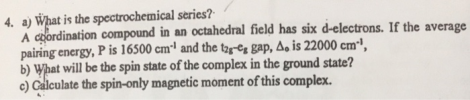
Hello, 4. a) What is the spectrochemical series? A cgordination compound in an octahedral field has...
 Hello,
4. a) What is the spectrochemical series? A cgordination compound in an octahedral field has six d-electrons. If the average pairing energy, P is l b) what will be the spin state of the complex in the ground state? o) Calculate the spin-only magnetic moment of this complex. 6500 cm" and the treg gap, Δ.is 22000 cm.,
Hello,
4. a) What is the spectrochemical series? A cgordination compound in an octahedral field has six d-electrons. If the average pairing energy, P is l b) what will be the spin state of the complex in the ground state? o) Calculate the spin-only magnetic moment of this complex. 6500 cm" and the treg gap, Δ.is 22000 cm.,
A dl octahedral complex is found to absorb visible light, with the absorption maximum occurring at...
 A dl octahedral complex is found to absorb visible light, with the absorption maximum occurring at 499 nm. Calculate the crystal-field splitting energy, A, in kJ/mol. A= kJ/mol If the complex has a formula of [M(H20)alt, what effect will replacing the 6 aqua ligands with 6 CN- ligands have on A? O A will remain constant A will decrease O A will increase
Q1. The following species a)-c) all contain complex ions of transition metals, which you can assume...
Q1. The following species a)-c) all contain complex ions of transition metals, which you can assume take up an octahedral geometry. a) [RuCl3(H2O)3] b) [Ir(bpy)3]Cl3 ; bipy = 2,2'-bipyridine c) K2[Mo(NCS)6] For each species: i) draw all the possible isomers of the complex ions; ii) calculate the charge of the metal, and the dn configuration; iii) draw a diagram showing d orbital occupancy and, where high and low spin cases are possible, predict which will be favoured considering the spectrochemical...
Use the following electrochemical series: CN -1 > NO2-1 > en > NH3 > H2O >...
Use the following electrochemical series: CN -1 > NO2-1 > en > NH3 > H2O > OH -1 > F -1 > Cl -1 > Br -1 > I -1 Given compound: [Mn(en)3]+3 For octahedral field splitting diagrams, outline in detail how you determine the following: a) neutral metal's electron configuration b) ion's electron configuration c) the number of d electrons in the ion d) drawing the splitting pattern, labeling the orbitals in the splitting pattern, the filling of electrons,...
4. (2 points) The absorbance maxima observed for the following octahedral cobalt complexes ([Co(NH)* max [Co(NH3)3Cl]...
 4. (2 points) The absorbance maxima observed for the following octahedral cobalt complexes ([Co(NH)* max [Co(NH3)3Cl] nmax = 680 nm) can be identified with transitions involving d-electrons. = 470 nm, [Co(NH);CI]2* Amax = 560 nm, [Co(NH),Cl2]* max = 630 nm, and What can be said about the trend observed in these complexes with relation to their crystal field splitting energies? Rank from LOWEST to HIGHEST splitting energies. а. b. Given the complexes above and the trend in absorbance maxima for...
So that we are all on the same page - we will use the following electrochemical...
 So that we are all on the same page - we will use the following electrochemical series, taken from page 1070 of Tro. CN-1 > NO, > en > NH3 > H20 > OH > F-1 > CL-1 > Br 1>1-1 For the octahedral field splitting diagrams, be sure to show and annotate how you determine the following in your problem-solving process: a) electron configuration of the neutral metal b) electron configuration of the ion c) number of d electrons...
 6. Draw orbital-energy splitting diagrams and use the spectrochemical series to show the orbital occupancy for each of the following (assuming that H2O is a weak-field ligand): [Мось) INi(H2O)e] [Ni(CN)J2
 The spectrochemical series is < Br<< Cl<F-<OH" <H2O <NH3 <en <NO2- < CN- The complex [Ni(Cl)c] is green and the complex [Ni(en)]2+ is violet, where en corresponds to the ethylenediamine ligand. The reason for the difference in the color of these complexes is: Select one: A. The chloride ligand is green, and the ethylenediamine ligand is violet. B. The difference in the coordination numbers of the chloride complex and the en complex. C. The difference in the oxidation states of...
 5. Use the spectrochemical series and the color of the following complex ions to write the electron configuration of the d orbitals showing the crystal field splitting. Use 5 horizontal lines for the orbitals, and use arrows to represent the electrons. You do not need to label the orbitals. a. [Mn(H2O)c] is pink (assume H2O is a weak-field ligand in this complex ion) b. [CoCla]? is blue (the complex is tetrahedral) C. [Fe(CN).]" is yellow d. (Co(NH3).]** is orange
 Hello,
4. a) What is the spectrochemical series? A cgordination compound in an octahedral field has six d-electrons. If the average pairing energy, P is l b) what will be the spin state of the complex in the ground state? o) Calculate the spin-only magnetic moment of this complex. 6500 cm" and the treg gap, Δ.is 22000 cm.,
Hello,
4. a) What is the spectrochemical series? A cgordination compound in an octahedral field has six d-electrons. If the average pairing energy, P is l b) what will be the spin state of the complex in the ground state? o) Calculate the spin-only magnetic moment of this complex. 6500 cm" and the treg gap, Δ.is 22000 cm.,
 A dl octahedral complex is found to absorb visible light, with the absorption maximum occurring at 499 nm. Calculate the crystal-field splitting energy, A, in kJ/mol. A= kJ/mol If the complex has a formula of [M(H20)alt, what effect will replacing the 6 aqua ligands with 6 CN- ligands have on A? O A will remain constant A will decrease O A will increase
 4. (2 points) The absorbance maxima observed for the following octahedral cobalt complexes ([Co(NH)* max [Co(NH3)3Cl] nmax = 680 nm) can be identified with transitions involving d-electrons. = 470 nm, [Co(NH);CI]2* Amax = 560 nm, [Co(NH),Cl2]* max = 630 nm, and What can be said about the trend observed in these complexes with relation to their crystal field splitting energies? Rank from LOWEST to HIGHEST splitting energies. а. b. Given the complexes above and the trend in absorbance maxima for...
 So that we are all on the same page - we will use the following electrochemical series, taken from page 1070 of Tro. CN-1 > NO, > en > NH3 > H20 > OH > F-1 > CL-1 > Br 1>1-1 For the octahedral field splitting diagrams, be sure to show and annotate how you determine the following in your problem-solving process: a) electron configuration of the neutral metal b) electron configuration of the ion c) number of d electrons...
Most questions answered within 3 hours.
-
Where is the error in this code sequence?
String s1 = "Hello";
String s2 = "ello";...
asked 11 months ago -
Financial data for Joel de Paris, Inc., for last year
follow:
Joel de Paris, Inc.
Balance...
asked 11 months ago -
Consider this reaction:
Al2(SO4)3 (aq)+ BaCl3
(aq) Al2Cl6 (aq)- +
3BaSO4(s) . What is the...
asked 11 months ago -
Suppose that Savneet is considering increasing her
recent random sample from 20 car rentals to 40...
asked 11 months ago -
Trucks arrive at an unloading terminal at an average rate of 120
per hour.
Trucks arrive...
asked 11 months ago -
Why are methanol and ethanol completely soluble in water while
octanol is not very little soluble....
asked 11 months ago -
A facilities manager at a university reads in a research report
that the mean amount of...
asked 11 months ago -
When the CuSO4 is rehydrated by adding water to the anhydrous
compound, is this an endothermic...
asked 11 months ago -
A ray of sunlight is passing from diamond into crown glass; the
angle of incidence is...
asked 11 months ago -
A block of mass 0.249 kg is placed on top of a light, vertical
spring of...
asked 11 months ago -
how do the kidneys compensate in the presences of acidosis
a) trigger hyperventilate
b) reserve acid...
asked 11 months ago -
Question 501 pts
The rental rate of capital to the firm increases. Which of the
following...
asked 11 months ago