
Homework Answers
I am given above all three answers please read carefully.
![CCCCCCCCCCC Here, the given rexns involve four elementary steps: (1) CH₃ COCH Ki City + Cty co rate= ((Hz Cochy] = ki [CH₂ C](http://img.homeworklib.com/questions/26651f90-d46b-11eb-a055-2d05c21fef79.png?x-oss-process=image/resize,w_560)
![Ans (6) 2 Assume kz » Ky [CH₃) apply the Steady -State approximation and we are work out an expression for [CH3] in term of k](http://img.homeworklib.com/questions/27efa490-d46b-11eb-ac84-3ffe27b94ad2.png?x-oss-process=image/resize,w_560)
![using [CHg] in egastep (iv) we get, rate = Ku [CH3] [CH3CO CH2] rate = kq [K3 [CH₃ Cochz] + Ki [Cth CO CH₂] [CH₂ CO CH₂ K, [с](http://img.homeworklib.com/questions/2987f280-d46b-11eb-a924-b98e77e31174.png?x-oss-process=image/resize,w_560)
Add Answer to:
Consider the following reaction on acetone (CH3COCH3), the mechanism is believed to involve four elementary steps:...
Temperature, Question 7 (13 marks) Acetone is brominated in acidic solution according to the following reaction:...
 Temperature, Question 7 (13 marks) Acetone is brominated in acidic solution according to the following reaction: CH3COCH3(aq) + Br2(aq) - CH3COCH_Br(aq) + H" (aq) + Br" (aq) Student A proposed the following four-step mechanism for the decomposition of Bra: CH3COCH3 + H + CH3C(OH)CH3 ki, ki CH,C(OH)CH3 -CH:C(OH)-CH2 + H+ ka, slow CH;C(OH)=CH2 + Br2 - CH3C(OH)CH2Br* + Br k3 CH:C(OH)CH2Br* - CH3COCH2Br + H+ k4 Deduce the rate law for the above reaction by assuming a pre-equilibrium (7 marks)...
ki Q3: The decomposition mechanism of 2 N2O(g) → 4NO2(g) + O2(g) is believed to follow...
 ki Q3: The decomposition mechanism of 2 N2O(g) → 4NO2(g) + O2(g) is believed to follow the elementary reactions: (1) N203 → NO2 + NO3 (1') NO2 + NO3 → N20 k_1 (2) NO, + NO3 → NO, + O2 + NO kz (3) NO + N203 → NO2 + NO2 + NO2 kz Using the steady-state approximation, deduce the rate law for this reaction.
The mechanism of the pyrolysis of acetaldehyde corresponding to the chemical reaction CH3CHO(8) CH4(8) +CO(g) at...
 The mechanism of the pyrolysis of acetaldehyde corresponding to the chemical reaction CH3CHO(8) CH4(8) +CO(g) at 520 °C and 0.2 bar is kị kg CHCH0g) CH3 g) + CH0g) CH3(g) + CH3CHO(g) = CH4(g) + CH3COg) CH3CO(g) = CO(g) + CH3(g) CH3(g) + CH3(g) = C2H6() Is this reaction a chain reaction? If so, identify the initiation, propagation, inhibition, and termination step(s). Using the steady state approximation for intermediate species CH3(g) and CH3CO(g), derive the rate law 1/2 kz [CH2CHO]3/2
03 (5 marks) : propose a two-step (elementary) mechanism for the reaction: 2NO2(g) + F2(g) →...
 03 (5 marks) : propose a two-step (elementary) mechanism for the reaction: 2NO2(g) + F2(g) → 2NO:F and·how that the chosen mechanism is consistent with the rate law = k!NollFJ. Hint, steady state approximation must be considered レ- Show your work
6. [20pt] The Rice-Herzfeld mechanism for the thermal decomposition of acetaldehyde (CH:CНO) is k1 CH3CHO CH3...
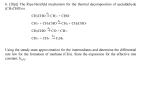 6. [20pt] The Rice-Herzfeld mechanism for the thermal decomposition of acetaldehyde (CH:CНO) is k1 CH3CHO CH3 CHO k2 CH3:: + CH3CНО $ СН4 + CH-CHO- k3 CH2CHO CO CH3 k4 СH3: + CH3. $ C2Н6 Using the steady-state approximation for the intermediates and determine the differential rate law for the formation of methane (CH4). State the expression for the effective rate constant, keff
Consider the recombination reaction: 2 Br(g) Br2 (8) The mechanism involves two elementary steps. The first...
 Consider the recombination reaction: 2 Br(g) Br2 (8) The mechanism involves two elementary steps. The first step results in formation of an energized Bra molecule, the excess energy carried by Bris then transferred to a molecule M for subsequent formation of Bry in the second step First step: 2 Br (8) Bry* () + M ) Brz* () Brz () +M() Second step: By the steady-state approximation and work out an expression for d[Brydr in term of k, k., ky...
The gas-phase decomposition of ozone: 20,+302 Is believed to have the mechanism: 03 + M =...
 The gas-phase decomposition of ozone: 20,+302 Is believed to have the mechanism: 03 + M = 02 + 0 + M 0+ 0; * 202 Where M is any molecule. at d[0]/dt = 2 k,[0][0,1+k, 031 M)-k_1020) M (1 mark) b) Write down a similar expression for: "93) (2 marks) c) Use the steady-state approximation to find an expression for the concentration of the intermediate species O. (2 marks) d) Show that when the steady-state approximation for [O] is substituted...
 Temperature, Question 7 (13 marks) Acetone is brominated in acidic solution according to the following reaction: CH3COCH3(aq) + Br2(aq) - CH3COCH_Br(aq) + H" (aq) + Br" (aq) Student A proposed the following four-step mechanism for the decomposition of Bra: CH3COCH3 + H + CH3C(OH)CH3 ki, ki CH,C(OH)CH3 -CH:C(OH)-CH2 + H+ ka, slow CH;C(OH)=CH2 + Br2 - CH3C(OH)CH2Br* + Br k3 CH:C(OH)CH2Br* - CH3COCH2Br + H+ k4 Deduce the rate law for the above reaction by assuming a pre-equilibrium (7 marks)...
 ki Q3: The decomposition mechanism of 2 N2O(g) → 4NO2(g) + O2(g) is believed to follow the elementary reactions: (1) N203 → NO2 + NO3 (1') NO2 + NO3 → N20 k_1 (2) NO, + NO3 → NO, + O2 + NO kz (3) NO + N203 → NO2 + NO2 + NO2 kz Using the steady-state approximation, deduce the rate law for this reaction.
 The mechanism of the pyrolysis of acetaldehyde corresponding to the chemical reaction CH3CHO(8) CH4(8) +CO(g) at 520 °C and 0.2 bar is kị kg CHCH0g) CH3 g) + CH0g) CH3(g) + CH3CHO(g) = CH4(g) + CH3COg) CH3CO(g) = CO(g) + CH3(g) CH3(g) + CH3(g) = C2H6() Is this reaction a chain reaction? If so, identify the initiation, propagation, inhibition, and termination step(s). Using the steady state approximation for intermediate species CH3(g) and CH3CO(g), derive the rate law 1/2 kz [CH2CHO]3/2
 03 (5 marks) : propose a two-step (elementary) mechanism for the reaction: 2NO2(g) + F2(g) → 2NO:F and·how that the chosen mechanism is consistent with the rate law = k!NollFJ. Hint, steady state approximation must be considered レ- Show your work
 6. [20pt] The Rice-Herzfeld mechanism for the thermal decomposition of acetaldehyde (CH:CНO) is k1 CH3CHO CH3 CHO k2 CH3:: + CH3CНО $ СН4 + CH-CHO- k3 CH2CHO CO CH3 k4 СH3: + CH3. $ C2Н6 Using the steady-state approximation for the intermediates and determine the differential rate law for the formation of methane (CH4). State the expression for the effective rate constant, keff
 Consider the recombination reaction: 2 Br(g) Br2 (8) The mechanism involves two elementary steps. The first step results in formation of an energized Bra molecule, the excess energy carried by Bris then transferred to a molecule M for subsequent formation of Bry in the second step First step: 2 Br (8) Bry* () + M ) Brz* () Brz () +M() Second step: By the steady-state approximation and work out an expression for d[Brydr in term of k, k., ky...
 The gas-phase decomposition of ozone: 20,+302 Is believed to have the mechanism: 03 + M = 02 + 0 + M 0+ 0; * 202 Where M is any molecule. at d[0]/dt = 2 k,[0][0,1+k, 031 M)-k_1020) M (1 mark) b) Write down a similar expression for: "93) (2 marks) c) Use the steady-state approximation to find an expression for the concentration of the intermediate species O. (2 marks) d) Show that when the steady-state approximation for [O] is substituted...
Most questions answered within 3 hours.
-
Where is the error in this code sequence?
String s1 = "Hello";
String s2 = "ello";...
asked 10 months ago -
Financial data for Joel de Paris, Inc., for last year
follow:
Joel de Paris, Inc.
Balance...
asked 10 months ago -
Consider this reaction:
Al2(SO4)3 (aq)+ BaCl3
(aq) Al2Cl6 (aq)- +
3BaSO4(s) . What is the...
asked 10 months ago -
Suppose that Savneet is considering increasing her
recent random sample from 20 car rentals to 40...
asked 10 months ago -
Trucks arrive at an unloading terminal at an average rate of 120
per hour.
Trucks arrive...
asked 10 months ago -
Why are methanol and ethanol completely soluble in water while
octanol is not very little soluble....
asked 10 months ago -
A facilities manager at a university reads in a research report
that the mean amount of...
asked 10 months ago -
When the CuSO4 is rehydrated by adding water to the anhydrous
compound, is this an endothermic...
asked 10 months ago -
A ray of sunlight is passing from diamond into crown glass; the
angle of incidence is...
asked 10 months ago -
A block of mass 0.249 kg is placed on top of a light, vertical
spring of...
asked 10 months ago -
how do the kidneys compensate in the presences of acidosis
a) trigger hyperventilate
b) reserve acid...
asked 10 months ago -
Question 501 pts
The rental rate of capital to the firm increases. Which of the
following...
asked 10 months ago