
Homework Answers

Add Answer to:
12. Design a synthetic route for the following compound free of other isomers. You do not...
Provide a synthetic route for the following compound from benzene and any other necessary organic and...
 Provide a synthetic route for the following compound from
benzene and any other necessary organic and inorganic reagents.
List the required reagents and conditions for each step and draw
the product for each step
14. Provide a synthetic route for the following compound from benzene and any other necessary organic and inorganic reagents. List the required reagents and conditions for each step and draw the product for each step. (4 pts) 0-V
Provide a synthetic route for the following compound from
benzene and any other necessary organic and inorganic reagents.
List the required reagents and conditions for each step and draw
the product for each step
14. Provide a synthetic route for the following compound from benzene and any other necessary organic and inorganic reagents. List the required reagents and conditions for each step and draw the product for each step. (4 pts) 0-V
2. Design a synthetic route for the following conversion of methylcylohexane into compound A using retrosynthesis...
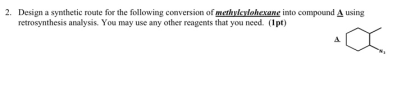 2. Design a synthetic route for the following conversion of methylcylohexane into compound A using retrosynthesis analysis. You may use any other reagents that you need. (1 pt)
2. Design a synthetic route for the following conversion of methylcylohexane into compound A using retrosynthesis a...
 2. Design a synthetic route for the following conversion of methylcylohexane into compound A using retrosynthesis analysis. You may use any other reagents that you need. (1pt) 3. Predict which of the following two compounds will undergo an E2 reaction more rapidly in presence of EtON/EtOH. Draw the reaction product(s) and the mechanism for the faster reaction using the correct chair conformation for the substrate (starting material). (1 pt)
orgo 2 design a synthetic route to prepare pentanal from 1-bromopropane. you are allowed to use...
orgo 2 design a synthetic route to prepare pentanal from 1-bromopropane. you are allowed to use any neccessary inorganic and organic reagents.
8. Provide a synthetic route to the desired compound using benzene and acetic acid as the starting materials. You don't have to draw the mechanisms. (If you get ortho- and para- mixture at a key...
 8. Provide a synthetic route to the desired compound using benzene and acetic acid as the starting materials. You don't have to draw the mechanisms. (If you get ortho- and para- mixture at a key step or steps, you may choose the isomer that you need to move forward.) C1
8. Provide a synthetic route to the desired compound using benzene and acetic acid as the starting materials. You don't have to draw the mechanisms. (If you get ortho- and...
8. Provide a synthetic route to the desired compound using benzene and acetic acid as the starting materials. You don't have to draw the mechanisms. (If you get ortho- and para- mixture at a key step or steps, you may choose the isomer that you need to move forward.) C1
8. Provide a synthetic route to the desired compound using benzene and acetic acid as the starting materials. You don't have to draw the mechanisms. (If you get ortho- and...
9. (7) Write a complete multi-step synthetic route for the following transformations, using only the given...
 9. (7) Write a complete multi-step synthetic route for the following transformations, using only the given starting material(s) as the sole source(s) of carbon. You do not have to show the synthesis of solvents or reagents if they are not incorporated into the final product. Clearly (in) Show all intermediate steps and reagents, but do not show any mechanisms or transition states. (24 points): a) Y. I-oyar onbino - we
Propose the most efficient synthetic route to make the following compound starting from the indicated reagents...
 Propose the most efficient synthetic route to make the following
compound starting from the indicated reagents and any other
reagents, clearly identifying the reaction conditions at each step
and the structure of the intermediates formed.
Propose the most efficient synthetic route to make the following compound starting from the indicated reagents and any other reagents, clearly identifying the reaction conditions at each step and the structure of the intermediates formed. *Note: This will require more than 3 steps* ohin 3...
Propose the most efficient synthetic route to make the following
compound starting from the indicated reagents and any other
reagents, clearly identifying the reaction conditions at each step
and the structure of the intermediates formed.
Propose the most efficient synthetic route to make the following compound starting from the indicated reagents and any other reagents, clearly identifying the reaction conditions at each step and the structure of the intermediates formed. *Note: This will require more than 3 steps* ohin 3...
PROBLEM o Using retro-synthesis or synthetic design propose a route for the following conversion. dando o Draw all...
 PROBLEM o Using retro-synthesis or synthetic design propose a route for the following conversion. dando o Draw all the forward reactions to complete the work (synthesis); o Starting with 1-pentyne synthesize 1,1-dichloro-cis-2,3- dipropylcyclopane using any alkyl iodide and any other necessary inorganic or organic reagents. I-penye
alon 4) Design a synthetic route that would form the following ketone using Acetoacetic Ester or...
 alon 4) Design a synthetic route that would form the following ketone using Acetoacetic Ester or Malonic Ester Synthesis. You can utilize any aldehyde, ketone, ester alkyl halide, acid, base, and any additional inorganic reagent or solvent needed. Remember to be specific with your choice of reagents and cond itions. Draw out each synthetic step with the reagent(s) needed for performing that step. (20 Pts) Sorry this ir all Over the plau... ( tricd to draN Prth но
Problem IV. Synthesis (24 points). These transformations will require multiple steps. Provide the reagents for each...
 Problem IV. Synthesis (24 points). These transformations will require multiple steps. Provide the reagents for each step and draw out your proposed synthetic intermediates. Please do not draw curved arrows; this prob- lem is not asking for mechanisms. You do not need to provide solvents for the reactions. (1) (12 points) Provide a synthetic route-i.e., a sequence of reactions-to produce compound SS from compound RR using any other starting materials and reagents you wish. RR (2) (12 points) Provide a...
 Provide a synthetic route for the following compound from
benzene and any other necessary organic and inorganic reagents.
List the required reagents and conditions for each step and draw
the product for each step
14. Provide a synthetic route for the following compound from benzene and any other necessary organic and inorganic reagents. List the required reagents and conditions for each step and draw the product for each step. (4 pts) 0-V
Provide a synthetic route for the following compound from
benzene and any other necessary organic and inorganic reagents.
List the required reagents and conditions for each step and draw
the product for each step
14. Provide a synthetic route for the following compound from benzene and any other necessary organic and inorganic reagents. List the required reagents and conditions for each step and draw the product for each step. (4 pts) 0-V
 2. Design a synthetic route for the following conversion of methylcylohexane into compound A using retrosynthesis analysis. You may use any other reagents that you need. (1 pt)
 2. Design a synthetic route for the following conversion of methylcylohexane into compound A using retrosynthesis analysis. You may use any other reagents that you need. (1pt) 3. Predict which of the following two compounds will undergo an E2 reaction more rapidly in presence of EtON/EtOH. Draw the reaction product(s) and the mechanism for the faster reaction using the correct chair conformation for the substrate (starting material). (1 pt)
 8. Provide a synthetic route to the desired compound using benzene and acetic acid as the starting materials. You don't have to draw the mechanisms. (If you get ortho- and para- mixture at a key step or steps, you may choose the isomer that you need to move forward.) C1
8. Provide a synthetic route to the desired compound using benzene and acetic acid as the starting materials. You don't have to draw the mechanisms. (If you get ortho- and...
8. Provide a synthetic route to the desired compound using benzene and acetic acid as the starting materials. You don't have to draw the mechanisms. (If you get ortho- and para- mixture at a key step or steps, you may choose the isomer that you need to move forward.) C1
8. Provide a synthetic route to the desired compound using benzene and acetic acid as the starting materials. You don't have to draw the mechanisms. (If you get ortho- and...
 9. (7) Write a complete multi-step synthetic route for the following transformations, using only the given starting material(s) as the sole source(s) of carbon. You do not have to show the synthesis of solvents or reagents if they are not incorporated into the final product. Clearly (in) Show all intermediate steps and reagents, but do not show any mechanisms or transition states. (24 points): a) Y. I-oyar onbino - we
 Propose the most efficient synthetic route to make the following
compound starting from the indicated reagents and any other
reagents, clearly identifying the reaction conditions at each step
and the structure of the intermediates formed.
Propose the most efficient synthetic route to make the following compound starting from the indicated reagents and any other reagents, clearly identifying the reaction conditions at each step and the structure of the intermediates formed. *Note: This will require more than 3 steps* ohin 3...
Propose the most efficient synthetic route to make the following
compound starting from the indicated reagents and any other
reagents, clearly identifying the reaction conditions at each step
and the structure of the intermediates formed.
Propose the most efficient synthetic route to make the following compound starting from the indicated reagents and any other reagents, clearly identifying the reaction conditions at each step and the structure of the intermediates formed. *Note: This will require more than 3 steps* ohin 3...
 PROBLEM o Using retro-synthesis or synthetic design propose a route for the following conversion. dando o Draw all the forward reactions to complete the work (synthesis); o Starting with 1-pentyne synthesize 1,1-dichloro-cis-2,3- dipropylcyclopane using any alkyl iodide and any other necessary inorganic or organic reagents. I-penye
 alon 4) Design a synthetic route that would form the following ketone using Acetoacetic Ester or Malonic Ester Synthesis. You can utilize any aldehyde, ketone, ester alkyl halide, acid, base, and any additional inorganic reagent or solvent needed. Remember to be specific with your choice of reagents and cond itions. Draw out each synthetic step with the reagent(s) needed for performing that step. (20 Pts) Sorry this ir all Over the plau... ( tricd to draN Prth но
 Problem IV. Synthesis (24 points). These transformations will require multiple steps. Provide the reagents for each step and draw out your proposed synthetic intermediates. Please do not draw curved arrows; this prob- lem is not asking for mechanisms. You do not need to provide solvents for the reactions. (1) (12 points) Provide a synthetic route-i.e., a sequence of reactions-to produce compound SS from compound RR using any other starting materials and reagents you wish. RR (2) (12 points) Provide a...
Most questions answered within 3 hours.
-
Where is the error in this code sequence?
String s1 = "Hello";
String s2 = "ello";...
asked 11 months ago -
Financial data for Joel de Paris, Inc., for last year
follow:
Joel de Paris, Inc.
Balance...
asked 11 months ago -
Consider this reaction:
Al2(SO4)3 (aq)+ BaCl3
(aq) Al2Cl6 (aq)- +
3BaSO4(s) . What is the...
asked 11 months ago -
Suppose that Savneet is considering increasing her
recent random sample from 20 car rentals to 40...
asked 11 months ago -
Trucks arrive at an unloading terminal at an average rate of 120
per hour.
Trucks arrive...
asked 11 months ago -
Why are methanol and ethanol completely soluble in water while
octanol is not very little soluble....
asked 11 months ago -
A facilities manager at a university reads in a research report
that the mean amount of...
asked 11 months ago -
When the CuSO4 is rehydrated by adding water to the anhydrous
compound, is this an endothermic...
asked 11 months ago -
A ray of sunlight is passing from diamond into crown glass; the
angle of incidence is...
asked 11 months ago -
A block of mass 0.249 kg is placed on top of a light, vertical
spring of...
asked 11 months ago -
how do the kidneys compensate in the presences of acidosis
a) trigger hyperventilate
b) reserve acid...
asked 11 months ago -
Question 501 pts
The rental rate of capital to the firm increases. Which of the
following...
asked 11 months ago