Consider the reaction Fe3+(aq) + Cl-(aq) FeCl2+(aq). If Ag+(aq) is added, the silver ion will react with...
Consider the reaction Fe3+(aq) + Cl-(aq) FeCl2+(aq).
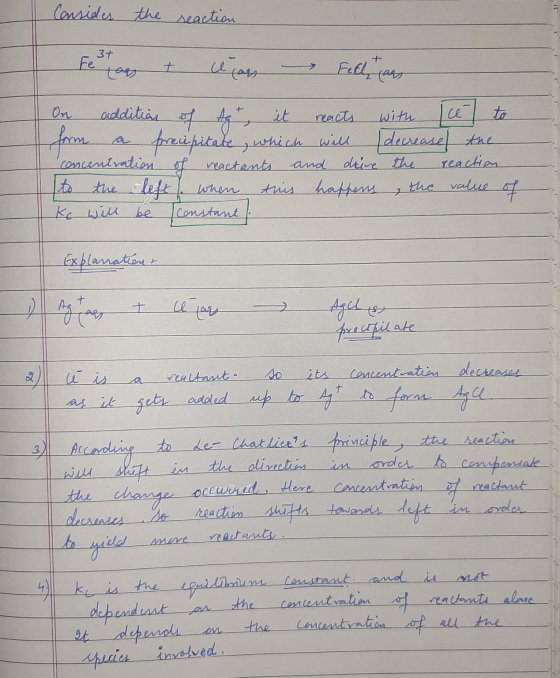
If Ag+(aq) is added, the silver ion will react with (Cl-, H2O, Fe3+) to form a precipitate, which will (decrease, increase, or not change) the concentration of reactants and drive the reaction(to the left, to the right, or neither one way or the other).
When this happens, the value of Kc will be(lower, higher, or constant).
Homework Answers
Answer
Add Answer to:
Consider the reaction Fe3+(aq) +
Cl-(aq) FeCl2+(aq).
If Ag+(aq) is added, the silver ion will react with...
. Consider the endothermic reaction: Fe3+(aq) + Cl-(aq) → FeCl2+(aq). Use Le Châtelier’s principle to predict...
. Consider the endothermic reaction: Fe3+(aq) + Cl-(aq) → FeCl2+(aq). Use Le Châtelier’s principle to predict how the equilibrium concentration of the complex ion FeCl2+ will change when: (3.1) Fe(NO3)3 is added (3.2) Cl- is precipitated as AgCl by addition of AgNO3 (3.3) The temperature is increased (3.4) A catalyst is added (3.5) The pressure of the system is increased
1. The reaction below competes with the formation of the FeSCN2+ complex: Fe3+ (aq) + 4C1-(aq) ye...
 Please help!
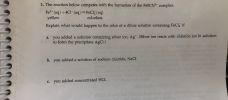
1. The reaction below competes with the formation of the FeSCN2+ complex: Fe3+ (aq) + 4C1-(aq) yellow FeCI(aq) colorless Explain what would happen to the color of a dilute solution containing FeCIzif you added a solution containing silver ion, Agt. (Silver ion reacts with chloride ion in solution to form the precipitate AgCl.) a. b. you added a solution of sodium chloride, NaCl c. you added concentrated HCL.
1. The reaction below competes with the formation of the...
Please help!
1. The reaction below competes with the formation of the FeSCN2+ complex: Fe3+ (aq) + 4C1-(aq) yellow FeCI(aq) colorless Explain what would happen to the color of a dilute solution containing FeCIzif you added a solution containing silver ion, Agt. (Silver ion reacts with chloride ion in solution to form the precipitate AgCl.) a. b. you added a solution of sodium chloride, NaCl c. you added concentrated HCL.
1. The reaction below competes with the formation of the...
Silver ions can be precipitated from aqueous solutions by the addition of aqueous chloride: Ag+(aq)+Cl−(aq)→AgCl(s) Silver...
Silver ions can be precipitated from aqueous solutions by the addition of aqueous chloride: Ag+(aq)+Cl−(aq)→AgCl(s) Silver chloride is virtually insoluble in water so that the reaction appears to go to completion. How many grams of solid NaCl must be added to 25.0 mL of 0.149 M AgNO3 solution to completely precipitate the silver?
Silver (I) ions in aqueous solutions react with NH3(aq) to form a complex ion according to...
Silver (I) ions in aqueous solutions react with NH3(aq) to form a complex ion according to the following reaction: Ag+ + 2NH3(aq) ---> Ag(NH3)2+ with a formation constant, Kf of 1.5 x 10⁷. Calculate the solubility in g/L, of AgCN(s) (Ksp = 2.2 x 10⁻¹⁶) in 0.75M NH3(aq)
Iron thiocyanate (FeSCN2+) is a complex ion that appears orange-red in solution. Iron(III) (Fe3+) and thiocyanate...
Iron thiocyanate (FeSCN2+) is a complex ion that appears orange-red in solution. Iron(III) (Fe3+) and thiocyanate (SCN-) are both colorless in solution. FeSCN2+ (aq) --(equilibrium)-- Fe3+ (aq) + SCN- (aq) a) If you add Fe(NO3)3 to a solution of these ions at equilibrium, in which direction will the reaction run to reach a new equilibrium? b) Silver ions react with thiocyanate ions to form a white precipitate. If you add silver ions to a solution of these ions at equilibrium,...
prelab /postlab all questions please Questions 1. For the reaction at 20°C, NH3(aq) + H+ (aq)...
 prelab /postlab all questions please
Questions 1. For the reaction at 20°C, NH3(aq) + H+ (aq) NH4(aq), the equilibrium constant is calculated to be K = to 4.5 x10%. CHAT] A. Write the Equilibrium expression for this reaction. Keq = ỞNH TH] B. From the size of the number for Keq, does the equilibrium lie to the left or to the right? Right 2. If the reaction between iron(III) ion and thiocyanate ion, Fe3+ (aq) + SCN (aq) → FeSCN2+(aq),...
prelab /postlab all questions please
Questions 1. For the reaction at 20°C, NH3(aq) + H+ (aq) NH4(aq), the equilibrium constant is calculated to be K = to 4.5 x10%. CHAT] A. Write the Equilibrium expression for this reaction. Keq = ỞNH TH] B. From the size of the number for Keq, does the equilibrium lie to the left or to the right? Right 2. If the reaction between iron(III) ion and thiocyanate ion, Fe3+ (aq) + SCN (aq) → FeSCN2+(aq),...
6). If a silver nitrate solution is slowly added to a solution where [Br-] = 0.05M and [Cl-] = 0.05M, at that [Ag+] will...
6). If a silver nitrate solution is slowly added to a solution where [Br-] = 0.05M and [Cl-] = 0.05M, at that [Ag+] will a precipitate begin to form and will the precipitate be AgBr or AgCl? Additional Info: Ksp(AgBr) = 5.0x10⁻¹³ and Ksp (AgCl) = 1.6x10⁻¹⁰
1) Consider the following equilibrium: Fe3+(aq) + SCN-(aq) ⇌ FeSCN2+(aq) Initial concentrations: [Fe3+] = 0.590; [SCN-]...
1) Consider the following equilibrium: Fe3+(aq) + SCN-(aq) ⇌ FeSCN2+(aq) Initial concentrations: [Fe3+] = 0.590; [SCN-] = 1.239; [FeSCN2+] = 0 The equilibrium concentration of [FeSCN2+]eq = 0.454 M. What is the numerical value of KC for this equilibrium? KC = __________________ 2) Consider the following equilibrium: Fe3+(aq) + SCN-(aq) ⇌ FeSCN2+(aq) Initial concentrations: [Fe3+] = 0.370; [SCN-] = 0.777; [FeSCN2+] = 0 The equilibrium concentration of [FeSCN2+]eq = 0.285 M. What is the equilibrium concentration of Fe3+? [Fe3+]eq =...
My question is #2 for the reaction Fe3+ (aq) + SCN- (aq) FeSCN2+ (aq). The goal...
 My question is #2 for the reaction Fe3+ (aq) + SCN- (aq)
FeSCN2+ (aq). The goal is to predict the color change (darker or
lighter) for test tubes 2-8. I have attached the supplemental
sheets given to help with the problem. The test tubes 2-8 are being
manipulated either by temperature or things being added which can
be seen by one of the pictures.
2. For reaction "UCTIONS are increased by the same amount. Fe3+ (aq) + SCN (aq) $...
My question is #2 for the reaction Fe3+ (aq) + SCN- (aq)
FeSCN2+ (aq). The goal is to predict the color change (darker or
lighter) for test tubes 2-8. I have attached the supplemental
sheets given to help with the problem. The test tubes 2-8 are being
manipulated either by temperature or things being added which can
be seen by one of the pictures.
2. For reaction "UCTIONS are increased by the same amount. Fe3+ (aq) + SCN (aq) $...
In an ammonia solution, the silver ion, Ag, forms the colorless, but soluble diamminesilver(I) complex ion,...
 In an ammonia solution, the silver ion, Ag, forms the colorless, but soluble diamminesilver(I) complex ion, Ag(NH3)2. If ammonia is added to a solution that contains an AgCI precipitate, the solid dissolves completely. Write a net-ionic equation for the equilibrium involved and explain the shift that takes place. Choose the best answer. AgCl(s) +2 NH3(a)Ag(NH3)2 (aa) C(aq) Adding ammonia to AgCl(s) dissolves the solid by displacing chloride ions with ammonia molecules, forming a soluble complex ion Ag (a2 NH3(aq) Ag(NH32...
 Please help!
1. The reaction below competes with the formation of the FeSCN2+ complex: Fe3+ (aq) + 4C1-(aq) yellow FeCI(aq) colorless Explain what would happen to the color of a dilute solution containing FeCIzif you added a solution containing silver ion, Agt. (Silver ion reacts with chloride ion in solution to form the precipitate AgCl.) a. b. you added a solution of sodium chloride, NaCl c. you added concentrated HCL.
1. The reaction below competes with the formation of the...
Please help!
1. The reaction below competes with the formation of the FeSCN2+ complex: Fe3+ (aq) + 4C1-(aq) yellow FeCI(aq) colorless Explain what would happen to the color of a dilute solution containing FeCIzif you added a solution containing silver ion, Agt. (Silver ion reacts with chloride ion in solution to form the precipitate AgCl.) a. b. you added a solution of sodium chloride, NaCl c. you added concentrated HCL.
1. The reaction below competes with the formation of the...
 prelab /postlab all questions please
Questions 1. For the reaction at 20°C, NH3(aq) + H+ (aq) NH4(aq), the equilibrium constant is calculated to be K = to 4.5 x10%. CHAT] A. Write the Equilibrium expression for this reaction. Keq = ỞNH TH] B. From the size of the number for Keq, does the equilibrium lie to the left or to the right? Right 2. If the reaction between iron(III) ion and thiocyanate ion, Fe3+ (aq) + SCN (aq) → FeSCN2+(aq),...
prelab /postlab all questions please
Questions 1. For the reaction at 20°C, NH3(aq) + H+ (aq) NH4(aq), the equilibrium constant is calculated to be K = to 4.5 x10%. CHAT] A. Write the Equilibrium expression for this reaction. Keq = ỞNH TH] B. From the size of the number for Keq, does the equilibrium lie to the left or to the right? Right 2. If the reaction between iron(III) ion and thiocyanate ion, Fe3+ (aq) + SCN (aq) → FeSCN2+(aq),...
 My question is #2 for the reaction Fe3+ (aq) + SCN- (aq)
FeSCN2+ (aq). The goal is to predict the color change (darker or
lighter) for test tubes 2-8. I have attached the supplemental
sheets given to help with the problem. The test tubes 2-8 are being
manipulated either by temperature or things being added which can
be seen by one of the pictures.
2. For reaction "UCTIONS are increased by the same amount. Fe3+ (aq) + SCN (aq) $...
My question is #2 for the reaction Fe3+ (aq) + SCN- (aq)
FeSCN2+ (aq). The goal is to predict the color change (darker or
lighter) for test tubes 2-8. I have attached the supplemental
sheets given to help with the problem. The test tubes 2-8 are being
manipulated either by temperature or things being added which can
be seen by one of the pictures.
2. For reaction "UCTIONS are increased by the same amount. Fe3+ (aq) + SCN (aq) $...
 In an ammonia solution, the silver ion, Ag, forms the colorless, but soluble diamminesilver(I) complex ion, Ag(NH3)2. If ammonia is added to a solution that contains an AgCI precipitate, the solid dissolves completely. Write a net-ionic equation for the equilibrium involved and explain the shift that takes place. Choose the best answer. AgCl(s) +2 NH3(a)Ag(NH3)2 (aa) C(aq) Adding ammonia to AgCl(s) dissolves the solid by displacing chloride ions with ammonia molecules, forming a soluble complex ion Ag (a2 NH3(aq) Ag(NH32...
Most questions answered within 3 hours.
-
Where is the error in this code sequence?
String s1 = "Hello";
String s2 = "ello";...
asked 11 months ago -
Financial data for Joel de Paris, Inc., for last year
follow:
Joel de Paris, Inc.
Balance...
asked 11 months ago -
Consider this reaction:
Al2(SO4)3 (aq)+ BaCl3
(aq) Al2Cl6 (aq)- +
3BaSO4(s) . What is the...
asked 11 months ago -
Suppose that Savneet is considering increasing her
recent random sample from 20 car rentals to 40...
asked 11 months ago -
Trucks arrive at an unloading terminal at an average rate of 120
per hour.
Trucks arrive...
asked 11 months ago -
Why are methanol and ethanol completely soluble in water while
octanol is not very little soluble....
asked 11 months ago -
A facilities manager at a university reads in a research report
that the mean amount of...
asked 11 months ago -
When the CuSO4 is rehydrated by adding water to the anhydrous
compound, is this an endothermic...
asked 11 months ago -
A ray of sunlight is passing from diamond into crown glass; the
angle of incidence is...
asked 11 months ago -
A block of mass 0.249 kg is placed on top of a light, vertical
spring of...
asked 11 months ago -
how do the kidneys compensate in the presences of acidosis
a) trigger hyperventilate
b) reserve acid...
asked 11 months ago -
Question 501 pts
The rental rate of capital to the firm increases. Which of the
following...
asked 11 months ago