1. Amino acids are considered to be either hydrophobic or hydrophilic as described by the relative...
1. Amino acids are considered to be either hydrophobic or hydrophilic as described by the relative polarity of their side chain. Consider a folded protein in an aqueous environment; where would the hydrophobic amino acids likely be found?
-Tucked away in the middle of the folded protein
-Randomly distributed throughout the protein
-Exposed on the exterior surface of the folded protein
2. All proteins exhibit a primary, secondary, and tertiary structure, but not all proteins exhibit a quaternary structure. Describe what a quaternary structure is, and why not all proteins exhibit this form of higher-order structure.
-A quaternary structure is the folding of the peptide backbone into a three-dimensional conformation. Not all proteins exhibit this type of structure because their backbone is rigid and thus cannot fold.
-A quaternary structure is the incorporation of two or more polypeptide subunits into one functional complex. Not all proteins exhibit a quaternary structure because not all proteins are comprised of two or more distinct subunits
- A quaternary structure is sequence of amino acids in the polypeptide chain. All proteins exhibit quaternary structure.
-A quaternary structure is the interaction of amino acid side chains. The statement is false- all proteins exhibit a quaternary structure.
Homework Answers
1. The Hydrophobic Amino Acids would be Tucked Away in the middle of the folded protein.
2. A quarternary structure is the incorporation of two or more polypeptide subunits into one functional Complex. Not all proteins exhibit a quarternary structure because not all Proteins are comprised of two or more distinct subunits.
Add Answer to:
1. Amino acids are considered to be either hydrophobic or
hydrophilic as described by the relative...
QUESTION 1 To study how proteins fold, scientists must be able to purify the protein of...
QUESTION 1 To study how proteins fold, scientists must be able to purify the protein of interest, use solvents like urea to denature the folded protein, and observe the process of refolding at successive time points. What is the effect of the solvents used in the denaturation process? a. The solvents break all noncovalent interactions. b. The solvents break all covalent interactions. c. The solvents create a new folded conformation. d. The solvents break some of the noncovalent interactions, resulting...
Proteins fold in water with hydrophilic amino acids on the exterior and hydrophobic ones in the...
Proteins fold in water with hydrophilic amino acids on the exterior and hydrophobic ones in the interior. The most common method of measuring amino acid hydrophobicity is partitioning between two immiscible liquid phases. Nozaki and Tanford proposed the first major hydrophobicity scale for nine amino acids. They measured the standard Gibbs free energy change of transfer of an amino acid sidechain from 100% organic phase into water at 25°C. AA(org) ---> AA(aq) IF the value for serine is -0.300 kcal/mol,...
Water-soluble proteins, such as myoglobin, tend to fold such that hydrophilic and hydrophobic amino acid R...
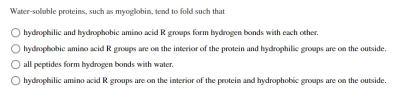 Water-soluble proteins, such as myoglobin, tend to fold such that hydrophilic and hydrophobic amino acid R groups form hydrogen bonds with each other. hydrophobic amino acid R groups are on the interior of the protein and hydrophilic groups are on the outside. all peptides form hydrogen bonds with water. hydrophilic amino acid R groups are on the interior of the protein and hydrophobic groups are on the outside.
1) Indicate why alpha helices and beta sheets help "bury" hydrophobic amino acids in the interior...
1) Indicate why alpha helices and beta sheets help "bury" hydrophobic amino acids in the interior of a folded polypeptide in an aqueous environment. 2) Explain what is meant by the statement "Protein folding is driven by hydrophobic interactions" and under what conditions this is true.
Pls answer fast Discuss how the properties of acidity, basicity, and polarity arise for some amino...
 Pls answer fast
Discuss how the properties of acidity, basicity, and polarity arise for some amino acids. 8. How does water interact with hydrophobic and hydrophllic molecules? How does water interact with amino acid side chains, and how does this facilitate the folding of proteins? 9. Describe how amino acids are linked together to form protein chains. 10. What does the Ramachandran plot describe? How is it useful in describing protein structure? 11. What physical forces act on the amino...
Pls answer fast
Discuss how the properties of acidity, basicity, and polarity arise for some amino acids. 8. How does water interact with hydrophobic and hydrophllic molecules? How does water interact with amino acid side chains, and how does this facilitate the folding of proteins? 9. Describe how amino acids are linked together to form protein chains. 10. What does the Ramachandran plot describe? How is it useful in describing protein structure? 11. What physical forces act on the amino...
3. The important function of molecular chaperones to A. move proteins from endoplasmic reticulum to the...
 3. The important function of molecular chaperones to A. move proteins from endoplasmic reticulum to the Golgi apparatus B. fold proteins into a native conformation C. add cofactors, coenzymes or prosthetic groups to proteins as they are synthesized D. assemble protein subunits into a quaternary structure E. transport proteins to either the plasma membrane or release them from cells to the extracellular space 4. Protein folding to a native conformation is highly dependent upon all of the following, except: A....
1. Which of the following statements is consistent with the structural motifs in 1OPF? This protein...
 1. Which of the following statements is consistent with the
structural motifs in 1OPF?
This protein has tertiary structure, where each subunit is a
large parallel beta barrel.
This protein has quaternary structure, where each subunit is a
large antiparallel beta barrel.
This protein has tertiary structure, where each subunit is a
large antiparallel beta barrel.
This protein has quaternary structure, where each subunit is a
large parallel beta barrel.
3. Given the information in the PDB entry for 1OPF,...
1. Which of the following statements is consistent with the
structural motifs in 1OPF?
This protein has tertiary structure, where each subunit is a
large parallel beta barrel.
This protein has quaternary structure, where each subunit is a
large antiparallel beta barrel.
This protein has tertiary structure, where each subunit is a
large antiparallel beta barrel.
This protein has quaternary structure, where each subunit is a
large parallel beta barrel.
3. Given the information in the PDB entry for 1OPF,...
26. Which of the following classification does not match the amino acid side chain A) Contains an basic group/ lysi...
 26. Which of the following classification does not match the amino acid side chain A) Contains an basic group/ lysine B) It is polar C) Forms disulfide bond/ cysteine D) Forms hydrogen bonds with neighbors/ alanine serine 27. All amino acids found in proteins are L-amino acids EXCEPT the achiral. A) glutamate B) Lysine C) glyeine D) Alamine 28. The plH at which the positive and negative charges of an amino acid balance each ofher is called the A) isotonic...
1) Select all that apply. Globular proteins: a)are found in hair and wool. b)include myoglobin and...
1) Select all that apply. Globular proteins: a)are found in hair and wool. b)include myoglobin and collagen. c)are usually water soluble. d)aggregate in aqueous media. e)are often made of β-pleated sheet and α-helix sections wrapped into compact structures. 2) Select all that apply. The Bohr effect: a)depends on the atomic orbital structure of hydrogen. b)can be summarized as a reduction in the oxygen affinity of hemoglobin with decreasing pH. c)is explained by the protonation of key amino acids, including the...
please answer 8. Quaternary structure: The image below is of a polypeptide in quaternary (4°) structure...
 please answer
8. Quaternary structure: The image below is of a polypeptide in quaternary (4°) structure level of protein folding. The image to the left is of hemoglobin. It is composed of four separate polypeptide chains indicated by the color differences. The image on the right indicates the backbone items as a ribbon (or line), while the side chains are chemically drawn. a. Name the specific bond/interaction indicated by the: i. Letter A ii. Letter B iii. Letter C iv....
please answer
8. Quaternary structure: The image below is of a polypeptide in quaternary (4°) structure level of protein folding. The image to the left is of hemoglobin. It is composed of four separate polypeptide chains indicated by the color differences. The image on the right indicates the backbone items as a ribbon (or line), while the side chains are chemically drawn. a. Name the specific bond/interaction indicated by the: i. Letter A ii. Letter B iii. Letter C iv....
 Water-soluble proteins, such as myoglobin, tend to fold such that hydrophilic and hydrophobic amino acid R groups form hydrogen bonds with each other. hydrophobic amino acid R groups are on the interior of the protein and hydrophilic groups are on the outside. all peptides form hydrogen bonds with water. hydrophilic amino acid R groups are on the interior of the protein and hydrophobic groups are on the outside.
 Pls answer fast
Discuss how the properties of acidity, basicity, and polarity arise for some amino acids. 8. How does water interact with hydrophobic and hydrophllic molecules? How does water interact with amino acid side chains, and how does this facilitate the folding of proteins? 9. Describe how amino acids are linked together to form protein chains. 10. What does the Ramachandran plot describe? How is it useful in describing protein structure? 11. What physical forces act on the amino...
Pls answer fast
Discuss how the properties of acidity, basicity, and polarity arise for some amino acids. 8. How does water interact with hydrophobic and hydrophllic molecules? How does water interact with amino acid side chains, and how does this facilitate the folding of proteins? 9. Describe how amino acids are linked together to form protein chains. 10. What does the Ramachandran plot describe? How is it useful in describing protein structure? 11. What physical forces act on the amino...
 3. The important function of molecular chaperones to A. move proteins from endoplasmic reticulum to the Golgi apparatus B. fold proteins into a native conformation C. add cofactors, coenzymes or prosthetic groups to proteins as they are synthesized D. assemble protein subunits into a quaternary structure E. transport proteins to either the plasma membrane or release them from cells to the extracellular space 4. Protein folding to a native conformation is highly dependent upon all of the following, except: A....
 1. Which of the following statements is consistent with the
structural motifs in 1OPF?
This protein has tertiary structure, where each subunit is a
large parallel beta barrel.
This protein has quaternary structure, where each subunit is a
large antiparallel beta barrel.
This protein has tertiary structure, where each subunit is a
large antiparallel beta barrel.
This protein has quaternary structure, where each subunit is a
large parallel beta barrel.
3. Given the information in the PDB entry for 1OPF,...
1. Which of the following statements is consistent with the
structural motifs in 1OPF?
This protein has tertiary structure, where each subunit is a
large parallel beta barrel.
This protein has quaternary structure, where each subunit is a
large antiparallel beta barrel.
This protein has tertiary structure, where each subunit is a
large antiparallel beta barrel.
This protein has quaternary structure, where each subunit is a
large parallel beta barrel.
3. Given the information in the PDB entry for 1OPF,...
 26. Which of the following classification does not match the amino acid side chain A) Contains an basic group/ lysine B) It is polar C) Forms disulfide bond/ cysteine D) Forms hydrogen bonds with neighbors/ alanine serine 27. All amino acids found in proteins are L-amino acids EXCEPT the achiral. A) glutamate B) Lysine C) glyeine D) Alamine 28. The plH at which the positive and negative charges of an amino acid balance each ofher is called the A) isotonic...
 please answer
8. Quaternary structure: The image below is of a polypeptide in quaternary (4°) structure level of protein folding. The image to the left is of hemoglobin. It is composed of four separate polypeptide chains indicated by the color differences. The image on the right indicates the backbone items as a ribbon (or line), while the side chains are chemically drawn. a. Name the specific bond/interaction indicated by the: i. Letter A ii. Letter B iii. Letter C iv....
please answer
8. Quaternary structure: The image below is of a polypeptide in quaternary (4°) structure level of protein folding. The image to the left is of hemoglobin. It is composed of four separate polypeptide chains indicated by the color differences. The image on the right indicates the backbone items as a ribbon (or line), while the side chains are chemically drawn. a. Name the specific bond/interaction indicated by the: i. Letter A ii. Letter B iii. Letter C iv....
Most questions answered within 3 hours.
-
Where is the error in this code sequence?
String s1 = "Hello";
String s2 = "ello";...
asked 10 months ago -
Financial data for Joel de Paris, Inc., for last year
follow:
Joel de Paris, Inc.
Balance...
asked 10 months ago -
Consider this reaction:
Al2(SO4)3 (aq)+ BaCl3
(aq) Al2Cl6 (aq)- +
3BaSO4(s) . What is the...
asked 10 months ago -
Suppose that Savneet is considering increasing her
recent random sample from 20 car rentals to 40...
asked 10 months ago -
Trucks arrive at an unloading terminal at an average rate of 120
per hour.
Trucks arrive...
asked 10 months ago -
Why are methanol and ethanol completely soluble in water while
octanol is not very little soluble....
asked 10 months ago -
A facilities manager at a university reads in a research report
that the mean amount of...
asked 10 months ago -
When the CuSO4 is rehydrated by adding water to the anhydrous
compound, is this an endothermic...
asked 10 months ago -
A ray of sunlight is passing from diamond into crown glass; the
angle of incidence is...
asked 10 months ago -
A block of mass 0.249 kg is placed on top of a light, vertical
spring of...
asked 10 months ago -
how do the kidneys compensate in the presences of acidosis
a) trigger hyperventilate
b) reserve acid...
asked 10 months ago -
Question 501 pts
The rental rate of capital to the firm increases. Which of the
following...
asked 10 months ago