This is all the information given. The experiment uses 2 drops of detergent and 0.5g vegetable...
This is all the information given. The experiment uses 2 drops of detergent and 0.5g vegetable oil for the soap.
|
Weight of salicylic acid =
#Moles of salicylic acid =
Weight of methanol =
#Moles of methanol =
Volume of product = 0.235 mL
Weight of product =
#Moles of product =
% Yield of esterification reaction =
Show calculations of % yield:
Calculate density of product:
Homework Answers
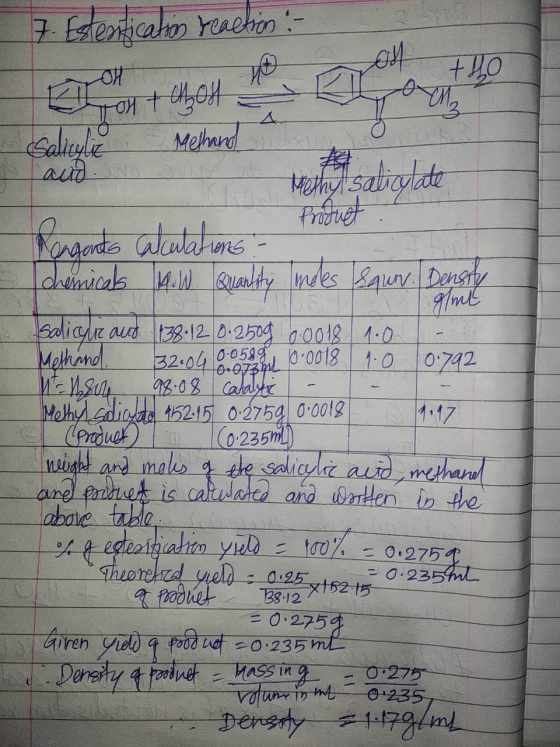
The weight and the moles calculations for the reactants like salicylic acid and methanol is performed based on the provided volume of the product and the literature density values of the reactant. The moles of the reactants consume to produce the same moles of the product as the maximum yield of the reaction.
As per given here the 0.235 mL of product is formed as 0.0018 moles. Thus back calculations have been performed and updated in the below table. The % yield caluculation for the esterification reaction and the density calcutaion of the product is explained as below.
Add Answer to:
This is all the information given. The experiment uses 2 drops
of detergent and 0.5g vegetable...
can you please help me with this !!! which ever you can is fine, please... thanks...
 can you please help me with this !!!
which ever you can is fine, please... thanks !
Results/Data • Aspirin synthesis salicylic acid: 2.0 g Acetic anhydride: 2 mL d= 1.082g/ml sodium acetate: 0.4 g • Experimental yield of aspirin: 2.4 g REPORT DATE: NAME: LAB PARTNER: I PREPARATION OF METHYL SALICYLATE (OIL OF WINTERGREEN): Reaction Odor: Color after addition of FeCl solution: Control Odor: Color after addition of FeCl3 solution: Question Which functional group of salicylic acid forms a...
can you please help me with this !!!
which ever you can is fine, please... thanks !
Results/Data • Aspirin synthesis salicylic acid: 2.0 g Acetic anhydride: 2 mL d= 1.082g/ml sodium acetate: 0.4 g • Experimental yield of aspirin: 2.4 g REPORT DATE: NAME: LAB PARTNER: I PREPARATION OF METHYL SALICYLATE (OIL OF WINTERGREEN): Reaction Odor: Color after addition of FeCl solution: Control Odor: Color after addition of FeCl3 solution: Question Which functional group of salicylic acid forms a...
please help me ! do you think this is good so far ? Results/Data • Aspirin...
 please help me ! do you think this is good so far ?
Results/Data • Aspirin synthesis salicylic acid: 2.0 g Acetic anhydride: 2 mL d= 1.082g/mL sodium acetate: 0.4 g • Experimental yield of aspirin: 2.4 g FORMATION OF ESTERS II. PREPARATION OF ACETYL SALICYLIC ACID (ASPIRIN): 1 Complete the table below by entering appropriate values into the empty boxes. Show calculations for all entries clearly below. Reactants Chemical MW Grams of Moles of Moles of Limiting Melting Formula...
please help me ! do you think this is good so far ?
Results/Data • Aspirin synthesis salicylic acid: 2.0 g Acetic anhydride: 2 mL d= 1.082g/mL sodium acetate: 0.4 g • Experimental yield of aspirin: 2.4 g FORMATION OF ESTERS II. PREPARATION OF ACETYL SALICYLIC ACID (ASPIRIN): 1 Complete the table below by entering appropriate values into the empty boxes. Show calculations for all entries clearly below. Reactants Chemical MW Grams of Moles of Moles of Limiting Melting Formula...
Answer all questions In today's experiment, benzoic acid and excess methanol are refluxed in the presence...
 Answer all questions
In today's experiment, benzoic acid and excess methanol are refluxed in the presence of a catalytic amount of sulfuric acid: + CH OH H.SO ? + H2O MW 136.15 Benzoic acid MW 122.12 Methanol density 0.791g/ml MW 32.04 1. Draw the structure for the expected organic product, shown as "?" in the equation above: 2. If the reactions starts with 10.00 g of benzoic acid and 25.0 ml. of methanol (excess), what is the theoretical yield of...
Answer all questions
In today's experiment, benzoic acid and excess methanol are refluxed in the presence of a catalytic amount of sulfuric acid: + CH OH H.SO ? + H2O MW 136.15 Benzoic acid MW 122.12 Methanol density 0.791g/ml MW 32.04 1. Draw the structure for the expected organic product, shown as "?" in the equation above: 2. If the reactions starts with 10.00 g of benzoic acid and 25.0 ml. of methanol (excess), what is the theoretical yield of...
find the theoretical yield of the acetysalicylic acid . EXPERIMENT 19 PREPARATION OF ASPIRIN In addition...
 find the theoretical yield of the acetysalicylic acid .
EXPERIMENT 19 PREPARATION OF ASPIRIN In addition to the Fischer esterification method presented in Experiment 18, a second method for preparation of esters involves the reaction of anhydrides with the hydroxyl This method is ospecialy usoful for tho preparation of acetate esters, since acetic anhydride is an inexpensive and reactive reagent. In this experiment the hydroxyl group of salicylic acid is acetic anhydride to make acetylsalicylic acid, or aspirin. The short...
find the theoretical yield of the acetysalicylic acid .
EXPERIMENT 19 PREPARATION OF ASPIRIN In addition to the Fischer esterification method presented in Experiment 18, a second method for preparation of esters involves the reaction of anhydrides with the hydroxyl This method is ospecialy usoful for tho preparation of acetate esters, since acetic anhydride is an inexpensive and reactive reagent. In this experiment the hydroxyl group of salicylic acid is acetic anhydride to make acetylsalicylic acid, or aspirin. The short...
answer it all please BS132 Experiment 3 2018-2019 The limiting reagent is the reagent which will...
 answer it all please
BS132 Experiment 3 2018-2019 The limiting reagent is the reagent which will completely react and so iIs excess. It will therefore be the reagent for which a lower number o present. Compare the respective molar proportions of the reagents used A and B above] and deduce which is the limiting reagent not in f moles are Igiven by Limiting reagent = 1 mark Scale of reaction (i.e. number of moles of limiting reagent used) - mol...
answer it all please
BS132 Experiment 3 2018-2019 The limiting reagent is the reagent which will completely react and so iIs excess. It will therefore be the reagent for which a lower number o present. Compare the respective molar proportions of the reagents used A and B above] and deduce which is the limiting reagent not in f moles are Igiven by Limiting reagent = 1 mark Scale of reaction (i.e. number of moles of limiting reagent used) - mol...
Given the amounts of reactants, please calculate the theoretical yield of the expected alkene reaction product, in mL. D...
Given the amounts of reactants, please calculate the theoretical yield of the expected alkene reaction product, in mL. Do not factor the sulfuric acid into your calculations. Your final answer must appear in the box provided, or it will not be counted. 4-methylcyclohexanol ------H2SO4(aq) -----> 4-methylcyclohexene Molecular Weight (grams/mole) 114.2 g/mol 98.08 g/mol 96.2 g/mol density (grams/mL) 0.914 g/mL 0.799 g/mL volume (mL) 28.0 mL mass (grams) moles Theoretical yield in mL=
EXPERIMENT 20 CSI: SMU Part 2. Synthesis of an Ester. Esters are compounds of the form...
 EXPERIMENT 20 CSI: SMU Part 2. Synthesis of an Ester. Esters are compounds of the form RCOOR'. They occur naturally in many plants and animals, and can be synthesized. They have a pleasant aroma usually described as "fruity of flowery". In a Fisher esterification an ester is formed from the reaction of a carboxylic acid and an alcohol with a strong acid as a catalyst. The OH contained in the carboxylic acid group 1s replaced with the alkoxy group (O-R")...
please help me answer the other missing part as soon as possible. Thank you I hope...
 please help me answer the other missing part as soon as possible.
Thank you
I hope they are clear now.
Man SA sede of Aused Mass of Medex 1.08 ) Theory of aspirm 2.24.. 1.913 in this? SLE Lased on your ration, whate of reactions Most of the perfody stwing Mas oferecer odeyinced weighing Man offer perfil 0.731 32 Percent yield 1001 Show all cations B. Aspirin Synthesis 1468 f. Mass of SA used (e) g. Volume of AA used...
please help me answer the other missing part as soon as possible.
Thank you
I hope they are clear now.
Man SA sede of Aused Mass of Medex 1.08 ) Theory of aspirm 2.24.. 1.913 in this? SLE Lased on your ration, whate of reactions Most of the perfody stwing Mas oferecer odeyinced weighing Man offer perfil 0.731 32 Percent yield 1001 Show all cations B. Aspirin Synthesis 1468 f. Mass of SA used (e) g. Volume of AA used...
Experiment 11: Synthesis of Aspirin pre-lab (4 pts) 1) (2 pts) Refer to the introduction on...
 Experiment 11: Synthesis of Aspirin pre-lab (4 pts) 1) (2 pts) Refer to the introduction on interpreting the ferric chloride test for phenols. Two students performed the aspirin synthesis experiment. Their melting point and ferric chloride test data are shown below. Based on the results, which student's aspirin has the higher purity? Justify your choice using the melting point data and ferric chloride test results. Melting point range for pure aspirin = 136-140 °C. Melting point range (°C) Ferric chloride...
1.) Look up the by-product of this reaction – glycerol – and determine whether this is...
1.) Look up the by-product of this reaction – glycerol – and determine whether this is a useful molecule: would it make sense to save and recycle this by-product? Explain. 2.) As mentioned above, soap molecules and biodiesel molecules have remarkably different properties. Describe the intermolecular forces that lead to these differences. (i.e., what intermolecular forces describe the behavior of soap molecules? What IMFs dictate the behavior of biodiesel molecules?) Be specific! 3.) You will be using corn oil for...
 can you please help me with this !!!
which ever you can is fine, please... thanks !
Results/Data • Aspirin synthesis salicylic acid: 2.0 g Acetic anhydride: 2 mL d= 1.082g/ml sodium acetate: 0.4 g • Experimental yield of aspirin: 2.4 g REPORT DATE: NAME: LAB PARTNER: I PREPARATION OF METHYL SALICYLATE (OIL OF WINTERGREEN): Reaction Odor: Color after addition of FeCl solution: Control Odor: Color after addition of FeCl3 solution: Question Which functional group of salicylic acid forms a...
can you please help me with this !!!
which ever you can is fine, please... thanks !
Results/Data • Aspirin synthesis salicylic acid: 2.0 g Acetic anhydride: 2 mL d= 1.082g/ml sodium acetate: 0.4 g • Experimental yield of aspirin: 2.4 g REPORT DATE: NAME: LAB PARTNER: I PREPARATION OF METHYL SALICYLATE (OIL OF WINTERGREEN): Reaction Odor: Color after addition of FeCl solution: Control Odor: Color after addition of FeCl3 solution: Question Which functional group of salicylic acid forms a...
 please help me ! do you think this is good so far ?
Results/Data • Aspirin synthesis salicylic acid: 2.0 g Acetic anhydride: 2 mL d= 1.082g/mL sodium acetate: 0.4 g • Experimental yield of aspirin: 2.4 g FORMATION OF ESTERS II. PREPARATION OF ACETYL SALICYLIC ACID (ASPIRIN): 1 Complete the table below by entering appropriate values into the empty boxes. Show calculations for all entries clearly below. Reactants Chemical MW Grams of Moles of Moles of Limiting Melting Formula...
please help me ! do you think this is good so far ?
Results/Data • Aspirin synthesis salicylic acid: 2.0 g Acetic anhydride: 2 mL d= 1.082g/mL sodium acetate: 0.4 g • Experimental yield of aspirin: 2.4 g FORMATION OF ESTERS II. PREPARATION OF ACETYL SALICYLIC ACID (ASPIRIN): 1 Complete the table below by entering appropriate values into the empty boxes. Show calculations for all entries clearly below. Reactants Chemical MW Grams of Moles of Moles of Limiting Melting Formula...
 Answer all questions
In today's experiment, benzoic acid and excess methanol are refluxed in the presence of a catalytic amount of sulfuric acid: + CH OH H.SO ? + H2O MW 136.15 Benzoic acid MW 122.12 Methanol density 0.791g/ml MW 32.04 1. Draw the structure for the expected organic product, shown as "?" in the equation above: 2. If the reactions starts with 10.00 g of benzoic acid and 25.0 ml. of methanol (excess), what is the theoretical yield of...
Answer all questions
In today's experiment, benzoic acid and excess methanol are refluxed in the presence of a catalytic amount of sulfuric acid: + CH OH H.SO ? + H2O MW 136.15 Benzoic acid MW 122.12 Methanol density 0.791g/ml MW 32.04 1. Draw the structure for the expected organic product, shown as "?" in the equation above: 2. If the reactions starts with 10.00 g of benzoic acid and 25.0 ml. of methanol (excess), what is the theoretical yield of...
 find the theoretical yield of the acetysalicylic acid .
EXPERIMENT 19 PREPARATION OF ASPIRIN In addition to the Fischer esterification method presented in Experiment 18, a second method for preparation of esters involves the reaction of anhydrides with the hydroxyl This method is ospecialy usoful for tho preparation of acetate esters, since acetic anhydride is an inexpensive and reactive reagent. In this experiment the hydroxyl group of salicylic acid is acetic anhydride to make acetylsalicylic acid, or aspirin. The short...
find the theoretical yield of the acetysalicylic acid .
EXPERIMENT 19 PREPARATION OF ASPIRIN In addition to the Fischer esterification method presented in Experiment 18, a second method for preparation of esters involves the reaction of anhydrides with the hydroxyl This method is ospecialy usoful for tho preparation of acetate esters, since acetic anhydride is an inexpensive and reactive reagent. In this experiment the hydroxyl group of salicylic acid is acetic anhydride to make acetylsalicylic acid, or aspirin. The short...
 answer it all please
BS132 Experiment 3 2018-2019 The limiting reagent is the reagent which will completely react and so iIs excess. It will therefore be the reagent for which a lower number o present. Compare the respective molar proportions of the reagents used A and B above] and deduce which is the limiting reagent not in f moles are Igiven by Limiting reagent = 1 mark Scale of reaction (i.e. number of moles of limiting reagent used) - mol...
answer it all please
BS132 Experiment 3 2018-2019 The limiting reagent is the reagent which will completely react and so iIs excess. It will therefore be the reagent for which a lower number o present. Compare the respective molar proportions of the reagents used A and B above] and deduce which is the limiting reagent not in f moles are Igiven by Limiting reagent = 1 mark Scale of reaction (i.e. number of moles of limiting reagent used) - mol...
 EXPERIMENT 20 CSI: SMU Part 2. Synthesis of an Ester. Esters are compounds of the form RCOOR'. They occur naturally in many plants and animals, and can be synthesized. They have a pleasant aroma usually described as "fruity of flowery". In a Fisher esterification an ester is formed from the reaction of a carboxylic acid and an alcohol with a strong acid as a catalyst. The OH contained in the carboxylic acid group 1s replaced with the alkoxy group (O-R")...
 please help me answer the other missing part as soon as possible.
Thank you
I hope they are clear now.
Man SA sede of Aused Mass of Medex 1.08 ) Theory of aspirm 2.24.. 1.913 in this? SLE Lased on your ration, whate of reactions Most of the perfody stwing Mas oferecer odeyinced weighing Man offer perfil 0.731 32 Percent yield 1001 Show all cations B. Aspirin Synthesis 1468 f. Mass of SA used (e) g. Volume of AA used...
please help me answer the other missing part as soon as possible.
Thank you
I hope they are clear now.
Man SA sede of Aused Mass of Medex 1.08 ) Theory of aspirm 2.24.. 1.913 in this? SLE Lased on your ration, whate of reactions Most of the perfody stwing Mas oferecer odeyinced weighing Man offer perfil 0.731 32 Percent yield 1001 Show all cations B. Aspirin Synthesis 1468 f. Mass of SA used (e) g. Volume of AA used...
 Experiment 11: Synthesis of Aspirin pre-lab (4 pts) 1) (2 pts) Refer to the introduction on interpreting the ferric chloride test for phenols. Two students performed the aspirin synthesis experiment. Their melting point and ferric chloride test data are shown below. Based on the results, which student's aspirin has the higher purity? Justify your choice using the melting point data and ferric chloride test results. Melting point range for pure aspirin = 136-140 °C. Melting point range (°C) Ferric chloride...
Most questions answered within 3 hours.
-
Where is the error in this code sequence?
String s1 = "Hello";
String s2 = "ello";...
asked 10 months ago -
Financial data for Joel de Paris, Inc., for last year
follow:
Joel de Paris, Inc.
Balance...
asked 10 months ago -
Consider this reaction:
Al2(SO4)3 (aq)+ BaCl3
(aq) Al2Cl6 (aq)- +
3BaSO4(s) . What is the...
asked 10 months ago -
Suppose that Savneet is considering increasing her
recent random sample from 20 car rentals to 40...
asked 10 months ago -
Trucks arrive at an unloading terminal at an average rate of 120
per hour.
Trucks arrive...
asked 10 months ago -
Why are methanol and ethanol completely soluble in water while
octanol is not very little soluble....
asked 10 months ago -
A facilities manager at a university reads in a research report
that the mean amount of...
asked 10 months ago -
When the CuSO4 is rehydrated by adding water to the anhydrous
compound, is this an endothermic...
asked 10 months ago -
A ray of sunlight is passing from diamond into crown glass; the
angle of incidence is...
asked 10 months ago -
A block of mass 0.249 kg is placed on top of a light, vertical
spring of...
asked 10 months ago -
how do the kidneys compensate in the presences of acidosis
a) trigger hyperventilate
b) reserve acid...
asked 10 months ago -
Question 501 pts
The rental rate of capital to the firm increases. Which of the
following...
asked 10 months ago