Assume that each of these molecule satisfies the 18-electron rule. Calculate the number of metal-metal bonds...
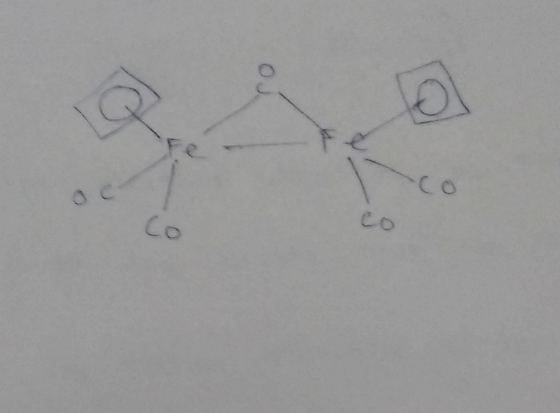
Assume that each of these molecule satisfies the 18-electron rule. Calculate the number of metal-metal bonds and sketch the molecule.
- [Mn2(CO)10]
- ? -CO-[(?4 -C4H4)Fe(CO)2]2
Homework Answers
![use the followi formula: & Charge= 18xn. nxofoom + 2x No. of] metal LM-M bonds e from ligands where, n= No. of metal atoms a)](http://img.homeworklib.com/questions/811bdd70-d51f-11eb-ad24-27ba08259d14.png?x-oss-process=image/resize,w_560)
Add Answer to:
Assume that each of these molecule satisfies the 18-electron
rule. Calculate the number of metal-metal bonds...
Identify the first-row transition metal (M) that follows the 18-electron rule for each of the fol...
 Identify the first-row transition metal (M) that follows the 18-electron rule for each of the following compounds (show how you arrived at your answer): (a) [M(CO)2(PPh3)2] (c) [M(n5-CsHs)(CO)3]2 (assume single M-M bond) (b) [M(nt-C4H4)(CO)3]
Identify the first-row transition metal (M) that follows the 18-electron rule for each of the following compounds (show how you arrived at your answer): (a) [M(CO)2(PPh3)2] (c) [M(n5-CsHs)(CO)3]2 (assume single M-M bond) (b) [M(nt-C4H4)(CO)3]
Identify the first-row transition metal (M) that follows the 18-electron rule for each of the following compounds (show how you arrived at your answer): (a) [M(CO)2(PPh3)2] (c) [M(n5-CsHs)(CO)3]2 (assume single M-M bond) (b) [M(nt-C4H4)(CO)3]
Show the metal center in each of the following obeys the 18-electron rule Fe(CO)5 2. Show...
 Show the metal center in each
of the following obeys the 18-electron rule Fe(CO)5
2. Show that the metal center in each of the following one 2.1) Fe(CO) of the following obeys the 18-electron rule (10 Pt.) Oxidation state of each metal center is 2.2) Ni(CO)4 Oxidation state of each metal center is 2.3) [Mn(CO)s] Oxidation state of each metal center is 2.4) Mo(CO), Oxidation state of each metal center is
Show the metal center in each
of the following obeys the 18-electron rule Fe(CO)5
2. Show that the metal center in each of the following one 2.1) Fe(CO) of the following obeys the 18-electron rule (10 Pt.) Oxidation state of each metal center is 2.2) Ni(CO)4 Oxidation state of each metal center is 2.3) [Mn(CO)s] Oxidation state of each metal center is 2.4) Mo(CO), Oxidation state of each metal center is
3. Use the 18-electron concept to calculate the number of metal-metal bonds in the multinuclear complex,...
 3. Use the 18-electron concept to calculate the number of metal-metal bonds in the multinuclear complex, [Fes(CO)12. Deduce the geometry of the metal-metal framework.
predict the number of Rh-Rh bonds in the molecule shown below based on the 18 electron...
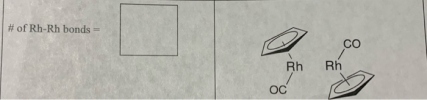 predict the number of Rh-Rh bonds in the molecule shown below based
on the 18 electron rule
#of Rh-Rh bonds CO Rh Rh OC
predict the number of Rh-Rh bonds in the molecule shown below based
on the 18 electron rule
#of Rh-Rh bonds CO Rh Rh OC
2. For each of the following compounds, 1) write the formal oxidation state of the transition...
2. For each of the following compounds, 1) write the formal oxidation state of the transition metal and 2) the corresponding number of d electrons. 3) State whether or not each one is likely to be stable enough to be characterized. (a) [Re(CO)5] (b) [Cr(η6 -C6H6)2] (c) [Mo(CO)3(PPh3)3] (d) [Fe(η2 -C2H4)(CO)4] (e) [Zr(η5 -C5H5)Cl(OH)] (f) [Co(η5 -C5H5)2] 3. Identify the first-row transition metal (M) that follows the 18-electron rule for each of the following compounds (show how you arrived at...
2. For each of the following compounds, 1) write the formal oxidation state of the transition met...
2. For each of the following compounds, 1) write the formal oxidation state of the transition metal and 2) the corresponding number of d electrons. 3) State whether or not each one is likely to be stable enough to be characterized. (a) [Re(CO)5] (b) [Cr(η6 -C6H6)2] (c) [Mo(CO)3(PPh3)3] (d) [Fe(η2 -C2H4)(CO)4] (e) [Zr(η5 -C5H5)Cl(OH)] (f) [Co(η5 -C5H5)2] 3. Identify the first-row transition metal (M) that follows the 18-electron rule for each of the following compounds (show how you arrived at...
For each of the complexes, draw the structure and determine whether or not they obey the 18- electron rule. (1) (11) (1...
 For each of the complexes, draw the structure and determine whether or not they obey the 18- electron rule. (1) (11) (111) (CpzCo] [Fe(n-C3Hs)(PMe3)2(CO)2]* [Fe(n'-C:Hs)(PMe3)2(THF)] CpRh(u2-H)2(CO)]2 [Mnz(CO)..] (v)
, determine the formal oxidation state of the transition metal and the corresponding number of d electrons. State whether each one is likely to be stable enough to be characterized.
Q1) For each of the following compounds, determine the formal oxidation state of the transition metal and the corresponding number of d electrons. State whether each one is likely to be stable enough to be characterized. (1) [Re(CO)5] (2) [HFe(CO)4]- (3) ((ŋ6-C5H5)2Fe) (4) ((ŋ6-C6H6)2Cr) (5) ((ŋ5-C5H5)ZrCl(OCH3) (6) (IrCl(PPh3)3) (7) (Mo(CO)3(PPh3)3) (8) (Fe(CO)4(C2H4)) (9) (W(CO)5Cl)- (10) Ni(CO)4)Q2) Use the 18-electron rule to predict the number of carbonyl ligands, n, in each of the following complexes: (1) [Cr(CO)n] (2) [Fe(CO)n(PPh3)2)] (3) [Mo(CO)n(PMe3)3] ...
(b) Each of the following transformations afford complex adhereing to the 18-electron rule. Provide structures for...
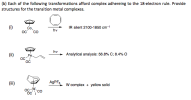 (b) Each of the following transformations afford complex adhereing to the 18-electron rule. Provide structures for the transition metal complexes. R silent 2100-1850 cm-1 OC CO Analytical analysis: 56.8% C: 8.4% O (X? AgPF6 W complex+yellow solid
Draw the structure for each of the following organometallic complexes and show that the complex satisfies...
Draw the structure for each of the following organometallic complexes and show that the complex satisfies the 18-electron rule. a. [( ?6 -C6H6)Mo(CO)3] b. [MnBr(CO)5] c. [RhCl(H)2(?2 -C2H4)(PPh3)2]
 Identify the first-row transition metal (M) that follows the 18-electron rule for each of the following compounds (show how you arrived at your answer): (a) [M(CO)2(PPh3)2] (c) [M(n5-CsHs)(CO)3]2 (assume single M-M bond) (b) [M(nt-C4H4)(CO)3]
Identify the first-row transition metal (M) that follows the 18-electron rule for each of the following compounds (show how you arrived at your answer): (a) [M(CO)2(PPh3)2] (c) [M(n5-CsHs)(CO)3]2 (assume single M-M bond) (b) [M(nt-C4H4)(CO)3]
Identify the first-row transition metal (M) that follows the 18-electron rule for each of the following compounds (show how you arrived at your answer): (a) [M(CO)2(PPh3)2] (c) [M(n5-CsHs)(CO)3]2 (assume single M-M bond) (b) [M(nt-C4H4)(CO)3]
 Show the metal center in each
of the following obeys the 18-electron rule Fe(CO)5
2. Show that the metal center in each of the following one 2.1) Fe(CO) of the following obeys the 18-electron rule (10 Pt.) Oxidation state of each metal center is 2.2) Ni(CO)4 Oxidation state of each metal center is 2.3) [Mn(CO)s] Oxidation state of each metal center is 2.4) Mo(CO), Oxidation state of each metal center is
Show the metal center in each
of the following obeys the 18-electron rule Fe(CO)5
2. Show that the metal center in each of the following one 2.1) Fe(CO) of the following obeys the 18-electron rule (10 Pt.) Oxidation state of each metal center is 2.2) Ni(CO)4 Oxidation state of each metal center is 2.3) [Mn(CO)s] Oxidation state of each metal center is 2.4) Mo(CO), Oxidation state of each metal center is
 3. Use the 18-electron concept to calculate the number of metal-metal bonds in the multinuclear complex, [Fes(CO)12. Deduce the geometry of the metal-metal framework.
 predict the number of Rh-Rh bonds in the molecule shown below based
on the 18 electron rule
#of Rh-Rh bonds CO Rh Rh OC
predict the number of Rh-Rh bonds in the molecule shown below based
on the 18 electron rule
#of Rh-Rh bonds CO Rh Rh OC
 For each of the complexes, draw the structure and determine whether or not they obey the 18- electron rule. (1) (11) (111) (CpzCo] [Fe(n-C3Hs)(PMe3)2(CO)2]* [Fe(n'-C:Hs)(PMe3)2(THF)] CpRh(u2-H)2(CO)]2 [Mnz(CO)..] (v)
 (b) Each of the following transformations afford complex adhereing to the 18-electron rule. Provide structures for the transition metal complexes. R silent 2100-1850 cm-1 OC CO Analytical analysis: 56.8% C: 8.4% O (X? AgPF6 W complex+yellow solid
Most questions answered within 3 hours.
-
Where is the error in this code sequence?
String s1 = "Hello";
String s2 = "ello";...
asked 11 months ago -
Financial data for Joel de Paris, Inc., for last year
follow:
Joel de Paris, Inc.
Balance...
asked 11 months ago -
Consider this reaction:
Al2(SO4)3 (aq)+ BaCl3
(aq) Al2Cl6 (aq)- +
3BaSO4(s) . What is the...
asked 11 months ago -
Suppose that Savneet is considering increasing her
recent random sample from 20 car rentals to 40...
asked 11 months ago -
Trucks arrive at an unloading terminal at an average rate of 120
per hour.
Trucks arrive...
asked 11 months ago -
Why are methanol and ethanol completely soluble in water while
octanol is not very little soluble....
asked 11 months ago -
A facilities manager at a university reads in a research report
that the mean amount of...
asked 11 months ago -
When the CuSO4 is rehydrated by adding water to the anhydrous
compound, is this an endothermic...
asked 11 months ago -
A ray of sunlight is passing from diamond into crown glass; the
angle of incidence is...
asked 11 months ago -
A block of mass 0.249 kg is placed on top of a light, vertical
spring of...
asked 11 months ago -
how do the kidneys compensate in the presences of acidosis
a) trigger hyperventilate
b) reserve acid...
asked 11 months ago -
Question 501 pts
The rental rate of capital to the firm increases. Which of the
following...
asked 11 months ago