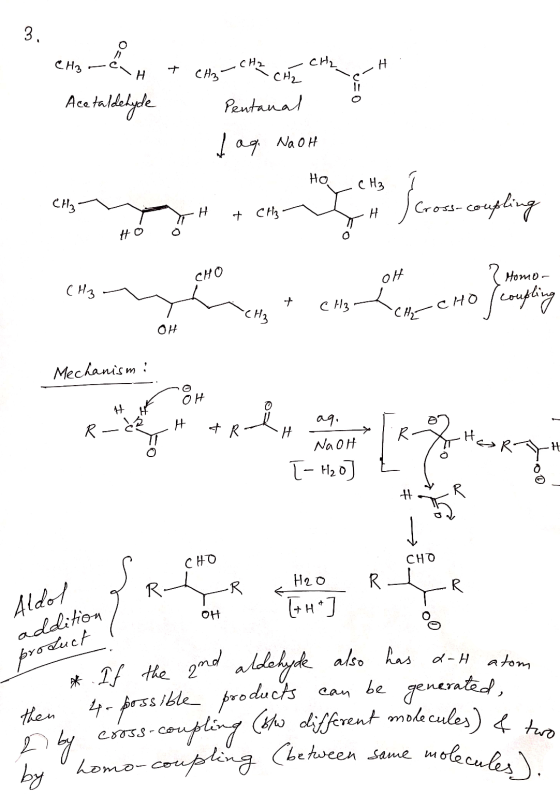
3. Draw all the aldol addition products that are formed when a mixture of acetaldehyde and pentanal is treated with aqueous sodium hydroxide.
4. A reaction, such as described in question 3, which produces a mixture of products is generally not useful for organic synthesis. Suggest a change in the reaction starting materials for question 3 that would produce a single, similar product.
5. Draw a generic mechanism for aldol condensation.
6. The last step for an aldol condensation involves hydroxide acting as a leaving group. As you have learned previously, hydroxide is NOT a good leaving group. What makes this step possible? (i.e. what is the driving force for this step?)
Homework Answers
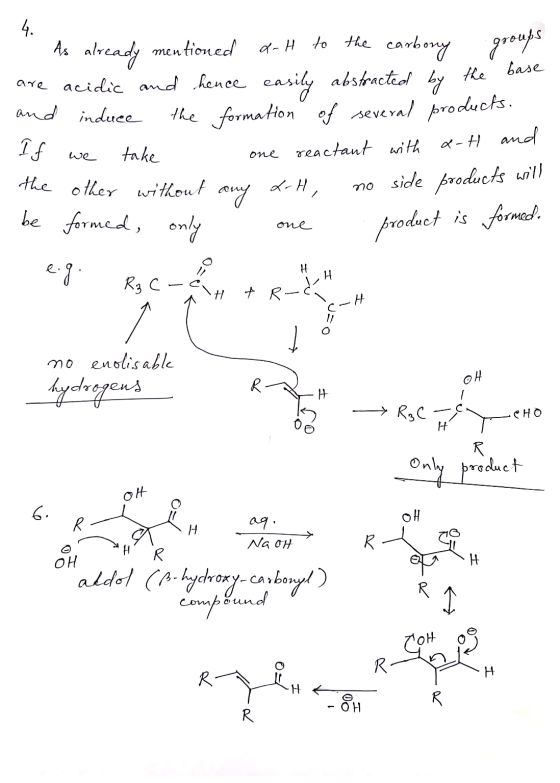
The last step of the aldol condensation goes via a E1-cB mechanism: meaning an alpha-hydrogen (alpha to the carbonyl group) is abstracted forming a conjugate base (enolate ion). This enolate ion can be formed due to the conjugation it can have with the carbonyl carbon. This conjugate base then eliminates the -OH group which is not a good leaving group generally, but here the negative charge forces the -OH group to leave (cause molecules don't like to be charged you know! they wanna quench that and become neutral eliminating the not-so-good leaving group in the process).
Note: Question 5 has been covered with the question 3.
Add Answer to:
3. Draw all the aldol addition products that are formed when a
mixture of acetaldehyde and...
Write all possible products from aldol reaction between: Butanal and Propanal Formaldehyde and Acetaldehyde What is...
 Write all possible products from aldol reaction between: Butanal and Propanal Formaldehyde and Acetaldehyde What is the product for aldol condensation in reaction 7(b) Write reaction for the synthesis of 3-Metyl-2-cyclohexenone using aldol condensation reaction.
HW 22: Enolates 1. Provide a detailed, stepwise mechanism for the base-catalyzed enolization (keto enol tautomerism) of acetaldehyde. 2. Provide the major organic product of the folowing reactio...
 HW 22: Enolates 1. Provide a detailed, stepwise mechanism for the base-catalyzed enolization (keto enol tautomerism) of acetaldehyde. 2. Provide the major organic product of the folowing reaction. 3. Provide the major organic product of the following reaction LDA 4. Which of the following ketones will give a positive iodoform test? A) 4-heptanone D) cyclohexanone B) 3-hexanone C)2-hexanone 5. Provide the major organic product of the following reaction. 6. Provide the structure of the major organic product which results when...
1. The aldol condensation reaction belongs to a group of reactions characterized by formation of an...
 1. The aldol condensation reaction belongs to a group of reactions characterized by formation of an enolate. For each of the following aldehydes or ketones, draw the enolate ion that forms when treated with a strong base such as sodium hydroxide. If an enolate cannot form, put NR (no reaction). 2. The first step in the aldol addition of acetaldehyde is an acid base reaction (proton transfer). pka = 16 pka = 15 OH a. The pk, for each acid...
How many different aldol addition products can be formed in the reaction of equal amounts of...
 How many different aldol addition products can be formed in the reaction of equal amounts of propanal and butanal with aqueous sodium hydroxide at OC? (Consider only constitutional isomer - not stereoisomers.) C1 OOO QUESTION 2 Which of the following is the aldol addition product of butanal in the presence of sodium hydroxide and water? 2-ethyl-3-hydroxyhexanal C2-methyl-2-hydroxyheptanal C 3-ethyl-2-hydroxyhexanal C2-ethyl-2-hydroxyhexanal QUESTION 3 The reaction of benzophenone in a Aldol self-condensation reaction with sodium hydroxide and water gives which product? C...
4. Draw all of the possible Aldol products (B-hydroxycarbonyl) for the following reaction below. Condensation products...
 4. Draw all of the possible Aldol products (B-hydroxycarbonyl) for the following reaction below. Condensation products are not necessary. (3 points) NaOH Aldol Products
a) Draw all of the products obtained from the base-catalyzed aldol condensation reaction between butanal and...
a) Draw all of the products obtained from the base-catalyzed aldol condensation reaction between butanal and pentanal(crossed and self) b) Show the half reaction corresponding to the reduction of permanganate ion to manganese dioxide. Show the half reaction corresponding to the oxidation of cyclopentene to 1,2 dihydroxycyclopentane. Add the two half-reactions together to give the overall net ionic equation of the oxidation of cyclopentene to 1,2 dihydroxycyclopentane using permanganate ion. Can anyone help me out?
4. Draw all of the possible Aldol products (B-hydroxycarbonyl) for the following reaction below. Condensation products...
 4. Draw all of the possible Aldol products (B-hydroxycarbonyl) for the following reaction below. Condensation products are not necessary. (3 points) NaOH Aldol Products .Ph Me H2O Ph Ме
Plz help 4 Draw all of the possible Aldol products (P-hydroxycarbonyl) for the following reaction below....
 Plz help
4 Draw all of the possible Aldol products (P-hydroxycarbonyl) for the following reaction below. Condensation products are not necessary. (3 points) Ph NaOH H2O Me Aldol Products Me
Plz help
4 Draw all of the possible Aldol products (P-hydroxycarbonyl) for the following reaction below. Condensation products are not necessary. (3 points) Ph NaOH H2O Me Aldol Products Me
In Organic Chem II from the Aldol Condensation lab (using 3-nitrobenzaldehyde, acetophenone, ethanol, sodium hydroxide, methanol...
In Organic Chem II from the Aldol Condensation lab (using 3-nitrobenzaldehyde, acetophenone, ethanol, sodium hydroxide, methanol and final product 3-nitrochalcone) please help anser the following answer. Please write clear; many times it's hard to read response on Chegg-thank you. 1. There are two possible products of this aldol condensation. Draw the structure of both. 2. Explain why only one aldol product is formed in this reaction. Comment on both the reactivity of the starting materials as well as your experimental...
pathway, substitution or elimination, will predominate and so a mixture of products is frequently observed. In...
 pathway, substitution or elimination, will predominate and so a mixture of products is frequently observed. In contrast to the El reaction which involves a carbocation intermediate, the ElcB reaction takes place through a carbanion intermediate. Base-induced abstraction of a proton in a slow, rate-limiting step gives an anion which then expels the leaving group from the adjacent carbon. The reaction is particularly suited to the elimination of substrates which contain poor leaving groups two carbons removed from a carbonyl group....
 Write all possible products from aldol reaction between: Butanal and Propanal Formaldehyde and Acetaldehyde What is the product for aldol condensation in reaction 7(b) Write reaction for the synthesis of 3-Metyl-2-cyclohexenone using aldol condensation reaction.
 HW 22: Enolates 1. Provide a detailed, stepwise mechanism for the base-catalyzed enolization (keto enol tautomerism) of acetaldehyde. 2. Provide the major organic product of the folowing reaction. 3. Provide the major organic product of the following reaction LDA 4. Which of the following ketones will give a positive iodoform test? A) 4-heptanone D) cyclohexanone B) 3-hexanone C)2-hexanone 5. Provide the major organic product of the following reaction. 6. Provide the structure of the major organic product which results when...
 1. The aldol condensation reaction belongs to a group of reactions characterized by formation of an enolate. For each of the following aldehydes or ketones, draw the enolate ion that forms when treated with a strong base such as sodium hydroxide. If an enolate cannot form, put NR (no reaction). 2. The first step in the aldol addition of acetaldehyde is an acid base reaction (proton transfer). pka = 16 pka = 15 OH a. The pk, for each acid...
 How many different aldol addition products can be formed in the reaction of equal amounts of propanal and butanal with aqueous sodium hydroxide at OC? (Consider only constitutional isomer - not stereoisomers.) C1 OOO QUESTION 2 Which of the following is the aldol addition product of butanal in the presence of sodium hydroxide and water? 2-ethyl-3-hydroxyhexanal C2-methyl-2-hydroxyheptanal C 3-ethyl-2-hydroxyhexanal C2-ethyl-2-hydroxyhexanal QUESTION 3 The reaction of benzophenone in a Aldol self-condensation reaction with sodium hydroxide and water gives which product? C...
 4. Draw all of the possible Aldol products (B-hydroxycarbonyl) for the following reaction below. Condensation products are not necessary. (3 points) NaOH Aldol Products
 4. Draw all of the possible Aldol products (B-hydroxycarbonyl) for the following reaction below. Condensation products are not necessary. (3 points) NaOH Aldol Products .Ph Me H2O Ph Ме
 Plz help
4 Draw all of the possible Aldol products (P-hydroxycarbonyl) for the following reaction below. Condensation products are not necessary. (3 points) Ph NaOH H2O Me Aldol Products Me
Plz help
4 Draw all of the possible Aldol products (P-hydroxycarbonyl) for the following reaction below. Condensation products are not necessary. (3 points) Ph NaOH H2O Me Aldol Products Me
 pathway, substitution or elimination, will predominate and so a mixture of products is frequently observed. In contrast to the El reaction which involves a carbocation intermediate, the ElcB reaction takes place through a carbanion intermediate. Base-induced abstraction of a proton in a slow, rate-limiting step gives an anion which then expels the leaving group from the adjacent carbon. The reaction is particularly suited to the elimination of substrates which contain poor leaving groups two carbons removed from a carbonyl group....
Most questions answered within 3 hours.
-
Where is the error in this code sequence?
String s1 = "Hello";
String s2 = "ello";...
asked 11 months ago -
Financial data for Joel de Paris, Inc., for last year
follow:
Joel de Paris, Inc.
Balance...
asked 11 months ago -
Consider this reaction:
Al2(SO4)3 (aq)+ BaCl3
(aq) Al2Cl6 (aq)- +
3BaSO4(s) . What is the...
asked 11 months ago -
Suppose that Savneet is considering increasing her
recent random sample from 20 car rentals to 40...
asked 11 months ago -
Trucks arrive at an unloading terminal at an average rate of 120
per hour.
Trucks arrive...
asked 11 months ago -
Why are methanol and ethanol completely soluble in water while
octanol is not very little soluble....
asked 11 months ago -
A facilities manager at a university reads in a research report
that the mean amount of...
asked 11 months ago -
When the CuSO4 is rehydrated by adding water to the anhydrous
compound, is this an endothermic...
asked 11 months ago -
A ray of sunlight is passing from diamond into crown glass; the
angle of incidence is...
asked 11 months ago -
A block of mass 0.249 kg is placed on top of a light, vertical
spring of...
asked 11 months ago -
how do the kidneys compensate in the presences of acidosis
a) trigger hyperventilate
b) reserve acid...
asked 11 months ago -
Question 501 pts
The rental rate of capital to the firm increases. Which of the
following...
asked 11 months ago