
Homework Answers
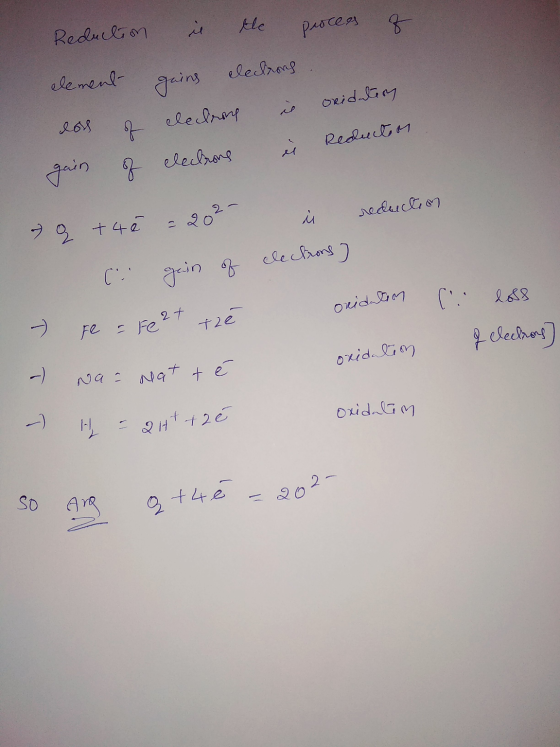
Add Answer to:
Question 18 3 points Save Answer Which of the following represents reduction? (equal sign is similar...
Refer to this table of reduction potentials to answer the questions. Reduction half-reaction Potential (V) +2.87...
 Refer to this table of reduction potentials to answer the questions. Reduction half-reaction Potential (V) +2.87 Electrolytic cells use electricity to cause a nonspontaneous redox reaction to occur. An electrolytic cell is constructed using the following components: • a power source, such as a battery, • the substance that will undergo electrolysis, and • two inert electrodes (usually platinum), which serve as the electrical connection between the power source and the substance undergoing electrolysis. As with any cell, oxidation occurs...
Use the galvanic cell notation to describe the Daniell cell. (4 marks) Using the reduction potential...
 Use the galvanic cell notation to describe the Daniell cell. (4 marks) Using the reduction potential table calculate Eº for the Daniel cell. 12 marks) Calculate the equilibrium constant K for the reaction Cu2+ + Zn → Cu + Zn²+, at 25 °C. (4 marks) Standard Potentials at 25°C Half Reaction Potential Potential +2.87 V 0.000 V +2.07 V -0.04 V +2.05 V -0.13 V -1.69 V -0.14 V +1.69 V -0.23 V +1.67 V -0.26 V +1.63 v -0.28...
Find the best reducing agent from Cu+, Ag+ F2 and Fe3+ #1. In the reduction table...
 Find the best reducing agent from Cu+, Ag+ F2 and Fe3+
#1. In the reduction table i can see several repeated values of
Fe3+ one is equal to 0.77v and the second one is equal to -0.036v
so, which one do I choose? Please explain.
#2.If I'm asked to find the best oxidation agent, from the
values already provided (Cu+, Ag+ F2 and Fe3+) which one would it
be? and how would I decide from repeated values, like in #1,...
Find the best reducing agent from Cu+, Ag+ F2 and Fe3+
#1. In the reduction table i can see several repeated values of
Fe3+ one is equal to 0.77v and the second one is equal to -0.036v
so, which one do I choose? Please explain.
#2.If I'm asked to find the best oxidation agent, from the
values already provided (Cu+, Ag+ F2 and Fe3+) which one would it
be? and how would I decide from repeated values, like in #1,...
Question 16 (5 points) Based on the following reduction potential data, which is the strongest oxidizing...
 Question 16 (5 points) Based on the following reduction potential data, which is the strongest oxidizing agent? E"red = +1.78 V for H2O2(aq) + 2H+(aq) + 2e. 2H20(1) E red +0.800 V for Ag (ac) + e' Ag(s) EPred 0.130 V for Pb2 (aq) + 2e -Pb(s) )Ag (aq b) Pb? (aq) c) H2O2(aq) Save
May or may not use Standard Reduction Potentials to answer the question. Standard Reduction Potentials at...
 May or may not use Standard Reduction Potentials to
answer the question.
Standard Reduction Potentials at 298 K E° (V) 2.08 v 1.776 v 1.33 v 0.800 v 0.520 v 0.337 v 0.159 v 0.000 v -0.227 v 0.42 v 0.90 v 2.36 v 2.84 v 2.92 v Half-reaction O3 +2 H+1 22 H20+02 H202 + 2 H +2 e -2 H20 Cr207 + 14 H+6e-->2 Cr+7 H20 Cu +e Cu Cut2 +2e Cu 2H+1+2e -H2 Co2 +2e --Co Cr2+2e-Cr...
May or may not use Standard Reduction Potentials to
answer the question.
Standard Reduction Potentials at 298 K E° (V) 2.08 v 1.776 v 1.33 v 0.800 v 0.520 v 0.337 v 0.159 v 0.000 v -0.227 v 0.42 v 0.90 v 2.36 v 2.84 v 2.92 v Half-reaction O3 +2 H+1 22 H20+02 H202 + 2 H +2 e -2 H20 Cr207 + 14 H+6e-->2 Cr+7 H20 Cu +e Cu Cut2 +2e Cu 2H+1+2e -H2 Co2 +2e --Co Cr2+2e-Cr...
Question 2 (1 point) Given the following half reactions with their corresponding standard reduction potentials, which...
 Question 2 (1 point) Given the following half reactions with their corresponding standard reduction potentials, which of the following is/are true for the overall reaction happening under standard conditions? S+ 2H+ + 2e + H2S E' = -0.243 V Fe3+ + e + Fe2+ E'' - 0.771 V (CHECK THE ONE(S) THAT IS/ARE CORRECT) 1) Fe3+ has a greater affinity for electrons than S. 2) AE'O = 1.014 V for the spontaneous reaction. 3) Fe2+ is the reducing agent. 4)...
Part III: Oxidation and Reduction of H2O2 1. Reduction of H2O2: H2O2(aq) + Cr(OH)3(S) (BASIC) •...
 Part III: Oxidation and Reduction of H2O2 1. Reduction of H2O2: H2O2(aq) + Cr(OH)3(S) (BASIC) • Observations · Evidence of the oxidation of Cr3+ • Reduction Half Reaction • Oxidation Half Reaction • Overall Balanced Redox Reaction · Explain occurrence or non-occurrence of reaction by calculating cell. 2. Oxidation of H2O2: H2O2(aq) + FeCl3(aq) • Observations • Evidence of the oxidation of H2O2 • Reduction Half Reaction • Oxidation Half Reaction • Overall Balanced Redox Reaction • Explain occurrence or...
Question 12 (10 points) Given the following standard reduction potentials, calculate Eºcell for the following reactions...
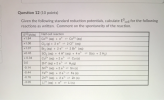 Question 12 (10 points) Given the following standard reduction potentials, calculate Eºcell for the following reactions as written. Comment on the spontaneity of the reaction. El (Volts) +1.84 +1.36 +1.07 +0.45 +0.34 0.0 -0.14 -0.44 -0.76 Half-cell reaction CO3+ (aq) + el Co2+ (aq) Cl2 (9) + 2 = 2 CI (aq) Brą (aq) + 2 = 2 Brl(aq) SO2 (aq) + 4 H+ (aq) + 4e = S(s) + 2 H2) Cu2+ (aq) + 2 * = Cu (s)...
1. How do I read the half reaction table? 2. If im asked for the best...
 1. How do I read the half reaction table?
2. If im asked for the best reducing agent from Cu+, Ag+, F2, and
Fe3+, where do I look first in the table? before the arrow or after
the arrow?
3. Sometimes a value that has originally a positive (V) from the
table it will have the negative sign in a homework problem, and
viceversa, so the question is, how do I use the positive and
negative signs in respect to...
1. How do I read the half reaction table?
2. If im asked for the best reducing agent from Cu+, Ag+, F2, and
Fe3+, where do I look first in the table? before the arrow or after
the arrow?
3. Sometimes a value that has originally a positive (V) from the
table it will have the negative sign in a homework problem, and
viceversa, so the question is, how do I use the positive and
negative signs in respect to...
the first picture is about some useful information, and the second picture is the question that...
 the first picture is about
some useful information, and the second picture is the question
that bothers me. I wonder how we know the half-cell reaction of it.
Please explain!!!
TABLE 18.1 | Standard Reduction Potentials at 25°C (298 K) for Many Common Half-Reactions 8° (V) 0.40 0.34 0.27 0.22 0.20 0.16 0.00 Half-Reaction F2 + 2e →2F Ag2+ + e +Agt Co3- + e + CO2- H2O2 + 2H+ + 2e +2H20 Ce+ + e + Ce+ PbO2 +...
the first picture is about
some useful information, and the second picture is the question
that bothers me. I wonder how we know the half-cell reaction of it.
Please explain!!!
TABLE 18.1 | Standard Reduction Potentials at 25°C (298 K) for Many Common Half-Reactions 8° (V) 0.40 0.34 0.27 0.22 0.20 0.16 0.00 Half-Reaction F2 + 2e →2F Ag2+ + e +Agt Co3- + e + CO2- H2O2 + 2H+ + 2e +2H20 Ce+ + e + Ce+ PbO2 +...
 Refer to this table of reduction potentials to answer the questions. Reduction half-reaction Potential (V) +2.87 Electrolytic cells use electricity to cause a nonspontaneous redox reaction to occur. An electrolytic cell is constructed using the following components: • a power source, such as a battery, • the substance that will undergo electrolysis, and • two inert electrodes (usually platinum), which serve as the electrical connection between the power source and the substance undergoing electrolysis. As with any cell, oxidation occurs...
 Use the galvanic cell notation to describe the Daniell cell. (4 marks) Using the reduction potential table calculate Eº for the Daniel cell. 12 marks) Calculate the equilibrium constant K for the reaction Cu2+ + Zn → Cu + Zn²+, at 25 °C. (4 marks) Standard Potentials at 25°C Half Reaction Potential Potential +2.87 V 0.000 V +2.07 V -0.04 V +2.05 V -0.13 V -1.69 V -0.14 V +1.69 V -0.23 V +1.67 V -0.26 V +1.63 v -0.28...
 Find the best reducing agent from Cu+, Ag+ F2 and Fe3+
#1. In the reduction table i can see several repeated values of
Fe3+ one is equal to 0.77v and the second one is equal to -0.036v
so, which one do I choose? Please explain.
#2.If I'm asked to find the best oxidation agent, from the
values already provided (Cu+, Ag+ F2 and Fe3+) which one would it
be? and how would I decide from repeated values, like in #1,...
Find the best reducing agent from Cu+, Ag+ F2 and Fe3+
#1. In the reduction table i can see several repeated values of
Fe3+ one is equal to 0.77v and the second one is equal to -0.036v
so, which one do I choose? Please explain.
#2.If I'm asked to find the best oxidation agent, from the
values already provided (Cu+, Ag+ F2 and Fe3+) which one would it
be? and how would I decide from repeated values, like in #1,...
 Question 16 (5 points) Based on the following reduction potential data, which is the strongest oxidizing agent? E"red = +1.78 V for H2O2(aq) + 2H+(aq) + 2e. 2H20(1) E red +0.800 V for Ag (ac) + e' Ag(s) EPred 0.130 V for Pb2 (aq) + 2e -Pb(s) )Ag (aq b) Pb? (aq) c) H2O2(aq) Save
 May or may not use Standard Reduction Potentials to
answer the question.
Standard Reduction Potentials at 298 K E° (V) 2.08 v 1.776 v 1.33 v 0.800 v 0.520 v 0.337 v 0.159 v 0.000 v -0.227 v 0.42 v 0.90 v 2.36 v 2.84 v 2.92 v Half-reaction O3 +2 H+1 22 H20+02 H202 + 2 H +2 e -2 H20 Cr207 + 14 H+6e-->2 Cr+7 H20 Cu +e Cu Cut2 +2e Cu 2H+1+2e -H2 Co2 +2e --Co Cr2+2e-Cr...
May or may not use Standard Reduction Potentials to
answer the question.
Standard Reduction Potentials at 298 K E° (V) 2.08 v 1.776 v 1.33 v 0.800 v 0.520 v 0.337 v 0.159 v 0.000 v -0.227 v 0.42 v 0.90 v 2.36 v 2.84 v 2.92 v Half-reaction O3 +2 H+1 22 H20+02 H202 + 2 H +2 e -2 H20 Cr207 + 14 H+6e-->2 Cr+7 H20 Cu +e Cu Cut2 +2e Cu 2H+1+2e -H2 Co2 +2e --Co Cr2+2e-Cr...
 Question 2 (1 point) Given the following half reactions with their corresponding standard reduction potentials, which of the following is/are true for the overall reaction happening under standard conditions? S+ 2H+ + 2e + H2S E' = -0.243 V Fe3+ + e + Fe2+ E'' - 0.771 V (CHECK THE ONE(S) THAT IS/ARE CORRECT) 1) Fe3+ has a greater affinity for electrons than S. 2) AE'O = 1.014 V for the spontaneous reaction. 3) Fe2+ is the reducing agent. 4)...
 Part III: Oxidation and Reduction of H2O2 1. Reduction of H2O2: H2O2(aq) + Cr(OH)3(S) (BASIC) • Observations · Evidence of the oxidation of Cr3+ • Reduction Half Reaction • Oxidation Half Reaction • Overall Balanced Redox Reaction · Explain occurrence or non-occurrence of reaction by calculating cell. 2. Oxidation of H2O2: H2O2(aq) + FeCl3(aq) • Observations • Evidence of the oxidation of H2O2 • Reduction Half Reaction • Oxidation Half Reaction • Overall Balanced Redox Reaction • Explain occurrence or...
 Question 12 (10 points) Given the following standard reduction potentials, calculate Eºcell for the following reactions as written. Comment on the spontaneity of the reaction. El (Volts) +1.84 +1.36 +1.07 +0.45 +0.34 0.0 -0.14 -0.44 -0.76 Half-cell reaction CO3+ (aq) + el Co2+ (aq) Cl2 (9) + 2 = 2 CI (aq) Brą (aq) + 2 = 2 Brl(aq) SO2 (aq) + 4 H+ (aq) + 4e = S(s) + 2 H2) Cu2+ (aq) + 2 * = Cu (s)...
 1. How do I read the half reaction table?
2. If im asked for the best reducing agent from Cu+, Ag+, F2, and
Fe3+, where do I look first in the table? before the arrow or after
the arrow?
3. Sometimes a value that has originally a positive (V) from the
table it will have the negative sign in a homework problem, and
viceversa, so the question is, how do I use the positive and
negative signs in respect to...
1. How do I read the half reaction table?
2. If im asked for the best reducing agent from Cu+, Ag+, F2, and
Fe3+, where do I look first in the table? before the arrow or after
the arrow?
3. Sometimes a value that has originally a positive (V) from the
table it will have the negative sign in a homework problem, and
viceversa, so the question is, how do I use the positive and
negative signs in respect to...
 the first picture is about
some useful information, and the second picture is the question
that bothers me. I wonder how we know the half-cell reaction of it.
Please explain!!!
TABLE 18.1 | Standard Reduction Potentials at 25°C (298 K) for Many Common Half-Reactions 8° (V) 0.40 0.34 0.27 0.22 0.20 0.16 0.00 Half-Reaction F2 + 2e →2F Ag2+ + e +Agt Co3- + e + CO2- H2O2 + 2H+ + 2e +2H20 Ce+ + e + Ce+ PbO2 +...
the first picture is about
some useful information, and the second picture is the question
that bothers me. I wonder how we know the half-cell reaction of it.
Please explain!!!
TABLE 18.1 | Standard Reduction Potentials at 25°C (298 K) for Many Common Half-Reactions 8° (V) 0.40 0.34 0.27 0.22 0.20 0.16 0.00 Half-Reaction F2 + 2e →2F Ag2+ + e +Agt Co3- + e + CO2- H2O2 + 2H+ + 2e +2H20 Ce+ + e + Ce+ PbO2 +...
Most questions answered within 3 hours.
-
Where is the error in this code sequence?
String s1 = "Hello";
String s2 = "ello";...
asked 10 months ago -
Financial data for Joel de Paris, Inc., for last year
follow:
Joel de Paris, Inc.
Balance...
asked 10 months ago -
Consider this reaction:
Al2(SO4)3 (aq)+ BaCl3
(aq) Al2Cl6 (aq)- +
3BaSO4(s) . What is the...
asked 10 months ago -
Suppose that Savneet is considering increasing her
recent random sample from 20 car rentals to 40...
asked 10 months ago -
Trucks arrive at an unloading terminal at an average rate of 120
per hour.
Trucks arrive...
asked 10 months ago -
Why are methanol and ethanol completely soluble in water while
octanol is not very little soluble....
asked 10 months ago -
A facilities manager at a university reads in a research report
that the mean amount of...
asked 10 months ago -
When the CuSO4 is rehydrated by adding water to the anhydrous
compound, is this an endothermic...
asked 10 months ago -
A ray of sunlight is passing from diamond into crown glass; the
angle of incidence is...
asked 10 months ago -
A block of mass 0.249 kg is placed on top of a light, vertical
spring of...
asked 10 months ago -
how do the kidneys compensate in the presences of acidosis
a) trigger hyperventilate
b) reserve acid...
asked 10 months ago -
Question 501 pts
The rental rate of capital to the firm increases. Which of the
following...
asked 10 months ago