
Homework Answers
Add Answer to:
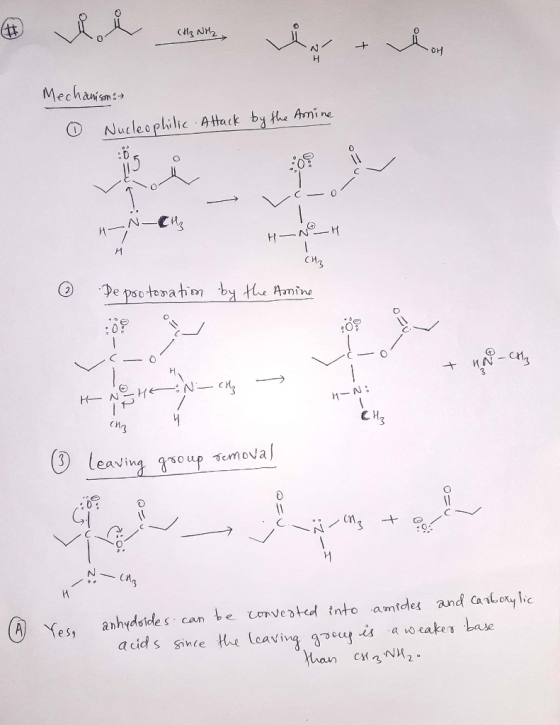
will the following reaction occur as written?
CH3NH2 он A) Yes, anhydrides can be converted into...
Which of the following statements is NOT true about acid anhydrides? A. Acid anhydrides are more...
Which of the following statements is NOT true about acid anhydrides? A. Acid anhydrides are more reactive than esters but less reactive than acyl chlorides. B. An acid anhydride reacts with water to form an ester product. C. Acid anhydrides eliminate a carboxylate ion as a leaving group. D. An acid anhydride is considered to have a better leaving group (i.e. weaker base) than the leaving groups of esters, carboxylic acids, and amides. A B C D
QUESTION 11 What are the expected products of the following reaction? ethanol HCI, heat b HO...
 QUESTION 11 What are the expected products of the following reaction? ethanol HCI, heat b HO A.c, b B.a, e C.a, b D.ad E.c,d QUESTION 12 Which of the following statements is not true about the reactions of carboxylic acid derivatives? For a reaction to occur, the added group must be a stronger base than the group attached to the acyl group B. Carboxylic acid derivatives form a tetrahedral intermediate. Less reactive derivatives can be converted directly into more reactive...
2. Identify the strongest type of intermolecular forces in acetone, ethanol, water and hexane. (Structures listed...
 2. Identify the strongest type of intermolecular forces in acetone, ethanol, water and hexane. (Structures listed on page 15.) Experiment 2 Intermolecular Forces There are three general types of intermolecular forces. All substances exhibit London Dispersion Forces (LDF), and they are generally the weakest of the three types. These London forces are due to the attractions between small, temporary dipoles that arise from the constant, random movement of the electrons in a substance. As molar mass increases, the size of...
For the following questions, provide an answer based on what is given. Question 16: Can the...
 For the following questions, provide an answer based on what is
given.
Question 16: Can the molecule below be optically active? Why or why not? A. No because N has lone pair electrons. CN B. No because the molecule is symmetrical. C. Yes since the molecule cannot rotate and has 3D shape. D. Yes since the molecule has chiral centers. Question 17: Is the reaction correct or not? Why or why not? Me HO-Cr-OH Me H20, H2SO4 A. Reaction is...
For the following questions, provide an answer based on what is
given.
Question 16: Can the molecule below be optically active? Why or why not? A. No because N has lone pair electrons. CN B. No because the molecule is symmetrical. C. Yes since the molecule cannot rotate and has 3D shape. D. Yes since the molecule has chiral centers. Question 17: Is the reaction correct or not? Why or why not? Me HO-Cr-OH Me H20, H2SO4 A. Reaction is...
Can you help me identify reagent (i), Compound 8 and Compound 12 in the reaction scheme?...
 Can you help me identify reagent (i), Compound 8 and
Compound 12 in the reaction scheme?
You have laboratory data on all the compounds in the
synthesis, however the amount of data available to you varies. Some
have the entirety of the spectral data, others have as little as
the elemental analysis. Use the laboratory data to help you
discover which reaction has been performed.
The lab data for Compound 8 and 12 is as
follows:
You can use any...
Can you help me identify reagent (i), Compound 8 and
Compound 12 in the reaction scheme?
You have laboratory data on all the compounds in the
synthesis, however the amount of data available to you varies. Some
have the entirety of the spectral data, others have as little as
the elemental analysis. Use the laboratory data to help you
discover which reaction has been performed.
The lab data for Compound 8 and 12 is as
follows:
You can use any...
INTERMOLECULAR FORCES INTRODUCTION LEARNING OBJECTIVES To relate the effecet of intermolecular fo...
 INTERMOLECULAR FORCES INTRODUCTION LEARNING OBJECTIVES To relate the effecet of intermolecular forces on relative melting points and vapour pressures of some organic substances THEORY Weak attractive forces that occur between individual molecules in substances are called intermolecular forces. These include London dispersion forces, dipole-dipole forces and hydrogen-bonding forces. Collectively, the three types of intermolecular forces are referred to as Van der Waals forces. These attractive forces are much weaker than the chemical bonds between atoms in a molecule. Note that...
1. In both the sodium iodide test and the silver nitrate test, why does 2-bromobutane react faster...
 1. In both the sodium iodide
test and the silver nitrate test, why does 2-bromobutane react
faster than 2-chlorobutane?
Bromine is a better leaving group since it is a weaker base than
chlorine is.
2. a. Why does benzyl chloride react under both
SN1 and SN2 conditions?
Benzyl
chloride is a primary alkyl halide, hence reactive under SN2
conditions.
The
primary carbocation formed due to the departure of Cl- is
stabilized by the pi electrons in the benzene ring.
b. Why is...
1. In both the sodium iodide
test and the silver nitrate test, why does 2-bromobutane react
faster than 2-chlorobutane?
Bromine is a better leaving group since it is a weaker base than
chlorine is.
2. a. Why does benzyl chloride react under both
SN1 and SN2 conditions?
Benzyl
chloride is a primary alkyl halide, hence reactive under SN2
conditions.
The
primary carbocation formed due to the departure of Cl- is
stabilized by the pi electrons in the benzene ring.
b. Why is...
____ 1. The diagram below represents serine, a polar, uncharged amino acid. Which functional group gives...
 ____ 1. The diagram below represents serine, a polar, uncharged
amino acid. Which functional group gives serine its
distinct property?
a. H3
b. CH2OH
c. –H
d. COO–
____ 2. The monomers shown below are monomers for which of the
following natural polymers?
a. polysaccharides
b. plastics
c. DNA
d. proteins
____ 3. Which of the following processes illustrates the production
of a protein?
a. specific code for amino acids --> amino acid chain -->
gene --> DNA --> specific...
____ 1. The diagram below represents serine, a polar, uncharged
amino acid. Which functional group gives serine its
distinct property?
a. H3
b. CH2OH
c. –H
d. COO–
____ 2. The monomers shown below are monomers for which of the
following natural polymers?
a. polysaccharides
b. plastics
c. DNA
d. proteins
____ 3. Which of the following processes illustrates the production
of a protein?
a. specific code for amino acids --> amino acid chain -->
gene --> DNA --> specific...
Which of the following is TRUE of incomplete penetrance? Select one: a. Epistatic interactions can result...
Which of the following is TRUE of incomplete penetrance? Select one: a. Epistatic interactions can result in incomplete penetrance in some cases. b. Environmental factors do not influence penetrance. c. Incomplete penetrance implies that some individuals will experience less severe forms of disease, such as cancer or Alzheimer's. d. Incomplete penetrance is never observed with Huntington's disease e. Incomplete penetrance refers to cases in which individuals developing a particular disease (e.g., cancer or Alzheimer's) lack the typical genotype for this...
Question 1 The following reaction between 2-methylbut-2-ene and hydrogen bromide (HBr) is best described as what...
 Question 1 The following reaction between 2-methylbut-2-ene and hydrogen bromide (HBr) is best described as what type of reaction? Refer to the Figure A) Addition B) Substitution C) Elimination D) Rearrangement Question 2 For the reaction in question 1, two products are possible- a major product, and a minor product. For the minor product, what is the splitting pattern for the added hydrogen (highlighted in red) that would be observed in the molecules HINMR spectrum? Refer to the Figure HBr...
 QUESTION 11 What are the expected products of the following reaction? ethanol HCI, heat b HO A.c, b B.a, e C.a, b D.ad E.c,d QUESTION 12 Which of the following statements is not true about the reactions of carboxylic acid derivatives? For a reaction to occur, the added group must be a stronger base than the group attached to the acyl group B. Carboxylic acid derivatives form a tetrahedral intermediate. Less reactive derivatives can be converted directly into more reactive...
 2. Identify the strongest type of intermolecular forces in acetone, ethanol, water and hexane. (Structures listed on page 15.) Experiment 2 Intermolecular Forces There are three general types of intermolecular forces. All substances exhibit London Dispersion Forces (LDF), and they are generally the weakest of the three types. These London forces are due to the attractions between small, temporary dipoles that arise from the constant, random movement of the electrons in a substance. As molar mass increases, the size of...
 For the following questions, provide an answer based on what is
given.
Question 16: Can the molecule below be optically active? Why or why not? A. No because N has lone pair electrons. CN B. No because the molecule is symmetrical. C. Yes since the molecule cannot rotate and has 3D shape. D. Yes since the molecule has chiral centers. Question 17: Is the reaction correct or not? Why or why not? Me HO-Cr-OH Me H20, H2SO4 A. Reaction is...
For the following questions, provide an answer based on what is
given.
Question 16: Can the molecule below be optically active? Why or why not? A. No because N has lone pair electrons. CN B. No because the molecule is symmetrical. C. Yes since the molecule cannot rotate and has 3D shape. D. Yes since the molecule has chiral centers. Question 17: Is the reaction correct or not? Why or why not? Me HO-Cr-OH Me H20, H2SO4 A. Reaction is...
 Can you help me identify reagent (i), Compound 8 and
Compound 12 in the reaction scheme?
You have laboratory data on all the compounds in the
synthesis, however the amount of data available to you varies. Some
have the entirety of the spectral data, others have as little as
the elemental analysis. Use the laboratory data to help you
discover which reaction has been performed.
The lab data for Compound 8 and 12 is as
follows:
You can use any...
Can you help me identify reagent (i), Compound 8 and
Compound 12 in the reaction scheme?
You have laboratory data on all the compounds in the
synthesis, however the amount of data available to you varies. Some
have the entirety of the spectral data, others have as little as
the elemental analysis. Use the laboratory data to help you
discover which reaction has been performed.
The lab data for Compound 8 and 12 is as
follows:
You can use any...
 INTERMOLECULAR FORCES INTRODUCTION LEARNING OBJECTIVES To relate the effecet of intermolecular forces on relative melting points and vapour pressures of some organic substances THEORY Weak attractive forces that occur between individual molecules in substances are called intermolecular forces. These include London dispersion forces, dipole-dipole forces and hydrogen-bonding forces. Collectively, the three types of intermolecular forces are referred to as Van der Waals forces. These attractive forces are much weaker than the chemical bonds between atoms in a molecule. Note that...
 1. In both the sodium iodide
test and the silver nitrate test, why does 2-bromobutane react
faster than 2-chlorobutane?
Bromine is a better leaving group since it is a weaker base than
chlorine is.
2. a. Why does benzyl chloride react under both
SN1 and SN2 conditions?
Benzyl
chloride is a primary alkyl halide, hence reactive under SN2
conditions.
The
primary carbocation formed due to the departure of Cl- is
stabilized by the pi electrons in the benzene ring.
b. Why is...
1. In both the sodium iodide
test and the silver nitrate test, why does 2-bromobutane react
faster than 2-chlorobutane?
Bromine is a better leaving group since it is a weaker base than
chlorine is.
2. a. Why does benzyl chloride react under both
SN1 and SN2 conditions?
Benzyl
chloride is a primary alkyl halide, hence reactive under SN2
conditions.
The
primary carbocation formed due to the departure of Cl- is
stabilized by the pi electrons in the benzene ring.
b. Why is...
 ____ 1. The diagram below represents serine, a polar, uncharged
amino acid. Which functional group gives serine its
distinct property?
a. H3
b. CH2OH
c. –H
d. COO–
____ 2. The monomers shown below are monomers for which of the
following natural polymers?
a. polysaccharides
b. plastics
c. DNA
d. proteins
____ 3. Which of the following processes illustrates the production
of a protein?
a. specific code for amino acids --> amino acid chain -->
gene --> DNA --> specific...
____ 1. The diagram below represents serine, a polar, uncharged
amino acid. Which functional group gives serine its
distinct property?
a. H3
b. CH2OH
c. –H
d. COO–
____ 2. The monomers shown below are monomers for which of the
following natural polymers?
a. polysaccharides
b. plastics
c. DNA
d. proteins
____ 3. Which of the following processes illustrates the production
of a protein?
a. specific code for amino acids --> amino acid chain -->
gene --> DNA --> specific...
 Question 1 The following reaction between 2-methylbut-2-ene and hydrogen bromide (HBr) is best described as what type of reaction? Refer to the Figure A) Addition B) Substitution C) Elimination D) Rearrangement Question 2 For the reaction in question 1, two products are possible- a major product, and a minor product. For the minor product, what is the splitting pattern for the added hydrogen (highlighted in red) that would be observed in the molecules HINMR spectrum? Refer to the Figure HBr...
Most questions answered within 3 hours.
-
Where is the error in this code sequence?
String s1 = "Hello";
String s2 = "ello";...
asked 10 months ago -
Financial data for Joel de Paris, Inc., for last year
follow:
Joel de Paris, Inc.
Balance...
asked 10 months ago -
Consider this reaction:
Al2(SO4)3 (aq)+ BaCl3
(aq) Al2Cl6 (aq)- +
3BaSO4(s) . What is the...
asked 10 months ago -
Suppose that Savneet is considering increasing her
recent random sample from 20 car rentals to 40...
asked 10 months ago -
Trucks arrive at an unloading terminal at an average rate of 120
per hour.
Trucks arrive...
asked 10 months ago -
Why are methanol and ethanol completely soluble in water while
octanol is not very little soluble....
asked 10 months ago -
A facilities manager at a university reads in a research report
that the mean amount of...
asked 10 months ago -
When the CuSO4 is rehydrated by adding water to the anhydrous
compound, is this an endothermic...
asked 10 months ago -
A ray of sunlight is passing from diamond into crown glass; the
angle of incidence is...
asked 10 months ago -
A block of mass 0.249 kg is placed on top of a light, vertical
spring of...
asked 10 months ago -
how do the kidneys compensate in the presences of acidosis
a) trigger hyperventilate
b) reserve acid...
asked 10 months ago -
Question 501 pts
The rental rate of capital to the firm increases. Which of the
following...
asked 10 months ago