
Homework Answers
Add Answer to:
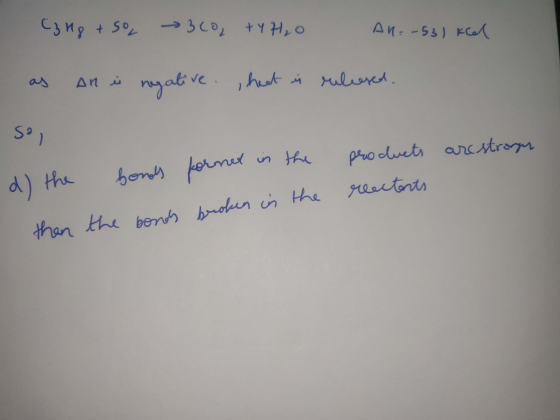
(6.2) Consider the reaction: C3H8) + 5 029) -- 3 CO2(g) + 4H2009), where AH =...
(6.4) The rate of a chemical reaction increases with an increase in the concentration of one...
 (6.4) The rate of a chemical reaction increases with an increase in the concentration of one or more reactants. This is best explained by which statement? Select one: a. The higher concentration of reactants increases the activation energy of the reaction. Ob. The higher concentration of reactants increases the potential energy of the molecules. c. The higher concentration of reactants increases the frequency of collisions between molecules. d. The higher concentration of reactants increases the temperature of the molecules. Check...
Consider the combustion reaction of propane: C3H8(g)+ 5 02(g)3 CO2(g) +4 H20(g), where AH= -531 kcal....
 Consider the combustion reaction of propane: C3H8(g)+ 5 02(g)3 CO2(g) +4 H20(g), where AH= -531 kcal. If 6.70 x 10⁴ kcal of energy is released in the reaction, how many grams of oxygen were consumed? ed 12.6 g of O2 2.02x 10⁴ g of O2 wer X 63.1g of O2 404 g of O2 Byt Hack
The predicted sign of AH of the reaction is best justified by claiming that: 2 CI...
 The predicted sign of AH of the reaction is best justified by claiming that: 2 CI (g) + O2 (g) 2 CIO(g) Energy is likely released in the reaction since more energy is produced when breaking stronger bonds in the reactants than what is needed to form weaker bonds in the products. Energy is likely released in the reaction because more energy is produced in forming stronger bonds in the products than is needed to break weaker bonds in the...
Consider the reaction shown: C3H8 + 5 O2 → 3 CO2 + 4 H2O + 488...
Consider the reaction shown: C3H8 + 5 O2 → 3 CO2 + 4 H2O + 488 kcal We can say that this reaction is ________ and that the sign of ΔH is ________. endothermic; positive exothermic; positive exothermic; neither positive nor negative endothermic; negative exothermic; negative
A reaction is said to be ________ if the bonds formed during the reaction are stronger...
A reaction is said to be ________ if the bonds formed during the reaction are stronger than the bonds broken. A) exergonic B) endergonic C) endothermic D) exothermic E) spontaneous I know the answer is exothermic but I'm confused as to why. Wouldn't having stronger bonds formed than bonds broken mean that delta_H is positive since the enthalpy on the products is bigger than the reactants thus making it endothermic?
The standard enthalpy of a reaction, AH, is the energy or enthalpy change associated with transforming...
 The standard enthalpy of a reaction, AH, is the energy or enthalpy change associated with transforming reactants into products, where "standard", denoted °, implies reaction conditions of 25°C, 1 atm and/or 1 M. Standard enthalpies of a reaction can be estimated by assuming that all reactant bonds are broken before forming all product bonds: AHTD =( enthalpies of bonds broken) - (2 enthalpies of bonds formed) Using the information below, calculate AH°r (kJ) for the reaction of H2(g) + Cl2(g)...
Consider the reaction: H2(g) + (1/2)O2(g) -------> H2O(l) ΔH° = -286 kJ Which of the following...
Consider the reaction: H2(g) + (1/2)O2(g) -------> H2O(l) ΔH° = -286 kJ Which of the following is true? (Select all that apply) the reaction is endothermic heat is given off by the surroundings the reaction is exothermic heat is absorbed by the system the enthalpy of the products is less than the that of the reactants
A chemist measures the energy change AH during the following reaction: CH4(9)+202(9) + CO2(9)+2H2O(1) AH= -882....
 A chemist measures the energy change AH during the following reaction: CH4(9)+202(9) + CO2(9)+2H2O(1) AH= -882. kJ Use the information to answer the following questions. This reaction is... ОО endothermic. exothermic. Yes, absorbed. Yes, released. Suppose 33.5 g of CH4 react. X 5 ? Will any heat be released or absorbed? No. If you said heat will be released or absorbed in the second part of this question, calculate how much heat will be released or absorbed. Round your answer...
A chemist measures the energy change AH during the following reaction: CH (9)+20,(9) CO2(9)+2H,000 AH=-882. kJ...
 A chemist measures the energy change AH during the following reaction: CH (9)+20,(9) CO2(9)+2H,000 AH=-882. kJ Use the information to answer the following questions. This reaction is... Suppose 93.3 g of CH , react. To endothermic. exothermic. Yes, absorbed. Yes, released. No. Will any heat be released or absorbed? If you said heat will be released or absorbed in the second part of this question, calculate how much heat will be released or absorbed. Be sure your answer has the...
2 pts Question 14 Consider the reaction 2H2(g) + O2(g) → 2H2O(l) AH = -286 kJ...
 2 pts Question 14 Consider the reaction 2H2(g) + O2(g) → 2H2O(l) AH = -286 kJ Which of the following is true? The reaction is exothermic The reaction is endothermic The reaction is neutral with respect to energy change Heat is absorbed by the system Information is not enough to tell about the energy change
 (6.4) The rate of a chemical reaction increases with an increase in the concentration of one or more reactants. This is best explained by which statement? Select one: a. The higher concentration of reactants increases the activation energy of the reaction. Ob. The higher concentration of reactants increases the potential energy of the molecules. c. The higher concentration of reactants increases the frequency of collisions between molecules. d. The higher concentration of reactants increases the temperature of the molecules. Check...
 Consider the combustion reaction of propane: C3H8(g)+ 5 02(g)3 CO2(g) +4 H20(g), where AH= -531 kcal. If 6.70 x 10⁴ kcal of energy is released in the reaction, how many grams of oxygen were consumed? ed 12.6 g of O2 2.02x 10⁴ g of O2 wer X 63.1g of O2 404 g of O2 Byt Hack
 The predicted sign of AH of the reaction is best justified by claiming that: 2 CI (g) + O2 (g) 2 CIO(g) Energy is likely released in the reaction since more energy is produced when breaking stronger bonds in the reactants than what is needed to form weaker bonds in the products. Energy is likely released in the reaction because more energy is produced in forming stronger bonds in the products than is needed to break weaker bonds in the...
 The standard enthalpy of a reaction, AH, is the energy or enthalpy change associated with transforming reactants into products, where "standard", denoted °, implies reaction conditions of 25°C, 1 atm and/or 1 M. Standard enthalpies of a reaction can be estimated by assuming that all reactant bonds are broken before forming all product bonds: AHTD =( enthalpies of bonds broken) - (2 enthalpies of bonds formed) Using the information below, calculate AH°r (kJ) for the reaction of H2(g) + Cl2(g)...
 A chemist measures the energy change AH during the following reaction: CH4(9)+202(9) + CO2(9)+2H2O(1) AH= -882. kJ Use the information to answer the following questions. This reaction is... ОО endothermic. exothermic. Yes, absorbed. Yes, released. Suppose 33.5 g of CH4 react. X 5 ? Will any heat be released or absorbed? No. If you said heat will be released or absorbed in the second part of this question, calculate how much heat will be released or absorbed. Round your answer...
 A chemist measures the energy change AH during the following reaction: CH (9)+20,(9) CO2(9)+2H,000 AH=-882. kJ Use the information to answer the following questions. This reaction is... Suppose 93.3 g of CH , react. To endothermic. exothermic. Yes, absorbed. Yes, released. No. Will any heat be released or absorbed? If you said heat will be released or absorbed in the second part of this question, calculate how much heat will be released or absorbed. Be sure your answer has the...
 2 pts Question 14 Consider the reaction 2H2(g) + O2(g) → 2H2O(l) AH = -286 kJ Which of the following is true? The reaction is exothermic The reaction is endothermic The reaction is neutral with respect to energy change Heat is absorbed by the system Information is not enough to tell about the energy change
Most questions answered within 3 hours.
-
Where is the error in this code sequence?
String s1 = "Hello";
String s2 = "ello";...
asked 11 months ago -
Financial data for Joel de Paris, Inc., for last year
follow:
Joel de Paris, Inc.
Balance...
asked 11 months ago -
Consider this reaction:
Al2(SO4)3 (aq)+ BaCl3
(aq) Al2Cl6 (aq)- +
3BaSO4(s) . What is the...
asked 11 months ago -
Suppose that Savneet is considering increasing her
recent random sample from 20 car rentals to 40...
asked 11 months ago -
Trucks arrive at an unloading terminal at an average rate of 120
per hour.
Trucks arrive...
asked 11 months ago -
Why are methanol and ethanol completely soluble in water while
octanol is not very little soluble....
asked 11 months ago -
A facilities manager at a university reads in a research report
that the mean amount of...
asked 11 months ago -
When the CuSO4 is rehydrated by adding water to the anhydrous
compound, is this an endothermic...
asked 11 months ago -
A ray of sunlight is passing from diamond into crown glass; the
angle of incidence is...
asked 11 months ago -
A block of mass 0.249 kg is placed on top of a light, vertical
spring of...
asked 11 months ago -
how do the kidneys compensate in the presences of acidosis
a) trigger hyperventilate
b) reserve acid...
asked 11 months ago -
Question 501 pts
The rental rate of capital to the firm increases. Which of the
following...
asked 11 months ago