
Homework Answers

Add Answer to:
17. A solution is prepared by dissolving 5.00 g of aspirin, C9H3O4, in 215 g of...
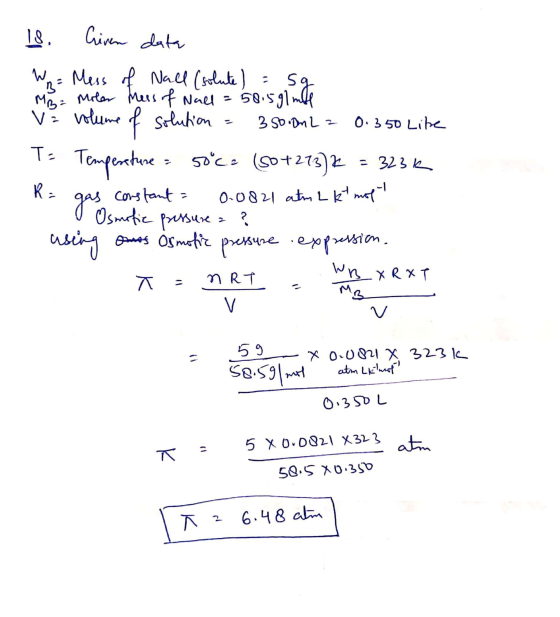
18. What osmotic pressure in atmospheres would you expect for each of the following solutions? a)...
 18. What osmotic pressure in atmospheres would you expect for each of the following solutions? a) 5.00 g of NaCl in 350.0 mL of aqueous solution at 50 °C b) 6.33 g of sodium acetate, CH3CO2Na, in 55.0 mL of aqueous solution at 10 °C. 19. Human blood gives rise to an osmotic pressure of approximately 7.7 atm at body temperature, 37.0 °C. What must the molarity of an intravenous glucose solution be to give rise to the same osmotic...
a. Consider these two solutions: Solution A is prepared by dissolving 5.00 g of MgCl2 in...
a. Consider these two solutions: Solution A is prepared by dissolving 5.00 g of MgCl2 in enough water to make .250 L of solutions, and Solution B is prepared by dissolving 5.00 g of KCl in enough water to make .250 L of solution. Which direction will solvent initally flow if these two solutions are seperated by a semipermeable membrane? b. Assuming that the volumes of the solutions described in question 4 are additive and igoring any effects that gravity...
A solution at 30 ° C is prepared by dissolving 3 g of urea in 100...
A solution at 30 ° C is prepared by dissolving 3 g of urea in 100 ml of water. Under these conditions, calculate for the solution: a) the boiling point b) the freezing point c) the vapor pressure d) the osmotic pressure e) the ebulloscopic and cryoscopic constant (from the solvent data).
What osmotic pressure (in atmospheres) would you expect for each of the following solutions? 5.70 g...
What osmotic pressure (in atmospheres) would you expect for each of the following solutions? 5.70 g of NaCl in 357.0 mL of aqueous solution at 54 ∘C. 6.63 g of sodium acetate, CH3CO2Na, in 56.5 mL of aqueous solution at 11 ∘C.
A solution is prepared by dissolving 5.00 g of glycerin () in 201 g of ethanol The...
A solution is prepared by dissolving 5.00 g of glycerin () in 201 g of ethanol The freezing point of the solution is ________°C. The freezing point of pure ethanol is -114.6 °C at 1 atm. The molal-freezing-point-depression constant () for ethanol is 1.99 °C/m. The molar masses of glycerin and of ethanol are 92.1 g/mol and 46.1 g/mol, respectively. -115.1 -119.4 0.537 -109.8 -114.1
18. Four aqueous solutions are prepared by dissolving 10 g of each of the following solutes...
 18. Four aqueous solutions are prepared by dissolving 10 g of each of the following solutes enough water to make a 1 M solution: benzene, KI, CaCl2, and AlBr3. Whe solution has the smallest osmotic pressure at 10 °C? Report the osmotic (in atm to two decimal places) for each solution. A: CaCl2 has largest osmotic pressure.
Find the boiling and freezing point of a solution prepared by dissolving 12.5g of naphthalene (C10H8)...
Find the boiling and freezing point of a solution prepared by dissolving 12.5g of naphthalene (C10H8) in 450g of chloroform. Melting and freezing points of pure chloroform are -36.5 celsius and 61.2 celsius.
A solution is prepared by dissolving 1.50 g of an unknown nonelectrolyte in 20.0 g of...
A solution is prepared by dissolving 1.50 g of an unknown nonelectrolyte in 20.0 g of the organic solvent carbon tetrachloride (CCl4). If the boiling point of the solution is 79.4 °C, what is the molar mass of the unknown nonelectrolyte? The boiling point of pure CCl4 is 76.5 °C. ?I(CCl4) = 5.03 °C/?.
1. A solution was prepared by dissolving 2.20g of urea (H2NCONH2) in 50.00g of water. If...
1. A solution was prepared by dissolving 2.20g of urea (H2NCONH2) in 50.00g of water. If for H2O Tb = 100C, Tf = 0C, Kb = 0.52C / m and Kf = 1.86C / m, determine the freezing and boiling point of the solution. 2. A solution is prepared by dissolving 17.41g of a substance X in 600g of benzene and the resulting solution is frozen at 4.00C. If the freezing point of pure benzene is 5.55C and its Kf...
A solution is prepared by dissolving 4.90 g sodium chloride in 225.0 g of water. The...
A solution is prepared by dissolving 4.90 g sodium chloride in 225.0 g of water. The density of the resulting solution is 1.33 g/mL. Determine the osmotic pressure (in atm) of this solution at 25.0 oC.
 18. What osmotic pressure in atmospheres would you expect for each of the following solutions? a) 5.00 g of NaCl in 350.0 mL of aqueous solution at 50 °C b) 6.33 g of sodium acetate, CH3CO2Na, in 55.0 mL of aqueous solution at 10 °C. 19. Human blood gives rise to an osmotic pressure of approximately 7.7 atm at body temperature, 37.0 °C. What must the molarity of an intravenous glucose solution be to give rise to the same osmotic...
 18. Four aqueous solutions are prepared by dissolving 10 g of each of the following solutes enough water to make a 1 M solution: benzene, KI, CaCl2, and AlBr3. Whe solution has the smallest osmotic pressure at 10 °C? Report the osmotic (in atm to two decimal places) for each solution. A: CaCl2 has largest osmotic pressure.
Most questions answered within 3 hours.
-
Where is the error in this code sequence?
String s1 = "Hello";
String s2 = "ello";...
asked 10 months ago -
Financial data for Joel de Paris, Inc., for last year
follow:
Joel de Paris, Inc.
Balance...
asked 10 months ago -
Consider this reaction:
Al2(SO4)3 (aq)+ BaCl3
(aq) Al2Cl6 (aq)- +
3BaSO4(s) . What is the...
asked 10 months ago -
Suppose that Savneet is considering increasing her
recent random sample from 20 car rentals to 40...
asked 10 months ago -
Trucks arrive at an unloading terminal at an average rate of 120
per hour.
Trucks arrive...
asked 10 months ago -
Why are methanol and ethanol completely soluble in water while
octanol is not very little soluble....
asked 10 months ago -
A facilities manager at a university reads in a research report
that the mean amount of...
asked 10 months ago -
When the CuSO4 is rehydrated by adding water to the anhydrous
compound, is this an endothermic...
asked 10 months ago -
A ray of sunlight is passing from diamond into crown glass; the
angle of incidence is...
asked 10 months ago -
A block of mass 0.249 kg is placed on top of a light, vertical
spring of...
asked 10 months ago -
how do the kidneys compensate in the presences of acidosis
a) trigger hyperventilate
b) reserve acid...
asked 10 months ago -
Question 501 pts
The rental rate of capital to the firm increases. Which of the
following...
asked 10 months ago