
Homework Answers
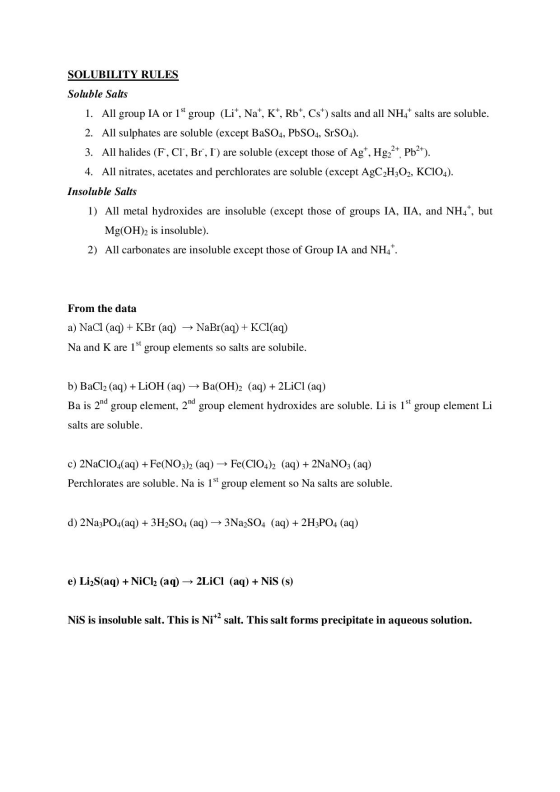
Li2S(aq) + NiCl2 (aq) → 2LiCl (aq) + NiS (s)
NiS is insoluble salt. This is Ni+2 salt. This salt forms precipitate in aqueous solution.
Add Answer to:
Select the set of reactants that will form a precipitate upon mixing. NaCl(aq) + KBr(aq) BaCl2(aq)...
Select the set of reactants that will form a precipitate upon mixing. NaClO4(aq) + Fe(NO3)2(aq) Li2S(aq)...
 Select the set of reactants that will form a precipitate upon mixing. NaClO4(aq) + Fe(NO3)2(aq) Li2S(aq) + NiCl2(aq) Na3PO4(aq) + H2SO4(aq) BaCl2(aq) + LiOH(aq) NaCl(aq) + KBr(aq)
Select the set of reactants that will form a precipitate upon mixing. NaCl(aq) + KBr(aq) BaCl2(aq)...
 Select the set of reactants that will form a precipitate upon mixing. NaCl(aq) + KBr(aq) BaCl2(aq) + LIOH(aq) NaClO4(aq) + FeNO3)2(aq) Na3PO4(ac) H2SO4(aq) Li2S(aq). NiClzlag) Moving to another question will save this response
Classify each reaction according to whether a precipitate forms. Precipitate forms Precipitate does not form answer...
Classify each reaction according to whether a precipitate forms. Precipitate forms Precipitate does not form answer bank: AgNO3 + Na3PO4 Fe(NO3)2 + Na2S NaNO3 + NaClO4 Mg(NO3)2 + NaCl Pb(NO3)2 + NaClO4 Mg(NO3)2 + NaOH Cu(NO3)2 + Na2CO3
In a precipitate reaction between BaCl2(aq) and Na3PO4(aq), 57 mL of 0.100 M BaCl2(aq) completely reacted...
In a precipitate reaction between BaCl2(aq) and Na3PO4(aq), 57 mL of 0.100 M BaCl2(aq) completely reacted with 25.7 mL of Na3PO4(aq). What was the molarity of Na3PO4(aq)? 3 BaCl2(aq) + 2 Na3PO4(aq) → Ba3(PO4)2(s) + 6 NaCl(aq)
1. Na2CO3(aq) + Ni(NO3)2(aq) 2. NaCl(aq) + AgNO3(aq) 3. Na2CO3(aq) + HCl(aq) Select Select precipitate gas...
 1. Na2CO3(aq) + Ni(NO3)2(aq) 2. NaCl(aq) + AgNO3(aq) 3. Na2CO3(aq) + HCl(aq) Select Select precipitate gas hot test tube cool test tube color change NR 4. NaOH(aq) + HCl(aq) 5. Kl(aq) + Pb(NO3)2(aq) Select Select 6. Na2CO3(aq) + CaCl2(aq) 7. BaCl2(aq) + H2SO4(aq) 8. CuSO4(aq) + NaOH(aq) 9. Zn(s) + H2SO4(aq) 10. Zn(s) + CuSO4(aq) 11. Ni(NO3)2(aq) + NaOH(aq) 12. NaOH(aq) + FeCl3(aq) Select Select Select Select 13. Mg(s) + HCl(aq) Select
In a precipitate reaction between BaCl2(aq) and Na3PO4(aq), 56.7 mL of 0.100 M BaCl2(aq) completely reacted with 25.3 mL...
In a precipitate reaction between BaCl2(aq) and Na3PO4(aq), 56.7 mL of 0.100 M BaCl2(aq) completely reacted with 25.3 mL of Na3PO4(aq). What was the molarity of Na3PO4(aq)? 3 BaCl2(aq) + 2 Na3PO4(aq) → Ba3(PO4)2(s) + 6 NaCl(aq) Note: Insert only the numerical value of your answer (do not include the units or chemical in your answer).
mapter 4-6 0 Saved Select the precipitate that forms when the following reactants are mixed. Cu(NO3)2(aq)...
 mapter 4-6 0 Saved Select the precipitate that forms when the following reactants are mixed. Cu(NO3)2(aq) + Na3PO4(aq) --> Multiple Choice O CUPO4 O Cu2(PO4)3 O NaNO3 O no precipitate would form O o cuzlPO4)2 < Prev 8 of 25 !!! Neyt
Determine whether or not the following will form a precipitate. H2SO4 (aq) + KOH (aq): Sodium...
 Determine whether or not the following will form a precipitate. H2SO4 (aq) + KOH (aq): Sodium hydroxide and cobalt (II) chloride: NaCl (aq) + KBr (aq): Potassium sulfide and silver nitrate: HTML Editor EX BI A - A - IX E 3 You Tube You V Tube [ 12p
15. The mixing of which pair of reactants will result in a precipitation reaction? CsI(aq)...
15. The mixing of which pair of reactants will result in a precipitation reaction? CsI(aq) + NaOH(aq) HCl(aq) + Ca(OH)2(aq) K2SO4(aq) + Hg2(NO3)2(aq) NaNO3(aq) + NH4Cl(aq) 16. Which of the following is a precipitation reaction? Zn(s) + 2 AgNO3(aq) 2 Ag(s) + Zn(NO3)2(aq) NaCl(aq) + LiI(aq) NaI(aq) + LiCl(aq) 2 KI(aq) + Hg2(NO3)2(aq) Hg2I2(s) + 2 KNO3(aq) HI(aq) + NaOH(aq) NaI(aq) + H2O(l) None of these are precipitation reactions. 17. Which...
Part C. Solubility reactions Table 1 Precipitate Reactants Observation Net Ionic Equation AgNO3 + NaCl Ag+(aq)...
 Part C. Solubility reactions Table 1 Precipitate Reactants Observation Net Ionic Equation AgNO3 + NaCl Ag+(aq) + Cl-(aq) → AgI N/A Solution KNOs +NaC remained clear No reactiorn Cu(NO3)2 +NaOH Ba(NO3)2+ NaOH Ba(NO3)2 + Na2SO4 color) Cas(PO4)2 Ca(NO3)2 +Na2CO3 CuCO3
 Select the set of reactants that will form a precipitate upon mixing. NaClO4(aq) + Fe(NO3)2(aq) Li2S(aq) + NiCl2(aq) Na3PO4(aq) + H2SO4(aq) BaCl2(aq) + LiOH(aq) NaCl(aq) + KBr(aq)
 Select the set of reactants that will form a precipitate upon mixing. NaCl(aq) + KBr(aq) BaCl2(aq) + LIOH(aq) NaClO4(aq) + FeNO3)2(aq) Na3PO4(ac) H2SO4(aq) Li2S(aq). NiClzlag) Moving to another question will save this response
 1. Na2CO3(aq) + Ni(NO3)2(aq) 2. NaCl(aq) + AgNO3(aq) 3. Na2CO3(aq) + HCl(aq) Select Select precipitate gas hot test tube cool test tube color change NR 4. NaOH(aq) + HCl(aq) 5. Kl(aq) + Pb(NO3)2(aq) Select Select 6. Na2CO3(aq) + CaCl2(aq) 7. BaCl2(aq) + H2SO4(aq) 8. CuSO4(aq) + NaOH(aq) 9. Zn(s) + H2SO4(aq) 10. Zn(s) + CuSO4(aq) 11. Ni(NO3)2(aq) + NaOH(aq) 12. NaOH(aq) + FeCl3(aq) Select Select Select Select 13. Mg(s) + HCl(aq) Select
 mapter 4-6 0 Saved Select the precipitate that forms when the following reactants are mixed. Cu(NO3)2(aq) + Na3PO4(aq) --> Multiple Choice O CUPO4 O Cu2(PO4)3 O NaNO3 O no precipitate would form O o cuzlPO4)2 < Prev 8 of 25 !!! Neyt
 Determine whether or not the following will form a precipitate. H2SO4 (aq) + KOH (aq): Sodium hydroxide and cobalt (II) chloride: NaCl (aq) + KBr (aq): Potassium sulfide and silver nitrate: HTML Editor EX BI A - A - IX E 3 You Tube You V Tube [ 12p
 Part C. Solubility reactions Table 1 Precipitate Reactants Observation Net Ionic Equation AgNO3 + NaCl Ag+(aq) + Cl-(aq) → AgI N/A Solution KNOs +NaC remained clear No reactiorn Cu(NO3)2 +NaOH Ba(NO3)2+ NaOH Ba(NO3)2 + Na2SO4 color) Cas(PO4)2 Ca(NO3)2 +Na2CO3 CuCO3
Most questions answered within 3 hours.
-
Where is the error in this code sequence?
String s1 = "Hello";
String s2 = "ello";...
asked 10 months ago -
Financial data for Joel de Paris, Inc., for last year
follow:
Joel de Paris, Inc.
Balance...
asked 10 months ago -
Consider this reaction:
Al2(SO4)3 (aq)+ BaCl3
(aq) Al2Cl6 (aq)- +
3BaSO4(s) . What is the...
asked 10 months ago -
Suppose that Savneet is considering increasing her
recent random sample from 20 car rentals to 40...
asked 10 months ago -
Trucks arrive at an unloading terminal at an average rate of 120
per hour.
Trucks arrive...
asked 10 months ago -
Why are methanol and ethanol completely soluble in water while
octanol is not very little soluble....
asked 10 months ago -
A facilities manager at a university reads in a research report
that the mean amount of...
asked 10 months ago -
When the CuSO4 is rehydrated by adding water to the anhydrous
compound, is this an endothermic...
asked 10 months ago -
A ray of sunlight is passing from diamond into crown glass; the
angle of incidence is...
asked 10 months ago -
A block of mass 0.249 kg is placed on top of a light, vertical
spring of...
asked 10 months ago -
how do the kidneys compensate in the presences of acidosis
a) trigger hyperventilate
b) reserve acid...
asked 10 months ago -
Question 501 pts
The rental rate of capital to the firm increases. Which of the
following...
asked 10 months ago