
Homework Answers
Add Answer to:
1. (a) Balance the following half-reactions by the ion-electron half-reaction method: (i) (acid solution) HSO3- (aq)...
1. (a) Balance the following half-reactions by the ion-electron half-reaction method: (i) (acid solution) BiO;- (aq)...
 1. (a) Balance the following half-reactions by the ion-electron half-reaction method: (i) (acid solution) BiO;- (aq) → BIO+ (aq) (ii) (acid solution) C002 (s) → Co2+ (aq) (iii) (base solution) Cr(OH).- (aq) → CrO2- (aq) (iv) (base solution) TeO 2- (aq) → H.Te0.2- (aq) (b) Which of the above equations are oxidation half-reactions? (c) Give the formulas of the reactants that become oxidized in the course of the reaction.
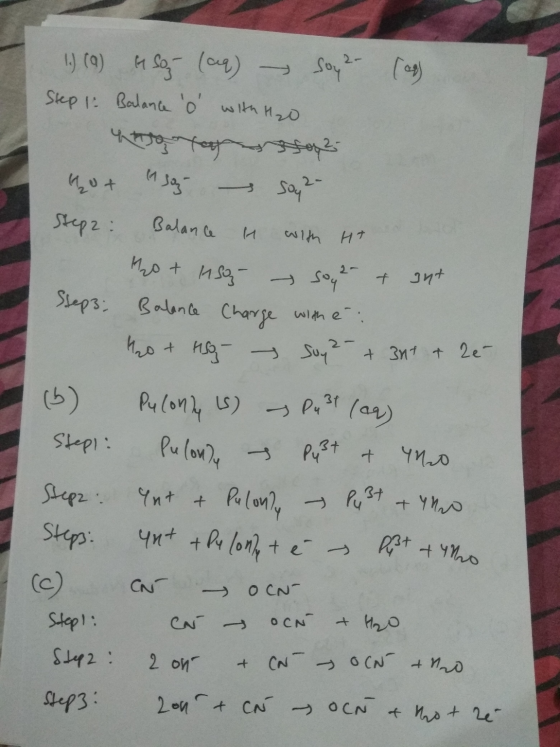
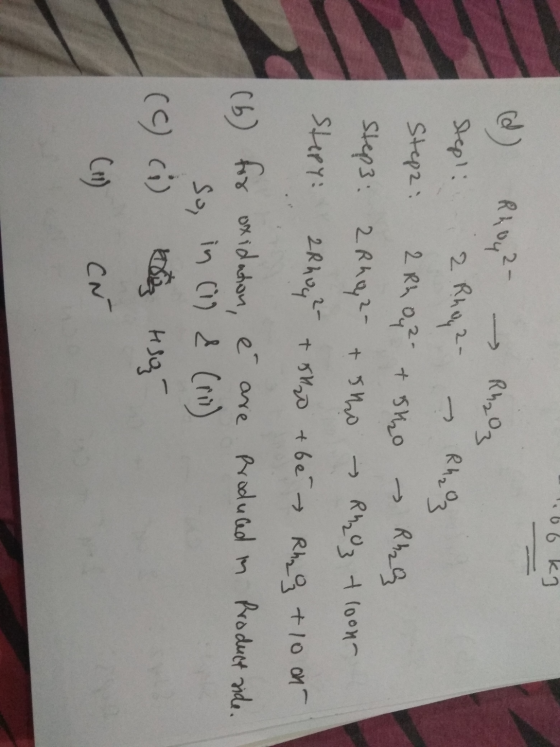
1. (a) Balance the following half-reactions by the ion-electron half-reaction method: (i) (acid solution) S2O3 2–...
1. (a) Balance the following half-reactions by the ion-electron half-reaction method: (i) (acid solution) S2O3 2– (aq) → SO4 2– (aq) (ii) (acid solution) RhO4 2– (aq) → RhO2 (s) (iii) (base solution) VO2+ (aq) → V(OH)3 (s) (iv) (base solution) N2 (g) → NH3 (aq) (b) Which of the above equations are oxidation half-reactions? (c) Give the formulas of the reactants that become oxidized in the course of the reaction.
1. (a) Balance the following half-reactions by the ion-electron half-reaction method: (i) (acid solution) NO3- (aq)...
 1. (a) Balance the following half-reactions by the ion-electron half-reaction method: (i) (acid solution) NO3- (aq) + N2O (g) (ii) (acid solution) Fe042- (aq) + Fe3+ (aq) (iii) (base solution) Fe203 () → Fe(OH)2 (S) (iv) (base solution) Cu20 (s) + Cu(OH)2 (S) (b) Which of the above equations are oxidation half-reactions? (c) Give the formulas of the reactants that become oxidized in the course of the reaction.
(a) Balance the following half-reactions by the ion-electron half-reaction method: (i) (acid solution) Cl– (aq) →...
(a) Balance the following half-reactions by the ion-electron half-reaction method: (i) (acid solution) Cl– (aq) → ClO3– (aq) (ii) (acid solution) MoO3 (s) → Mo (s) (iii) (base solution) P4 (s) → H2PO2– (aq) (iv) (base solution) Se (s) → SeO32– (aq) (b) Which of the above equations are oxidation half-reactions? (c) Give the formulas of the reactants that become oxidized in the course of the reaction.
1. (a) Balance the following half-reactions by the ion-electron half-reaction method: (i) (acid solution) NO2(g) →...
 1. (a) Balance the following half-reactions by the ion-electron half-reaction method: (i) (acid solution) NO2(g) → NO,- (aq) (ii) (acid solution) H SeO(aq) → Se (s) (iii) (base solution) P (8) PH, (g) (iv) (base solution) Co(OH)(s) C002 () (b) Which of the above equations are oxidation half-reactions? (c) Give the formulas of the reactants that become oxidized in the course of the reaction.
1. (a) Balance the following half-reactions by the ion-electron half-reaction method: (i) (acid solution) NO2 (g)...
1. (a) Balance the following half-reactions by the ion-electron half-reaction method: (i) (acid solution) NO2 (g) → NO3 – (aq) (ii) (acid solution) H2SeO3 (aq) → Se (s) (iii) (base solution) P4 (s) → PH3 (g) (iv) (base solution) Co(OH)3 (s) → CoO2 (s) (b) Which of the above equations are oxidation half-reactions? (c) Give the formulas of the reactants that become oxidized in the course of the reaction.
1.a) Balance the following half-reactions by the ion-electron half-reaction method: (i) (acid solution) NO2 (g) →...
1.a) Balance the following half-reactions by the ion-electron half-reaction method: (i) (acid solution) NO2 (g) → NO3– (aq) (ii) (acid solution) H2SeO3 (aq) → Se (s) (iii) (base solution) P4 (s) → PH3 (g) (iv) (base solution) Co(OH)3 (s) → CoO2 (s) (b) Which of the above equations are oxidation half-reactions? (c) Give the formulas of the reactants that become oxidized in the course of the reaction.
Balance the following redox equations by the ion-electron half-reaction method: (a) (acid solution): BrO3 – +...
Balance the following redox equations by the ion-electron half-reaction method: (a) (acid solution): BrO3 – + Cr3+ → Br2 + HCrO4 – (b) (acid solution): MnO4 – + VO2+ → Mn2+ + V(OH)4 + (c) (basic solution): MnO4 – + OH– → MnO4 2– + O2 (g)
Balance the following redox equations by the ion-electron half-reaction method: (a) (acid solution): VŽ+ + V(OH)....
 Balance the following redox equations by the ion-electron half-reaction method: (a) (acid solution): VŽ+ + V(OH). - VO2 (b) (acid solution): C 02 + MnO - CO2(g) + Mn (c) (basic solution): Cr(OH), (s) + H2O2 → CrO
3. Balance the following redox equations by the ion-electron half-reaction method: (a) (acid solution): Cr0(aq) +...
 3. Balance the following redox equations by the ion-electron half-reaction method: (a) (acid solution): Cr0(aq) + U" (aq) → Cr" (aq) +UO; (aq) (b) (acid solution): Cr(s) + O2(g) → Cr* (aq) (C) (basic solution): P. (s) + OH' (aq) → PH; (g) + H2PO2 (aq)
 1. (a) Balance the following half-reactions by the ion-electron half-reaction method: (i) (acid solution) BiO;- (aq) → BIO+ (aq) (ii) (acid solution) C002 (s) → Co2+ (aq) (iii) (base solution) Cr(OH).- (aq) → CrO2- (aq) (iv) (base solution) TeO 2- (aq) → H.Te0.2- (aq) (b) Which of the above equations are oxidation half-reactions? (c) Give the formulas of the reactants that become oxidized in the course of the reaction.
 1. (a) Balance the following half-reactions by the ion-electron half-reaction method: (i) (acid solution) NO3- (aq) + N2O (g) (ii) (acid solution) Fe042- (aq) + Fe3+ (aq) (iii) (base solution) Fe203 () → Fe(OH)2 (S) (iv) (base solution) Cu20 (s) + Cu(OH)2 (S) (b) Which of the above equations are oxidation half-reactions? (c) Give the formulas of the reactants that become oxidized in the course of the reaction.
 1. (a) Balance the following half-reactions by the ion-electron half-reaction method: (i) (acid solution) NO2(g) → NO,- (aq) (ii) (acid solution) H SeO(aq) → Se (s) (iii) (base solution) P (8) PH, (g) (iv) (base solution) Co(OH)(s) C002 () (b) Which of the above equations are oxidation half-reactions? (c) Give the formulas of the reactants that become oxidized in the course of the reaction.
 Balance the following redox equations by the ion-electron half-reaction method: (a) (acid solution): VŽ+ + V(OH). - VO2 (b) (acid solution): C 02 + MnO - CO2(g) + Mn (c) (basic solution): Cr(OH), (s) + H2O2 → CrO
 3. Balance the following redox equations by the ion-electron half-reaction method: (a) (acid solution): Cr0(aq) + U" (aq) → Cr" (aq) +UO; (aq) (b) (acid solution): Cr(s) + O2(g) → Cr* (aq) (C) (basic solution): P. (s) + OH' (aq) → PH; (g) + H2PO2 (aq)
Most questions answered within 3 hours.
-
Where is the error in this code sequence?
String s1 = "Hello";
String s2 = "ello";...
asked 11 months ago -
Financial data for Joel de Paris, Inc., for last year
follow:
Joel de Paris, Inc.
Balance...
asked 11 months ago -
Consider this reaction:
Al2(SO4)3 (aq)+ BaCl3
(aq) Al2Cl6 (aq)- +
3BaSO4(s) . What is the...
asked 11 months ago -
Suppose that Savneet is considering increasing her
recent random sample from 20 car rentals to 40...
asked 11 months ago -
Trucks arrive at an unloading terminal at an average rate of 120
per hour.
Trucks arrive...
asked 11 months ago -
Why are methanol and ethanol completely soluble in water while
octanol is not very little soluble....
asked 11 months ago -
A facilities manager at a university reads in a research report
that the mean amount of...
asked 11 months ago -
When the CuSO4 is rehydrated by adding water to the anhydrous
compound, is this an endothermic...
asked 11 months ago -
A ray of sunlight is passing from diamond into crown glass; the
angle of incidence is...
asked 11 months ago -
A block of mass 0.249 kg is placed on top of a light, vertical
spring of...
asked 11 months ago -
how do the kidneys compensate in the presences of acidosis
a) trigger hyperventilate
b) reserve acid...
asked 11 months ago -
Question 501 pts
The rental rate of capital to the firm increases. Which of the
following...
asked 11 months ago