
Homework Answers
Thank you ?
All the best.
Add Answer to:
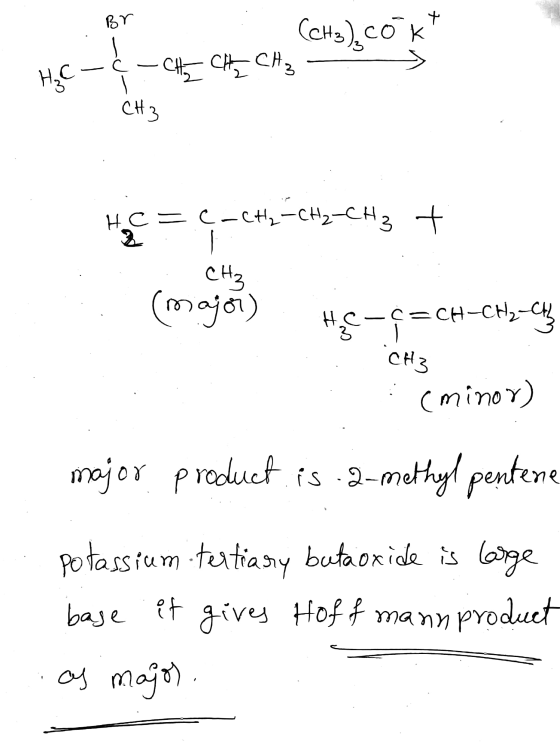
Question 12 - 6 pts. Homework What is the major product when 2-bromo-2-methylpentane reacts with potassium...
what major E2 product would form on the reaction of (2S,3R) 2-bromo-3-methylpentane with base? QuesLIUI What...
 what major E2 product would form on the reaction of
(2S,3R) 2-bromo-3-methylpentane with base?
QuesLIUI What major E2 product would form on reaction of (2S,3R) 2-bromo-3-methylpentane with ba CH3 O (Z) 3-methylpent-2-ene (E) 3-methylpent-2-ene (3R) 3-methylpent-1-ene (Z) 3-methylpenta-1,3-diene
what major E2 product would form on the reaction of
(2S,3R) 2-bromo-3-methylpentane with base?
QuesLIUI What major E2 product would form on reaction of (2S,3R) 2-bromo-3-methylpentane with ba CH3 O (Z) 3-methylpent-2-ene (E) 3-methylpent-2-ene (3R) 3-methylpent-1-ene (Z) 3-methylpenta-1,3-diene
QUESTION 2 What major E2 product would form on reaction of (2S,3R) 2-bromo-3-methylpentane with base? |||11111...
 QUESTION 2 What major E2 product would form on reaction of (2S,3R) 2-bromo-3-methylpentane with base? |||11111 CH3 A. (Z) 3-methylpent-2-ene B. (E) 3-methylpent-2-ene C. (3R) 3-methylpent-1-ene D. (Z) 3-methylpenta-1,3-diene
What is the major product resulting after heating 1-bromo-3-methylpentane with 2M sodium hydroxide What is the...
 What is the major product resulting after heating
1-bromo-3-methylpentane with 2M sodium hydroxide
What is the major product resulting after heating 1-bromo-3-methylpentane with 2M sodium hydroxide: Select one: a. 3-methylpent-2-ene O b. 3-methylpent-1-ene O C. 3-methylpentan-1-ol O d. 3-methylpentan-2-ol e. There is no reaction
What is the major product resulting after heating
1-bromo-3-methylpentane with 2M sodium hydroxide
What is the major product resulting after heating 1-bromo-3-methylpentane with 2M sodium hydroxide: Select one: a. 3-methylpent-2-ene O b. 3-methylpent-1-ene O C. 3-methylpentan-1-ol O d. 3-methylpentan-2-ol e. There is no reaction
What are the mechanisms and major/minor products when 2-Chloro-2-Methylbutane reacts with A.) Potassium Hydroxide in 1-propanol+Heat...
What are the mechanisms and major/minor products when 2-Chloro-2-Methylbutane reacts with A.) Potassium Hydroxide in 1-propanol+Heat B.)Potassium tert-butoxide in tertbutyl alcohol+heat I know they proceed via E2 reaction mechanism but need help figuring out the steps and the major and minor products. Also if you could offer a brief explanation of why the mechanism reacts the way it does I would really appreciate it. Thank you!
Question 25 6 pts Complete the 2 step synthesis below that converts 2-bromo-2-methylpentane to 3-bromo- 2-methylpentane....
 Question 25 6 pts Complete the 2 step synthesis below that converts 2-bromo-2-methylpentane to 3-bromo- 2-methylpentane. (A) will represent your reagents for the first reaction. (B) represents the product of the first reaction (and the starting material of the second), while (C) represents the reagents for the second reaction. You will write your answers out and then submit them via a file upload. You can either recreate the format shown below, or just simply list A,B, and C along with...
A) Reaction of 3-bromo-3-methylpentane and H2O and heat Draw the major product formed when the structure shown below...
 A) Reaction of
3-bromo-3-methylpentane and H2O and heat
Draw the major product formed when the structure shown below
undergoes substitution in H2O with heat.
B)Substitution reaction of 3-bromo-3-methylpentane and CH3OH
Draw the major product formed when the structure shown below
undergoes solvolysis in CH3OH.
A) Reaction of
3-bromo-3-methylpentane and H2O and heat
Draw the major product formed when the structure shown below
undergoes substitution in H2O with heat.
B)Substitution reaction of 3-bromo-3-methylpentane and CH3OH
Draw the major product formed when the structure shown below
undergoes solvolysis in CH3OH.
organic chemistry Question 6 Choose the final, major product for the following reactions. cyclohexanol reacts with:...
 organic chemistry
Question 6 Choose the final, major product for the following reactions. cyclohexanol reacts with: a) PC13/ pyridine b) гон c) HBr / heat d) tert-butoxide e) BH3 / THE f) OH, H202, H20 1. bromocyclohexanol O2. cyclohexane 3. cyclohexene 4. cyclohexanol
organic chemistry
Question 6 Choose the final, major product for the following reactions. cyclohexanol reacts with: a) PC13/ pyridine b) гон c) HBr / heat d) tert-butoxide e) BH3 / THE f) OH, H202, H20 1. bromocyclohexanol O2. cyclohexane 3. cyclohexene 4. cyclohexanol
7. Shown below are the major product formed and the proposed mechanism when 1- methylcyclohexanol reacts...
 7. Shown below are the major product formed and the proposed mechanism when 1- methylcyclohexanol reacts with 85% H3PO4 at 150 °C. Name all curved arrows shown in each step as either "lone pair to bond" or "bond to long pair". Specify the atom that donates/accepts the lone pair. [1 Mark] Step 1 -H O ro-H + Ho + H2O H H Commons Kagamo Step 2 + H2O Step 3 = + H,PO. H HAPO Zaitsev product 6. Given below...
When 1-bromobutane reacts with sodium tert-butoxide (the conjugate base of tert-butyl alcohol) the major product is...
 When 1-bromobutane reacts with sodium tert-butoxide (the conjugate base of tert-butyl alcohol) the major product is the elimination. Is this E1 or E2? Show the product Based on the information given in the problem, what was the key factor that changed the changed the major product from substitution to elimination?
When 3-bromo-2,2-dimethylbutane is treated with potassium tert-butoxide, a single product, A, having the formula C6H12 is formed. When 3,3-dimethyl-2-butanol is treated with sulfuric acid, the major product, B, has the formula C6H12. Given the following N
When 3-bromo-2,2-dimethylbutane is treated with potassium tert-butoxide, a single product, A, having the formula C6H12 is formed. When 3,3-dimethyl-2-butanol is treated with sulfuric acid, the major product, B, has the formula C6H12. Given the following NMR data, what are the structures of A and B?Write reactions for the formation of A and B and draw a splitting diagram for the protons at 4.82, 4.93, and 5.83 ppm in compound A1H NMR of A: 1.01 (s, 9H), 4.82 (dd, 1H, J = 10, 1.7 Hz), 4.93 (dd,...
 what major E2 product would form on the reaction of
(2S,3R) 2-bromo-3-methylpentane with base?
QuesLIUI What major E2 product would form on reaction of (2S,3R) 2-bromo-3-methylpentane with ba CH3 O (Z) 3-methylpent-2-ene (E) 3-methylpent-2-ene (3R) 3-methylpent-1-ene (Z) 3-methylpenta-1,3-diene
what major E2 product would form on the reaction of
(2S,3R) 2-bromo-3-methylpentane with base?
QuesLIUI What major E2 product would form on reaction of (2S,3R) 2-bromo-3-methylpentane with ba CH3 O (Z) 3-methylpent-2-ene (E) 3-methylpent-2-ene (3R) 3-methylpent-1-ene (Z) 3-methylpenta-1,3-diene
 QUESTION 2 What major E2 product would form on reaction of (2S,3R) 2-bromo-3-methylpentane with base? |||11111 CH3 A. (Z) 3-methylpent-2-ene B. (E) 3-methylpent-2-ene C. (3R) 3-methylpent-1-ene D. (Z) 3-methylpenta-1,3-diene
 What is the major product resulting after heating
1-bromo-3-methylpentane with 2M sodium hydroxide
What is the major product resulting after heating 1-bromo-3-methylpentane with 2M sodium hydroxide: Select one: a. 3-methylpent-2-ene O b. 3-methylpent-1-ene O C. 3-methylpentan-1-ol O d. 3-methylpentan-2-ol e. There is no reaction
What is the major product resulting after heating
1-bromo-3-methylpentane with 2M sodium hydroxide
What is the major product resulting after heating 1-bromo-3-methylpentane with 2M sodium hydroxide: Select one: a. 3-methylpent-2-ene O b. 3-methylpent-1-ene O C. 3-methylpentan-1-ol O d. 3-methylpentan-2-ol e. There is no reaction
 Question 25 6 pts Complete the 2 step synthesis below that converts 2-bromo-2-methylpentane to 3-bromo- 2-methylpentane. (A) will represent your reagents for the first reaction. (B) represents the product of the first reaction (and the starting material of the second), while (C) represents the reagents for the second reaction. You will write your answers out and then submit them via a file upload. You can either recreate the format shown below, or just simply list A,B, and C along with...
 A) Reaction of
3-bromo-3-methylpentane and H2O and heat
Draw the major product formed when the structure shown below
undergoes substitution in H2O with heat.
B)Substitution reaction of 3-bromo-3-methylpentane and CH3OH
Draw the major product formed when the structure shown below
undergoes solvolysis in CH3OH.
A) Reaction of
3-bromo-3-methylpentane and H2O and heat
Draw the major product formed when the structure shown below
undergoes substitution in H2O with heat.
B)Substitution reaction of 3-bromo-3-methylpentane and CH3OH
Draw the major product formed when the structure shown below
undergoes solvolysis in CH3OH.
 organic chemistry
Question 6 Choose the final, major product for the following reactions. cyclohexanol reacts with: a) PC13/ pyridine b) гон c) HBr / heat d) tert-butoxide e) BH3 / THE f) OH, H202, H20 1. bromocyclohexanol O2. cyclohexane 3. cyclohexene 4. cyclohexanol
organic chemistry
Question 6 Choose the final, major product for the following reactions. cyclohexanol reacts with: a) PC13/ pyridine b) гон c) HBr / heat d) tert-butoxide e) BH3 / THE f) OH, H202, H20 1. bromocyclohexanol O2. cyclohexane 3. cyclohexene 4. cyclohexanol
 7. Shown below are the major product formed and the proposed mechanism when 1- methylcyclohexanol reacts with 85% H3PO4 at 150 °C. Name all curved arrows shown in each step as either "lone pair to bond" or "bond to long pair". Specify the atom that donates/accepts the lone pair. [1 Mark] Step 1 -H O ro-H + Ho + H2O H H Commons Kagamo Step 2 + H2O Step 3 = + H,PO. H HAPO Zaitsev product 6. Given below...
 When 1-bromobutane reacts with sodium tert-butoxide (the conjugate base of tert-butyl alcohol) the major product is the elimination. Is this E1 or E2? Show the product Based on the information given in the problem, what was the key factor that changed the changed the major product from substitution to elimination?
Most questions answered within 3 hours.
-
Where is the error in this code sequence?
String s1 = "Hello";
String s2 = "ello";...
asked 10 months ago -
Financial data for Joel de Paris, Inc., for last year
follow:
Joel de Paris, Inc.
Balance...
asked 10 months ago -
Consider this reaction:
Al2(SO4)3 (aq)+ BaCl3
(aq) Al2Cl6 (aq)- +
3BaSO4(s) . What is the...
asked 10 months ago -
Suppose that Savneet is considering increasing her
recent random sample from 20 car rentals to 40...
asked 10 months ago -
Trucks arrive at an unloading terminal at an average rate of 120
per hour.
Trucks arrive...
asked 10 months ago -
Why are methanol and ethanol completely soluble in water while
octanol is not very little soluble....
asked 10 months ago -
A facilities manager at a university reads in a research report
that the mean amount of...
asked 10 months ago -
When the CuSO4 is rehydrated by adding water to the anhydrous
compound, is this an endothermic...
asked 10 months ago -
A ray of sunlight is passing from diamond into crown glass; the
angle of incidence is...
asked 10 months ago -
A block of mass 0.249 kg is placed on top of a light, vertical
spring of...
asked 10 months ago -
how do the kidneys compensate in the presences of acidosis
a) trigger hyperventilate
b) reserve acid...
asked 10 months ago -
Question 501 pts
The rental rate of capital to the firm increases. Which of the
following...
asked 10 months ago