Find The Singularities Of The Hyper Geometric Differential Equation (HGDD) In Finite And Infinite Regions
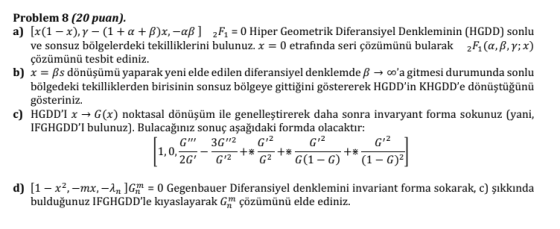
a) \([x(1-x), \gamma-(1+\alpha+\beta) x,-\alpha \beta]{ }_{2} F_{1}=0\) Hiper Geometrik Diferansiyel Denkleminin (HGDD) sonlu ve sonsuz bölgelerdeki tekilliklerini bulunuz, \(x=0\) etrafinda seri çõzümủnü bularak \(\quad{ }_{2} F_{1}(\alpha, \beta, \gamma ; x)\) çözumünü tesbit ediniz.
b) \(x=\beta s\) dönüșumũ yaparak yeni elde edilen diferansiyel denklemde \(\beta \rightarrow \infty^{\prime}\) a gitmesi durumunda sonlu bōlgedeki tekilliklerden birisinin sonsuz bölgeye gittiğini göstererek HGDD'in KHGDD'e dönüştüğũnũ gōsteriniz.
c) HGDD'l \(x \rightarrow G(x)\) noktasal dōnüșüm ile genelleștirerek daha sonra invaryant forma sokunuz (yani, IFGHGDD'I bulunuz). Bulacağanız sonuç aşağıdaki formda olacaktur:
$$ \left[1,0, \frac{G^{\prime \prime \prime}}{2 G^{\prime}}-\frac{3 G^{\prime \prime 2}}{G^{\prime 2}}+* \frac{G^{\prime 2}}{G^{2}}+* \frac{G^{\prime 2}}{G(1-G)}+* \frac{G^{\prime 2}}{(1-G)^{2}}\right] $$
d) \(\left[1-x^{2},-m x,-\lambda_{n}\right] G_{n}^{m}=0\) Gegenbauer Diferansiyel denklemini invariant forma sokarak, c) şıkkında bulduğunuz IFGHGDD'le kryaslayarak \(G_{n}^{m}\) çōzümunũ elde ediniz.
Homework Answers
Request Answer!
We need at least 9 more requests to produce the answer.
1 / 10 have requested this problem solution
The more requests, the faster the answer.
Add Answer to:
Find The Singularities Of The Hyper Geometric Differential Equation (HGDD) In Finite And Infinite Regions
Suppose that
Suppose that \(\left(\xi_{j}\right)^{\infty}=1\) is a sequence of independent identically distributed \((i . i . d .)\) continuous random variables.- Suppose that each \(\xi_{i}\) has a probability density function \(p_{i}(x)=\left\{\begin{array}{c}\frac{\beta}{x^{x}}, x \geq 1 \\ 0, x<1\end{array}\right.\), where \(\alpha, \beta \in\)R.- Let \(S_{n}=\sum_{i=1}^{n} \xi_{i}\).- Let \(S_{n}=\frac{s_{n}-\operatorname{mE}\left(\xi_{0}\right)}{\sqrt{n} \operatorname{Var}(\mathcal{B})}\).a. Find a condition on \(\alpha\) and a condition on \(\beta\) (as a function of \(\alpha\) ) which together make \(f_{1}(x)\) a probability density function.b. Find conditions on \(\alpha\) which guarantee that \(\lim _{n \rightarrow \infty}...
Most questions answered within 3 hours.
-
Where is the error in this code sequence?
String s1 = "Hello";
String s2 = "ello";...
asked 10 months ago -
Financial data for Joel de Paris, Inc., for last year
follow:
Joel de Paris, Inc.
Balance...
asked 10 months ago -
Consider this reaction:
Al2(SO4)3 (aq)+ BaCl3
(aq) Al2Cl6 (aq)- +
3BaSO4(s) . What is the...
asked 10 months ago -
Suppose that Savneet is considering increasing her
recent random sample from 20 car rentals to 40...
asked 10 months ago -
Trucks arrive at an unloading terminal at an average rate of 120
per hour.
Trucks arrive...
asked 10 months ago -
Why are methanol and ethanol completely soluble in water while
octanol is not very little soluble....
asked 10 months ago -
A facilities manager at a university reads in a research report
that the mean amount of...
asked 10 months ago -
When the CuSO4 is rehydrated by adding water to the anhydrous
compound, is this an endothermic...
asked 10 months ago -
A ray of sunlight is passing from diamond into crown glass; the
angle of incidence is...
asked 10 months ago -
A block of mass 0.249 kg is placed on top of a light, vertical
spring of...
asked 10 months ago -
how do the kidneys compensate in the presences of acidosis
a) trigger hyperventilate
b) reserve acid...
asked 10 months ago -
Question 501 pts
The rental rate of capital to the firm increases. Which of the
following...
asked 10 months ago